L-1 Visa Intracompany Transfer to Florida: Your 2026 Guide
Planning an L-1 visa intracompany transfer to Florida in 2026? This comprehensive guide from Florida Immigration Lawyers covers everything from eligibility requirements and the step-by-step application process to essential documentation, processing timelines, and associated costs. Learn the distinctions between L-1A and L-1B visas, common mistakes to avoid, and when to seek expert legal counsel. We focus on helping multinational companies and skilled professionals navigate the complexities of U.S. immigration to establish or expand operations in Florida, including vibrant areas like Orlando. Discover how to secure your L-1 visa successfully and ensure a smooth transition for your business and family.
An L-1 visa allows multinational companies to transfer certain employees-executives, managers, or specialized knowledge professionals-from a foreign office to a qualifying U.S. office in Florida. This nonimmigrant visa facilitates temporary relocation for business purposes, crucial for expanding operations or establishing new offices in key Florida economic hubs like Orlando. The process involves a petition by the U.S. employer to USCIS.
- The L-1 visa is for intracompany transfers of executives, managers, or specialized knowledge workers.
- It requires a qualifying relationship between the foreign and U.S. entities.
- There are two categories: L-1A for managers/executives and L-1B for specialized knowledge.
- The U.S. employer files Form I-129 with USCIS, often requiring detailed business documentation.
- Consulting an experienced Florida immigration lawyer is highly recommended for a smooth process.
Are you a multinational company looking to expand your operations into the vibrant Florida market, perhaps in Orlando, by transferring key personnel? Or are you a highly skilled professional eager to bring your expertise to a U.S. affiliate in the Sunshine State? The L-1 visa, specifically designed for intracompany transfers, can be your pathway to achieving these goals in 2026.
Navigating the complexities of U.S. immigration law, especially for a specialized visa like the L-1, requires precision and a deep understanding of federal regulations. This comprehensive guide from Florida Immigration Lawyers will walk you through everything you need to know about securing an L-1 visa for an intracompany transfer to Florida.
We will cover eligibility, the application process, required documentation, timelines, and common pitfalls to avoid. Our aim is to demystify this critical work visa category, helping you understand how to successfully bring top talent to your Florida enterprise. Do not hesitate to seek professional guidance. Call Florida Immigration Lawyers at 1-844-967-3536 for a free consultation to discuss your specific L-1 visa needs today.
Understanding the L-1 Visa: A Gateway to Florida Business
The L-1 visa category is a nonimmigrant visa that enables U.S. employers to transfer an executive, manager, or a person with specialized knowledge from one of its affiliated foreign offices to one of its offices in the United States. This visa is instrumental for businesses seeking to leverage global talent within their U.S. operations, particularly in a growing economic center like Florida.
What is an L-1 Visa?
The L-1 visa facilitates the temporary relocation of qualifying employees within multinational corporations. It is divided into two main categories: L-1A for executives and managers, and L-1B for individuals with specialized knowledge. Both categories require a qualifying relationship between the foreign and U.S. entities, and the employee must have worked for the foreign entity for at least one continuous year within the three years preceding their application.
This visa category is defined under the Immigration and Nationality Act (INA) Section 101(a)(15)(L), and further regulated by 8 CFR 214.2(l). It is a vital tool for global businesses, including those establishing a new office in Florida, to maintain continuity and expertise across international borders. For more details on business immigration, visit our business immigration page.
L-1A vs. L-1B: Key Distinctions for Florida Companies
Understanding the difference between L-1A and L-1B is crucial as it impacts the validity period and potential for green card pathways. The L-1A visa is for executives and managers. An executive primarily directs the management of the organization or a major component, while a manager supervises other supervisory, professional, or managerial employees, or manages an essential function within the organization.
The L-1B visa is for individuals with specialized knowledge. This refers to knowledge possessed by an individual of the petitioning organization's product, service, research, equipment, techniques, management, or other interests and its application in international markets, or an advanced level of knowledge of processes and procedures of the organization. Each category has distinct requirements that must be carefully met for approval.
Eligibility Criteria for the L-1 Visa in Florida
To qualify for an L-1 visa, both the petitioning U.S. employer and the foreign employee must meet specific criteria. The U.S. company must be an affiliate, parent, subsidiary, or branch of the foreign company. This qualifying relationship is fundamental to the L-1 intracompany transfer.
The employee must have been employed abroad by the qualifying organization for at least one continuous year within the three years preceding their admission to the U.S. or the filing of the petition. This employment must have been in a managerial, executive, or specialized knowledge capacity. The employee must also be coming to the U.S. to perform services in a similar capacity for the U.S. employer.
Benefits of the L-1 Visa for Intracompany Transfers
The L-1 visa offers several advantages for both employers and employees. For companies, it allows for the seamless transfer of experienced personnel, facilitating business continuity and growth, especially when entering new markets like Florida. It also helps preserve institutional knowledge and corporate culture.
For employees, the L-1 visa provides an opportunity to live and work in the U.S. for a significant period. L-1A visa holders may be eligible for an expedited path to a green card through the EB-1C multinational executive or manager category. Spouses of L-1 visa holders (L-2 visa holders) are generally eligible to apply for work authorization in the U.S., offering greater flexibility for families relocating to Florida.
Florida's Appeal for L-1 Visa Holders
Florida, particularly the Orlando metropolitan area, presents an attractive destination for multinational corporations and their transferees. The state boasts a robust economy, a business-friendly environment, and strategic access to Latin American markets. Many international companies choose Florida for their U.S. headquarters or major operational hubs.
Orlando's diverse industries, including tourism, technology, aerospace, and advanced manufacturing, offer ample opportunities for L-1 visa holders to thrive professionally. The state's vibrant cultural scene, excellent educational institutions, and pleasant climate further enhance its appeal for families considering an international move. Florida Immigration Lawyers is well-versed in the local landscape and federal immigration laws impacting businesses across the state.
Step-by-Step Guide to Your L-1 Visa Transfer
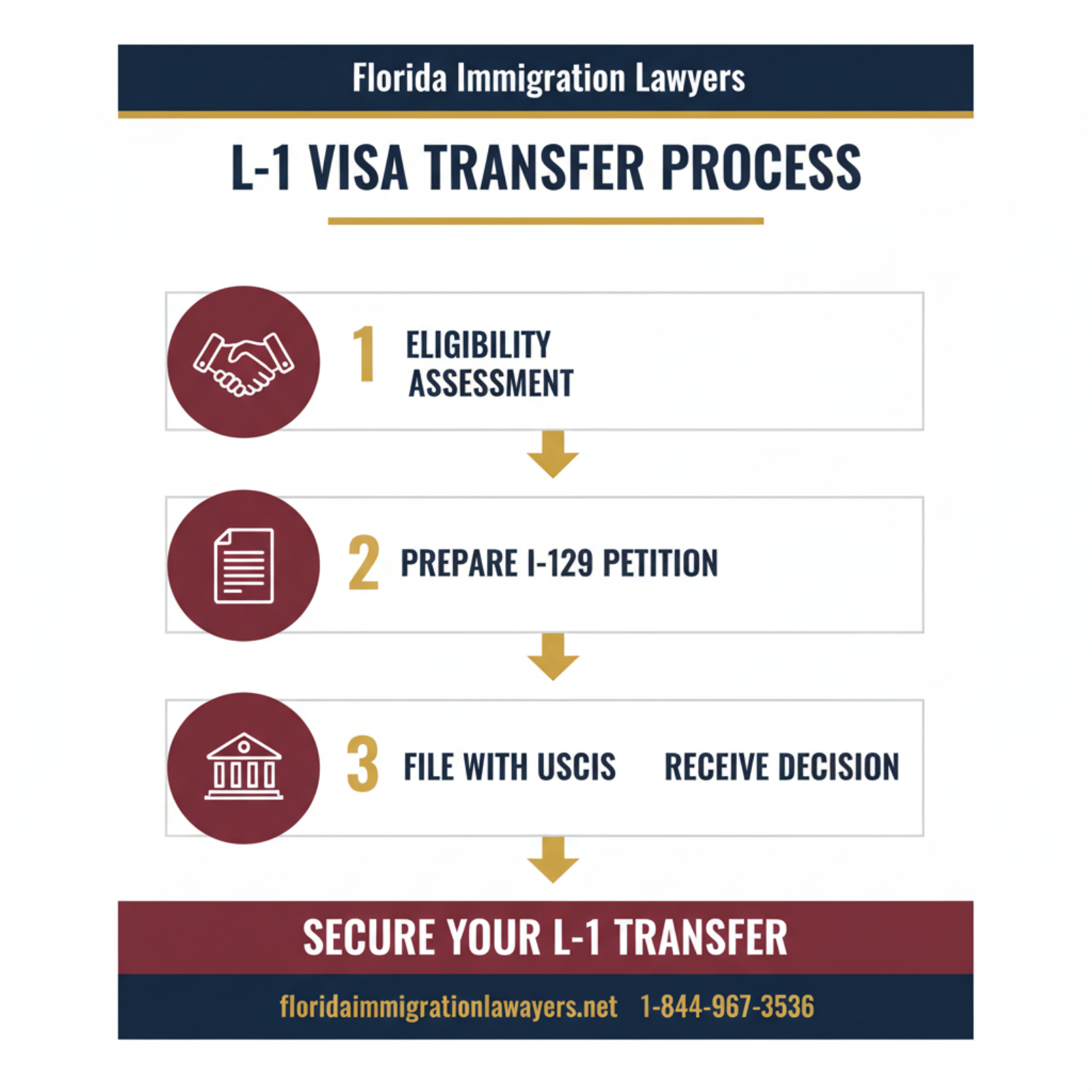
The L-1 visa application process involves several critical steps, requiring meticulous preparation and adherence to USCIS guidelines. Understanding each stage is vital for a successful intracompany transfer to Florida in 2026.
-
Step 1: Employer Establishes Qualifying Relationship and Employee Eligibility
Before any petition is filed, the U.S. employer must confirm that a qualifying relationship exists with the foreign entity (parent, subsidiary, affiliate, or branch). They must also ensure the employee meets the "one year abroad" requirement and will serve in an executive, managerial, or specialized knowledge capacity in the U.S. This foundational step is critical for a strong L-1 visa petition.
-
Step 2: Prepare and File Form I-129, Petition for a Nonimmigrant Worker
The U.S. employer files Form I-129, Petition for a Nonimmigrant Worker, with U.S. Citizenship and Immigration Services (USCIS). This petition must include extensive supporting documentation, such as evidence of the qualifying relationship, the employee's foreign employment, the nature of the U.S. position, and the financial viability of both entities. If the U.S. entity is a new office, a detailed business plan is also required. USCIS processes petitions at service centers, including those serving Florida. For general immigration questions, visit our immigration practice area page.
-
Step 3: U.S. Embassy/Consulate Interview (if applicable)
Once the Form I-129 is approved by USCIS, the foreign employee, if outside the U.S., will attend an interview at a U.S. embassy or consulate in their home country. During this interview, a consular officer will review the application, verify the information, and determine the applicant's eligibility for the L-1 visa. It is crucial to be prepared to articulate your role and the company's operations clearly.
-
Step 4: Visa Issuance and Entry to the U.S.
Upon successful interview and approval, the consular officer will stamp the L-1 visa into the employee's passport. The employee can then travel to the U.S. and seek admission at a port of entry. At the port of entry, a Customs and Border Protection (CBP) officer will review their documents and determine the period of admission, typically noted on Form I-94. Ensure all documents are in order upon arrival in Florida.
-
Step 5: Maintaining L-1 Status in Florida
After entering the U.S., L-1 visa holders must adhere to the terms of their visa, including working only for the petitioning employer in the approved capacity. Extensions of stay are possible, up to a maximum of seven years for L-1A and five years for L-1B. Maintaining compliance with immigration laws is paramount. For any changes or concerns, consulting an attorney is recommended.
Essential Document Checklist for L-1 Visa Applicants
A successful L-1 visa petition hinges on comprehensive and accurate documentation. Gather these documents diligently to avoid delays or denials. We strongly advise working with experienced legal counsel to ensure your submission is complete.
- Employer Documents (U.S. and Foreign Entities):
- Evidence of a qualifying relationship (e.g., articles of incorporation, stock certificates, partnership agreements, organizational charts).
- Financial statements, annual reports, tax returns for both U.S. and foreign entities.
- Leases or deeds for office space in the U.S. and abroad.
- Detailed business plan for new U.S. offices, including projected staffing and financial projections.
- Job descriptions for both the foreign and U.S. positions, clearly outlining duties and responsibilities.
- Letter of support from the U.S. employer explaining the transfer, the employee's role, and the need for their services.
- Employee Documents:
- Proof of employment with the foreign entity for at least one continuous year in the past three years (e.g., employment contracts, pay stubs, tax documents, HR letters).
- Diplomas, degrees, and other educational qualifications, particularly for L-1B specialized knowledge applicants.
- Resume or curriculum vitae detailing professional experience.
- Copy of passport, birth certificate, and marriage certificate (if applicable for dependents).
- Any previous U.S. visa or immigration documents.
- Evidence of specialized knowledge or managerial/executive experience as required by the visa category.
L-1 Visa Timeline and Processing Expectations for 2026
Understanding the processing timeline for an L-1 visa is crucial for business planning. While times can vary, here’s what you can generally expect for 2026, keeping in mind that USCIS processing centers serving Florida may experience fluctuations.
Standard Processing
Under standard processing, USCIS typically takes several months to adjudicate Form I-129 petitions. The exact duration depends on the specific USCIS service center handling the case and their current caseload. It is not uncommon for approvals to take anywhere from 4 to 8 months. New office L-1 petitions often take longer due to the additional scrutiny required for establishing a new U.S. business presence.
We recommend checking the USCIS website for the most current processing times for the specific service center that will handle your petition. These times are estimates and can change without prior notice. Proactive filing and a complete application package are key to avoiding unnecessary delays.
Premium Processing
For employers who need a faster decision, USCIS offers a Premium Processing service for an additional fee. This service guarantees adjudication of the Form I-129 petition within 15 calendar days. If USCIS issues a Request for Evidence (RFE) or a Notice of Intent to Deny (NOID), a new 15-day period begins once the response is received.
Premium processing can significantly shorten the initial waiting period, which is often essential for critical business transfers to Florida. However, it does not guarantee approval, only expedited processing. It is an investment that many companies find worthwhile for strategic planning.
Cost Factors and Fee Breakdown for L-1 Visa Petitions
The total cost of an L-1 visa transfer to Florida involves several components. These fees are subject to change, so always verify the latest amounts on the official USCIS website before filing. It is important to budget for all potential expenses.
USCIS Filing Fees
The primary cost is the USCIS filing fee for Form I-129, Petition for a Nonimmigrant Worker. Additionally, there may be a Fraud Prevention and Detection Fee and, for certain employers, the American Competitiveness and Workforce Improvement Act of 1998 (ACWIA) fee. These fees vary based on the employer's size and other factors. USCIS fees are non-refundable, regardless of the petition's outcome.
Attorney Fees
Engaging an experienced immigration attorney, like those at Florida Immigration Lawyers, is a significant investment that can save time, prevent errors, and increase the likelihood of approval. Attorney fees cover legal expertise, petition preparation, document review, and communication with USCIS. Our firm offers transparent fee structures, and we encourage you to schedule a free consultation to discuss your specific case costs.
Other Potential Costs
Beyond government and legal fees, other expenses might include translation services for foreign documents, courier fees, and travel expenses for the consular interview. For L-2 dependents, separate fees for Form I-539 (Application to Extend/Change Nonimmigrant Status) or consular processing may apply. Planning for these ancillary costs is an important part of the overall budget for an intracompany transfer.
Do not navigate this complex process alone. The success of your L-1 visa petition for a Florida intracompany transfer can significantly impact your business and your career. Contact Florida Immigration Lawyers today to ensure your application is handled with the expertise it deserves. Our team is ready to assist you.
Common Mistakes to Avoid in Your L-1 Visa Application
The L-1 visa process is intricate, and even minor errors can lead to Requests for Evidence (RFEs) or outright denials. Avoiding these common mistakes can significantly improve your chances of a successful intracompany transfer to Florida.
- Inadequate Documentation: Failing to provide sufficient evidence for every claim, particularly regarding the qualifying relationship, employee's foreign employment, or the U.S. entity's financial viability. USCIS requires robust proof, not just assertions.
- Failing to Prove Qualifying Relationship: Not clearly demonstrating the parent, subsidiary, affiliate, or branch relationship between the foreign and U.S. companies. This is a foundational requirement for all L-1 petitions.
- Misclassifying Employee Role (L-1A vs. L-1B): Incorrectly categorizing an employee as an executive/manager when they only perform specialized knowledge duties, or vice versa. The duties listed in the job description must align perfectly with the chosen L-1 category.
- Insufficient Business Plan for New Offices: For new U.S. offices in Florida, a vague or incomplete business plan that fails to show financial viability, a realistic staffing plan, or the ability to support an executive or manager within one year.
- Not Meeting "One Year Abroad" Requirement: The employee must have worked for the foreign entity for at least one continuous year within the three years preceding the petition filing or entry. Gaps in employment or insufficient duration can lead to denial.
- Ignoring USCIS Policy Manual Updates: Immigration laws and policies are subject to change. Relying on outdated information or forms can lead to significant issues. Always refer to the latest guidance from USCIS.
- Lack of Timely Filings: Missing deadlines for RFE responses, extension applications, or initial petitions. Timeliness is critical in all immigration matters.
- Providing Inconsistent Information: Discrepancies between documents, or between the petition and interview statements, can raise red flags and lead to suspicions of misrepresentation. Ensure all information is consistent and accurate.
- Not Preparing for Consular Interview: Underestimating the importance of the visa interview. Applicants should be ready to clearly articulate their role, the company's operations, and their intentions in the U.S.
- Failure to Consult with an Attorney: Attempting to navigate the complex L-1 visa process without expert legal guidance. An attorney can identify potential issues, strengthen your case, and ensure compliance with all regulations.
When to Call a Lawyer for Your L-1 Visa Transfer
While this guide provides a comprehensive overview, the nuances of immigration law often require personalized attention. Knowing when to engage an attorney can be the difference between approval and denial for your L-1 visa intracompany transfer to Florida.
You should strongly consider contacting Florida Immigration Lawyers if your case involves any complexities. This includes situations where the qualifying relationship between entities is not straightforward, if the U.S. office is a "new office" requiring a detailed business plan, or if the employee's role is not clearly executive, managerial, or specialized knowledge. We help clarify these distinctions and build a strong case.
If you have a previous immigration history that includes denials, overstays, or other issues, legal counsel is indispensable. Furthermore, if you receive a Request for Evidence (RFE) from USCIS, a lawyer can help craft a robust and timely response. Our attorneys are adept at handling intricate L-1 visa scenarios, from initial filing to responding to complex challenges. We are here to serve businesses and individuals across Florida, including Orlando, Miami, and Tampa, ensuring your immigration journey is as smooth as possible.
For more information on the various paths to U.S. residency and citizenship, explore our citizenship page, or for family-based immigration matters, visit our family immigration section. Our experienced attorneys are ready to provide guidance.
About Florida Immigration Lawyers
Florida Immigration Lawyers is a leading immigration law firm dedicated to serving individuals and businesses throughout Florida. With a profound understanding of U.S. immigration laws and a commitment to client success, we provide comprehensive legal services tailored to your unique needs. Our firm prides itself on its compassionate approach and unwavering advocacy for our clients.
We offer a wide range of immigration services, including family-based petitions, employment visas like the L-1, deportation defense, asylum applications, and naturalization assistance. Our experienced attorneys are equipped to handle complex cases and guide you through every step of the immigration process, whether you are in Orlando, Miami, Jacksonville, or anywhere else in the state.
Choosing Florida Immigration Lawyers means partnering with a team that genuinely cares about your future. We are available 24/7 to answer your questions and provide support. We offer free consultations to help you understand your options without financial commitment. Let us be your trusted legal partner in achieving your immigration goals in Florida. Call us at 1-844-967-3536 or visit our website at https://www.floridaimmigrationlawyers.net.
Frequently Asked Questions About L-1 Visas
Here are answers to some common questions about the L-1 visa, addressing concerns frequently raised by applicants and employers.
Can I switch companies on an L-1 visa?
No, an L-1 visa is employer-specific. You cannot "switch" companies in the same way you might with some other visa types. If you wish to work for a different employer, that employer would generally need to file a new L-1 petition on your behalf, demonstrating a qualifying intracompany relationship and meeting all L-1 eligibility criteria. This would be considered a new L-1 transfer, not a simple switch.
Which company can sponsor an L-1 visa?
An L-1 visa must be sponsored by a qualifying U.S. employer that has a specific relationship (parent, subsidiary, affiliate, or branch) with the foreign company where the employee worked. Both the foreign and U.S. entities must be actively engaged in providing goods or services. The petition is filed by the U.S. entity on behalf of the foreign employee.
What happens to the L-1 visa if the company is acquired?
If the U.S. company that sponsored your L-1 visa is acquired by another entity, it can impact your visa status. Generally, if the acquiring company maintains the qualifying relationship with the foreign entity and continues the employment in the same capacity, an amended petition may be required. In some cases, a new petition might be necessary. It is crucial to consult with an immigration attorney immediately upon learning of such a corporate change to ensure continuous compliance.
How long does an L-1 transfer take?
The duration of an L-1 transfer varies. Standard processing by USCIS can take 4 to 8 months or longer, depending on the service center's workload and whether an RFE is issued. If Premium Processing is utilized, USCIS guarantees a decision within 15 calendar days for an additional fee. This does not include the time for consular processing if the employee is outside the U.S., which can add several weeks to a few months.
Sources and References
- U.S. Citizenship and Immigration Services (USCIS) - L-1 Intracompany Transferee
- U.S. Department of State - L Visas
- 8 U.S.C. § 1101(a)(15)(L) - Immigration and Nationality Act (INA) Section 101(a)(15)(L)
- 8 CFR § 214.2(l) - Regulations Pertaining to L-1 Nonimmigrants
- USCIS Policy Manual - Volume 2, Part L, L-1 Intracompany Transferees
This article provides general legal information and is not intended as legal advice. Every case is unique, and outcomes depend on specific facts and circumstances. Contact an attorney for advice about your particular situation.
Embarking on an L-1 visa transfer to Florida requires meticulous planning and expert legal guidance. Do not leave your future or your business's success to chance. Our dedicated team at Florida Immigration Lawyers is here to provide the personalized support you need. For a free consultation and professional assistance, call us today at 1-844-967-3536. Se Habla Español - Estamos aquí para ayudarle.
Need help with Immigration?
Our Florida immigration attorneys offer free consultations. Call today or schedule online.
Frequently Asked Questions
Florida Immigration Lawyers
Legal Team
Our experienced attorneys at Florida Immigration Lawyers have been serving clients across Florida for over 20 years. We specialize in immigration, personal injury, criminal defense, workers compensation, and family law.