Naturalization Ceremony ICE Concerns in Florida: Your Rights
Attending a naturalization ceremony in Florida can be overshadowed by concerns about ICE presence. This comprehensive guide addresses your rights and offers essential preparation steps for a smooth transition to U.S. citizenship. Learn what to do if approached by ICE, understand the naturalization timeline, and discover critical documents to bring. We also highlight common mistakes to avoid and when to seek legal counsel. Florida Immigration Lawyers stands ready to assist you with any naturalization ceremony ICE concerns, ensuring your rights are protected throughout this significant process. Call us for a free consultation to navigate your path to citizenship confidently.
For individuals attending a naturalization ceremony in Florida, concerns about U.S. Immigration and Customs Enforcement (ICE) presence are understandable. While naturalization grants full citizenship, issues from prior immigration history can sometimes lead to ICE interaction. Knowing your rights and preparing thoroughly is crucial to ensure a smooth transition to U.S. citizenship.
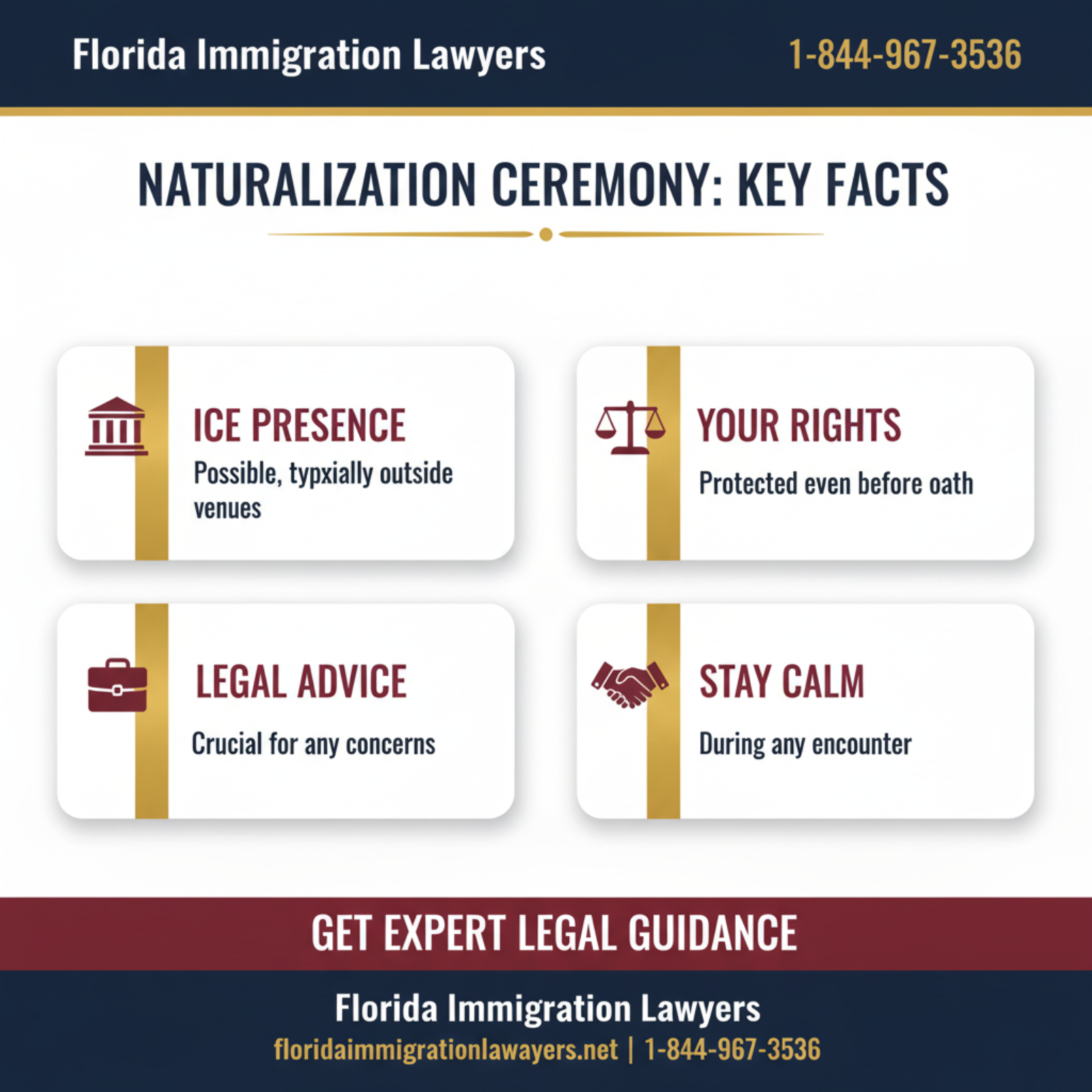
- ICE presence at naturalization ceremonies is rare but possible, usually tied to prior issues.
- As an applicant, you have constitutional rights, including the right to remain silent and to an attorney.
- Thorough preparation and legal review of your immigration history are essential.
- Do not sign anything without understanding it or without legal counsel.
- Consulting an immigration lawyer can provide peace of mind and protection.
The journey to becoming a U.S. citizen is a momentous occasion, filled with anticipation and pride. For many in Florida, especially in diverse communities like Coral Springs, this dream culminates in a naturalization ceremony. However, in recent years, a looming concern for some applicants has been the potential presence of U.S. Immigration and Customs Enforcement (ICE) at these ceremonies.
This article aims to address these critical naturalization ceremony ICE concerns. We will explore your rights, how to prepare, and what steps to take if you encounter immigration enforcement. Understanding your legal standing is key to protecting your future as a new citizen. Call Florida Immigration Lawyers at 1-844-967-3536 for a free consultation to discuss your specific situation and ensure peace of mind.
Understanding Naturalization and ICE Presence in Florida
Naturalization is the process by which a lawful permanent resident becomes a U.S. citizen. This grants you full rights and responsibilities, including the right to vote and protection from deportation. The U.S. Citizenship and Immigration Services (USCIS) oversees this process, which culminates in an Oath of Allegiance ceremony.
While a naturalization ceremony is typically a joyous event, instances of ICE presence, though infrequent, have raised naturalization ceremony ICE concerns. These situations generally arise when an applicant has a previous immigration issue, a criminal record, or a warrant that was not fully resolved or disclosed during their application process. ICE's primary mission is to enforce immigration laws, and they may act on information regarding individuals with outstanding issues, even at such events. This is particularly relevant in a state like Florida, with its large immigrant population.
It is important to remember that becoming a U.S. citizen offers robust protections. However, until you take the Oath of Allegiance and receive your Certificate of Naturalization, you are still considered a lawful permanent resident. This status, while strong, does not offer the same level of protection against certain immigration enforcement actions. For more details on this process, visit our citizenship practice area page.
The Immigration and Nationality Act (INA) outlines the requirements for naturalization, specifically in 8 U.S.C. § 1421 et seq. These laws ensure a thorough vetting process. However, if new information or previous undisclosed issues come to light, ICE may take action. This is why a comprehensive review of your history is paramount.
Your Rights at a Naturalization Ceremony in Florida
If you or someone you know is approached by ICE at a naturalization ceremony in Florida, it is vital to understand your rights. Even as an applicant, you are protected by the U.S. Constitution. Knowing how to react calmly and assertively can make a significant difference.
- Remain Calm and Do Not Resist: If approached by an ICE agent, stay calm. Do not physically resist or obstruct their actions.
- Do Not Answer Questions: You have the right to remain silent. Do not answer questions about your immigration status, birthplace, or how you entered the U.S. You can state, "I choose to remain silent."
- Ask if You Are Free to Leave: Clearly ask, "Am I free to leave?" If the agent says yes, you may leave. If they say no, you are being detained.
- Do Not Sign Anything: Do not sign any documents without first consulting an attorney. You are not required to sign anything presented to you, especially if you do not understand its contents.
- Request to Speak with an Attorney: Immediately state, "I want to speak with an attorney." ICE agents must cease questioning once you invoke your right to counsel.
- Memorize or Write Down Information: Try to remember or write down the agent's badge number, agency, and any details of the interaction. This information is crucial for your legal team.
- Inform Your Family: If detained, try to inform a trusted family member or friend. They can then contact an attorney on your behalf.
Understanding these steps is a critical part of protecting your rights. For assistance with any detention or deportation concerns, please visit our deportation defense page.
Preparing for Your Naturalization Ceremony: A Document Checklist
Thorough preparation is your best defense against unexpected issues. Beyond the excitement, ensure all your documents are in order and your history is fully reviewed. This can help mitigate naturalization ceremony ICE concerns.
- Your USCIS interview appointment notice.
- Your Permanent Resident Card (Green Card). You will surrender this at the ceremony.
- All travel documents, such as your passport, that you used to enter the U.S.
- Any immigration documents issued by USCIS, such as an Employment Authorization Document (EAD).
- Any court orders or records related to arrests, citations, or convictions, even if expunged.
- Proof of any name changes (marriage certificate, court order).
- Any documents requested by the USCIS officer at your naturalization interview.
- A valid state-issued ID (e.g., Florida driver's license).
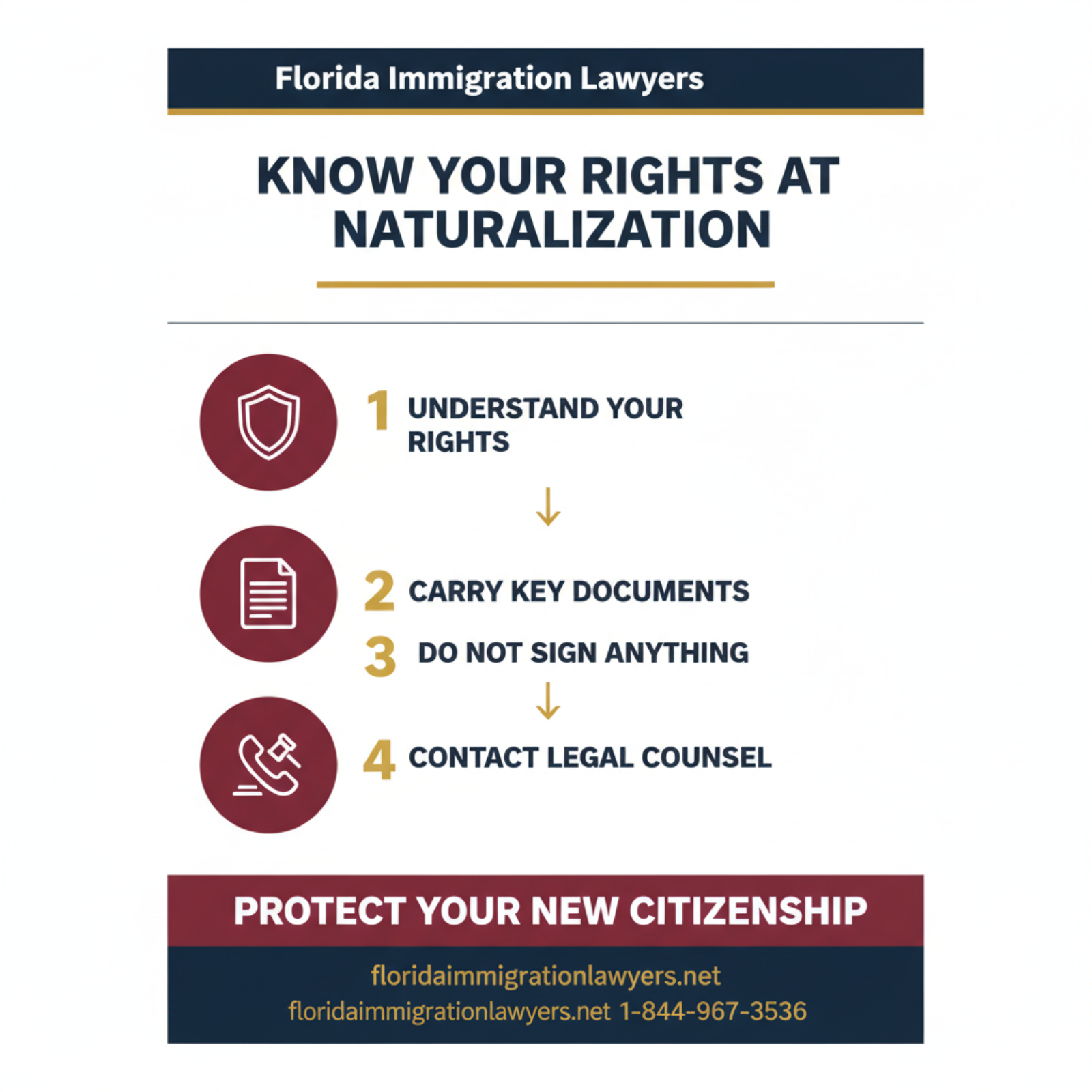
It is always advisable to make copies of all important documents for your records before attending the ceremony. For the most current information on required documents, always check the official USCIS website.
Naturalization Ceremony Timeline and Processing Expectations
The naturalization process involves several stages, and the timeline can vary significantly. After your N-400 application for naturalization is submitted, you will typically undergo biometrics, an interview, and finally, the Oath of Allegiance ceremony. In Florida, processing times can differ depending on the specific USCIS field office, such as Miami, Orlando, or Tampa.
Generally, from the time you file your N-400 to attending your ceremony, the process can take anywhere from 6 to 24 months, or even longer in some complex cases. Factors influencing this timeline include the volume of applications, the complexity of your case, and any requests for additional evidence. If there are delays, it could sometimes be a sign of deeper scrutiny, which might heighten naturalization ceremony ICE concerns.
USCIS aims to process applications efficiently, but unforeseen circumstances can arise. It is crucial to respond promptly to any USCIS requests for information. Staying informed about your case status through the USCIS online tool is also recommended. For general immigration information, our immigration practice area page offers valuable resources.
Cost Factors and Fee Breakdown for Naturalization
Pursuing U.S. citizenship involves various costs, primarily the USCIS filing fee for Form N-400, Application for Naturalization. This fee is subject to change, so it is essential to check the most current fees on the official USCIS website or 8 CFR 103.7.
Beyond the application fee, you may also incur costs for obtaining necessary documents, such as birth certificates, marriage licenses, or police records. If you require translations for any documents, certified translation services will add to your expenses. These preparations are vital for a successful application.
Legal fees for an immigration attorney represent another significant cost factor. While not mandatory, hiring an attorney can be invaluable, especially if you have a complex immigration history, criminal record, or specific naturalization ceremony ICE concerns. An attorney can help you prepare your application, represent you at interviews, and advise you on your rights. We invite you to contact us for a consultation regarding legal fees.
Do not navigate this process alone. Contact Florida Immigration Lawyers today for expert guidance.
Common Mistakes to Avoid at Your Naturalization Ceremony
- Failing to Disclose All Information: Any past arrests, citations, or immigration violations, even minor ones, must be fully disclosed. Failure to do so can lead to accusations of misrepresentation, denial of naturalization, and potential deportation proceedings.
- Arriving Unprepared: Forgetting essential documents, such as your Green Card or appointment notice, can cause delays or even prevent you from taking the oath. This unpreparedness can also draw unwanted attention.
- Failing to Update USCIS on Changes: If your address, marital status, or criminal history changes after filing your N-400, you must inform USCIS. Failure to do so can be seen as misrepresentation.
- Providing False Information: Intentionally providing false information on your application or during your interview can result in severe penalties, including a permanent bar from future immigration benefits.
- Ignoring Legal Advice: If an attorney has advised you on specific actions or disclosures, ignoring that advice can have detrimental consequences.
- Engaging in Confrontation with Officials: While you have rights, being confrontational or disrespectful to USCIS or ICE officers can negatively impact your case. Maintain a respectful demeanor while asserting your rights.
- Traveling Internationally Before the Ceremony: While generally permitted, international travel after your interview but before your ceremony can sometimes complicate matters or raise flags, especially if there are any pending issues.
When to Call a Florida Immigration Lawyer
While many naturalization cases proceed smoothly, certain situations warrant the immediate assistance of a Florida immigration lawyer. If you have naturalization ceremony ICE concerns, legal counsel is paramount. Our team at Florida Immigration Lawyers is dedicated to protecting your rights.
You should contact an attorney if you have any criminal history, no matter how minor or old. This includes arrests, charges, or convictions, even if they were expunged or dismissed. Such issues can trigger ICE interest and complicate your naturalization. Similarly, if you have any prior immigration violations, such as previous deportations or periods of unlawful presence, legal guidance is essential.
If you receive a "Notice of Intent to Deny" (NOID) for your naturalization application, or if you are asked to attend a second interview after your initial one, these are significant red flags. These situations often indicate that USCIS has concerns about your eligibility. Furthermore, if you are ever approached by ICE or any law enforcement official at your ceremony or any other immigration appointment, immediately invoke your right to an attorney. Our experienced attorneys are here to help.
People Also Ask (PAA) about Naturalization and ICE
Can ICE deport you if you're a naturalized citizen?
Once you are a naturalized U.S. citizen, you generally cannot be deported. Citizenship is one of the strongest protections against deportation. However, citizenship can potentially be revoked (denaturalization) in rare cases if it was obtained fraudulently, through misrepresentation, or if certain criminal acts were committed before or during the naturalization process and concealed. Denaturalization is a complex legal process initiated by the government.
Do naturalized citizens have to worry about ICE?
After successfully naturalizing and becoming a U.S. citizen, the vast majority of individuals do not need to worry about ICE. Your citizenship status provides strong protection. Concerns about ICE are primarily relevant during the application process, before taking the Oath of Allegiance, if there are unresolved issues that could lead to your application's denial or if you have a history that ICE is actively investigating. Once a citizen, your status is secure.
What proof of citizenship is ICE looking for?
ICE agents are not typically "looking for" proof of citizenship from naturalized citizens in the same way they might question non-citizens. However, if ICE questions an individual, they may ask for identification. For a naturalized citizen, your U.S. Passport or Certificate of Naturalization serves as definitive proof of citizenship. It is always wise to carry some form of identification. If you are not yet a citizen, but are a lawful permanent resident, your Green Card is your primary proof of status.
Can ICE detain you at a biometrics appointment?
Yes, ICE can detain individuals at biometrics appointments. While these appointments are typically routine, if an applicant has an outstanding warrant, a criminal record that makes them deportable, or a final order of removal, ICE may be present or notified. This is why it is crucial for anyone with a complex history to consult with an immigration attorney before attending any USCIS appointment. An attorney can assess your risks and advise you on how to proceed safely.
About Florida Immigration Lawyers
Florida Immigration Lawyers is a leading immigration law firm dedicated to serving individuals and families across the entire state of Florida. We understand the complexities and emotional challenges of the immigration system. Our experienced attorneys provide compassionate, strategic, and effective legal representation for a wide range of immigration matters.
We offer comprehensive services, including assistance with naturalization, family-based petitions, business immigration, asylum claims, and deportation defense. Our firm is committed to protecting your rights and helping you achieve your American dream. We pride ourselves on clear communication, personalized attention, and a deep understanding of immigration law.
Choose Florida Immigration Lawyers for our unwavering commitment to our clients, our proven track record, and our dedication to excellence. We are available 24/7 and offer free consultations to discuss your case. Call us today at 1-844-967-3536 or visit us at https://www.floridaimmigrationlawyers.net. Serving all of Florida, we are here to help.
Sources and References
- U.S. Citizenship and Immigration Services (USCIS)
- Executive Office for Immigration Review (EOIR)
- U.S. Immigration and Customs Enforcement (ICE)
- 8 U.S.C. Chapter 12 - Immigration and Nationality Act (INA), specifically 8 U.S.C. § 1421 et seq. for naturalization.
- 8 Code of Federal Regulations (CFR) Part 310-343 for naturalization procedures.
- 8 CFR 103.7 - Fees.
This article provides general legal information and is not intended as legal advice. Every case is unique, and outcomes depend on specific facts and circumstances. Contact an attorney for advice about your particular situation.
Your journey to U.S. citizenship should be a joyous one, free from unnecessary worry. If you have any naturalization ceremony ICE concerns or questions about your immigration status, do not hesitate to seek professional legal guidance. Contact Florida Immigration Lawyers today for a free, confidential consultation at 1-844-967-3536. Se Habla Español - Estamos aquí para ayudarle.
Need help with Immigration?
Our Florida immigration attorneys offer free consultations. Call today or schedule online.
Frequently Asked Questions
Florida Immigration Lawyers
Legal Team
Our experienced attorneys at Florida Immigration Lawyers have been serving clients across Florida for over 20 years. We specialize in immigration, personal injury, criminal defense, workers compensation, and family law.