H-1B Visa Florida Employers Guide 2026: Sponsoring Talent
For Florida employers, navigating the H-1B visa process in 2026 is essential for securing specialized talent. This comprehensive guide covers eligibility requirements, the step-by-step application process, necessary documentation, and understanding associated costs. Learn about the H-1B cap, lottery system, and crucial deadlines. We also highlight common mistakes to avoid and when to seek expert legal assistance. Florida Immigration Lawyers offers unparalleled support for your business immigration needs. Contact us for a free consultation to ensure a smooth and compliant H-1B sponsorship.

The H-1B visa program allows Florida employers to temporarily employ foreign workers in specialty occupations requiring a bachelor's degree or higher. This guide helps Orlando businesses understand the 2026 application process, eligibility, and compliance. Navigating the H-1B cap and lottery is crucial for successful sponsorship.
- The H-1B visa is for specialty occupations.
- Employers must sponsor the foreign worker.
- An annual cap and lottery system apply to most petitions.
- Compliance with labor laws is essential for Florida companies.
- Legal guidance is critical for a smooth application.
Florida's economy is vibrant and growing, attracting diverse industries from technology to tourism. Many businesses across Orlando and the entire state recognize the critical need for specialized talent. Often, the best candidates for these roles are found globally. If your Florida business is considering hiring a foreign professional, the H-1B visa program is a primary pathway.
Understanding the complexities of the H-1B visa process for 2026 is vital for any employer looking to sponsor foreign talent. From navigating the annual lottery to ensuring federal regulation compliance, each step requires careful attention. This comprehensive guide provides Florida employers with essential information to successfully sponsor an H-1B worker.
We will cover eligibility, the application process, required documentation, timelines, and associated costs. Our goal is to equip you with the knowledge to make informed decisions for your workforce needs. Do not navigate this intricate process alone; call Florida Immigration Lawyers at 1-844-967-3536 for a free consultation. Our experienced team is ready to assist your Florida business.
Overview of the H-1B Visa Program for Florida Employers
The H-1B visa is a nonimmigrant visa that permits U.S. employers to temporarily employ foreign workers in specialty occupations. These occupations generally require a bachelor's degree or higher in a specific field. Fields like IT, engineering, medicine, and education often qualify for H-1B classification. This visa is a crucial tool for Florida businesses seeking highly skilled professionals.
The H-1B program is vital for addressing talent shortages in various sectors across Florida, including technology hubs in Orlando and healthcare facilities statewide. It allows your company to bring in expertise that may be difficult to find domestically. Understanding the fundamental aspects of this visa is the first step toward successful sponsorship.
Eligibility for Employers and Employees
To sponsor an H-1B visa, your Florida business must offer a "specialty occupation" requiring a bachelor's degree or higher in a specific field. The employee must hold a bachelor's degree or its equivalent, or possess relevant work experience. They must be qualified to perform services in the specialty occupation.
The H-1B Cap and Lottery System
USCIS caps H-1B visas at 65,000 annually, plus 20,000 for U.S. master's degrees. This creates the "H-1B cap" or "H1B visa lottery." Certain organizations are cap-exempt. For 2026, employers must register electronically in March. Lottery selection is mandatory for cap-subject petitions.
Prevailing Wage Determination
Florida employers need a certified Labor Condition Application (LCA) from the DOL. This attests you will pay the H-1B worker at least the prevailing wage for the occupation in your area, or the actual wage paid to others, whichever is higher. Accurate wage determination is critical for compliance, as detailed under 20 CFR Part 655, Subpart A.
Step-by-Step H-1B Visa Application Process for Florida Employers
Navigating the H-1B visa application process requires precision and adherence to strict deadlines. For Florida employers, understanding each stage is crucial for a successful outcome. Here is a detailed, numbered guide to help you through the journey.
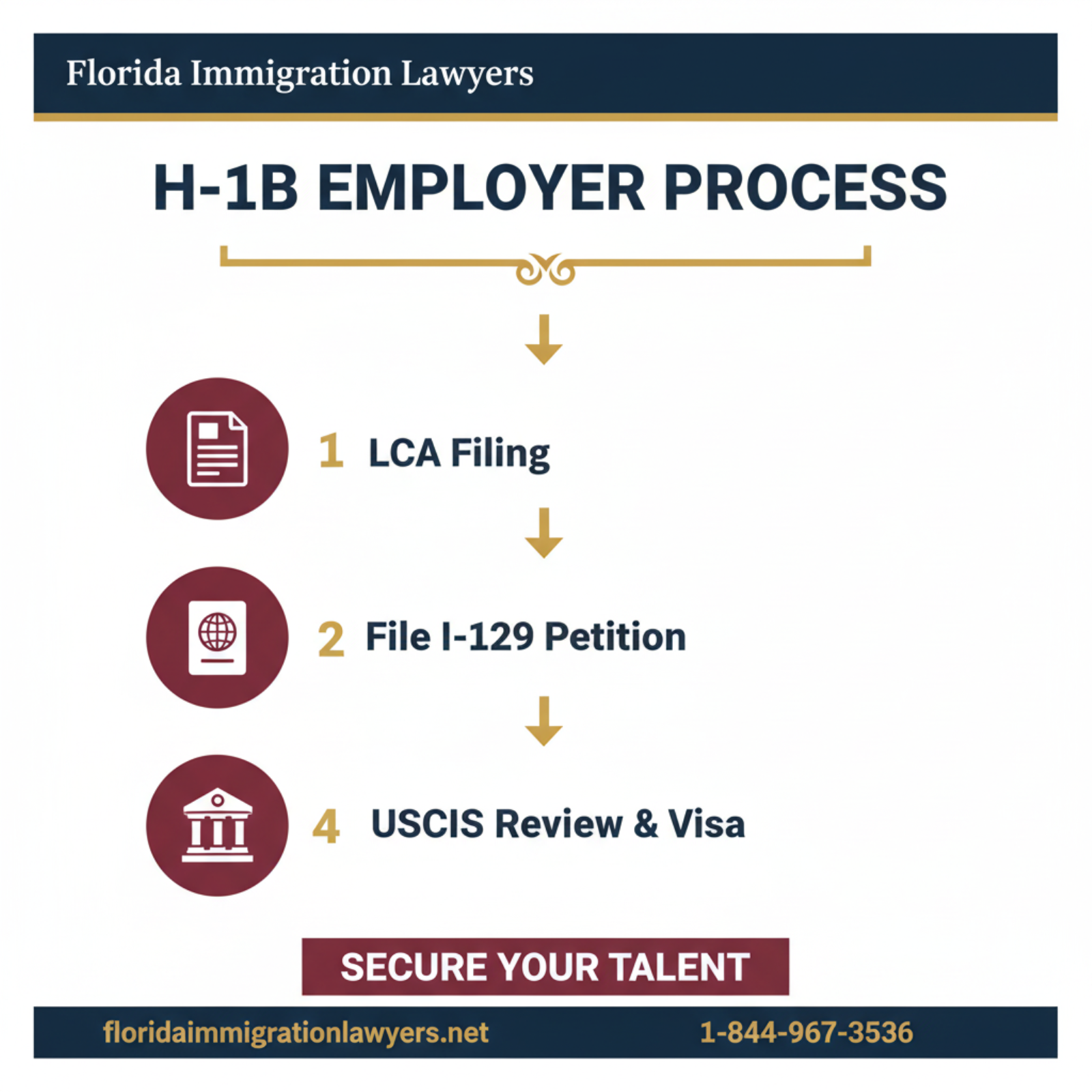
- Determine Eligibility and Prevailing Wage: Confirm job and employee qualifications. Research the prevailing wage for your Florida location using the DOL's Foreign Labor Certification Data Center.
- File a Labor Condition Application (LCA): Submit Form ETA-9035 electronically to the DOL. It typically certifies within 7 business days if complete.
- H-1B Cap Registration (If Applicable): For cap-subject petitions, register the employee during the March period via the USCIS online system. Only selected registrations proceed.
- Prepare and File Form I-129 Petition: After LCA certification and lottery selection, file Form I-129 with USCIS. Include supporting documents, the certified LCA, and all fees.
- Respond to Requests for Evidence (RFEs): USCIS may issue an RFE for more information. Respond thoroughly and promptly to avoid delays or denial.
- Petition Approval: USCIS sends an approval notice, Form I-797, if approved. For U.S. beneficiaries, this may include a change of status, effective October 1st for cap-subject cases.
- Visa Interview and Stamping (for Beneficiaries Abroad): Beneficiaries abroad attend an interview at a U.S. Embassy/Consulate. Successful interviews result in the H-1B visa stamp.
- Begin Employment: Once the H-1B visa is issued or status changes, the worker can begin employment for your Florida company on the petition's start date. Comply with all LCA attestations.
Essential Document Checklist for H-1B Petitions
A meticulous approach to documentation is crucial for a successful H-1B visa petition. Missing or incorrect documents can lead to delays, Requests for Evidence (RFEs), or even denial. Florida employers should prepare the following comprehensive list of documents for their H-1B filings.
- Employer-Related Documents:
- Proof of Employer's Federal Employer Identification Number (FEIN).
- Company financials (statements, tax returns, annual reports).
- Business license and articles of incorporation.
- Lease agreement for Florida business premises.
- Organizational chart showing H-1B position.
- Detailed job description with duties and qualifications.
- Evidence of the employer's ability to pay the proffered wage.
- Employee-Related Documents:
- Copy of the beneficiary's passport.
- Copies of all previous U.S. visas and I-94 records (if applicable).
- Copies of all educational degrees, diplomas, and transcripts.
- Foreign degree evaluations if degrees were obtained outside the U.S.
- Professional licenses or certifications (if applicable).
- Detailed resume or curriculum vitae.
- Letters of experience from previous employers.
- Any previous USCIS approval notices.
Step-by-Step Process Guide - Petition-Specific Documents:
- Certified Labor Condition Application (LCA) Form ETA-9035.
- Form I-129, Petition for a Nonimmigrant Worker, and its supplements.
- Support letter from the employer detailing the specialty occupation and terms of employment.
- Evidence supporting the specialty occupation requirement.
- Any other evidence requested by USCIS.
H-1B Visa Timeline and Processing Expectations
The timeline for an H-1B visa petition can vary significantly depending on several factors, including the annual cap and USCIS processing loads. Florida employers need to understand these expectations to plan their workforce effectively for 2026.
Key Dates for Cap-Subject H-1B Petitions
For cap-subject H-1B visas, the process typically begins well in advance of the October 1st start date for the new fiscal year.
- March: H-1B electronic registration period opens and closes. USCIS conducts the lottery within this month.
- Late March/Early April: USCIS announces lottery results. Selected registrants are then eligible to file their Form I-129 petitions.
- April 1st to June 30th (typically): Filing window for cap-subject H-1B petitions for selected registrants.
- October 1st: Earliest possible start date for approved cap-subject H-1B employment.
Petitions that are cap-exempt (e.g., for universities or non-profits) can be filed at any time during the year.
USCIS Processing Times
Once the Form I-129 petition is filed, processing times vary by USCIS service center and current caseload. You can check the approximate processing times on the official USCIS website. Regular processing can take several months, often between 3 to 6 months, or even longer in some cases.
Premium processing is available for an additional fee, guaranteeing a decision or an RFE within 15 calendar days. Many Florida businesses choose this option for critical roles to expedite the process. However, premium processing can be temporarily suspended by USCIS at times.
Understanding H-1B Visa Cost Factors and Fees
Sponsoring an H-1B visa involves various costs that Florida employers must consider. These fees can add up, and it is important to budget for them accurately. While specific fee amounts are subject to change, understanding the categories of expenses is crucial. You should always refer to the official USCIS website for the most current fee schedule.
Government Filing Fees
The U.S. government levies several fees for H-1B petitions. These generally include:
- USCIS Base Filing Fee (Form I-129): A standard fee for filing the petition.
- American Competitiveness and Workforce Improvement Act (ACWIA) Fee: An additional fee depending on the employer's size.
- Fraud Prevention and Detection Fee: A mandatory fee for all initial H-1B petitions and for employers filing a second or subsequent H-1B petition for the same beneficiary.
- Public Law 114-113 Fee (for certain employers): A specific fee for employers with 50 or more employees where more than 50% of their workforce are in H-1B or L-1 nonimmigrant status.
- Premium Processing Fee (Optional): If you opt for expedited processing, an additional fee applies, guaranteeing faster adjudication.
Most of these fees, particularly the ACWIA and Fraud Prevention fees, are the responsibility of the employer and cannot be passed on to the employee. This is a critical compliance point for Florida businesses.
Attorney Fees and Other Costs
Beyond government fees, employers typically incur legal fees for professional assistance. Immigration law is complex, and an experienced attorney can significantly increase the chances of a successful petition. Attorney fees vary based on the complexity of the case and the services provided.
Other potential costs may include:
- Educational credential evaluations for foreign degrees.
- Translation services for foreign documents.
- Travel costs for the employee's visa interview at a U.S. consulate abroad.
Regarding the common question, "Who pays the $100,000 for H-1B?", it's important to clarify there isn't a standard $100,000 fee. While total H-1B sponsorship costs can be substantial, especially for large employers, it rarely reaches this figure for a single petition. Costs combine government fees and legal/administrative expenses, typically ranging from a few thousand to $10,000-$15,000. Employers generally bear most of these costs for compliance.
Do not navigate this process alone. Contact Florida Immigration Lawyers today to ensure your H-1B petition is prepared accurately and efficiently. Our team is here to support your Florida business.
Common Mistakes Florida Employers Must Avoid in H-1B Sponsorship
Sponsoring an H-1B visa is a complex undertaking, and even minor errors can lead to significant delays or denials. Florida employers must be vigilant to avoid these common pitfalls. Proactive legal guidance can prevent many of these issues.
- Incorrect Prevailing Wage: Failing to accurately determine and pay the prevailing wage is a serious violation, leading to penalties. Use the correct wage level and geographic area.
- Incomplete LCA: Errors in the Labor Condition Application can delay or reject your petition. Ensure accuracy before submission.
- Missing Cap Deadlines: Missing the March electronic registration for cap-subject petitions means waiting until the next fiscal year. This significantly impacts hiring plans.
- Insufficient Specialty Occupation Evidence: USCIS scrutinizes if the job truly requires a specialized bachelor's degree. Generic descriptions often lead to RFEs.
- Lack of Employee Qualification Proof: Employee education and experience must clearly align with the specialty occupation. Inadequate documentation causes issues.
- Failure to Maintain Public Access File: Employers must maintain a public access file (PAF) for LCA-related documents. Non-compliance can result in penalties during DOL audits.
- Improper Employer-Employee Relationship: For third-party placements, USCIS reviews the employer-employee relationship closely. Insufficient control can lead to RFE or denial.
- Inadequate RFE Response: A weak or incomplete response to a Request for Evidence from USCIS will likely lead to denial. Provide comprehensive, well-supported answers.
- Incorrect Cap Exemptions: Misinterpreting cap exemptions can lead to incorrect filings and rejection. Confirm your organization truly qualifies as cap-exempt.
- Failure to Notify of Changes: Significant changes to employment, like a new work location, may require an amended petition. Failing to do so can jeopardize status.
- Premature Employment: An H-1B worker cannot start until status is effective. Starting work early is a serious violation.
- Ignoring Attorney Advice: Bypassing legal counsel can be costly. Experienced attorneys provide crucial guidance in evolving immigration law.
When to Call a Florida Immigration Lawyer for H-1B Guidance
The H-1B visa process is intricate, with many potential pitfalls for even the most diligent Florida employer. While this guide provides a comprehensive overview, certain situations absolutely warrant the expertise of an experienced immigration attorney. Florida Immigration Lawyers are here to offer the specialized assistance you need.
You should consider contacting our firm if your business encounters any of the following scenarios:
- Uncertainty about Specialty Occupation: If unsure if a job qualifies, an attorney can assess the role and provide clarity, preventing RFEs.
- Complex Prevailing Wage Issues: For unusual industries or unique job duties, determining the correct wage is challenging. We ensure DOL compliance.
- Prior Denials or RFEs: If you received an RFE or denial, our lawyers review reasons and strategize a stronger resubmission.
- Third-Party Placement Scenarios: USCIS scrutinizes employer-employee relationships for client-site placements. Legal counsel is essential to demonstrate proper control.
- Corporate Restructuring: Mergers or acquisitions impact existing H-1B petitions. Legal navigation is crucial to maintain employee status.
- Compliance Concerns: For questions about public access files or H-1B dependent employer rules, an attorney provides audits and guidance.
- Any Legal Red Flags: If you encounter unusual circumstances or receive official notices, seek legal advice immediately.
Florida Immigration Lawyers specializes in business immigration, including the H-1B visa. We serve employers throughout Florida, from Orlando to Miami, Tampa, and Jacksonville. Our team understands the nuances of federal immigration law and how it applies to your specific business needs. Let us help you navigate the complexities and secure the talent your company deserves.
Learn more about our Business Immigration services. We also handle a wide range of other immigration matters, including general immigration, deportation defense, and citizenship applications.
About Florida Immigration Lawyers
Florida Immigration Lawyers is a leading law firm dedicated to providing exceptional legal representation and guidance to individuals and businesses across the entire state of Florida. With offices conveniently located to serve clients from Orlando to Miami, we are committed to helping our clients achieve their immigration goals. Our team of experienced attorneys possesses a deep understanding of U.S. immigration law and its ever-evolving landscape.
We understand that navigating the immigration system can be overwhelming and stressful. That is why we offer compassionate, client-focused service, ensuring you feel supported and informed every step of the way. Whether you are an employer seeking to sponsor foreign talent, an individual pursuing family-based immigration, or someone facing complex deportation issues, we are here to advocate for your best interests.
Why Choose Florida Immigration Lawyers?
- Expertise: Our attorneys specialize exclusively in immigration law, bringing focused knowledge to your case.
- Client-Centered Approach: We prioritize your needs, offering personalized strategies and clear communication.
- Bilingual Services: Se habla español. Our team is fully equipped to assist both English and Spanish-speaking clients.
- Accessibility: We are available 24/7 to address urgent concerns and provide peace of mind.
- Free Consultations: We offer a free initial consultation to discuss your case and outline potential legal pathways.
- Florida-Wide Service: No matter where you are in Florida, our firm can provide comprehensive legal support.
Contact Florida Immigration Lawyers today at 1-844-967-3536 or visit our website at https://www.floridaimmigrationlawyers.net to schedule your free consultation. Let us be your trusted partner in your immigration journey. You can also learn more about our dedicated attorneys who are ready to assist you.
Sources and References
- U.S. Citizenship and Immigration Services (USCIS) - H-1B Specialty Occupations
- U.S. Department of Labor (DOL) - Foreign Labor Certification Data Center (FLCDataCenter)
- Executive Office for Immigration Review (EOIR)
- 8 U.S.C. § 1101(a)(15)(H)(i)(b) - Immigration and Nationality Act (INA) defining H-1B nonimmigrant.
- 8 CFR Part 214.2(h) - Regulations governing H nonimmigrants.
- 20 CFR Part 655, Subpart A - Regulations governing Labor Condition Applications.
This article provides general legal information and is not intended as legal advice. Every case is unique, and outcomes depend on specific facts and circumstances. Contact an attorney for advice about your particular situation.
Navigating the complexities of the H-1B visa program for your Florida business requires expert legal guidance. Do not risk delays or denials by attempting to manage this process alone. Our dedicated team at Florida Immigration Lawyers is ready to provide the professional support you need. Call us today for a free consultation at 1-844-967-3536. Se Habla Español - Estamos aquí para ayudarle.
Do Not Navigate This Process Alone
Our experienced immigration attorneys are ready to fight for you. Get a free, confidential consultation today.
Se Habla Español
Or leave your details and we’ll call you:
Free Evaluation in 24 Hours
Or talk to us right now

AI voice assistant — available 24/7
FreeFrequently Asked Questions

William J. Vásquez
Founding Attorney · Vasquez Law Firm
U.S. Air Force veteran and immigration attorney with years of hands-on U.S. immigration experience. J.D., NCCU School of Law. AILA member. Admitted to the 4th, 5th, and 11th Circuit Courts.
Available 24/7 - Free Evaluations
Reviewed for legal accuracy by William J. Vásquez
Licensed in North Carolina; U.S. immigration is federal practice.
Related Legal Services
Our Florida immigration attorneys can help you with free immigration consultation, experienced immigration attorneys and business immigration. Call today at 1-844-967-3536 for a free consultation.
Related Links
Related Topics
Free Legal Consultation
Discuss your case with our experienced attorneys. We're available 24/7.
Se Habla Español - Estamos aquí para ayudarle.
Related Articles
Military Naturalization Expedited in Florida Bases
Explore military naturalization options for families at Florida bases, including parole in place benefits in Miami. Learn how to expedite your application with expert guidance from Florida Immigration Lawyers.
Immigration Lawyer Orlando Free Consultation 2026
Discover how to find an immigration lawyer in Orlando offering a free consultation. Understand the services available and why choosing Florida Immigration Lawyers can make a difference in your case.
Immigration Lawyer Orlando Free Consultation: 2026 Policy
As Florida anticipates significant immigration policy changes by 2026, understanding their potential impact is crucial for residents and businesses across the state, from Naples to Orlando. These reforms may include enhanced enforcement, adjustments to visa programs, and shifts in asylum processing. Navigating these new rules requires expert legal guidance to ensure compliance and protect your rights. Florida Immigration Lawyers offers free consultations to help you understand how these changes affect your specific case, whether you're applying for a visa, seeking adjustment of status, or facing a complex legal challenge. Our comprehensive guide covers anticipated timelines, document requirements, and common mistakes to avoid, emphasizing the importance of informed preparation. Don't let uncertainty jeopardize your future; learn how our experienced attorneys can advocate for you.
DUI Immigration Consequences in Florida: What to Know
A DUI conviction in Florida can have significant immigration consequences, including potential inadmissibility and deportation. Learn how to navigate these challenges and protect your rights with guidance from Florida Immigration Lawyers.