Immediate Relative Petition Florida: Your 2026 Green Card Guide
For U.S. citizens in Florida, sponsoring an immediate relative for a Green Card offers a streamlined path to family reunification. This guide from Florida Immigration Lawyers details the I-130 petition process, including who qualifies, essential documents, expected timelines for 2026, and associated costs. We cover the crucial steps from filing with USCIS to navigating Adjustment of Status or Consular Processing. Learn how to avoid common mistakes and when professional legal assistance is vital for a successful outcome. Our firm, serving all of Florida, provides expert guidance for your family immigration needs.
An immediate relative petition in Florida allows U.S. citizens to sponsor close family members like spouses, unmarried children under 21, and parents for a Green Card, without numerical limitations or long waiting lists. The process typically begins with filing Form I-130, Petition for Alien Relative, with USCIS, followed by either Adjustment of Status or Consular Processing.
- Immediate relatives include spouses, minor children, and parents of U.S. citizens.
- There are no visa backlogs for immediate relatives, meaning faster processing.
- The process starts with Form I-130, Petition for Alien Relative.
- Options for Green Card application include Adjustment of Status or Consular Processing.
- Legal guidance from Florida Immigration Lawyers can streamline your application.
Are you a U.S. citizen living in Hollywood, Florida, dreaming of reuniting with your spouse, child, or parent? The process of bringing your loved ones to the United States permanently can seem complex, but for immediate relatives, it offers a direct path to a Green Card. Understanding the specific requirements and steps for an immediate relative petition Florida is crucial for a successful outcome in 2026.
This comprehensive guide from Florida Immigration Lawyers will walk you through everything you need to know about sponsoring an immediate relative. We cover the entire I-130 petition process, eligibility criteria, required documents, and what to expect regarding timelines and costs. Our goal is to provide clarity and empower you with the information you need to navigate this journey confidently.
Do not let the complexities of immigration law deter you from pursuing your family's future. For personalized guidance on your immediate relative petition in Florida, call Florida Immigration Lawyers at 1-844-967-3536 for a free consultation. We are here to help you every step of the way.
Understanding Immediate Relative Petitions in Florida
The U.S. immigration system prioritizes certain family relationships, classifying them as "immediate relatives." This designation is highly advantageous because it means there are no annual numerical limits on the number of visas issued in this category. Unlike other family-based categories, immediate relatives do not face lengthy waiting lists based on visa bulletin priority dates, leading to generally faster processing times.
An immediate relative, as defined by Section 201(b)(2)(A)(i) of the Immigration and Nationality Act (INA), includes the spouse of a U.S. citizen, the unmarried child under 21 years of age of a U.S. citizen, and the parent of a U.S. citizen (if the U.S. citizen is 21 years of age or older). This category is distinct from "family preference" categories, which are subject to annual quotas and often involve significant delays. For residents of Florida, especially in diverse areas like Hollywood, understanding this distinction is vital for family reunification. Florida Immigration Lawyers specializes in all aspects of family immigration, ensuring your petition meets all legal requirements.
Who Qualifies as an Immediate Relative?
To qualify as an immediate relative, the relationship must fall into one of these specific categories:
- Spouses of U.S. Citizens: This includes legally married husbands and wives. The marriage must be legitimate and not solely for immigration purposes.
- Unmarried Children Under 21 of U.S. Citizens: This refers to biological children, stepchildren (if the marriage creating the relationship occurred before the child turned 18), and adopted children (under specific conditions).
- Parents of U.S. Citizens: A U.S. citizen must be at least 21 years old to petition for their parent. This includes biological parents, stepparents, and adoptive parents.
It is important to note that while U.S. citizens can petition for siblings and married children, these relationships fall under the family preference categories and are subject to visa quotas, meaning longer waiting periods.
The I-130 Petition Process: A Step-by-Step Guide for Florida Residents
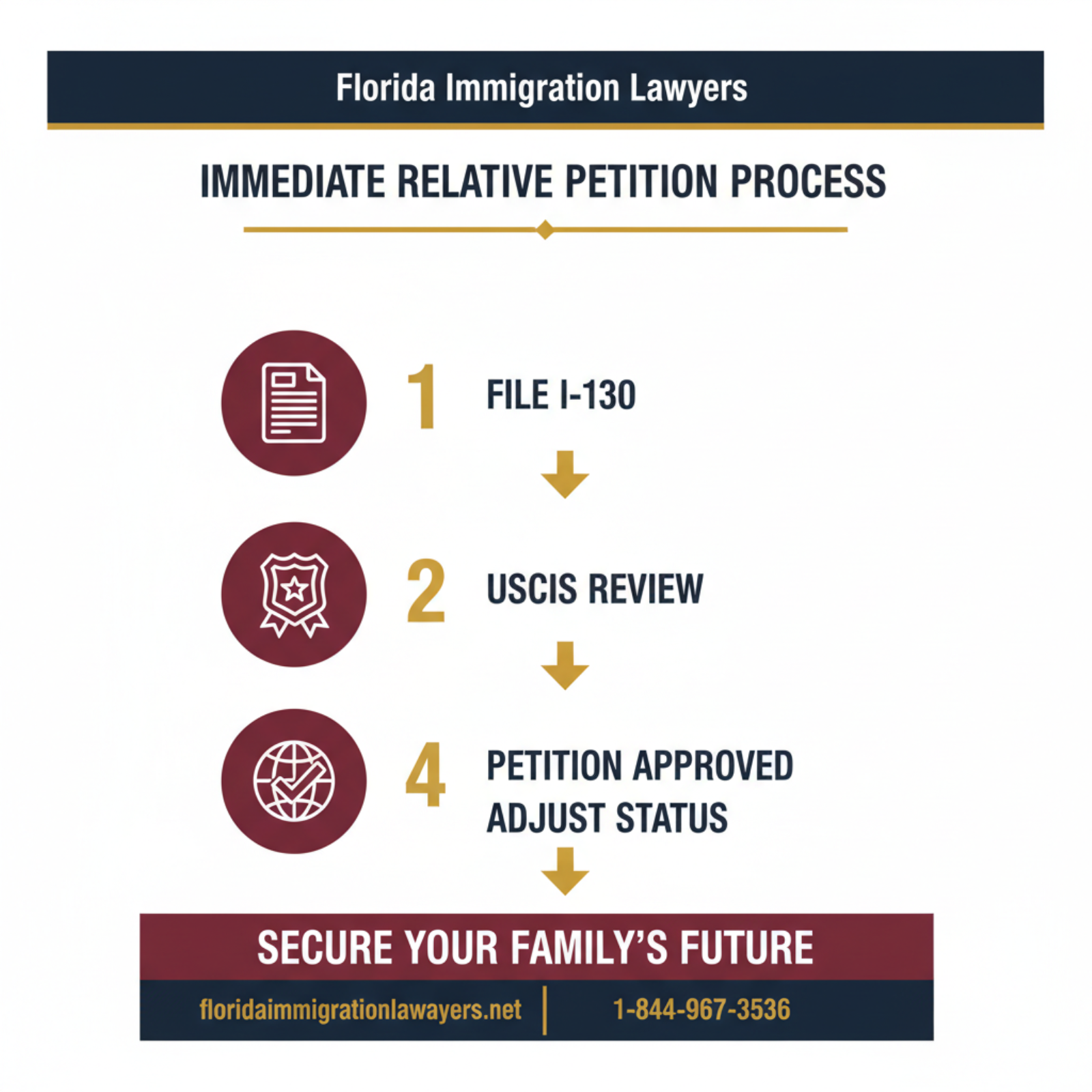
The journey to obtaining a green card for your immediate relative typically begins with filing Form I-130, Petition for Alien Relative. This form establishes the qualifying relationship between the U.S. citizen petitioner and the foreign national beneficiary. Here is a step-by-step guide to help Florida residents navigate this crucial initial phase:
-
Step 1: Determine Eligibility and Gather Initial Information. First, confirm that your family member truly qualifies as an immediate relative. Collect basic information for both the petitioner (U.S. citizen) and the beneficiary (foreign national), including names, birth dates, addresses, and immigration history. This foundational step is critical for a smooth application process.
-
Step 2: Collect Required Supporting Documents. Before filling out the I-130 form, compile all necessary documentation to prove your U.S. citizenship and the qualifying relationship. This often includes birth certificates, marriage certificates, and evidence of genuine relationships. Thorough preparation at this stage can prevent delays and Requests for Evidence (RFEs) from USCIS.
-
Step 3: Complete Form I-130, Petition for Alien Relative. Carefully fill out Form I-130. Ensure all questions are answered accurately and completely. Any discrepancies or omissions can lead to processing delays or even denials. Review the form multiple times before submission, or seek assistance from an experienced attorney to avoid common pitfalls.
-
Step 4: File the Petition with U.S. Citizenship and Immigration Services (USCIS). Once the I-130 form is completed and all supporting documents are compiled, mail the petition package to the appropriate USCIS Lockbox facility. The filing location depends on where you live and whether you are filing other forms concurrently. Always keep a copy of everything you submit for your records. You can find up-to-date filing addresses on the USCIS website.
-
Step 5: USCIS Processing and Approval. After filing, USCIS will send a receipt notice (Form I-797C, Notice of Action) confirming they received your petition. They will then review the petition and supporting evidence. If everything is in order, USCIS will approve your Form I-130. This approval signifies that the qualifying relationship has been established. This is a critical step in any immigration process.
-
Step 6: Adjustment of Status or Consular Processing. Upon I-130 approval, the beneficiary will proceed with their Green Card application. If the immediate relative is already in the U.S. and meets specific eligibility criteria, they may file Form I-485, Application to Register Permanent Residence or Adjust Status. If the immediate relative is outside the U.S., they will undergo Consular Processing through the National Visa Center (NVC) and a U.S. embassy or consulate abroad. Contact us to discuss which path is right for your family.
Adjustment of Status vs. Consular Processing
The path your immediate relative takes to obtain their Green Card after I-130 approval depends on their current location and immigration status:
- Adjustment of Status (AoS): If the immediate relative is physically present in the United States and entered lawfully, they may be eligible to "adjust" their status to a lawful permanent resident. This typically involves filing Form I-485 with USCIS. Eligibility for AoS is governed by INA Section 245(a), which generally requires a lawful entry and no specific bars to adjustment. The benefit of AoS is that the applicant remains in the U.S. during processing.
- Consular Processing: If the immediate relative is outside the United States, they will go through Consular Processing. After the I-130 is approved, the petition is sent to the National Visa Center (NVC), which collects additional documents and fees. The beneficiary then attends an interview at a U.S. embassy or consulate in their home country. Upon approval, they receive an immigrant visa to enter the U.S. as a permanent resident. More details are available on the Department of State website.
Essential Documents for Your Immediate Relative Petition
A well-prepared petition package is key to avoiding delays. Here is a comprehensive list of documents typically required for an immediate relative petition. Remember that specific situations may require additional evidence:
- Proof of U.S. Citizenship (Petitioner):
- Copy of U.S. birth certificate.
- Copy of U.S. passport (unexpired).
- Copy of Consular Report of Birth Abroad (FS-240, DS-1350, or FS-545).
- Copy of Certificate of Naturalization or Certificate of Citizenship.
- Proof of Qualifying Relationship:
- For Spouses: Copy of marriage certificate, and copies of any divorce decrees or death certificates for previous marriages of both petitioner and beneficiary.
- For Children: Copy of child's birth certificate showing the U.S. citizen parent's name. If a stepchild, marriage certificate between the U.S. citizen parent and the child's biological parent.
- For Parents: Copy of the U.S. citizen's birth certificate showing the parent's name. If a stepparent, marriage certificate between the U.S. citizen's biological parent and the stepparent.
- Evidence of Bona Fide Marriage (for spousal petitions):
- Joint bank account statements.
- Joint leases or mortgages.
- Birth certificates of children born to both spouses.
- Affidavits from third parties attesting to the marriage.
- Photographs of the couple together over time.
- Joint insurance policies, utility bills, or tax returns.
- Proof of Financial Support (Affidavit of Support):
- Form I-864, Affidavit of Support, completed by the petitioner (sponsor).
- Federal income tax returns and W-2s for the most recent tax year.
- Evidence of assets, if necessary, to meet income requirements.
Step-by-Step Process Guide - Biographic Documents (Beneficiary):
- Copy of foreign birth certificate.
- Copy of passport biographical page.
- Two passport-style photographs.
- Medical Examination (for Adjustment of Status applicants):
- Form I-693, Report of Medical Examination and Vaccination Record, completed by a USCIS-approved civil surgeon.
Ensuring all documents are accurate, translated (if necessary), and properly submitted is crucial. Florida Immigration Lawyers can assist you in compiling a strong citizenship or immigration petition package.
Immediate Relative Petition Timeline & Processing Expectations in 2026
One of the most common questions we receive in Hollywood, Florida, is "How long does an immediate relative petition take?" While immediate relatives are not subject to visa backlogs, the overall processing time can still vary significantly. It is important to manage expectations and understand the factors that influence the timeline in 2026.
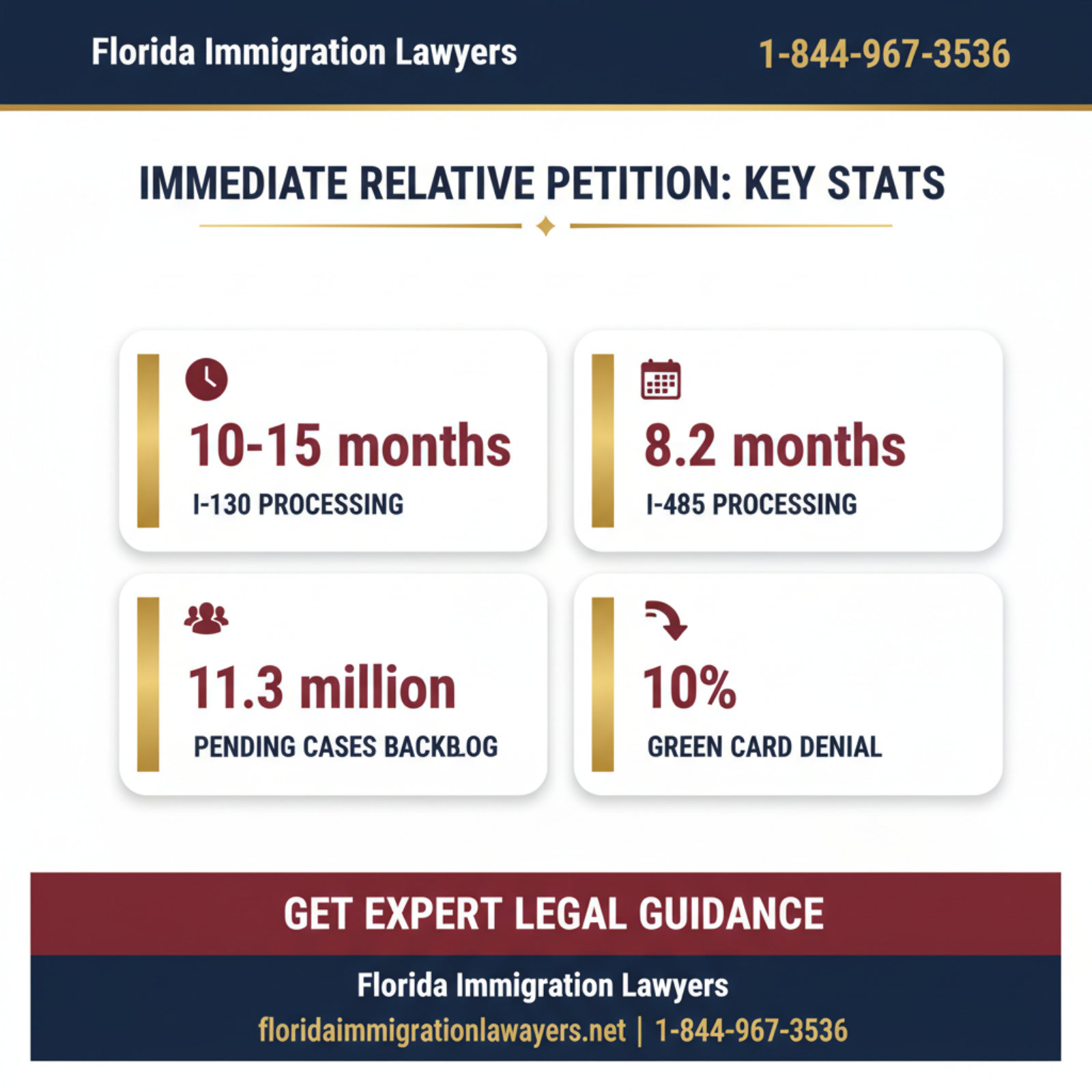
- I-130 Petition Processing (USCIS): This initial stage can take several months. As of early 2026, USCIS processing times for Form I-130 can range from 6 to 18 months or more, depending on the specific service center and the volume of applications. These times are estimates and subject to change. You can always check the most current processing times on the USCIS website by selecting Form I-130 and your specific service center.
- Adjustment of Status (I-485) Processing: If the beneficiary is adjusting status in the U.S., this stage can add another 8 to 24 months or longer, including biometrics appointments, potential interviews at a USCIS field office (like the Miami or Orlando offices), and background checks. The total time from filing I-130 to Green Card approval via AoS can be 1-3 years.
- Consular Processing: For beneficiaries abroad, after I-130 approval, the case moves to the National Visa Center (NVC). NVC processing typically takes 2-4 months to collect all documents and schedule an interview. The interview itself, at a U.S. embassy or consulate, usually occurs within a few months of NVC completion. The overall consular processing timeline, from I-130 filing to visa issuance, can be 1-2 years.
Factors influencing these timelines include the completeness of your application, responses to Requests for Evidence (RFEs), interview scheduling availability, and the specific USCIS service center or consulate handling your case. While an U.S. citizen petition for parents or spouses generally moves faster than other categories, patience and thorough preparation are essential.
Understanding Cost Factors and Fees for Immediate Relative Petitions
The cost of an immediate relative petition Florida involves several components, including government filing fees and potential legal or ancillary costs. It is crucial to budget appropriately for these expenses, as fees are subject to change and are generally non-refundable.
- Form I-130 Filing Fee: This is the initial fee paid to USCIS when you submit the Petition for Alien Relative.
- Form I-485 Filing Fee (if Adjusting Status): If the beneficiary is applying for Adjustment of Status within the U.S., this separate fee is required. This fee typically includes the biometrics service fee and the fee for employment authorization and advance parole applications if filed concurrently.
- Biometrics Services Fee: This fee covers the cost of fingerprinting and background checks. For Adjustment of Status applicants, it is often bundled with the I-485 fee.
- Medical Examination Fee: For Adjustment of Status applicants, a medical examination by a USCIS-approved civil surgeon is mandatory. The cost of this exam is paid directly to the civil surgeon and varies by provider.
- Affidavit of Support (Form I-864) related costs: While there is no separate filing fee for Form I-864, there may be costs associated with obtaining necessary financial documents.
- Consular Processing Fees: For beneficiaries undergoing Consular Processing, there are fees for the immigrant visa application and the Affidavit of Support processing by the National Visa Center.
- Attorney Fees: Retaining an experienced immigration attorney, such as Florida Immigration Lawyers, is an investment that can save you time, stress, and potential pitfalls. Attorney fees vary based on the complexity of the case.
Please note: Government filing fees are set by USCIS and the Department of State and are subject to change without notice. Always check the official USCIS website for the most current fee schedule before filing. Do not send cash. Payments must be made by check, money order, or credit card as specified by USCIS.
Do not navigate this process alone. Contact Florida Immigration Lawyers today. Our team is ready to provide the dedicated support and legal expertise you need for your immediate relative petition.
Common Mistakes to Avoid in Your Immediate Relative Petition
Filing an immediate relative petition can be a detailed process, and even minor errors can lead to significant delays or even denial. Here are some common mistakes to avoid:
-
Incomplete or Inaccurate Forms: Failing to answer every question or providing incorrect information on Form I-130 can result in a Request for Evidence (RFE) or outright denial. Consequences: Delayed processing, need to refile, potential loss of fees.
-
Insufficient Evidence of Relationship: Not providing enough compelling evidence to prove a bona fide relationship (especially for spouses) is a frequent issue. Consequences: Suspicion of fraud, RFE, interview scrutiny, denial.
-
Failure to Meet Financial Sponsorship Requirements: The petitioner must demonstrate the ability to financially support the beneficiary. Not meeting the poverty guidelines or providing incomplete Form I-864 can lead to problems. Consequences: Denial based on public charge concerns, need for a joint sponsor.
-
Missing Deadlines or Ignoring RFEs: Failing to respond to an RFE by the deadline, or ignoring notices from USCIS or NVC, will likely lead to denial. Consequences: Case closure, need to refile, loss of fees, potential accrual of unlawful presence.
-
Not Disclosing All Immigration History: Attempting to conceal previous immigration violations, arrests, or denials is a serious mistake. Consequences: Finding of misrepresentation or fraud, permanent bars to immigration, criminal charges.
-
Improper Filing Location or Fees: Sending your petition to the wrong USCIS Lockbox facility or submitting incorrect fees can cause the entire package to be rejected. Consequences: Significant delays, returned application, potential loss of priority date.
-
Not Keeping Copies of Everything Submitted: Always retain a complete copy of your entire petition package, including all forms and supporting documents. Consequences: Inability to respond to RFEs, difficulty tracking case status, lack of proof if original documents are lost.
-
Assuming "Immediate Relative" Means No Issues: While immediate relatives have advantages, they are still subject to all grounds of inadmissibility. Having a criminal record, certain health issues, or prior immigration fraud can still prevent approval. Consequences: Denial, need for complex waivers, potential deportation proceedings.
-
Failure to Update Address with USCIS: Moving without notifying USCIS of your new address can lead to missed notices and important documents. Consequences: Missed appointments, RFEs, or denials without your knowledge.
-
Not Seeking Legal Counsel for Complex Cases: Attempting to handle a case with previous denials, criminal history, or other complications without an attorney. Consequences: Increased risk of denial, missed legal strategies, prolonged separation from family.
When to Call a Lawyer for Your Immediate Relative Petition
While some immediate relative petitions may seem straightforward, the intricacies of immigration law can quickly become overwhelming. Knowing when to seek professional legal assistance can make a significant difference in the outcome of your case. Florida Immigration Lawyers are here to provide expert guidance, especially in the following scenarios:
- Complex Relationship Proof: If proving your relationship is not straightforward (e.g., stepchildren, adoption, or if you lack traditional documentation).
- Prior Immigration Violations: If either the petitioner or beneficiary has a history of overstaying visas, unlawful entry, previous deportations, or other immigration issues. Our firm has extensive experience in deportation defense and can assess potential inadmissibility issues.
- Criminal History: Any arrests, charges, or convictions for either party can complicate the petition and may require waivers of inadmissibility.
- Previous Denials: If a past immigration petition for your relative was denied, understanding the reasons for denial and strategizing a new approach is critical.
- Difficulty Meeting Financial Requirements: If the petitioner's income does not meet the Affidavit of Support guidelines, you may need assistance finding a joint sponsor or proving sufficient assets.
- Concerns about Fraud or Misrepresentation: If there are any allegations or concerns about marriage fraud or misrepresentation in prior applications.
- Beneficiary is Out of Status: If the immediate relative is in the U.S. but entered without inspection, or has overstayed their visa for an extended period, specific legal strategies may be required to pursue adjustment of status.
- Need for Waivers: If the beneficiary is found inadmissible for any reason, a waiver may be necessary, which is a complex application process.
- Asylum Seekers: If your family member has a pending asylum claim, this can add layers of complexity to the immediate relative petition.
- Any Uncertainty or Stress: If you feel overwhelmed, confused, or simply want the peace of mind that comes with professional representation.
Florida Immigration Lawyers has a proven track record of successfully guiding families through the immediate relative petition process across Florida, including Hollywood, Miami, Orlando, and Tampa. We understand the local USCIS procedures and can provide strategic advice tailored to your unique situation. Our dedicated attorneys are committed to protecting your family's future.
About Florida Immigration Lawyers
Florida Immigration Lawyers is a leading law firm dedicated to providing comprehensive and compassionate immigration legal services throughout Florida. With years of experience and a deep understanding of U.S. immigration law, our attorneys are committed to helping individuals and families achieve their immigration goals.
We offer a wide range of services, including family-based immigration, employment visas, deportation defense, asylum claims, naturalization, and more. Our firm is built on the principles of integrity, professionalism, and client-focused advocacy. We pride ourselves on offering personalized attention and strategic solutions to even the most complex immigration challenges.
Why Choose Florida Immigration Lawyers?
- Expertise: Our attorneys are highly knowledgeable in all facets of immigration law.
- Client-Centered Approach: We prioritize your needs and keep you informed every step of the way.
- Proven Results: We have a strong record of success in various immigration cases.
- Accessibility: We are available 24/7 to address your urgent concerns.
- Free Consultations: We offer free initial consultations to discuss your case.
- Serving All of Florida: From Hollywood to Jacksonville, we serve clients across the entire state.
Let Florida Immigration Lawyers be your trusted partner in navigating the U.S. immigration system. Your family's future is our priority.
Sources and References
- U.S. Citizenship and Immigration Services (USCIS)
- USCIS - Form I-130, Petition for Alien Relative
- USCIS - Check Case Processing Times
- USCIS - Our Fees
- U.S. Department of State - Immigrant Visa Process
- Executive Office for Immigration Review (EOIR)
- 8 U.S.C. Chapter 12 - Immigration and Nationality Act (INA)
- INA Section 201(b)(2)(A)(i) - Immediate Relatives
- INA Section 245(a) - Adjustment of Status of Nonimmigrant to That of Person Admitted for Permanent Residence
- 8 CFR Part 204 - Immigrant Petitions
This article provides general legal information and is not intended as legal advice. Every case is unique, and outcomes depend on specific facts and circumstances. Contact an attorney for advice about your particular situation.
Ready to take the next step towards reuniting your family in Florida? Do not face the complexities of immigration law alone. Call Florida Immigration Lawyers today at 1-844-967-3536 for a free consultation. Our experienced team is here to provide the expert guidance and support you deserve. Se Habla Español - Estamos aquí para ayudarle.
Florida Immigration Lawyers
Legal Team
Our experienced attorneys at Florida Immigration Lawyers have been serving clients across Florida for over 20 years. We specialize in immigration, personal injury, criminal defense, workers compensation, and family law.