TPS to Green Card Florida: Your Path to Permanent Residency
For individuals with Temporary Protected Status (TPS) in Florida, the dream of obtaining a green card and securing permanent residency is achievable through various established immigration pathways. While TPS itself offers temporary protection, it can serve as a crucial foundation for pursuing family-based petitions, employment sponsorship, or other special immigrant categories. This comprehensive guide details the eligibility requirements, step-by-step application process, essential documents, and critical considerations for TPS holders in Florida seeking to adjust their status. Learn how to navigate the complexities of lawful entry, USCIS procedures, and common pitfalls to avoid. Florida Immigration Lawyers provides expert legal guidance to help you successfully transition from TPS to a green card, offering free consultations to discuss your unique situation and strategic options for a stable future in Florida.
Temporary Protected Status (TPS) in Florida does not directly lead to a green card, but it can provide a crucial stepping stone. TPS holders may be eligible for lawful permanent residency through other avenues, such as family-based petitions, employment sponsorship, or asylum, often requiring a qualifying lawful entry or parole. Understanding these complex pathways is key to achieving permanent status.
- TPS holders must qualify for an underlying green card category.
- Lawful entry or parole is a critical factor for adjustment of status.
- Common pathways include family-based or employment-based petitions.
- Legal guidance from experienced attorneys is essential for a successful transition.
- The process involves multiple forms, fees, and potential interviews with USCIS.
TPS to Green Card Florida: Your Path to Permanent Residency
Are you living in Florida with Temporary Protected Status (TPS) and dreaming of a more permanent, stable future for yourself and your family? The journey from TPS to a green card can seem complex, but for many, it is a realistic goal. While TPS itself does not directly lead to lawful permanent residency, it can provide a vital layer of protection while you pursue other immigration pathways.
This comprehensive guide will help you understand the requirements, processes, and potential challenges involved in transitioning from TPS to a green card in Florida. We will explore the various routes available, critical eligibility factors, and how an experienced immigration law firm like Florida Immigration Lawyers can assist you every step of the way. Do not navigate this intricate process alone; we are here to provide clarity and support.
Call Florida Immigration Lawyers at 1-844-967-3536 for a free consultation. Our team is ready to discuss your specific situation and help you chart a course toward permanent residency in Florida.
Understanding TPS and the Green Card Connection in Florida
Temporary Protected Status (TPS) offers temporary lawful status to eligible nationals of certain countries designated by the U.S. government due to ongoing armed conflict, environmental disaster, or other extraordinary and temporary conditions. For thousands of individuals across Florida, including many in Gainesville and surrounding communities, TPS has provided a safe haven and the ability to work legally in the United States.
It is important to understand that TPS, as outlined in INA § 244, is inherently temporary. It does not automatically provide a path to a green card or U.S. citizenship. However, holding TPS does not prevent you from pursuing other immigration benefits for which you may qualify. Many TPS beneficiaries in Florida successfully transition to lawful permanent residence through various existing immigration channels.
For individuals in Florida, the ability to obtain a green card while holding TPS typically depends on two main factors: having an independent qualifying basis for permanent residency and meeting specific eligibility criteria for adjustment of status. This often involves demonstrating a lawful entry into the United States or a grant of humanitarian parole, which is a critical element for many TPS holders seeking to adjust their status.
Eligibility Requirements: Pathways from TPS to a Green Card
To transition from TPS to a green card, you must first qualify for an underlying immigrant visa category. TPS itself is not an immigrant visa. The most common pathways for TPS holders in Florida to obtain a green card include:
Family-Based Immigration Options
If you have a qualifying U.S. citizen or lawful permanent resident (LPR) family member, you may be able to pursue a family-sponsored green card. This could include a U.S. citizen spouse, parent, or adult child. For more information on these options, visit our family immigration page.
The relationship must be legitimate and meet all USCIS requirements. This pathway is one of the most common for TPS holders seeking permanent residency in Florida.
Employment-Based Immigration Options
If you have a job offer from a U.S. employer willing to sponsor you, you may be eligible for an employment-based green card. This typically requires the employer to go through a labor certification process with the Department of Labor (DOL) before filing an immigrant petition with USCIS. Learn more about these opportunities on our business immigration page.
Eligibility often depends on your skills, education, and the availability of U.S. workers for the position. Many professionals and skilled workers in Florida find success through this route.
Asylum or Refugee Status
If you have a well-founded fear of persecution in your home country, you may be eligible for asylum. If granted, asylum status provides a direct pathway to a green card one year after approval. This is a separate and distinct process from TPS. Our asylum practice area page offers detailed information.
It is crucial to understand that applying for asylum has its own strict deadlines and evidentiary requirements. Consulting with an attorney is vital if you believe you qualify.
Other Special Immigrant Categories
In some cases, individuals may qualify for other special immigrant categories, such as VAWA (Violence Against Women Act) for victims of abuse, or Special Immigrant Juvenile Status for certain children. These pathways have specific criteria and can be complex.
Determining your eligibility for any of these categories is the crucial first step. An immigration attorney can assess your unique circumstances and advise on the most suitable path.
Step-by-Step Guide to Adjusting Status from TPS in Florida
The process of adjusting status to a lawful permanent resident from TPS, particularly for those residing in Florida, involves several critical steps. This guide assumes you have an underlying basis for a green card, such as an approved family petition.
-
Determine Your Eligibility for an Underlying Green Card Category: Before anything else, you must establish that you qualify for a green card through a family member (e.g., U.S. citizen spouse, parent, or adult child) or an employer. This involves filing the appropriate petition, such as Form I-130, Petition for Alien Relative, or Form I-140, Immigrant Petition for Alien Worker.
This foundational step is often the longest part of the process, as visa bulletins and processing times can vary significantly. Once the petition is approved and a visa number is available (if applicable), you can proceed to the next stage.
-
Establish Lawful Entry or Parole: This is a critical requirement for adjusting status within the United States under 8 U.S.C. § 1255. Generally, to adjust status, you must have been inspected and admitted or paroled into the U.S. While TPS itself does not constitute an admission, certain TPS beneficiaries who traveled with Advance Parole (Form I-512L) and were paroled back into the U.S. may satisfy this requirement. Some individuals may also have had a prior lawful entry before receiving TPS.
The legal interpretation of "lawful admission" for TPS holders has evolved, and it is vital to discuss your entry history with an attorney. This step can be a significant hurdle for many TPS recipients in Florida.
-
File Form I-485, Application to Register Permanent Residence or Adjust Status: Once your underlying immigrant petition is approved and a visa is available (if applicable), and you meet the lawful entry/parole requirement, you can file Form I-485 with USCIS. This application is the core of your green card request.
Along with Form I-485, you will typically file supporting forms such as Form I-765 for employment authorization (EAD) and Form I-131 for advance parole, allowing you to work and travel while your green card application is pending.
-
Attend Biometrics Appointment: After filing your I-485, USCIS will send you a notice to attend a biometrics appointment at an Application Support Center (ASC). At this appointment, your fingerprints, photograph, and signature will be collected for background checks.
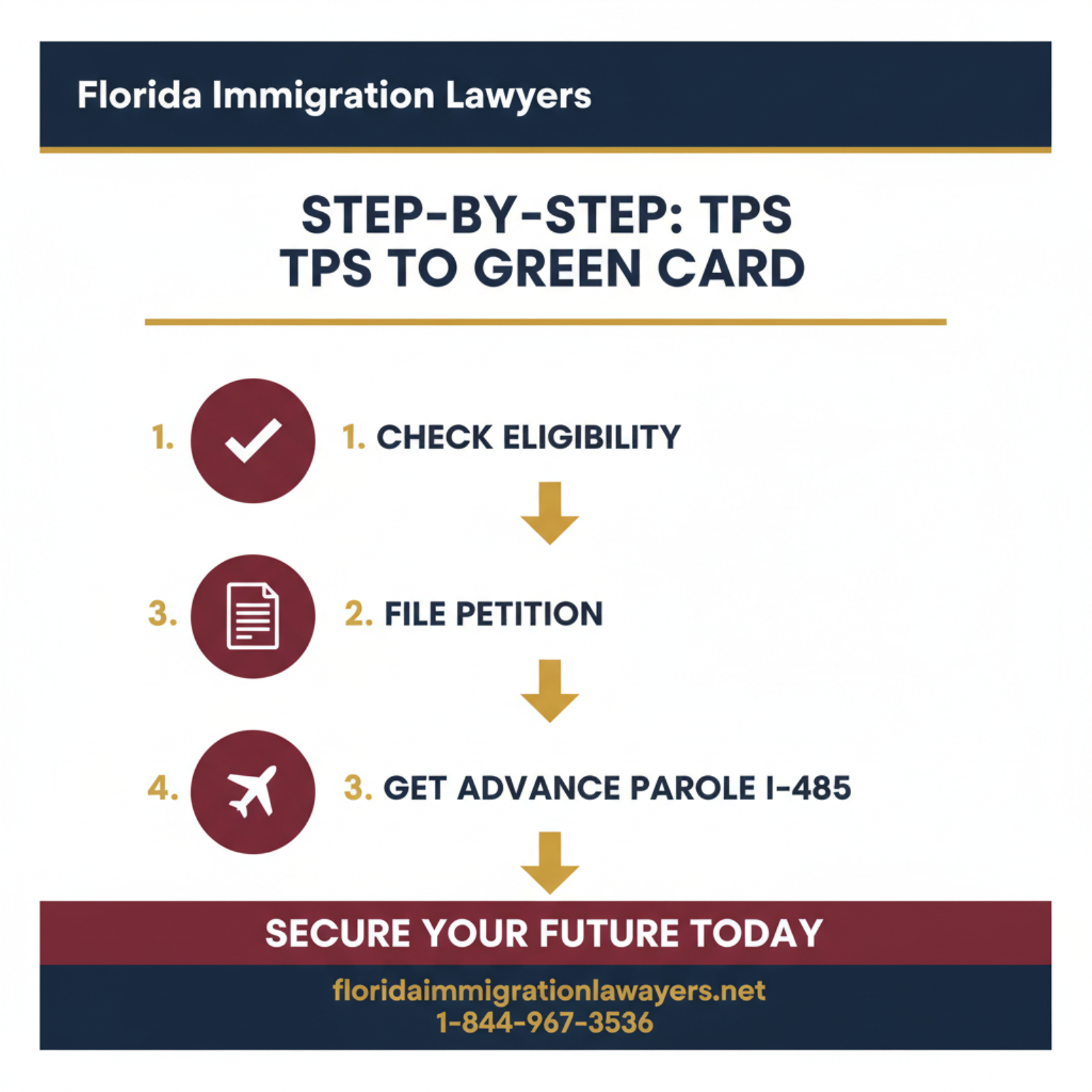
Step-by-Step Process Guide It is crucial to attend this appointment as scheduled, as failure to do so can delay or even lead to the denial of your application.
-
Attend Interview (if required): Many adjustment of status applicants are required to attend an interview with a USCIS officer. For Florida residents, this interview would typically take place at a local USCIS field office, such as those in Orlando, Jacksonville, or Miami, depending on your residency, including those from Gainesville.
During the interview, the officer will review your application, ask questions about your eligibility, and verify the information provided. Having an attorney present at your interview can be highly beneficial.
-
Receive Decision: After the interview, or if an interview is waived, USCIS will make a decision on your I-485 application. If approved, you will receive a welcome notice and your green card will be mailed to you. If denied, USCIS will provide a reason for the denial, and you may have options to appeal or refile.
The entire process can take many months or even years, depending on the specific category and USCIS processing times. Patience and careful preparation are key.
Essential Documents for Your Green Card Application
A complete and accurate application package is vital for a smooth process. When applying for adjustment of status from TPS in Florida, you will generally need to gather the following documents:
- Form I-485, Application to Register Permanent Residence or Adjust Status
- Form I-130, Petition for Alien Relative (if family-based) or Form I-140, Immigrant Petition for Alien Worker (if employment-based)
- Form I-864, Affidavit of Support (for family-based petitions)
- Form I-693, Report of Medical Examination and Vaccination Record (completed by a USCIS-approved civil surgeon)
- Form I-765, Application for Employment Authorization (optional, but recommended)
- Form I-131, Application for Travel Document (optional, but recommended for advance parole)
- Two passport-style photos
- Copy of your birth certificate
- Copy of your marriage certificate (if applicable)
- Copies of your passport biographical page and visa pages (if any)
- Copy of your Form I-94, Arrival/Departure Record (if available)
- Proof of lawful entry or parole (e.g., I-94, parole document, passport stamp)
- Copies of all TPS approval notices (Form I-797)
- Copies of all EADs issued under TPS
- Evidence of your relationship (for family-based petitions)
- Employer letter and labor certification (for employment-based petitions)
- Police clearances from any country where you lived for more than six months since age 16 (if required)
- Certified copies of any court records if you have a criminal history
Timeline and Processing Expectations for Florida Applicants
The timeline for transitioning from TPS to a green card in Florida can vary significantly. Several factors influence how long the process will take, including the specific green card category you are pursuing, current USCIS processing times, and the workload of the USCIS field office handling your case.
Generally, family-based petitions (I-130) can take several months to a few years, especially if there is a visa bulletin backlog. Employment-based petitions (I-140) also have varying timelines. Once the underlying petition is approved and you file Form I-485, the adjustment of status process itself can take anywhere from 10 months to over 2 years.
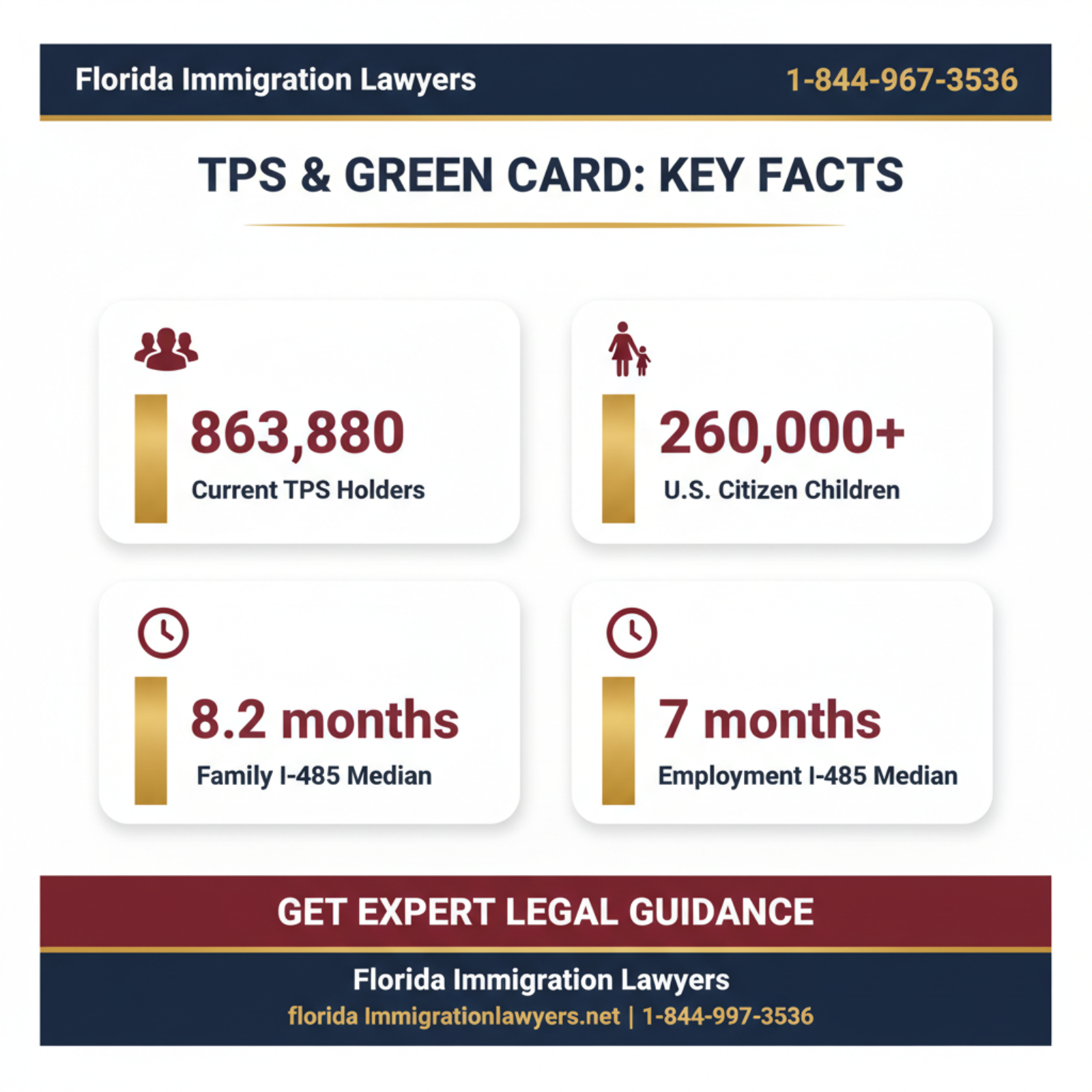
For Florida residents, your case will likely be processed by one of the USCIS field offices in the state, such as those in Orlando, Jacksonville, or Miami. You can check the current average processing times for specific forms and field offices on the official USCIS website. Remember, these are estimates and individual cases may take longer.
Cost Factors and Fee Breakdown
Pursuing a green card involves various fees that you should budget for. These fees are set by USCIS and are subject to change, as outlined in 8 CFR Part 103. It is crucial to always check the most current fee schedule on the USCIS website before filing.
Typical costs may include:
- USCIS Filing Fees: These include fees for Form I-130 (if applicable), Form I-485, biometrics, and potentially Forms I-765 and I-131. These fees can total over a thousand dollars per applicant.
- Medical Examination Fee: You must undergo a medical examination by a USCIS-approved civil surgeon. The cost of this exam varies by provider but typically ranges from a few hundred dollars.
- Attorney Fees: While not mandatory, retaining an experienced immigration attorney is highly recommended. Legal fees will vary based on the complexity of your case and the services provided. Investing in legal counsel can save you time, stress, and potential costly mistakes.
- Other Costs: You may incur expenses for obtaining birth certificates, marriage certificates, police clearances, translations of foreign documents, and postage.
Do not let the potential costs deter you from pursuing your dream of permanent residency. We can discuss payment options during your free consultation.
Do not navigate this process alone. Contact Florida Immigration Lawyers today. Our dedicated team is here to provide the expert legal guidance you need to successfully transition from TPS to a green card in Florida. We serve clients throughout the state, including Gainesville, Orlando, Tampa, and Miami.
Common Mistakes to Avoid When Applying for a Green Card from TPS
The immigration process is filled with potential pitfalls. Avoiding these common mistakes can significantly improve your chances of a successful outcome:
-
Assuming TPS is a Direct Green Card Path: This is a fundamental misunderstanding. TPS offers temporary protection but does not automatically lead to permanent residency. You must qualify for a separate green card category.
Consequence: Misdirection of efforts and potential disappointment if an underlying pathway is not pursued.
-
Filing Without Establishing Lawful Entry or Parole: Many TPS holders entered the U.S. without inspection. Without a lawful admission or parole (e.g., through Advance Parole), adjustment of status within the U.S. is generally not possible. This is a critical eligibility factor.
Consequence: Denial of the I-485 application, potentially leading to deportation proceedings if you do not have other lawful status.
-
Misrepresenting Facts or Omitting Information: Any false statements or omissions on immigration forms can lead to serious consequences, including accusations of fraud or misrepresentation.
Consequence: Denial of all applications, potential bars to future immigration benefits, and even criminal charges.
-
Failing to Disclose Criminal History: Even minor arrests or convictions must be disclosed. USCIS will conduct thorough background checks.
Consequence: Denial of the application, accusations of misrepresentation, and potential inadmissibility.
-
Missing Deadlines or Not Responding to RFEs: USCIS provides strict deadlines for submitting documents or responding to Requests for Evidence (RFEs). Missing these can jeopardize your application.
Consequence: Delay or denial of your application, requiring you to refile and pay new fees.
-
Not Updating Your Address with USCIS: If you move, you must inform USCIS of your new address within 10 days using Form AR-11. Failure to do so can result in missed notices or interview appointments.
Consequence: Missed communications from USCIS, leading to delays or denial of your application.
-
Traveling Internationally Without Advance Parole: If you leave the U.S. while your adjustment of status application is pending without an approved Advance Parole document (Form I-131), your application may be considered abandoned.
Consequence: Automatic denial of your I-485 and potential inadmissibility upon attempting to re-enter the U.S.
-
Ignoring the Public Charge Rule: For most family-based green card applications, you must demonstrate that you are not likely to become a public charge. This involves submitting an Affidavit of Support.
Consequence: Denial of your application if you cannot demonstrate sufficient financial means or support.
-
Filing Incomplete Applications: Submitting an application without all required forms, supporting documents, or correct fees will lead to delays or rejection.
Consequence: USCIS may reject your application, return it, or issue an RFE, significantly prolonging the process.
-
Not Seeking Legal Counsel: Navigating the complex immigration laws and procedures without professional guidance is a common and often costly mistake.
Consequence: Increased risk of errors, delays, denials, and missed opportunities for alternative pathways.
When to Call a Lawyer for Your TPS to Green Card Journey
While this guide provides general information, every immigration case is unique. There are specific scenarios where the expertise of a qualified immigration attorney, like those at Florida Immigration Lawyers, becomes invaluable:
- Complex Eligibility Issues: If your lawful entry is unclear, you have a criminal history, or you have previous immigration violations, an attorney can assess your options and prepare waivers if necessary.
- Uncertainty About the Best Pathway: An attorney can help you identify the most suitable green card category based on your unique circumstances and connections.
- Receiving a Request for Evidence (RFE) or Notice of Intent to Deny (NOID): These notices from USCIS indicate a problem with your application. A lawyer can help you formulate a strong and timely response.
- Preparing for Interviews: Having legal representation at your USCIS interview can provide peace of mind and ensure your rights are protected.
- Family-Based Petitions with Complications: If your family relationship is complex, or if there are issues with the petitioner's eligibility or financial support, an attorney can guide you.
- Deportation Concerns: If you have received a Notice to Appear (NTA) or are in deportation proceedings, an attorney is essential to protect your rights.
Florida Immigration Lawyers has extensive experience assisting individuals throughout Florida, including Gainesville, Orlando, and Miami, with their TPS to green card transitions. Our attorneys are dedicated to providing personalized and effective legal strategies. We understand the nuances of immigration law and are committed to helping you achieve your goals.
About Florida Immigration Lawyers
Florida Immigration Lawyers is a leading immigration law firm dedicated to serving individuals and families across the entire state of Florida. Our mission is to provide compassionate, high-quality legal representation to those navigating the complexities of U.S. immigration law. We understand the profound impact immigration matters have on people's lives and are committed to achieving the best possible outcomes for our clients.
Our experienced attorneys offer a wide range of immigration services, including family-based petitions, employment-based visas, asylum claims, citizenship applications, and deportation defense. We pride ourselves on our client-focused approach, ensuring that each client receives personalized attention and strategic legal advice tailored to their unique situation. We are available 24/7 and offer free consultations to help you understand your options without financial commitment.
Choose Florida Immigration Lawyers because:
- We possess in-depth knowledge of U.S. immigration laws and policies.
- We offer personalized legal strategies for every client.
- We are committed to clear communication and client education.
- We have a proven track record of success in complex immigration cases.
- We serve clients statewide, from Gainesville to Key West.
Contact us today at 1-844-967-3536 or visit our website at https://www.floridaimmigrationlawyers.net to schedule your free consultation. Let us be your trusted partner on your immigration journey.
Sources and References
- U.S. Citizenship and Immigration Services (USCIS)
- Immigration and Nationality Act (INA) § 244 - Temporary Protected Status
- 8 U.S.C. § 1255 - Adjustment of Status of Nonimmigrant to That of Person Admitted for Permanent Residence
- 8 CFR Part 244 - Temporary Protected Status
- 8 CFR Part 245 - Adjustment of Status to That of Person Admitted for Permanent Residence
- 8 CFR Part 103 - Adjudication of Applications
- USCIS Check Case Processing Times
This article provides general legal information and is not intended as legal advice. Every case is unique, and outcomes depend on specific facts and circumstances. Immigration laws are complex and subject to change. Contact an attorney for advice about your particular situation.
Your journey from Temporary Protected Status to a green card in Florida is a significant step towards securing your future. While the path requires careful planning and adherence to strict legal requirements, it is achievable with the right guidance. Do not let the complexity of immigration law deter you from pursuing lawful permanent residency.
Florida Immigration Lawyers is here to empower you with expert legal representation. Schedule your free consultation today by calling 1-844-967-3536. Se Habla Español - Estamos aquí para ayudarle.
Florida Immigration Lawyers
Legal Team
Our experienced attorneys at Florida Immigration Lawyers have been serving clients across Florida for over 20 years. We specialize in immigration, personal injury, criminal defense, workers compensation, and family law.