Immigration Medical Exam in Florida: Your 2026 Guide
The immigration medical exam, documented on Form I-693, is a mandatory step for most individuals seeking adjustment of status to become lawful permanent residents in the U.S. This comprehensive guide details the process for applicants in Florida, including how to find a USCIS-designated civil surgeon in Orlando or other Central Florida areas, what to expect during the examination, and a checklist of required documents and vaccinations. We also cover typical timelines and cost factors as of 2026, and highlight common mistakes to avoid that could delay your application. Understanding these critical aspects ensures you meet public health and admissibility standards, preventing potential issues with your green card application. Florida Immigration Lawyers offers expert assistance to navigate these requirements smoothly.
The immigration medical exam in Florida is a mandatory part of the U.S. immigration process for most applicants seeking adjustment of status, ensuring public health and admissibility. Conducted by a USCIS-designated civil surgeon, it involves a physical examination, mental health screening, review of your medical history, and required vaccinations. The results are documented on Form I-693, Report of Medical Examination and Vaccination Record, which must be submitted in a sealed envelope to USCIS. Understanding this process, including finding an authorized doctor in Orlando or Central Florida, and preparing necessary documents, is crucial for a smooth application.
- All adjustment of status applicants generally need Form I-693.
- Only a USCIS-authorized civil surgeon can perform the exam.
- The exam includes a physical, mental health check, and vaccination review.
- Form I-693 must be submitted in a sealed envelope and is valid for two years.
- Preparation and attention to detail are key to avoiding delays.
Navigating the complex U.S. immigration system can feel overwhelming, with numerous forms, interviews, and requirements. For many individuals seeking to adjust their status to a lawful permanent resident, the immigration medical exam stands as a critical and mandatory step. This examination, documented on Form I-693, ensures that applicants meet specific health-related admissibility standards set by the U.S. government.
Whether you reside in Orlando, Miami, Tampa, or anywhere across Florida, understanding the intricacies of this medical evaluation is essential. It's not just a routine check-up; it's a specialized assessment designed to protect public health and identify certain medical conditions that could deem an applicant inadmissible. This comprehensive guide from Florida Immigration Lawyers will walk you through everything you need to know about the immigration medical exam in Florida, from locating a qualified civil surgeon to understanding the costs and common pitfalls. We aim to equip you with the knowledge to approach this stage of your immigration journey with confidence.
Do not navigate this crucial process alone. For personalized guidance and to ensure your medical exam results are correctly handled, call Florida Immigration Lawyers at 1-844-YO-PELEO for a free case review. Our experienced team is ready to assist you through every step of your immigration application.
What is the Immigration Medical Exam (Form I-693) in Florida?
The immigration medical exam, officially documented on Form I-693, Report of Medical Examination and Vaccination Record, is a required health screening for most individuals applying for adjustment of status to become a lawful permanent resident in the United States. Its primary purpose is to identify any health-related conditions that could make an applicant inadmissible under U.S. immigration law, specifically under Section 212(a) of the Immigration and Nationality Act (INA).
This exam is a crucial component of your application, ensuring that you do not pose a public health risk to the United States. It evaluates various aspects of your health, including communicable diseases of public health significance, certain physical or mental disorders that may pose a threat, and drug abuse or addiction. The civil surgeon performing the exam will also verify that you have received all required vaccinations. Failure to complete this exam correctly or to meet the health standards can lead to significant delays or even denial of your green card application.
For applicants in Florida, whether you're filing for a family-based green card or an employment-based one, the I-693 is a mandatory submission. USCIS field offices in Florida, such as those in Orlando, Miami, and Tampa, will expect a valid and properly completed Form I-693 as part of your adjustment of status package. Understanding the strict requirements and ensuring accuracy is vital. For comprehensive support with your adjustment of status application, including the I-693, visit our immigration practice areas page.
How Do I Find a USCIS Civil Surgeon in Orlando, Florida?
To ensure the validity of your immigration medical exam, it must be performed by a physician authorized by U.S. Citizenship and Immigration Services (USCIS), known as a civil surgeon. These are licensed medical doctors who have been specifically designated by USCIS to conduct these specialized examinations. You cannot simply go to your regular family doctor; the exam must be completed by an approved civil surgeon.
Finding a civil surgeon in Orlando or other Central Florida areas is a straightforward process using the official USCIS website. The site provides a dedicated Find a Civil Surgeon tool where you can search by zip code or city. It is imperative to use this official resource to locate an authorized physician to avoid any issues with your application. Always verify the surgeon's current authorization before scheduling your appointment, as their status can change.
When selecting a civil surgeon in Florida, consider factors such as their location, availability, and the languages they speak, especially if English is not your primary language. Many civil surgeons in Florida's diverse communities, including Orlando, Miami, and Tampa, offer services in multiple languages to better assist applicants. Confirm the cost of the exam and what it includes before your visit. Remember, per 8 CFR 232.1, only a designated civil surgeon can properly complete and seal your Form I-693, making this step non-negotiable for your immigration journey.
What to Expect During Your Immigration Medical Exam: A Step-by-Step Guide
The immigration medical exam is a comprehensive evaluation designed to assess your overall health in relation to U.S. immigration law. While the exact flow may vary slightly between civil surgeons, the core components remain consistent. Being prepared for each stage will help alleviate any anxiety and ensure a smooth process.
Here is a typical step-by-step guide on what to expect during your exam:
-
Scheduling Your Appointment: Contact a USCIS-designated civil surgeon in your area of Florida, such as Orlando or Miami. When scheduling, inform them it's for an immigration medical exam (Form I-693). Inquire about what documents to bring, fees, and if they offer required vaccinations. Some clinics may require multiple visits.
-
Initial Consultation and Medical History: Upon arrival, you will typically fill out a medical history questionnaire. The civil surgeon or their staff will review your past and present medical conditions, surgeries, hospitalizations, and any history of mental health issues, drug abuse, or harmful behavior. Be honest and thorough in your responses, as any discrepancies can cause delays.
-
Physical Examination: The civil surgeon will conduct a general physical exam, checking your eyes, ears, nose, throat, heart, lungs, and extremities. They will also measure your height, weight, blood pressure, and pulse. This part of the exam is to detect any communicable diseases or physical abnormalities relevant to immigration admissibility.
-
Vaccination Review and Administration: This is a critical component. The civil surgeon will review your immunization records to ensure you are up-to-date on all required vaccinations for immigrants. If you lack proof of certain vaccinations or need new ones, they may administer them on-site or refer you to a local health department. Common required vaccinations include MMR, polio, tetanus, diphtheria, pertussis, hepatitis B, and varicella.
Step-by-Step Process — Immigration Medical Exam in Florida: Your 2026 Guide
-
Required Lab Tests and Screenings: All applicants aged 15 and older must be tested for syphilis and gonorrhea. A tuberculosis (TB) screening, typically a blood test (IGRA), is also mandatory for all ages. If the TB test is positive, a chest X-ray will be required to rule out active TB disease. Additional tests may be ordered if the civil surgeon suspects other conditions relevant to inadmissibility.
-
Mental Health Assessment: A brief screening for mental health conditions that could pose a threat to yourself or others is part of the exam. This involves questions about your mood, behavior, and any history of psychiatric treatment. It's designed to identify conditions that might lead to harmful behavior.
-
Completion and Sealing of Form I-693: Once all components of the exam are complete and the results are processed, the civil surgeon will fill out and sign Form I-693. This form, along with any supporting documents like lab results, will be placed in a sealed envelope. It is crucial that you DO NOT open this envelope. USCIS requires the form to be submitted in its original sealed condition. You will receive a copy for your records.
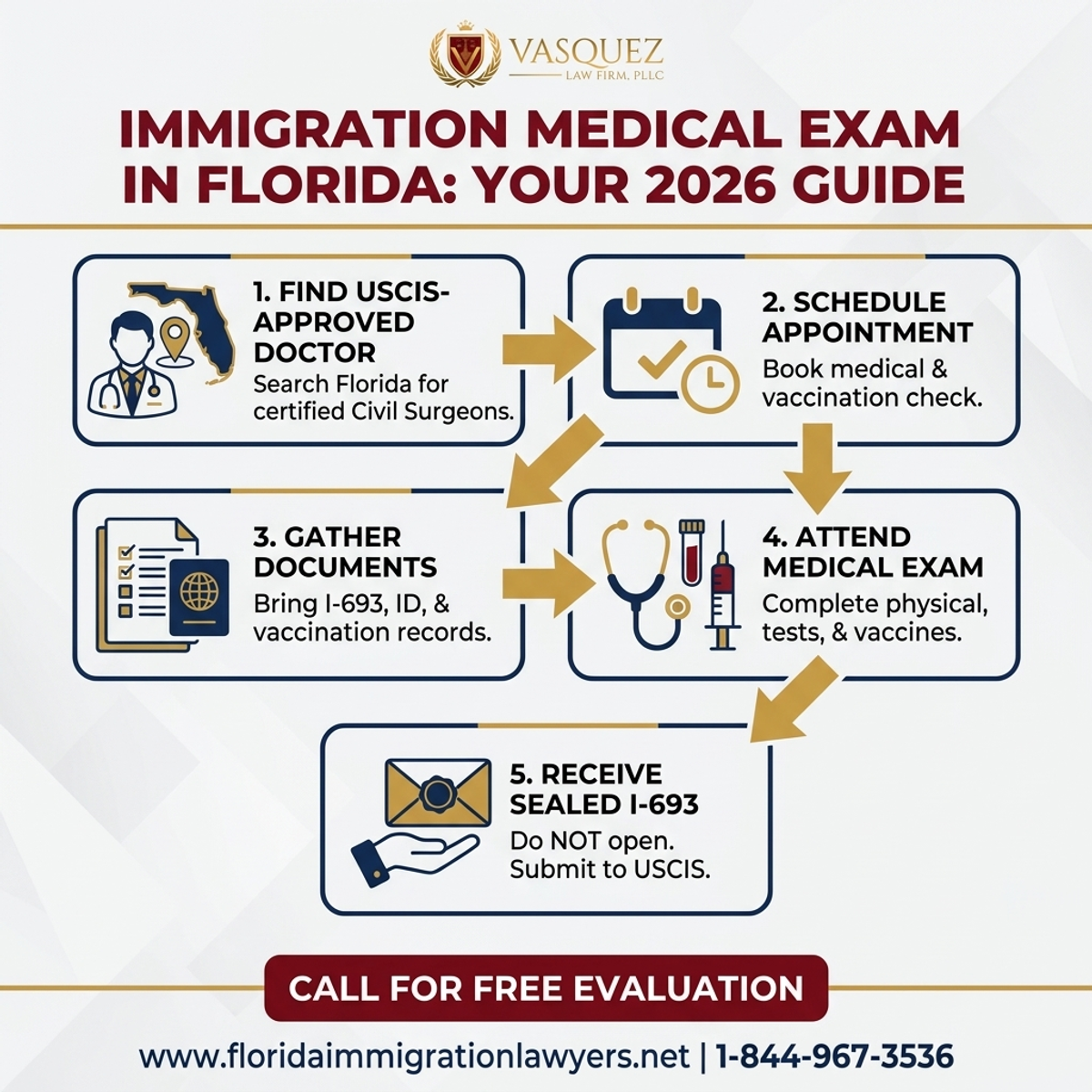
For assistance with preparing for your immigration medical exam or understanding the overall adjustment of status process, feel free to contact Florida Immigration Lawyers. We are here to help you navigate every requirement.
Required Documents and Vaccinations for Form I-693
Proper preparation is key to a smooth immigration medical exam. Collecting all necessary documents and ensuring your vaccination records are up-to-date before your appointment will save you time and potentially additional visits to the civil surgeon. The medical exam is designed to be thorough, and having your information readily available streamlines the process for both you and the examining physician.
Here is a comprehensive checklist of documents to bring to your appointment:
- Form I-693, Part 1: Fill out your personal information on Part 1 of Form I-693 before your visit, but do not sign it. The civil surgeon will instruct you when to sign.
- Valid Photo Identification: Bring a government-issued photo ID such as your passport, driver's license, or state ID. Ensure it is current and matches the name on your immigration application.
- Vaccination Records: Gather all available immunization records, including childhood vaccinations. These are critical for the civil surgeon to determine if you meet the vaccination requirements.
- Medical Records: If you have any significant past or present medical conditions, chronic illnesses, or mental health diagnoses, bring relevant medical records, treatment plans, and medication lists. This includes records for any past positive TB tests or waivers previously filed.
- Insurance Card: While most immigration medical exams are not covered by health insurance, some labs or follow-up appointments might be. Bring your card just in case.
- Payment for the Exam: Confirm the accepted payment methods and bring sufficient funds. Civil surgeons typically require payment upfront.
- USCIS Interview Notice (if applicable): If you received a Request for Evidence (RFE) for your I-693 or are bringing it to an interview, having the notice can be helpful.
Regarding vaccinations, USCIS requires proof of immunity to several vaccine-preventable diseases. As of 2026, these typically include Measles, Mumps, Rubella (MMR), Polio, Tetanus and Diphtheria Toxoids, Pertussis, Haemophilus influenzae type b, Hepatitis A, Hepatitis B, Rotavirus, Meningococcal disease, and Varicella (chickenpox), as well as Influenza for certain age groups. The civil surgeon will determine which vaccinations are medically appropriate for your age and medical history. If you lack certain immunizations due to medical contraindications or religious/moral convictions, you may be eligible for a waiver, which requires additional documentation and review by USCIS.
Immigration Medical Exam Timeline and Cost Factors in 2026
Understanding the typical timeline and potential costs associated with the immigration medical exam is crucial for planning your adjustment of status application. While there's no single fixed price or duration, being aware of the influencing factors will help you budget and manage expectations for your I-693 submission in Florida.
Here is a general timeline for the immigration medical exam process as of 2026:
| Stage | Typical Timeframe (As of 2026) | Notes |
|---|---|---|
| Scheduling Exam | 1-2 weeks | Varies by civil surgeon availability in Orlando, Miami, etc. |
| Exam Completion | 1-3 visits | Depends on required tests (e.g., TB results), vaccinations, and follow-ups. |
| I-693 Validity | 2 years | From the date the civil surgeon signs the form. Must be valid when submitted to USCIS. |
| Submission | Varies | Can be submitted with Form I-485 or later if requested by USCIS via RFE. |
The cost of the immigration medical exam varies significantly based on the civil surgeon's office, your location in Florida (e.g., rural versus urban Central Florida), and the specific services you require. There is no standard fee set by USCIS, and applicants are responsible for all costs. Here are the typical cost factors:
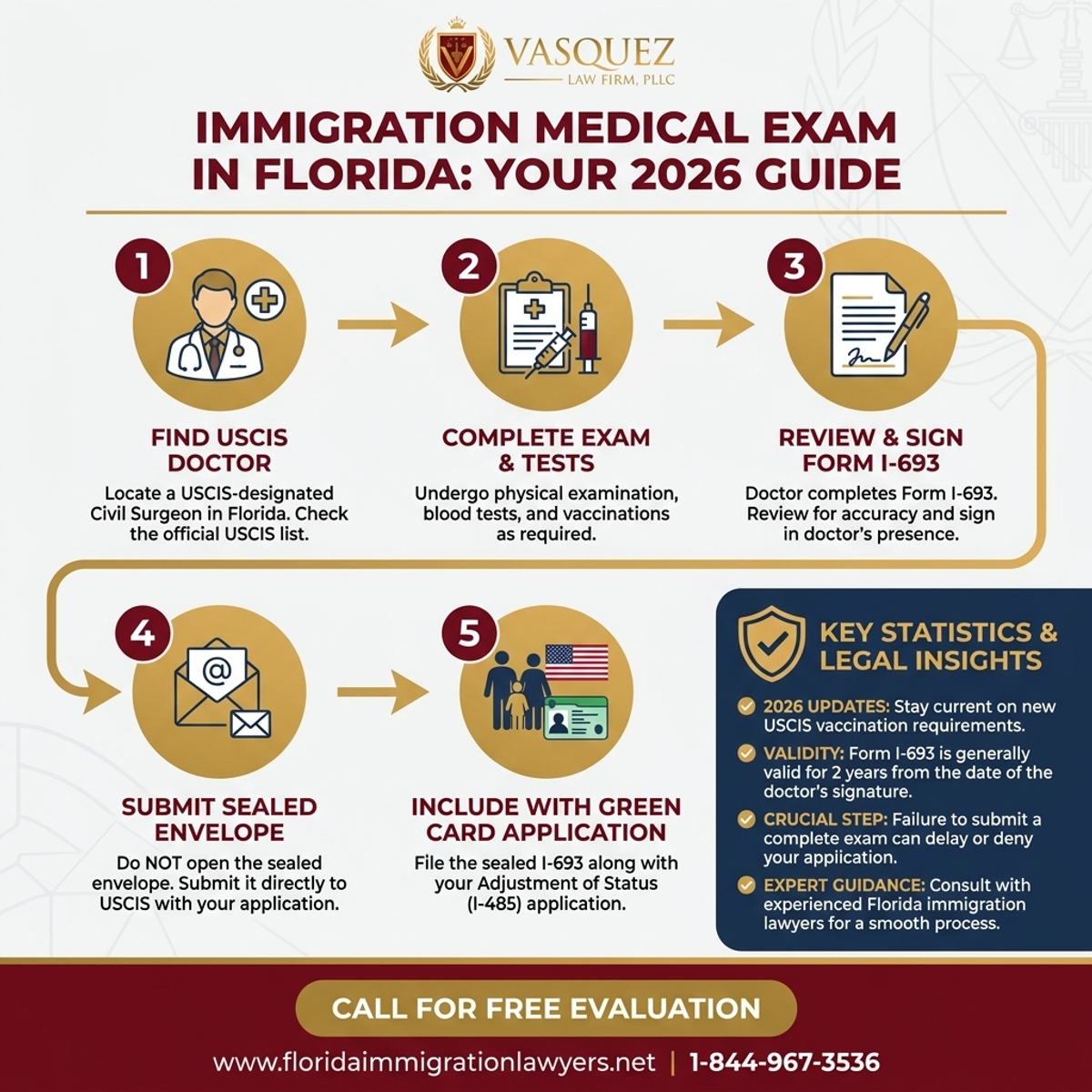
Key Statistics — Immigration Medical Exam in Florida: Your 2026 Guide
| Item | Typical Fee (Estimate) | Notes |
|---|---|---|
| Civil Surgeon Exam Fee | Varies widely | Can range from $200-$700+. Often includes physical exam, medical history review. |
| Required Vaccinations | Additional cost | If you need new immunizations, these are separate from the exam fee. |
| Lab Tests (Syphilis, Gonorrhea, TB) | Additional cost | These tests are mandatory for most applicants and are billed separately. |
| Chest X-ray (if needed for TB) | Additional cost | If your initial TB screening is positive, a chest X-ray will be required. |
| Attorney Fees | Varies | For legal guidance, waiver preparation, or complex case resolution. |
It is important to inquire about the total cost upfront when scheduling your appointment with a civil surgeon. Some clinics offer package deals that include all required tests and vaccinations, while others charge for each service separately. Being prepared for these expenses is part of the overall immigration planning process. For any questions regarding the fees or the process, our experienced attorneys can provide clarity.
Do not navigate this process alone. The immigration medical exam is a critical step, and errors can lead to significant delays or even adverse outcomes. Contact Florida Immigration Lawyers today for a free case review to ensure your I-693 is handled correctly and efficiently. We are here to support you.
Common Mistakes to Avoid with Your Immigration Medical Exam
The immigration medical exam is a detail-oriented process where seemingly minor errors can lead to major setbacks for your green card application. Being aware of these common mistakes can help you avoid unnecessary delays, requests for evidence (RFEs), or even denials.
-
Not Using a USCIS-Authorized Civil Surgeon: This is perhaps the most critical mistake. Your exam will be rejected if performed by a doctor not designated by USCIS. Always use the official USCIS Civil Surgeon Locator tool.
-
Opening the Sealed Envelope: The Form I-693, once completed and signed by the civil surgeon, must be returned to you in a sealed envelope. Opening this envelope invalidates the results, requiring you to get a new exam and incur additional costs and delays.
-
Missing Vaccinations or Documentation: Failing to provide proof of required vaccinations or neglecting to get updated shots can delay the completion of your I-693. Bring all immunization records, even childhood ones, to your appointment.
-
Failing to Disclose Medical History: Withholding information about past or present medical conditions, mental health issues, or substance abuse can lead to serious problems, including allegations of misrepresentation, which can have severe immigration consequences.
-
Ignoring Deadlines: The I-693 has a validity period (two years from the civil surgeon's signature date). Submitting an expired form will result in an RFE or denial. Plan your exam strategically close to your I-485 submission or interview date.
-
Submitting an Outdated Form I-693: USCIS regularly updates its forms. Ensure your civil surgeon uses the most current version of Form I-693 available on the USCIS website to avoid rejection.
-
Not Understanding Medical Waivers: If you have a medical condition that makes you inadmissible, such as certain communicable diseases or mental health disorders, you might be eligible for a waiver. Not exploring this option or submitting it incorrectly can jeopardize your application.
-
Delaying the Exam: Waiting until the last minute to schedule your exam can cause significant stress and potential delays, especially if lab results or follow-up appointments are needed. Start early.
-
Not Preparing for the Physical Exam: While not a 'mistake,' being unprepared for the physical aspects (e.g., wearing uncomfortable clothing, not having a list of current medications) can make the process less efficient.
-
Assuming All Doctors Are Authorized: Many immigrants mistakenly believe any licensed doctor can perform the exam. Only a USCIS-designated civil surgeon has the authority to complete Form I-693 for immigration purposes.
When to Call a Lawyer for Your Immigration Medical Exam
While the immigration medical exam itself is a medical procedure, certain situations can arise where legal guidance becomes invaluable. Florida Immigration Lawyers are here to assist you, ensuring that the results of your I-693 do not negatively impact your immigration journey, especially if complications or questions arise.
You should consider contacting an experienced immigration attorney if:
- You have a complex medical history: If you have a serious or chronic medical condition, a history of mental health treatment, or have previously been diagnosed with a communicable disease, an attorney can help you understand potential inadmissibility issues and prepare any necessary waivers, such as Form I-601, Application for Waiver of Grounds of Inadmissibility.
- Your medical exam results are concerning: If the civil surgeon identifies a condition that might make you inadmissible, such as active tuberculosis or a serious mental health disorder, a lawyer can advise on the best course of action, including treatment plans and waiver applications.
- You need a vaccination waiver: If you cannot receive certain vaccinations due to medical reasons or strong religious/moral convictions, an attorney can help you prepare a robust waiver application, ensuring all legal requirements are met.
- You received a Request for Evidence (RFE) related to your I-693: An RFE indicates USCIS needs more information or clarification regarding your medical exam. An attorney can help you understand the RFE and prepare a timely and comprehensive response.
- You have a history of drug or alcohol abuse: Such history can raise inadmissibility concerns. An attorney can help you address these issues proactively and mitigate potential negative impacts on your application.
- You are unsure about any part of the process: From finding a civil surgeon in Orlando to understanding the validity of your I-693, an attorney provides clarity and peace of mind, ensuring every step is correctly executed.
Our team at Florida Immigration Lawyers has extensive experience with all aspects of immigration law, including handling medical inadmissibility issues and waivers. We can review your case, prepare necessary documents, and represent your interests before USCIS. Whether you are seeking family-based immigration or facing unique challenges, we are dedicated to protecting your rights and helping you achieve your immigration goals.
About Florida Immigration Lawyers
Florida Immigration Lawyers is a leading law firm dedicated to providing exceptional legal representation to individuals and families throughout Florida. With a deep understanding of the complexities of U.S. immigration law, our experienced attorneys are committed to guiding clients through every step of their immigration journey. We offer a wide range of services, including assistance with green card applications, family petitions, naturalization, asylum claims, and deportation defense. Our firm is proud to serve the diverse communities of Orlando and Central Florida, as well as clients across the entire state.
We understand that immigration matters are often life-changing, which is why we approach each case with compassion, diligence, and a personalized strategy. Our team is available 24/7 to address your concerns and provide clear, actionable advice. We believe everyone deserves high-quality legal representation, and we offer free case reviews to help you understand your options without financial commitment. Our bilingual staff ensures that language is never a barrier to receiving the legal support you need. When you choose Florida Immigration Lawyers, you choose a partner who will fight tirelessly for your future. Schedule a free consultation today and let us help you navigate the path to your American dream.
Sources and References
- U.S. Citizenship and Immigration Services (USCIS)
- USCIS Find a Civil Surgeon Tool
- U.S. Department of State
- 8 U.S.C. Chapter 12 - Immigration and Nationality Act (INA Section 212(a))
- 8 Code of Federal Regulations (CFR) 232.1 - Medical examination
- USCIS Policy Manual - Volume 8, Part B, Chapter 4 - Medical Examination and Vaccination Requirements
Related services: citizenship and naturalization, asylum protection.
This article provides general legal information and is not intended as legal advice. Every case is unique, and outcomes depend on specific facts and circumstances. Contact an attorney for advice about your particular situation.
The immigration medical exam is a vital step in your journey toward permanent residency. Don't let uncertainty or potential complications derail your application. Florida Immigration Lawyers are here to provide the expert guidance and support you need. Call us today at 1-844-YO-PELEO for your free case review. Se Habla Español - Estamos aquí para ayudarle.
Do Not Navigate This Process Alone
Our experienced immigration attorneys are ready to fight for you. Get a free, confidential case review today.
Se Habla Español
Or leave your details and we’ll call you:
Free Evaluation in 24 Hours
Or talk to us right now
AI voice assistant — available 24/7
FreeFrequently Asked Questions

William J. Vásquez
Founding Attorney · Vasquez Law Firm
U.S. Air Force veteran and immigration attorney with years of hands-on U.S. immigration experience. J.D., NCCU School of Law. AILA member. Admitted to the 4th, 5th, and 11th Circuit Courts.
Available 24/7 - Free Evaluations
Reviewed for legal accuracy by William J. Vásquez
Licensed in North Carolina; U.S. immigration is federal practice.
Related Legal Services
Our Florida immigration attorneys can help you with family immigration services, immigration lawyer cost in Florida and experienced immigration attorneys. Call today at 1-844-YO-PELEO for a free case review.
Related Links
Related Topics
Free Legal Case Review
Discuss your case with our experienced attorneys. We're available 24/7.
Se Habla Español - Estamos aquí para ayudarle.
Related Articles
DUI Immigration Consequences in Florida 2026
A DUI conviction in Florida can have severe immigration consequences, potentially leading to inadmissibility, deportation, or denial of immigration benefits. For non-citizens, a DUI is not just a traffic offense but a serious criminal matter that federal immigration law scrutinizes closely. Factors like multiple offenses, injury, or property damage can escalate a simple DUI to a Crime Involving Moral Turpitude (CIMT) or even an aggravated felony, triggering mandatory detention and removal proceedings. Understanding the specific nature of your Florida conviction and its interpretation under the Immigration and Nationality Act (INA) is crucial. This article outlines how DUIs impact immigration status, the grounds for inadmissibility and deportation, a step-by-step guide to navigating the process, essential documentation, and expected timelines for 2026. We also highlight common mistakes to avoid and when to seek legal counsel from an experienced immigration attorney. Florida Immigration Lawyers offers comprehensive support for individuals facing these challenging situations, providing expert guidance through complex legal landscapes.
Dual Citizenship Lawyer in Florida: What You Need to Know
For Florida residents, the concept of dual citizenship, or holding two passports, offers a compelling blend of opportunities and challenges. While the U.S. generally permits dual nationality, the path to achieving this status requires a meticulous understanding of both U.S. immigration laws and the citizenship policies of your country of origin. This guide explores the definition of dual citizenship, the detailed step-by-step process for U.S. naturalization, and the significant benefits and potential pitfalls involved. We cover essential documentation, typical timelines, and cost considerations for 2026, providing crucial insights for anyone in Orlando, Miami, or across Florida considering this important legal step. Learn about common mistakes to avoid and understand when to seek professional legal counsel to navigate this complex process successfully. Florida Immigration Lawyers is here to provide expert, bilingual support for your dual citizenship journey.
Immigration Lawyer Orlando Free Consultation in Florida
For individuals and families in Orlando, Florida, navigating the complexities of U.S. immigration law requires expert guidance. An immigration lawyer in Orlando offers crucial support for everything from visa applications and green card processes to naturalization and deportation defense. This comprehensive guide details what a free consultation covers, providing a step-by-step overview of immigration pathways, essential document checklists, and expected timelines in 2026. We also highlight common mistakes to avoid, discuss the critical role of legal counsel in deportation and asylum cases, and explain why choosing a local Orlando immigration attorney is beneficial. Florida Immigration Lawyers is dedicated to serving the diverse community of Orlando with compassionate, effective legal solutions, ensuring you receive personalized advice and robust representation for a successful immigration journey.
EAD Advance Parole Combo Card in Florida 2026
For individuals with a pending Form I-485, Application to Register Permanent Residence or Adjust Status, the EAD Advance Parole Combo Card is an essential document. This single card combines the authorization to work legally in the U.S. (Employment Authorization Document - EAD) with permission to travel internationally and re-enter without abandoning your green card application (Advance Parole). This guide from Florida Immigration Lawyers provides a comprehensive overview for applicants in Florida in 2026, covering eligibility, the step-by-step application process, required documents, expected processing times, and associated costs. We also highlight common mistakes to avoid and when to seek legal counsel to ensure a smooth and successful immigration journey. Understanding this vital card is key to maintaining stability while awaiting your permanent residency approval.