Visa Bulletin October 2025: Florida Immigration Updates
The Visa Bulletin October 2025 significantly impacts green card applications for family-sponsored and employment-based categories across Florida. Understanding your priority date, the difference between Dates of Filing and Final Action Dates, and specific visa categories is crucial for immigrants in Pembroke Pines, Miami, and other Florida cities. This guide provides a step-by-step overview of the green card process, essential document checklists, and expected timelines. Learn how to avoid common mistakes and when to seek legal counsel to navigate the complex U.S. immigration system effectively. Florida Immigration Lawyers offers free consultations to help you understand these critical updates.
The Visa Bulletin October 2025 outlines visa availability for family-sponsored and employment-based preferences. It's crucial for immigrants in Florida to monitor these dates, as they dictate when you can file for adjustment of status or apply for an immigrant visa. Understanding your priority date and category is essential for navigating the complex U.S. immigration system effectively.
- The Visa Bulletin provides monthly updates on visa availability.
- Priority dates determine your place in line for a green card.
- Dates of Filing (DoF) and Final Action Dates (FAD) are key to understand.
- Family-based and employment-based categories have different wait times.
- Consulting an immigration lawyer is vital for personalized guidance.
Are you living in Pembroke Pines, Miami, Orlando, or anywhere across Florida, eagerly awaiting your turn to become a permanent resident? The U.S. immigration journey often involves complex waiting periods, and the Visa Bulletin October 2025 is a critical document that can impact your future. Understanding its implications is essential for anyone pursuing a green card through family-sponsored or employment-based categories.
This comprehensive guide will break down the intricacies of the Visa Bulletin, explain how it affects applicants in Florida, and provide crucial insights into USCIS processing times. We will help you understand your priority date, navigate the different visa categories, and prepare for your next steps. Do not navigate this complex process alone. Call Florida Immigration Lawyers at 1-844-967-3536 for a free consultation and personalized legal guidance. Our experienced team is ready to assist you.
Understanding the Visa Bulletin October 2025: A Florida Perspective
The Visa Bulletin, published monthly by the U.S. Department of State, serves as a vital tool for prospective immigrants. It indicates when immigrant visas are available for specific preference categories and countries of chargeability. For many individuals and families in Florida, this bulletin directly impacts their ability to move forward with their immigration applications.
The Visa Bulletin October 2025 sets the tone for the new fiscal year, often bringing significant changes to priority dates. These changes can either advance, retrogress, or remain current, directly affecting the eligibility of thousands of applicants. Tracking these updates is paramount for strategic planning in your immigration journey.
What are Priority Dates and Why Do They Matter?
Your priority date is the date your petition was properly filed with USCIS or the Department of Labor. This date essentially marks your place in line for an immigrant visa. When your priority date becomes "current" according to the Visa Bulletin, you may be eligible to file your adjustment of status application (Form I-485) if you are in the U.S., or proceed with consular processing abroad.
For Florida residents, understanding these dates is critical because the state has a large and diverse immigrant population. This means many people are competing for a limited number of visas in certain categories, potentially leading to longer wait times. Our firm, Florida Immigration Lawyers, can help you interpret your priority date and its implications.
Family-Based and Employment-Based Visa Categories
The Visa Bulletin categorizes immigrant visas into two main groups: family-sponsored and employment-based. Each category has sub-preferences with specific annual limits, which contribute to varying wait times. For example, some family-based categories, like siblings of U.S. citizens (F4), often have long backlogs, especially for individuals from countries with high demand.
Employment-based categories (EB-1, EB-2, EB-3, EB-4, EB-5) also experience fluctuations based on demand and country of origin. The Visa Bulletin October 2025 will provide specific dates for these categories, guiding professionals and skilled workers in Florida on their path to permanent residency. We specialize in both family-based immigration and business immigration matters.
Navigating the Green Card Process: A Step-by-Step Guide for Florida Applicants
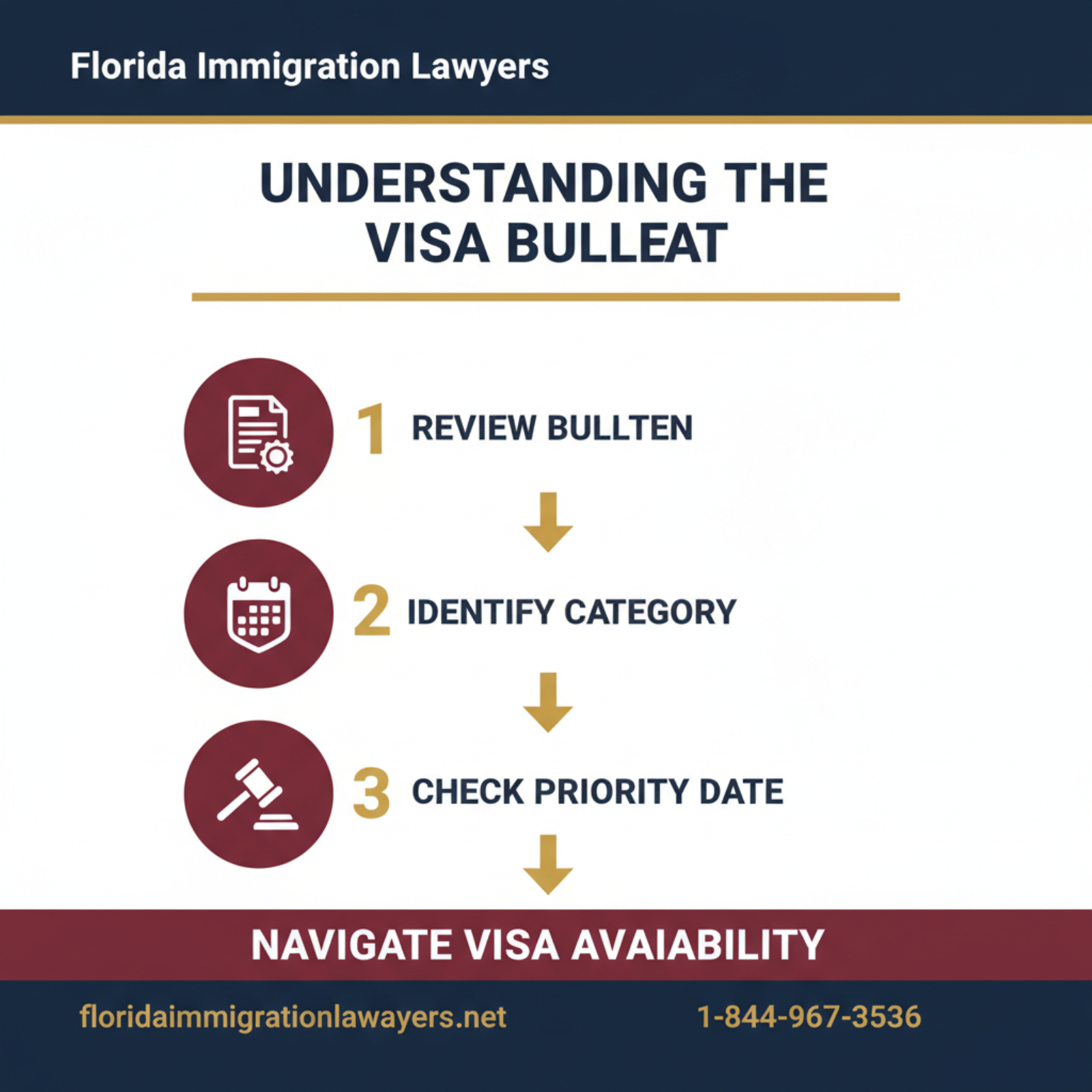
Applying for a green card is a multi-stage process that requires careful attention to detail. Whether you are adjusting status from within Florida or going through consular processing, each step is crucial. Here is a general outline of the process, which can be further complicated by the Visa Bulletin October 2025 dates.
- Petition Filing: An eligible U.S. citizen or lawful permanent resident (for family-based) or an employer (for employment-based) files an immigrant petition on your behalf. This is typically Form I-130 (Petition for Alien Relative) or Form I-140 (Immigrant Petition for Alien Worker). The date USCIS receives this petition generally becomes your priority date.
- Petition Approval: USCIS reviews the petition to ensure you meet the eligibility requirements for the visa category. Once approved, you will receive an I-797 approval notice. This step does not mean a visa is immediately available, but it confirms your petition has been accepted.
- Monitoring the Visa Bulletin: Regularly check the Visa Bulletin October 2025 and subsequent bulletins for your preference category and country of chargeability. Pay close attention to both the "Dates for Filing Applications" (DoF) and "Final Action Dates" (FAD). USCIS will announce which chart to use each month.
-
Applying for an Immigrant Visa or Adjustment of Status:
- Adjustment of Status (AOS): If you are physically present in the U.S. and your priority date is current (or within the DoF chart if USCIS allows it), you may file Form I-485, Application to Register Permanent Residence or Adjust Status. This is often done concurrently with Form I-765 (Employment Authorization Document) and Form I-131 (Advance Parole).
- Consular Processing: If you are outside the U.S., or if you choose to process abroad, your approved petition is sent to the National Visa Center (NVC). Once your priority date is current, the NVC will contact you to begin collecting documents and scheduling your interview at a U.S. Embassy or Consulate in your home country.
- Interview and Decision: You will attend an interview with a USCIS officer (for AOS) or a Consular Officer (for consular processing). During the interview, you will answer questions about your application and supporting documents. If approved, you will either receive your green card by mail or a visa stamp in your passport to enter the U.S. as a permanent resident.
Essential Documents for Your Green Card Application in Florida
A well-prepared application package is crucial for a smooth process. Missing documents can lead to delays or even a denial. While the exact list varies by case, here is a general checklist of documents typically required for both family-based and employment-based green card applications. Our team at Florida Immigration Lawyers can help you compile everything correctly.
- Immigrant Petition Approval Notice: Form I-797, Notice of Action, showing approval of your Form I-130 or I-140.
- Birth Certificate: Original or certified copy, with certified English translation if applicable.
- Marriage Certificate: If applicable, original or certified copy, with certified English translation.
- Divorce Decrees or Death Certificates: For any prior marriages of either petitioner or beneficiary.
- Passport: Valid passport for at least six months beyond your intended period of stay.
- Photographs: Passport-style photographs meeting USCIS specifications.
- Medical Examination Report: Form I-693, completed by a USCIS-approved civil surgeon in Florida.
- Affidavit of Support: Form I-864 (for family-based cases), demonstrating the petitioner's financial ability to support the applicant.
- Financial Documents: Tax returns, W-2s, employment verification letters, pay stubs for the petitioner.
- Police Certificates: From your home country and any country where you lived for six months or more since age 16 (for consular processing).
- Form I-94 Arrival/Departure Record: If adjusting status in the U.S., demonstrating lawful entry.
- Employment Verification Letter: For employment-based cases, from the sponsoring employer in Florida.
- Educational and Professional Credentials: Degrees, transcripts, licenses relevant to employment-based petitions.
- Proof of Relationship: Birth certificates of children, joint bank accounts, leases, photos (for family-based cases).
Timeline and Processing Expectations for Florida Immigrants
The processing time for a green card application can vary significantly, influenced by your visa category, country of chargeability, and the current Visa Bulletin October 2025 dates. USCIS and the Department of State provide estimates, but these are subject to change. For residents of Pembroke Pines and other Florida cities, understanding these general timelines is crucial for planning.
USCIS Processing Times and Field Offices in Florida
USCIS processing times are regularly updated on their website and depend on the specific form and the workload of the service center or field office. For adjustment of status applications, interviews are typically conducted at your local USCIS field office. Florida has several key offices, including those in Miami, Orlando, and Tampa. These offices handle a high volume of cases, which can sometimes impact local processing speeds.
For example, an I-485 application filed in Florida might take several months to over a year to process after your priority date becomes current. This includes biometric appointments, potential Requests for Evidence (RFEs), and the final interview. It is important to monitor the status of your case online and respond promptly to any USCIS requests.
National Visa Center and Consular Processing
If you are undergoing consular processing, the NVC will manage your case after the I-130 or I-140 approval. This stage involves document collection and fee payments. Once all documents are submitted and reviewed, the NVC will forward your case to the appropriate U.S. Embassy or Consulate. The wait time for an interview appointment can vary widely by country, sometimes taking many months.
The Visa Bulletin October 2025 is particularly relevant here, as it dictates when the NVC can schedule your interview. It is crucial to have all documents ready to avoid delays once your priority date becomes current. Our firm assists clients across Florida with both adjustment of status and consular processing, ensuring a smooth transition.
Cost Factors and Fee Breakdown for Green Card Applications
The financial aspect of applying for a green card is a significant consideration for many Florida families and employers. While specific fees are subject to change and should always be verified on the official USCIS website, understanding the general cost categories can help you plan. Florida Immigration Lawyers provides transparent guidance on all associated costs.
Government Filing Fees
The primary costs are the government filing fees paid to USCIS and, if applicable, the Department of State. These typically include:
- I-130 or I-140 Petition Fee: Paid by the petitioner.
- I-485 Application to Adjust Status Fee: Paid by the applicant. This often includes fees for the I-765 (Employment Authorization) and I-131 (Advance Parole) applications when filed concurrently.
- Biometrics Services Fee: For fingerprinting and background checks.
- Immigrant Visa Processing Fee: For consular processing applicants, paid to the Department of State.
- USCIS Immigrant Fee: Paid after visa approval and before entering the U.S. (for consular processing).
These fees are non-refundable, regardless of the outcome of your application. It is important to budget for these expenses carefully.
Other Potential Costs
Beyond government fees, applicants may incur other expenses:
- Medical Examination Fees: Paid directly to the USCIS-approved civil surgeon. These vary by provider.
- Translation Costs: For any documents not in English.
- Postage and Courier Fees: For sending documents.
- Travel Expenses: For interviews, biometrics appointments, or consular interviews abroad.
- Attorney Fees: For legal representation and guidance. While an additional cost, expert legal advice from Florida Immigration Lawyers can save you time, stress, and potential errors, making it a valuable investment in your future.
Do not navigate this complex and often overwhelming process alone. The nuances of the Visa Bulletin October 2025 and the entire green card application require expert knowledge. Contact Florida Immigration Lawyers today at 1-844-967-3536 to schedule your free consultation. Our dedicated team is here to provide the support and legal expertise you need in Florida.
Even small errors can cause significant delays or even lead to denial of your green card application. Here are some common mistakes applicants in Florida should meticulously avoid:
- Ignoring the Visa Bulletin: Failing to regularly check the Visa Bulletin October 2025 and subsequent months can mean missing your window to file. This can lead to unnecessary delays or having your application rejected.
- Filing with an Incorrect Priority Date: Submitting your Form I-485 or immigrant visa application when your priority date is not current can result in rejection. Always confirm your eligibility using the correct chart (DoF or FAD) designated by USCIS.
- Incomplete or Inaccurate Documentation: Submitting an application with missing documents, incorrect information, or uncertified translations is a primary cause of RFEs (Requests for Evidence) and delays. Ensure every document is precisely as required.
- Failing to Disclose All Information: Withholding information, even seemingly minor details, about your immigration history, criminal record, or past interactions with law enforcement can lead to serious consequences, including accusations of misrepresentation.
- Missing Deadlines: Failing to respond to RFEs or appointment notices by the specified deadline can lead to your application being denied. Keep track of all communications from USCIS and the NVC.
- Incorrectly Completing Forms: Immigration forms are highly detailed and require precise answers. Errors, even typographical ones, can cause processing delays or rejections. Carefully review all forms before submission.
- Not Seeking Legal Counsel: Attempting to navigate the complex immigration system without the guidance of an experienced attorney can be a costly mistake. An attorney can help avoid pitfalls, ensure compliance, and represent your best interests.
When to Call a Lawyer at Florida Immigration Lawyers
The U.S. immigration system is notoriously complex, and the Visa Bulletin October 2025 is just one piece of a larger puzzle. While this article provides general information, your specific situation will always require tailored advice. You should contact Florida Immigration Lawyers if you encounter any of the following scenarios:
- Your priority date is approaching or has become current: We can help you understand the next steps, prepare your application, and ensure timely submission.
- You receive an RFE or Notice of Intent to Deny (NOID): These documents require a precise and timely response. Our attorneys can formulate a strong response on your behalf.
- You have a complex immigration history: Past visa overstays, criminal convictions, or previous denials can complicate your case. We specialize in deportation defense and complex immigration challenges.
- You need assistance with specific visa categories: Whether it's a family-based petition or an employment-based green card, our expertise ensures your application meets all legal requirements.
- You are unsure about which Visa Bulletin chart to use: USCIS sometimes specifies which chart (DoF or FAD) to use each month. We can clarify this for your specific case.
- You are considering U.S. Citizenship and need to understand the path: Our firm guides clients through all stages of their immigration journey, from initial petitions to naturalization.
Our team at Florida Immigration Lawyers is dedicated to serving the diverse communities of Florida, including Pembroke Pines, Miami, and Orlando. We are here to provide clarity and strong legal advocacy.
About Florida Immigration Lawyers
Florida Immigration Lawyers is a leading law firm dedicated to providing comprehensive immigration legal services throughout Florida. With a deep understanding of U.S. immigration law, our experienced attorneys are committed to helping individuals, families, and businesses navigate the complexities of the immigration system. We serve clients in Pembroke Pines, Miami, Orlando, Tampa, Jacksonville, and all surrounding areas.
Our firm offers a wide range of services, including visa applications, green card petitions, asylum claims, deportation defense, and naturalization. We pride ourselves on our client-focused approach, ensuring that each case receives personalized attention and strategic representation. Our goal is to achieve the best possible outcomes for our clients, helping them build new lives and opportunities in the United States.
Why choose Florida Immigration Lawyers? We offer free consultations, are available 24/7, and provide bilingual services (Se Habla Español) to better serve Florida's diverse population. When you choose us, you are choosing a partner dedicated to your immigration success. Visit our website at https://www.floridaimmigrationlawyers.net or call us at 1-844-967-3536 to speak with an attorney today.
Sources and References
- U.S. Citizenship and Immigration Services (USCIS)
- U.S. Department of State - Visa Bulletin
- Executive Office for Immigration Review (EOIR)
- 8 U.S.C. Chapter 12 - Immigration and Nationality Act (INA)
- 8 CFR (Code of Federal Regulations)
- INA Section 203 - Preference Immigrant Visas
- INA Section 245 - Adjustment of Status of Nonimmigrant to That of Person Admitted for Permanent Residence
This article provides general legal information and is not intended as legal advice. Every case is unique, and outcomes depend on specific facts and circumstances. Contact an attorney for advice about your particular situation.
Navigating the complexities of the Visa Bulletin October 2025 and the entire U.S. immigration system can be daunting. Do not leave your future to chance. The experienced attorneys at Florida Immigration Lawyers are here to provide the expert legal guidance and support you need. We serve clients across all of Florida, including Pembroke Pines, Miami, Orlando, and Tampa. Call us today at 1-844-967-3536 for a free consultation. Se Habla Español - Estamos aquí para ayudarle.
Florida Immigration Lawyers
Legal Team
Our experienced attorneys at Florida Immigration Lawyers have been serving clients across Florida for over 20 years. We specialize in immigration, personal injury, criminal defense, workers compensation, and family law.