ICE Check-In Attorney Florida Representation Guide 2026
For immigrants in Florida, navigating an ICE check-in or the Intensive Supervision Appearance Program (ISAP) can be daunting. These mandatory appointments and stringent monitoring requirements carry significant weight for your immigration status and future. An experienced ICE check-in attorney provides essential legal guidance, helping you understand your rights, prepare necessary documents, and represent your interests before U.S. Immigration and Customs Enforcement. Especially in areas like Hialeah, proactive legal representation can prevent common mistakes, protect against potential detention, and explore avenues for relief. Our guide explains the process, the role of legal counsel, and how Florida Immigration Lawyers can help ensure compliance and safeguard your immigration journey. Secure your peace of mind with expert legal support.

Quick Answer: ICE Check-In Attorney Florida Representation
An ICE check-in attorney in Florida provides crucial legal guidance for individuals under immigration supervision, including those enrolled in the ISAP (Intensive Supervision Appearance Program). These appointments are mandatory and can significantly impact your immigration status. An attorney helps you understand your obligations, gather necessary documents, and represent your interests before ICE officers, particularly in Florida locations like Hialeah. Their expertise can prevent common mistakes, protect your rights, and explore potential avenues for relief, ensuring compliance and safeguarding your future.
Key Takeaways:
- Legal representation at ICE check-ins is highly recommended to protect your rights.
- Attorneys assist with document preparation and understanding supervision terms.
- ISAP requirements are strict; legal counsel helps ensure compliance.
- Florida Immigration Lawyers serve clients across the state, including Hialeah.
- Proactive legal support can prevent detention and facilitate favorable outcomes.
Receiving a notice for an ICE check-in or finding yourself enrolled in the Intensive Supervision Appearance Program (ISAP) can be a source of significant anxiety and confusion for immigrants in Florida. These mandates from U.S. Immigration and Customs Enforcement (ICE) require individuals to report regularly, often with stringent conditions, and can have profound implications for one's immigration journey. Navigating this complex process, especially without legal counsel, can lead to serious consequences, including potential detention or even deportation.
In Florida, a state with one of the largest immigrant populations in the U.S., understanding your rights and obligations during ICE supervision is paramount. Whether you are in Hialeah, Miami, Orlando, or any other part of the Sunshine State, securing experienced ICE check-in attorney Florida representation is not just advisable—it is often critical. An attorney can demystify the process, prepare you for appointments, and advocate on your behalf, ensuring your rights are protected at every turn. This comprehensive guide will illuminate the intricacies of ICE check-ins and ISAP, the invaluable role of legal representation, and how Florida Immigration Lawyers can help you navigate these challenges.
Do not face the U.S. immigration system alone. Your future and freedom may depend on it. Call Florida Immigration Lawyers at 1-844-967-3536 for a free consultation today.
Understanding ICE Check-Ins and ISAP in Florida
ICE check-ins are mandatory appointments for non-citizens released from immigration detention or those who have been issued an Order of Supervision. These appointments are designed to monitor an individual's compliance with immigration laws and ensure they appear for future court dates or adhere to release conditions. For many, these regular check-ins become a consistent part of their immigration experience, especially in a state like Florida, which has several active ICE field offices in cities such as Miami (serving Hialeah), Orlando, and Tampa. The specific frequency and nature of these check-ins can vary significantly based on an individual's immigration history, risk assessment, and the discretion of the supervising ICE officer.
The Intensive Supervision Appearance Program (ISAP) is a specialized form of ICE supervision, often involving more rigorous monitoring requirements. ISAP participants may be required to wear ankle monitors, report via telephone or mobile app, or attend more frequent in-person check-ins. The goal of ISAP, as outlined by ICE, is to ensure compliance with release conditions and appearance at immigration proceedings while allowing individuals to remain in their communities. However, the strict nature of ISAP can be overwhelming, and any perceived non-compliance can trigger severe repercussions. Understanding the specific terms of your ISAP enrollment, which can be found in your Order of Supervision (8 CFR § 241.5), is crucial. An experienced ICE check-in attorney can help decipher these complex requirements and advocate for a less restrictive supervision level if appropriate. The evolving landscape of immigration enforcement, sometimes influenced by broader policy changes, makes informed legal counsel more essential than ever for those under ICE supervision in Florida.
The Role of an Attorney in Your ICE Check-In Process
Having an attorney by your side during an ICE check-in or while navigating ISAP requirements offers an unparalleled layer of protection and expertise. Many individuals mistakenly believe these appointments are mere formalities, but they are critical interactions that can dramatically alter your immigration trajectory. An experienced immigration lawyer understands the nuances of immigration law, the specific protocols of Florida ICE field offices, and the potential pitfalls that can arise during these meetings. They serve as your advocate, ensuring that your rights are upheld and that you are not subjected to unfair or illegal questioning.
Before your appointment, your attorney will thoroughly review your immigration history, current status, and any pending applications for relief, such as asylum (learn more about asylum) or adjustment of status. They will help you gather all necessary documents, ensuring that everything is accurate and complete, which is vital for a smooth check-in. During the actual check-in, your attorney can speak on your behalf, answer questions posed by ICE officers, and clarify any ambiguities. This reduces the risk of miscommunication or inadvertently providing information that could be detrimental to your case. For individuals in ISAP, an attorney can help manage the reporting requirements, address any technical issues with monitoring devices, and even petition for modifications to your supervision conditions if circumstances warrant. Their presence signals to ICE that you are taking your obligations seriously and are professionally advised, often leading to a more respectful and efficient interaction. This is particularly important in busy Florida offices where caseloads are high.
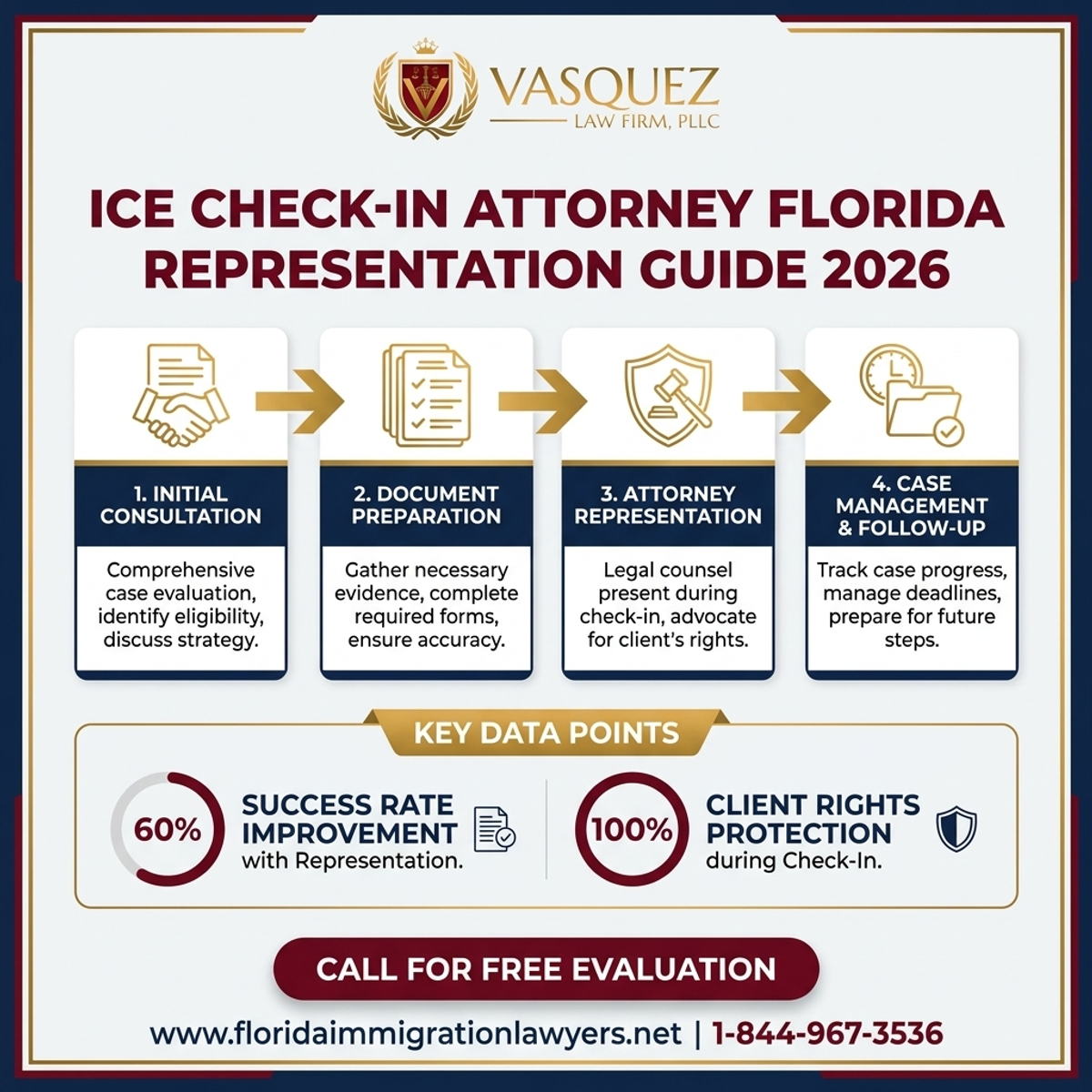
Step-by-Step Process — ICE Check-In Attorney Florida Representation Guide 2026
Step-by-Step Guide to Preparing for an ICE Check-In
Preparation is key to a successful ICE check-in. By following a structured approach, you can minimize stress and reduce the risk of unforeseen complications. This guide outlines the essential steps, emphasizing where your ICE check-in attorney provides indispensable support. Florida Immigration Lawyers are adept at guiding clients through each stage, ensuring you are fully prepared.
-
Understand Your Notice and Appointment Details
Carefully review the Notice to Report or Order of Supervision. Note the date, time, and location of your appointment. Understand if it's an in-person check-in, a phone report, or a virtual meeting. If any details are unclear, contact your attorney immediately. Missing an appointment or arriving at the wrong location, especially in a large area like South Florida, can have severe consequences, including the issuance of a warrant for your arrest.
-
Gather All Required Documents
Your attorney will provide a comprehensive list of documents to bring. This typically includes your passport, immigration documents (I-94, Notice to Appear), proof of address, and any documents related to pending immigration applications. Ensure all documents are original or certified copies as requested. Having an organized folder of documents demonstrates diligence and can expedite the check-in process. This is where an attorney's guidance is invaluable, ensuring you don't overlook any critical paperwork.
- Passport and National ID (if applicable)
- Form I-94, Arrival/Departure Record
- Notice to Appear (NTA) or any court documents
- Order of Supervision (if applicable)
- Proof of current address (utility bills, lease agreement)
- Proof of employment (pay stubs, employment letter)
- Marriage certificate or birth certificates of U.S. citizen children (if applicable)
- Receipts or approval notices for any pending USCIS applications (USCIS)
- Any court disposition documents for criminal charges, even if dismissed
-
Consult with Your Attorney Thoroughly
Schedule a meeting with your ICE check-in attorney well in advance of your appointment. Your attorney will explain the purpose of the check-in, potential questions ICE officers might ask, and how to respond. They will also discuss any changes in your immigration case since your last interaction with ICE. This consultation is your opportunity to ask questions and alleviate concerns, preparing you mentally and legally for the appointment.
-
Prepare for the Interview
While your attorney can speak on your behalf, you should be ready to answer basic biographical questions and confirm your contact information. Be truthful, but avoid volunteering unnecessary information. If you are unsure how to answer a question, politely state that you would like to consult with your attorney before responding. Remember, anything you say can be used in immigration proceedings. Your attorney will advise you on the appropriate demeanor and responses.
-
Know Your Rights
You have the right to remain silent regarding certain questions, especially those pertaining to your country of origin or how you entered the U.S., beyond what is necessary for identification. You have the right to legal counsel. Do not sign any documents you do not understand or that your attorney has not reviewed. Being informed about your rights empowers you during the check-in. Your attorney will ensure these rights are respected by ICE.
-
Follow Up After the Appointment
After your check-in, discuss the outcome with your attorney. They will help you understand any new instructions or requirements from ICE. If you were issued a new reporting date or changes to your supervision, ensure you understand and comply. Your attorney will continue to monitor your case and advise on next steps, including any further filings or court appearances, such as those at the Miami Immigration Court (EOIR).
Navigating ISAP Requirements and Reporting in Florida
The Intensive Supervision Appearance Program (ISAP) represents a significant commitment for individuals under ICE supervision. Unlike standard check-ins, ISAP often involves advanced monitoring technologies and more frequent contact requirements. In Florida, individuals enrolled in ISAP might be required to wear a GPS ankle monitor, participate in voice recognition reporting via phone, or use a mobile application on their smartphone for check-ins. The specific requirements are tailored to each individual's case and risk assessment, but the common thread is a heightened level of scrutiny and a strict adherence to the program's terms. Understanding and complying with these requirements is non-negotiable, as even minor infractions can lead to serious consequences, including re-detention and accelerated removal proceedings.
An ICE check-in attorney specializing in Florida immigration law can be invaluable in navigating ISAP. They can help you understand the technical aspects of any monitoring device, clarify reporting schedules, and address any issues that arise, such as technical malfunctions or difficulties in meeting reporting deadlines. For instance, if a GPS monitor malfunctions or if you need to travel outside your approved geographic area (e.g., from Hialeah to Orlando for a family emergency), your attorney can communicate with ICE on your behalf to seek necessary permissions or resolve problems before they escalate. Furthermore, an attorney can work to challenge the necessity of ISAP or advocate for less restrictive forms of supervision if your circumstances have changed or if you demonstrate a consistent record of compliance. They can also explore pathways to terminate supervision altogether, such as through successful adjustment of status applications or other forms of immigration relief. Given the strict nature of ISAP and the potential for misunderstandings or technical glitches, legal representation ensures you have an expert advocating for your best interests and protecting you from unwarranted penalties.
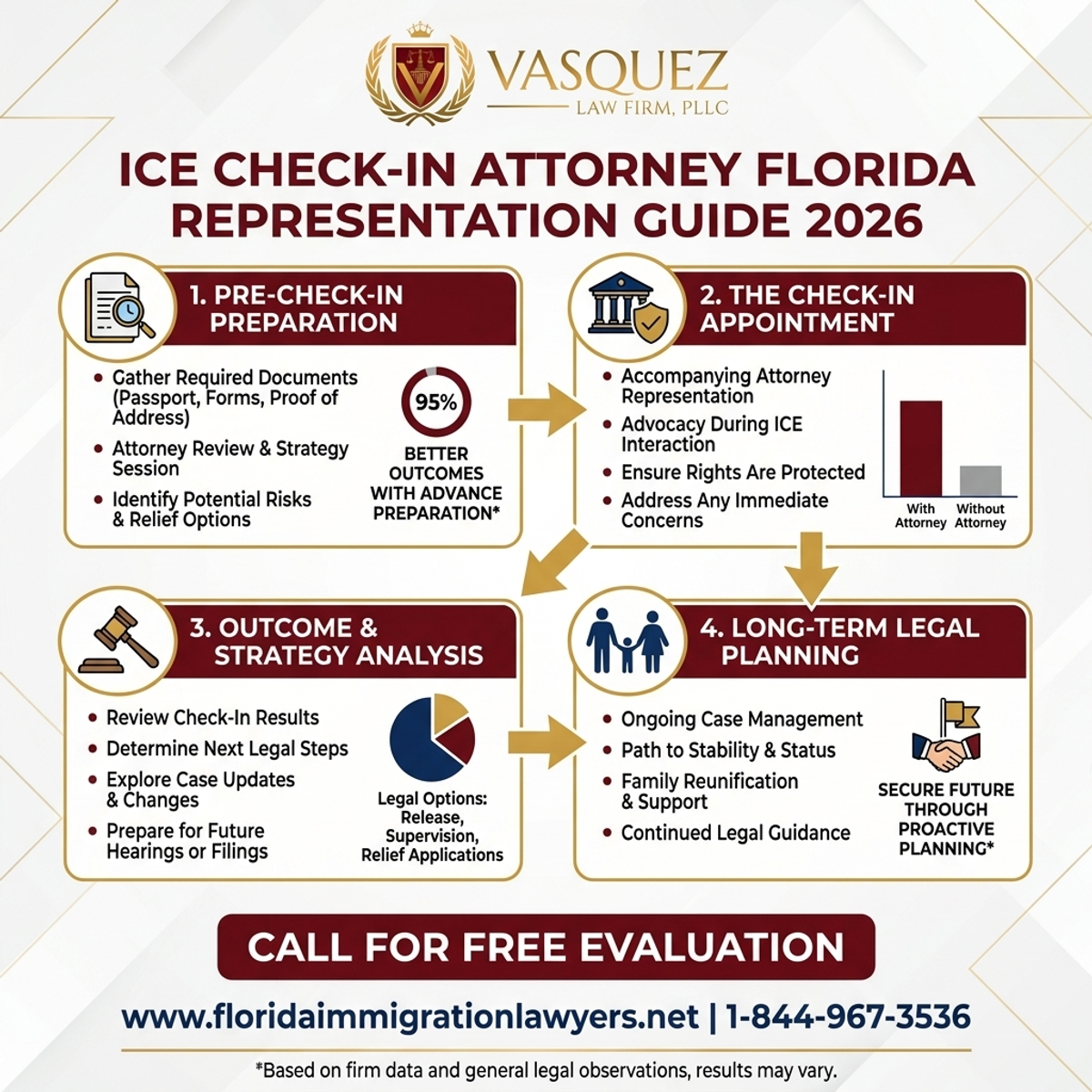
Key Statistics — ICE Check-In Attorney Florida Representation Guide 2026
Common Challenges and Seeking Relief during ICE Supervision
Individuals under ICE supervision, particularly those in ISAP, often face unique challenges that require astute legal intervention. Life circumstances change, and these changes can impact your ability to comply with supervision terms or present new opportunities for immigration relief. For example, a person under supervision might marry a U.S. citizen, become eligible for a U visa as a crime victim, or be granted asylum. These developments can alter your immigration status and potentially lead to the termination of ICE supervision. However, without legal guidance, many individuals are unaware of these possibilities or how to properly inform ICE and USCIS of their changed circumstances.
An experienced ICE check-in attorney can identify these opportunities and guide you through the process of seeking relief. They can file necessary applications with USCIS, such as an I-485 for adjustment of status (family-based immigration), and then present this information to ICE to request a modification or termination of your supervision. In some cases, individuals may face challenges such as medical issues that prevent them from complying with reporting requirements, or they may need to travel for work or family emergencies. Your attorney can liaise with ICE to explain these situations and seek temporary modifications to your supervision terms, preventing unintentional violations. Moreover, if your case involves ongoing removal proceedings, your attorney provides critical deportation defense (learn more about deportation defense), advocating for you in immigration court while simultaneously managing your ICE supervision requirements. Navigating these interconnected legal processes requires a comprehensive understanding of both enforcement and benefits aspects of immigration law, which is precisely what Florida Immigration Lawyers offer to clients across the state, including Hialeah and surrounding areas.
Understanding the Timelines and Potential Outcomes
The duration of ICE supervision, whether through regular check-ins or ISAP, is not fixed and varies significantly based on individual circumstances, the complexity of your immigration case, and the availability of relief. Some individuals may be under supervision for only a few months, while others might remain under supervision for several years, especially if their underlying immigration case is protracted or involves appeals. Factors influencing the timeline include the speed of USCIS processing for any applications you have filed, the schedule of immigration court hearings, and the discretion of the supervising ICE officer. For instance, if you have a pending application for adjustment of status, your supervision may continue until a final decision is reached on that application. Similarly, if you are in removal proceedings, your supervision could last until your case is resolved by an immigration judge or the Board of Immigration Appeals (BIA).
Potential outcomes of ICE supervision range from the ideal to the most severe. The most favorable outcome is the termination of supervision, typically occurring when an individual obtains a permanent legal status (e.g., green card, asylum grant) or when ICE determines that supervision is no longer necessary. This is often the primary goal an ICE check-in attorney works towards. Conversely, less favorable outcomes include continued supervision with unchanged or even stricter conditions, or in serious cases, re-detention. Re-detention can occur if an individual violates the terms of their supervision, commits new offenses, or if ICE determines they pose a flight risk or a danger to the community. In such scenarios, individuals may face expedited removal proceedings. Understanding these potential outcomes and actively working with your attorney to achieve the best possible result is crucial. Your attorney can provide realistic expectations based on your specific case and help you strategize to navigate these complex timelines effectively, whether you are in Hialeah or another part of Florida. The average processing times for various immigration benefits can be found on the USCIS website, which your attorney will monitor closely.
Common Mistakes to Avoid During ICE Check-Ins and ISAP
Navigating ICE supervision is fraught with potential pitfalls that can lead to adverse immigration consequences. Avoiding these common mistakes is crucial for anyone under an Order of Supervision or enrolled in ISAP in Florida. An experienced ICE check-in attorney can help you steer clear of these errors and protect your future.
- Missing Appointments: Failing to appear for a scheduled ICE check-in or ISAP reporting can lead to a warrant for your arrest, immediate detention, and potential expedited removal proceedings. Always confirm dates and times.
- Providing False Information: Lying or providing misleading information to ICE officers, even about seemingly minor details, is a serious offense. It can result in criminal charges, denial of immigration benefits, and make you inadmissible or deportable under INA § 212(a)(6)(C)(i).
- Not Bringing Required Documents: Arriving at an appointment without all requested documents, or with incomplete paperwork, can cause delays, require multiple visits, or lead to negative assumptions by ICE officers about your compliance.
- Going Alone Without Legal Counsel: Attending an ICE check-in without an attorney leaves you vulnerable. You may inadvertently say something detrimental, sign documents you don't understand, or miss opportunities to present evidence for relief. An attorney acts as your advocate.
- Violating Supervision Terms: Failing to adhere to the specific conditions of your ISAP or Order of Supervision, such as travel restrictions, curfew, or tampering with monitoring devices, can result in immediate re-detention and accelerated removal proceedings.
- Not Updating Contact Information: Moving to a new address or changing your phone number without promptly notifying ICE and the immigration court can lead to missed notices, orders issued in absentia, and warrants for your arrest.
- Failing to Disclose Criminal History: Attempting to conceal past arrests or convictions, even if they were minor or occurred long ago, can be disastrous. ICE has access to criminal databases. Full disclosure allows your attorney to address potential issues proactively.
- Ignoring Notices: Disregarding any mail or notices from ICE or the immigration court is extremely dangerous. These documents often contain critical information about your case, new reporting requirements, or court dates, and ignoring them can lead to serious legal consequences.
- Assuming ICE Knows Your Case Status: Do not assume ICE officers are fully aware of your pending applications with USCIS or your current immigration court status. It is your responsibility, with your attorney's help, to keep ICE informed with relevant documentation.
- Signing Documents Without Understanding: Never sign any document presented by an ICE officer without fully understanding its contents and implications. Always ask for clarification and, if possible, consult your attorney before signing, as you might waive important rights.
When to Call a Florida Immigration Lawyer
The complexities of ICE check-ins and ISAP, combined with the ever-evolving nature of U.S. immigration law (8 U.S.C. Chapter 12), make legal representation not just a luxury, but a necessity for many. Knowing when to seek legal counsel can be the difference between successfully navigating your immigration journey and facing severe setbacks. Florida Immigration Lawyers are here to provide expert guidance for a wide range of scenarios related to ICE supervision.
You should contact an attorney immediately if you have received any notice from ICE, an Order of Supervision, or have been enrolled in ISAP. Even if you believe your case is straightforward, an attorney can review your documents, explain your rights, and prepare you for what to expect. If you are experiencing difficulties complying with ISAP requirements, such as issues with a monitoring device or needing to travel, legal counsel can intervene on your behalf. Should your personal circumstances change—for example, if you get married, have a child, or receive a new job offer—an attorney can assess how these changes impact your immigration case and supervision status. Furthermore, if you have any past criminal history, even minor infractions, it is imperative to discuss this with a lawyer before any ICE interaction. If you fear detention, have been detained, or are facing removal proceedings, immediate legal assistance is critical. Our team at Florida Immigration Lawyers is well-versed in handling complex immigration cases in Florida's unique legal landscape, from Hialeah to Jacksonville. We offer comprehensive services, including deportation defense, family immigration petitions, and asylum claims. Do not wait for a problem to escalate; proactive legal support is your best defense.
About Florida Immigration Lawyers
Florida Immigration Lawyers is a leading law firm dedicated to providing comprehensive and compassionate legal representation to immigrants across the entire state of Florida. With years of experience and a deep understanding of U.S. immigration law, our attorneys are committed to helping individuals and families navigate the complexities of the immigration system. We understand the unique challenges faced by immigrants, especially those under ICE supervision or enrolled in ISAP, and we strive to offer personalized, effective solutions.
Our firm specializes in a broad array of immigration services, including ICE check-in and ISAP representation, deportation defense, asylum applications, family-based immigration, citizenship, and business immigration. We pride ourselves on our client-focused approach, ensuring that every individual receives the attention and expert advice they deserve. Our team is bilingual, offering services in both English and Spanish, to effectively serve Florida's diverse immigrant communities, including those in Hialeah, Miami, Orlando, Tampa, and beyond. We are available 24/7 to address urgent concerns and offer free, no-obligation consultations to discuss your case. When you choose Florida Immigration Lawyers, you choose a dedicated advocate committed to protecting your rights and achieving the best possible outcome for your immigration journey. Visit our website at floridaimmigrationlawyers.net or call us at 1-844-967-3536 to schedule your free consultation.
Sources and References
- U.S. Citizenship and Immigration Services (USCIS)
- Executive Office for Immigration Review (EOIR)
- U.S. Department of State
- 8 U.S.C. Chapter 12 - Immigration and Nationality Act (INA)
- 8 CFR § 241.5 - Orders of supervision
Related services: immigration practice areas, citizenship and naturalization, experienced immigration attorneys.
This article provides general legal information and is not intended as legal advice. Every case is unique, and outcomes depend on specific facts and circumstances. Contact an attorney for advice about your particular situation.
Do not face your ICE check-in or ISAP obligations without expert legal support. The stakes are too high. Contact Florida Immigration Lawyers today for a free consultation at 1-844-967-3536. Se Habla Espanol - Estamos aqui para ayudarle.
Do Not Navigate This Process Alone
Our experienced immigration attorneys are ready to fight for you. Get a free, confidential consultation today.
Se Habla Español
Frequently Asked Questions

William J. Vásquez
Founding Attorney · Vasquez Law Firm
U.S. Air Force veteran and immigration attorney with thousands of cases resolved. J.D., NCCU School of Law. AILA member. Admitted to the 4th, 5th, and 11th Circuit Courts.
Available 24/7 - Free Evaluations
Related Legal Services
Our Florida immigration attorneys can help you with deportation defense, citizenship and naturalization and family immigration services. Call today at 1-844-967-3536 for a free consultation.
Related Links
Related Topics
Free Legal Consultation
Discuss your case with our experienced attorneys. We're available 24/7.
Se Habla Español - Estamos aquí para ayudarle.
Related Articles
Biometrics Appointment in Florida: What to Expect in 2026
Navigating a biometrics appointment in Florida is crucial for your USCIS process. Learn what to expect, how to prepare, and common pitfalls to avoid. Florida Immigration Lawyers are here to help with personalized guidance and support.
Withholding of Removal Explained: Florida Defense in 2026
For those in Florida facing deportation and fearing persecution or torture in their home country, understanding withholding of removal is critical. This form of protection prevents removal to a dangerous country, though it differs significantly from asylum in its eligibility criteria and benefits. It requires proving a "more likely than not" chance of persecution based on protected grounds or torture, a higher standard than asylum's "well-founded fear." While withholding of removal does not lead to a Green Card, it offers mandatory protection if the stringent criteria are met, even for some individuals barred from asylum. The process involves complex legal proceedings before an immigration judge, often in Miami or Orlando immigration courts. A comprehensive application, detailed testimony, and robust supporting evidence, including country conditions reports and affidavits, are essential. Given the high stakes and intricate legal requirements, securing the expertise of a Florida immigration lawyer is paramount to building a strong defense and navigating the path to safety.
US Visa Policy Changes July 2026: What Students in Florida
As of July 2026, international students in Florida seeking a change of status to an F-1 student visa must prepare for potential adjustments to U.S. visa policies. This comprehensive guide from Florida Immigration Lawyers explores the anticipated policy changes, detailing their potential impact on application requirements, processing times, and eligibility criteria. We provide a step-by-step overview of the change of status process, including a document checklist, expected timelines, and cost considerations. Understanding these complexities and avoiding common mistakes is crucial for a successful application. With potential changes approaching, proactive planning and expert legal guidance are more important than ever. Our firm is dedicated to helping students in Tampa and across Florida navigate these challenges, offering tailored advice and robust representation. Learn how to protect your academic future and ensure a smooth transition to F-1 student status.
Dual Citizenship Lawyer: Your 2026 Guide to Naturalization
Achieving U.S. citizenship is a profound milestone, but the path to naturalization, especially with dual citizenship in mind, is fraught with legal intricacies and a critical interview process. This comprehensive guide from Florida Immigration Lawyers demystifies the journey, offering essential citizenship interview tips and highlighting the invaluable role of a dual citizenship lawyer. We cover eligibility, document preparation, timelines, and common pitfalls, all tailored for Florida residents in areas like Pembroke Pines. Discover how expert legal counsel can prepare you for your naturalization interview, address dual nationality concerns, and ensure a smooth, successful application. From initial assessment to interview representation, we provide the support needed to navigate USCIS requirements confidently. Call Florida Immigration Lawyers for a free consultation to start your journey.