H-2B Visa for Hospitality in Florida: What to Know
The H-2B visa is crucial for Florida's hospitality industry, allowing non-agricultural workers to fill seasonal roles. Discover how to navigate the application process, including eligibility, document requirements, and common pitfalls. Learn how Florida Immigration Lawyers can assist you with expert guidance and support.

Applying for an H-2B visa for hospitality work in Florida involves understanding eligibility, application processes, and current regulations. Key takeaways include:
- The H-2B visa is for non-agricultural seasonal workers.
- Florida's hospitality industry frequently uses this visa.
- Recent policy changes may affect application timelines.
- Consult a lawyer to navigate the complexities.
Introduction
As Coral Springs, Florida, continues to thrive as a vibrant hub for hospitality, the demand for seasonal workers is on the rise. The H-2B visa provides a pathway for non-agricultural workers to fill temporary roles in this bustling sector. Whether you're an employer seeking to fill a seasonal gap or a worker aiming to explore opportunities in the U.S., understanding the nuances of the H-2B visa is crucial. Call Florida Immigration Lawyers at 1-844-967-3536 for a free consultation to discuss your specific situation.
Florida's hospitality industry, from the bustling resorts of Orlando to the serene beaches of the Gulf Coast, relies heavily on a flexible workforce to manage seasonal fluctuations in tourism. Coral Springs, with its growing attractions and events, mirrors this demand, creating numerous opportunities for both U.S. and foreign workers. The H-2B visa program is specifically designed to address these temporary staffing needs when qualified U.S. workers are not available.
For employers, securing H-2B workers can be a strategic solution to maintain service quality during peak seasons without committing to year-round staffing levels that might be unsustainable. For workers, it offers a valuable chance to gain international work experience, earn competitive wages, and explore the vibrant culture of Florida. However, the program is highly regulated, necessitating meticulous adherence to legal requirements and timelines.
Navigating the H-2B landscape requires a deep understanding of federal immigration and labor laws. This comprehensive guide aims to demystify the process, offering insights into eligibility, application steps, potential challenges, and critical considerations for both employers and prospective employees. Remember, the journey can be complex, and expert legal guidance from Florida Immigration Lawyers is often the key to a successful outcome.
What is the H-2B Visa for Hospitality?
The H-2B visa is a non-immigrant visa that allows U.S. employers to hire foreign nationals for temporary non-agricultural jobs, which are seasonal in nature. As of 2026, this visa is particularly popular in Florida's hospitality industry, including positions in hotels, theme parks, and restaurants.
Employers must demonstrate that there are not enough U.S. workers who are able, willing, qualified, and available to do the temporary work. Additionally, the employment must not adversely affect the wages and working conditions of similarly employed U.S. workers.
The "temporary" nature of the employment is a cornerstone of the H-2B program. This can manifest in several ways: a seasonal need (e.g., increased staff for tourist season), a peak load need (e.g., a specific event or surge in demand requiring extra hands), an intermittent need (e.g., sporadic but recurring needs), or a one-time occurrence (e.g., a new project of limited duration). For Florida's hospitality sector, seasonal and peak load needs are most common, often tied to school holidays, major events, or specific travel seasons.
Common roles filled by H-2B workers in Florida's hospitality sector include housekeepers, cooks, resort staff, landscapers for resorts, theme park attendants, and specialized event workers. Employers must rigorously prove that these positions are indeed temporary and that their attempts to recruit U.S. workers for these roles have been unsuccessful. This involves specific recruitment efforts mandated by the Department of Labor (DOL) to ensure fair opportunity for the domestic workforce.
The "no adverse effect" clause is equally critical, requiring employers to offer wages and working conditions that do not undercut those of similarly employed U.S. workers. This typically means paying at least the prevailing wage for the occupation in the geographic area, as determined by the DOL. Compliance with these conditions is continuously monitored and is essential for both initial approval and maintaining visa status.
Eligibility Requirements
To be eligible for the H-2B visa, employers must meet specific criteria set by the USCIS, including proving the temporary nature of the job and the need for foreign workers.
Beyond demonstrating temporary need, employers must also be able to financially support the workers, comply with all relevant labor laws, and have a legitimate business need for the foreign labor. They must not have laid off U.S. workers in the same or a similar occupation in the area of intended employment within the past 60 days, unless specific exceptions apply. For workers, eligibility generally requires having the necessary skills, education, or experience for the temporary job, and meeting general admissibility requirements for entry into the U.S.
A critical aspect for employers is understanding the annual H-2B cap, which limits the number of visas issued each fiscal year. This cap, often split into two halves (one for the first half of the fiscal year and one for the second), means that demand frequently outstrips supply, making timely and accurate applications paramount. Additional cap exemptions or supplemental visa allocations may be announced by the government, but these are often unpredictable and require swift action. Staying informed on these policy updates is crucial for successful planning.
How to Apply for an H-2B Visa in Florida
Applying for an H-2B visa involves several steps. As of 2026, the process can be broken down into the following:
- Employers must obtain a temporary labor certification from the Department of Labor.
- File Form I-129 with the USCIS.
- Prospective workers apply for the visa at a U.S. Embassy or Consulate.
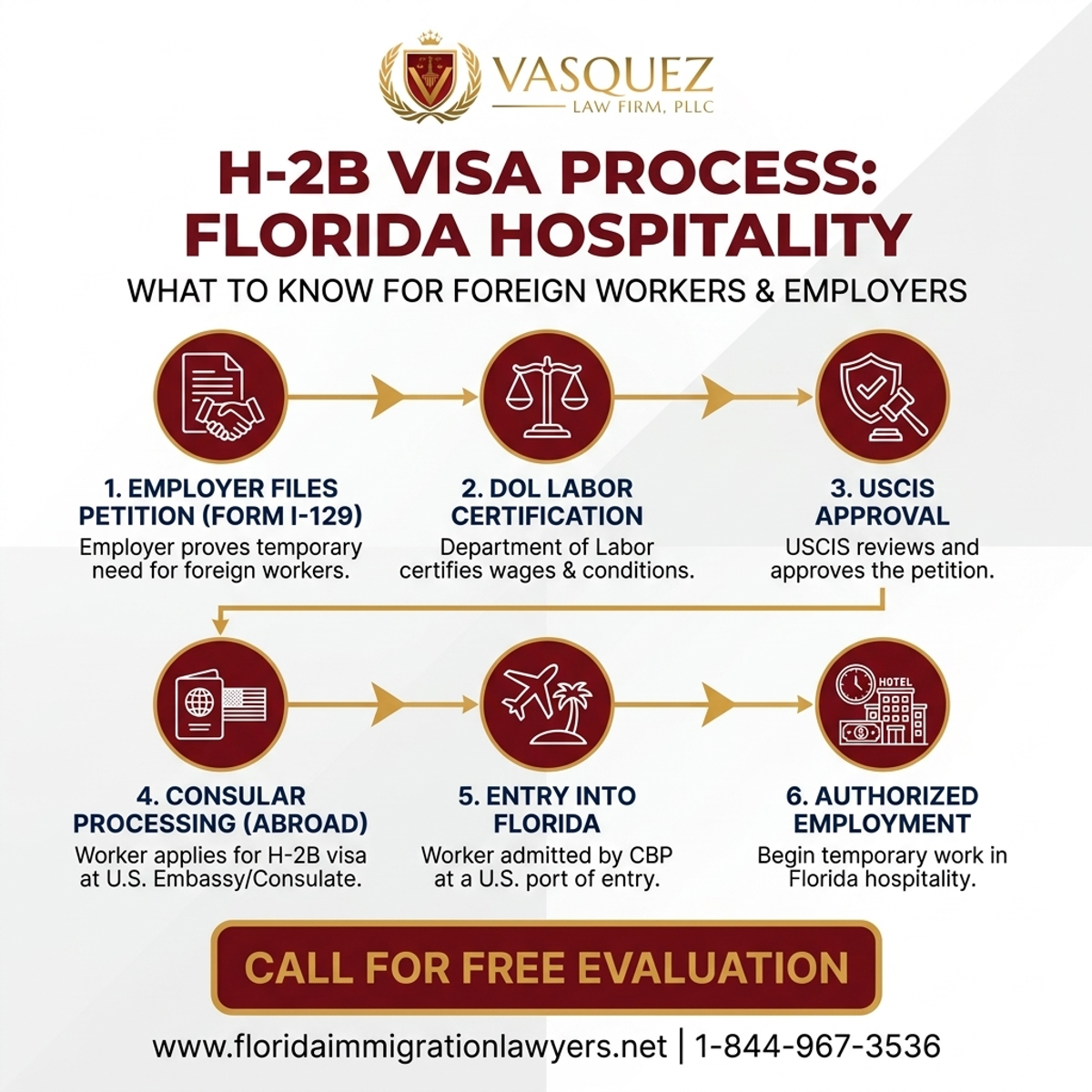
Step-by-Step Process — H-2B Visa for Hospitality in Florida: What to Know
Each step requires careful attention to detail to ensure compliance with immigration laws and timely processing.
The first critical step, obtaining a temporary labor certification from the Department of Labor (DOL), is perhaps the most time-consuming and complex. Employers must conduct extensive recruitment efforts to demonstrate that no qualified U.S. workers are available for the temporary positions. This involves placing advertisements, contacting former employees, and often working with state workforce agencies. The DOL also determines the prevailing wage for the position, which the employer must commit to paying.
Once the labor certification is approved, the employer proceeds to file Form I-129, Petition for a Nonimmigrant Worker, with U.S. Citizenship and Immigration Services (USCIS). This petition formally requests the H-2B workers. Along with Form I-129, the employer must submit the approved labor certification and various supporting documents that further prove the temporary nature of the job, the employer's financial viability, and the workers' qualifications. Premium processing is often available for an additional fee, which can significantly expedite USCIS review.
Finally, after USCIS approves the I-129 petition, prospective workers located outside the U.S. must apply for the H-2B visa at a U.S. Embassy or Consulate in their home country. This typically involves completing an online visa application (DS-160), paying a fee, and attending an interview. During the interview, applicants must demonstrate their intent to return to their home country after the temporary employment ends. It is crucial for workers to bring all required documents, including their passport, the approved I-797 (Notice of Action for the I-129), and any other supporting materials as requested by the consulate. Florida Immigration Lawyers can assist employers in preparing workers for this crucial final step.
Document Checklist for H-2B Visa Application
- Temporary Labor Certification from the Department of Labor
- Form I-129 submitted by the employer
- Proof of temporary job offer and employment conditions
- Passport valid for at least six months beyond the period of stay
Having all necessary documents prepared in advance can streamline the application process.
For employers, the checklist extends to detailed job descriptions, proof of recruitment efforts (e.g., copies of advertisements, recruitment reports), prevailing wage determinations, and financial statements demonstrating the ability to pay the H-2B workers. Additionally, any contracts with third-party recruiters, if applicable, must be disclosed. It's vital to maintain meticulous records of all communications and filings throughout the entire process.
Prospective workers will need a valid passport, their DS-160 confirmation page, proof of payment for visa fees, and the original or a copy of the I-797 approval notice. Depending on the consulate, additional documents might include educational certificates, professional licenses, letters of experience, and proof of ties to their home country (e.g., property deeds, family commitments) to demonstrate non-immigrant intent. All foreign language documents must be accompanied by certified English translations.
A common pitfall is submitting incomplete or incorrect documentation, which can lead to Requests for Evidence (RFEs) from USCIS or even outright denials. To avoid such delays, it is highly recommended to engage with an experienced immigration lawyer, like those at Florida Immigration Lawyers, who can help compile a comprehensive and accurate application package. Their expertise ensures that all specific requirements are met, significantly increasing the chances of a smooth approval.
Processing Times and What to Expect
As of 2026, processing times for H-2B visas can vary based on demand and USCIS workload. Here's a typical timeline:
| Stage | Typical Timeframe | Notes |
|---|---|---|
| Labor Certification | 2-3 months | Subject to Department of Labor processing times |
| USCIS Processing | 2-4 months | Varies based on service center workload |
| Visa Application | 1-2 months | Consular processing time |
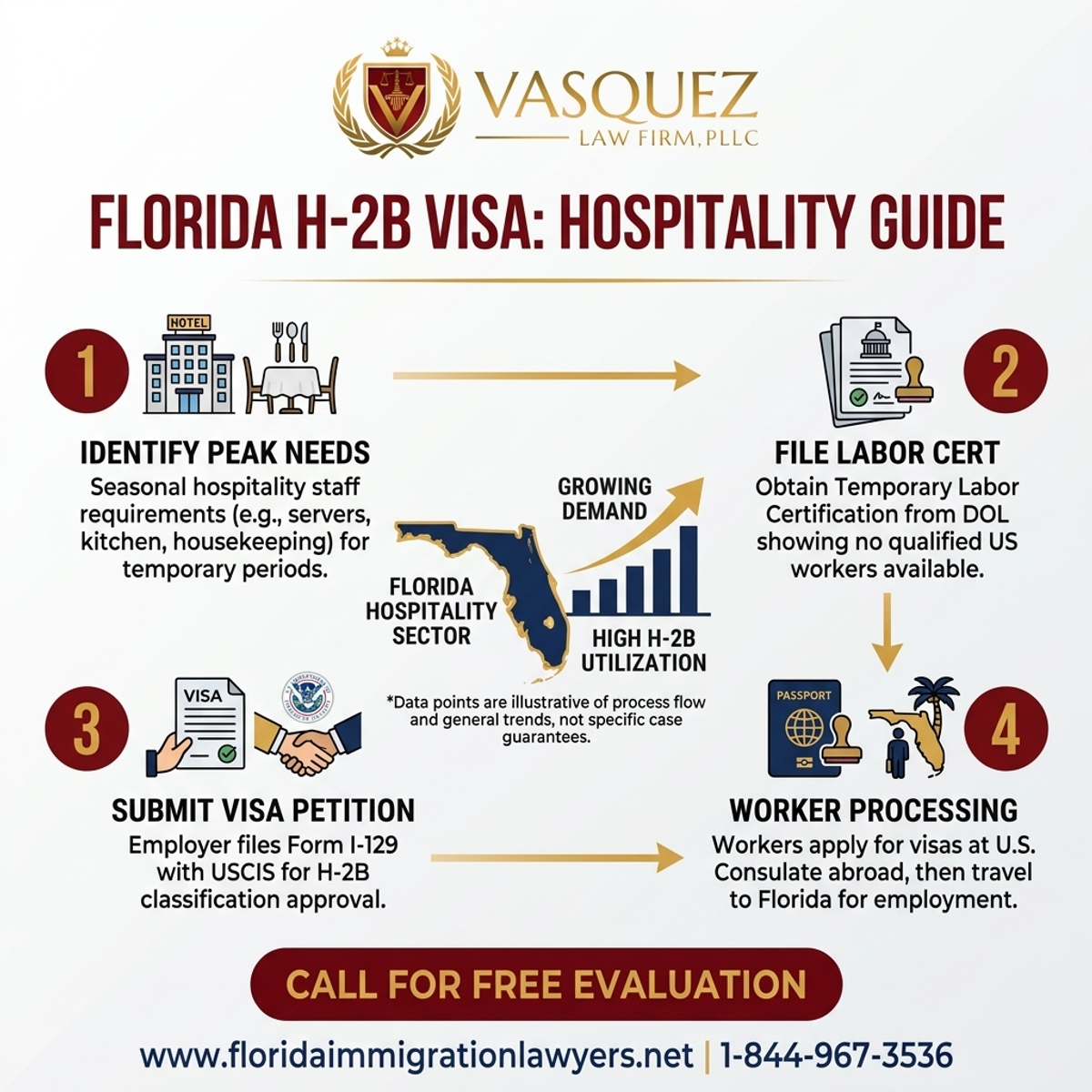
Key Statistics — H-2B Visa for Hospitality in Florida: What to Know
Delays can occur due to policy changes or increased demand, so planning ahead is essential.
The H-2B program is subject to an annual cap, which can significantly influence processing times. Once the cap is reached, USCIS will stop accepting new petitions for that fiscal half, often leading to a rush of applications at the beginning of each filing period. Employers who miss these windows or whose petitions are not selected in a lottery (if one is implemented due to oversubscription) may face significant delays or be unable to secure workers for their desired start dates. Staying updated on cap announcements from USCIS is crucial.
Beyond the cap, other factors can impact the timeline. Requests for Evidence (RFEs) from USCIS, often issued when an application is incomplete or lacks sufficient supporting documentation, can add several weeks or even months to the process. While premium processing is an option for the USCIS stage, which guarantees a response within 15 calendar days, it comes with an additional fee and doesn't expedite the prior labor certification step or subsequent consular processing.
To mitigate potential delays, employers should initiate the H-2B application process well in advance of their anticipated start date, ideally 6-8 months beforehand. Having all documentation meticulously prepared and reviewed by an immigration attorney, such as Florida Immigration Lawyers, can help prevent RFEs. Additionally, being flexible with start dates, if possible, can provide a buffer against unforeseen processing challenges. Communication with your legal team throughout the process is key to managing expectations and responding promptly to any agency requests.
Cost Factors and Fees for H-2B Visa
| Item | Typical Fee | Notes |
|---|---|---|
| Labor Certification | Varies | Paid by employer |
| USCIS Filing Fee | Varies | Check current fee schedule |
| Visa Application Fee | Varies | Paid at the consulate |
Employers typically cover these costs, but it's crucial to confirm this aspect during the job offer stage.
The costs associated with the H-2B visa process can be substantial and primarily fall upon the employer. For the Labor Certification stage, costs can include advertising fees for recruitment efforts (which vary based on publication and duration) and potentially fees for using a professional recruitment agency. While there isn't a direct DOL filing fee for the labor certification itself, the indirect costs of compliance and recruitment can add up.
USCIS filing fees for Form I-129 are subject to change, but employers should anticipate several hundred dollars, often increasing periodically. If premium processing is elected, an additional fee of over $2,500 is typically added. Beyond these government fees, employers often incur legal fees for immigration attorneys who prepare and file petitions, ensure compliance, and represent the employer throughout the complex process. These legal fees can range from several thousands to tens of thousands of dollars, depending on the complexity and number of workers.
For the visa application at the consulate, the fee is typically paid by the worker, though employers sometimes reimburse this. However, Department of Labor regulations stipulate that employers cannot recoup certain costs from H-2B workers if it would bring their wages below the federal minimum wage or the prevailing wage, whichever is higher. Other potential employer costs include transportation for workers to the U.S. and back, and sometimes housing assistance, especially in high-cost areas of Florida. Understanding these financial obligations upfront is essential for budgeting and compliance.
Common Mistakes to Avoid
- Failing to provide sufficient proof of temporary employment need: This can result in denial of the labor certification.
- Incorrect or incomplete Form I-129: Errors can lead to processing delays or rejections.
- Not adhering to application timelines: Missing deadlines can significantly delay the process.
- Overlooking visa cap limitations: There is an annual cap on H-2B visas, and applying after it has been reached can prevent approval.
- Inadequate documentation of job conditions: Failure to show non-adverse effects on U.S. workers may lead to denial.
- Not verifying the employer's eligibility: Employers must be in good standing and meet all legal requirements.
- Misinterpreting employment duration: The job must be clearly temporary with a definite end date.
One of the most frequent errors employers make is not clearly articulating and substantiating the temporary nature of the job. Simply stating a job is seasonal is insufficient; detailed business projections, historical staffing data, and a clear explanation of why U.S. workers cannot fill the role temporarily are crucial. Without this, the Department of Labor may question the legitimacy of the temporary need, leading to a denial of the labor certification.
Another critical mistake is failing to conduct proper and compliant recruitment efforts for U.S. workers. The DOL has strict guidelines on advertising channels, duration, and content. Any deviation or insufficient effort can lead to the rejection of the labor certification, forcing the employer to restart the arduous process. Working with experienced immigration counsel, such as Florida Immigration Lawyers, can ensure all recruitment steps are meticulously followed and documented.
Furthermore, employers sometimes underestimate the importance of accurately determining and paying the prevailing wage. Paying below the prevailing wage or failing to document wage compliance can lead to severe penalties, including debarment from the H-2B program. It is imperative to consult the DOL's online wage library and ensure that all wage requirements are met and properly recorded throughout the employment period. This protects both the employer from legal issues and the foreign worker from exploitation.
When to Call a Lawyer
Navigating the H-2B visa application process can be complex. If you encounter issues such as application denials, need for expedited processing, or changes in employment conditions, consulting with an experienced immigration lawyer is advisable. Florida Immigration Lawyers can assist with understanding legal requirements and preparing your case.
Beyond initial application challenges, legal counsel becomes indispensable in several other scenarios. If your business has a history of H-2B applications or plans for large-scale recruitment, a lawyer can streamline the process, develop robust compliance strategies, and manage multiple petitions efficiently. Similarly, if your business structure is complex, involves multiple entities, or operates across various Florida locations, an attorney can ensure all legal nuances are properly addressed.
Furthermore, if you receive a Request for Evidence (RFE) from USCIS or a Notice of Intent to Deny (NOID) from the DOL, immediate legal intervention is paramount. These notices require precise and timely responses, often demanding additional documentation or clarification of specific points. An immigration attorney can analyze the request, gather the necessary evidence, and craft a compelling response to protect your application. Don't hesitate to reach out to Florida Immigration Lawyers at 1-844-967-3536 for expert guidance in these critical moments.
Even after a visa is approved and workers are employed, ongoing compliance is crucial. Regular audits by the Department of Labor or USCIS can occur, and having legal representation ensures you are prepared to demonstrate adherence to all H-2B regulations, including wage payment, working conditions, and record-keeping. Proactive legal advice can prevent future issues, making Florida Immigration Lawyers a valuable partner throughout the entire H-2B employment cycle.
Frequently Asked Questions (FAQs)
Can H-2B visa holders bring their families to the U.S.?
Generally, H-2B visa holders cannot bring their dependents (spouses or children) with them to the U.S. The H-2B visa is specifically for temporary workers and does not have a dependent visa category like some other non-immigrant visas (e.g., H-1B or L-1). Dependents would need to explore other independent visa options, such as visitor visas, if eligible, but they would not be able to work or reside long-term based on the H-2B status. It's important to understand this limitation when planning.
What is the maximum duration for an H-2B visa?
The maximum period of stay for an H-2B visa is three years. However, the initial period of admission is typically limited to the validity of the temporary labor certification and the I-
Sources and References
- U.S. Citizenship and Immigration Services (USCIS)
- Executive Office for Immigration Review (EOIR)
- U.S. Department of State - Bureau of Consular Affairs
- Immigration and Nationality Act (INA), 8 U.S.C. Chapter 12
Do Not Navigate This Process Alone
Our experienced immigration attorneys are ready to fight for you. Get a free, confidential consultation today.
Se Habla Español
Or leave your details and we’ll call you:
Free Evaluation in 24 Hours
Or talk to us right now

AI voice assistant — available 24/7
FreeFrequently Asked Questions

William J. Vásquez
Founding Attorney · Vasquez Law Firm
U.S. Air Force veteran and immigration attorney with years of hands-on U.S. immigration experience. J.D., NCCU School of Law. AILA member. Admitted to the 4th, 5th, and 11th Circuit Courts.
Available 24/7 - Free Evaluations
Reviewed for legal accuracy by William J. Vásquez
Licensed in North Carolina; U.S. immigration is federal practice.
Related Legal Services
Our Florida immigration attorneys can help you with deportation defense, citizenship and naturalization and family immigration services. Call today at 1-844-967-3536 for a free consultation.
Related Links
Related Topics
Free Legal Consultation
Discuss your case with our experienced attorneys. We're available 24/7.
Se Habla Español - Estamos aquí para ayudarle.
Related Articles
Immigration Lawyer Orlando Free Consultation in 2026
Navigating U.S. immigration law in Orlando, Lakeland, and Polk County requires expert legal guidance. Florida Immigration Lawyers offers a free consultation to help you understand your options for visas, Green Cards, citizenship, or deportation defense. This comprehensive guide covers the typical process, essential documents, processing timelines for 2026, and cost factors associated with an immigration lawyer in Orlando. Learn about common mistakes to avoid and when it's crucial to seek legal assistance. Our firm provides personalized, empathetic, and strategic representation across Central Florida, ensuring you have dedicated support for your immigration journey.
I-140 Premium Processing Timeline in Florida 2026
Expediting an I-140 immigrant petition through premium processing can significantly shorten your wait time for an employment-based green card in Florida. As of 2026, USCIS guarantees a decision within 15 calendar days for eligible EB-1, EB-2, and EB-3 cases, provided Form I-907 and the associated fee are correctly filed. This guide explores the detailed timeline, eligibility requirements, necessary documents, and cost factors involved in I-140 premium processing. We also highlight crucial mistakes to avoid and underscore the importance of professional legal counsel. For employers and skilled workers in West Palm Beach and across Florida, understanding these nuances is key to a successful and timely immigration process. Florida Immigration Lawyers offers expert guidance to navigate these complex procedures effectively.
Public Charge Rule Florida: Immigrant Eligibility & Public
The public charge rule is a critical aspect of U.S. immigration law affecting non-citizens seeking green cards or visas, particularly in Florida. This rule assesses whether an individual is likely to become primarily dependent on specific government benefits, such as cash assistance for income maintenance or long-term institutional care. While many essential non-cash benefits are excluded, understanding the nuances is crucial. USCIS employs a "totality of the circumstances" test, evaluating factors like age, health, education, and financial resources. For immigrants in Tampa and across Florida, navigating this complex regulation requires careful preparation and often the guidance of an experienced attorney. This guide provides a detailed overview, common mistakes to avoid, and when to seek legal help to ensure a successful immigration journey.
SIJS in Florida: A Path for Juvenile Immigration
Discover how Special Immigrant Juvenile Status (SIJS) can help minors in Florida gain legal residency. Learn about eligibility, application steps, and common mistakes to avoid. Consult Florida Immigration Lawyers for expert guidance.