H-2A Visa for Florida Growers: Agricultural Worker Guide
Florida's agricultural sector heavily relies on the H-2A visa program to address seasonal labor shortages. This comprehensive guide details the H-2A application process for Florida growers, including navigating Department of Labor (DOL) and USCIS requirements, essential documentation, processing timelines, and associated costs. We cover critical steps from labor certification to visa interviews, emphasizing the importance of meticulous compliance. Learn about common mistakes to avoid, such as inadequate recruitment or non-compliant housing, which can lead to costly delays or denials. Florida Immigration Lawyers offers expert guidance to ensure a smooth and successful H-2A petition, safeguarding your harvest and business operations. Contact us for a free consultation to protect your agricultural future.

The H-2A visa program allows U.S. agricultural employers, including many Florida growers, to bring foreign nationals to the United States to fill temporary or seasonal agricultural jobs. This is crucial when there are not enough U.S. workers available. To qualify, employers must demonstrate a temporary need, offer fair wages and housing, and follow strict Department of Labor (DOL) and U.S. Citizenship and Immigration Services (USCIS) regulations. Navigating this complex process, from labor certification to visa petitions, requires meticulous planning and compliance to ensure a successful harvest season for Florida’s vital agricultural sector.
- H-2A visas address temporary or seasonal agricultural labor shortages.
- Florida growers must meet specific wage, housing, and recruitment standards.
- The process involves both the Department of Labor and USCIS.
- Meticulous documentation and timely filing are critical for success.
- Expert legal guidance can prevent costly delays and ensure compliance.
Florida’s agricultural industry is a cornerstone of its economy, producing a vast array of crops from citrus and tomatoes to sugarcane and ornamental plants. Yet, finding a sufficient and reliable workforce for seasonal harvests can be a significant challenge for many Florida growers. When domestic workers are unavailable, the H-2A visa program offers a vital solution, allowing employers to lawfully bring in temporary foreign agricultural workers.
Understanding the intricacies of the H-2A program is essential for growers in areas like West Palm Beach and across the state who rely on this critical labor force. This comprehensive guide from Florida Immigration Lawyers will walk you through the process, requirements, potential pitfalls, and how professional legal assistance can safeguard your operations. Do not let complex immigration laws jeopardize your harvest or business continuity.
Facing labor shortages and complex regulations? Call Florida Immigration Lawyers at 1-844-967-3536 for a free consultation. We are here to help Florida growers navigate the H-2A visa process with confidence and clarity.
Understanding the H-2A Visa Program for Florida Agricultural Workers
The H-2A temporary agricultural worker program is designed to assist U.S. employers who anticipate a shortage of domestic workers to perform agricultural labor or services of a temporary or seasonal nature. This program is authorized under the Immigration and Nationality Act (INA) Section 101(a)(15)(H)(ii)(a), allowing for nonimmigrant visas for temporary workers. For Florida growers, the H-2A visa is indispensable for securing the necessary workforce during peak planting, cultivating, and harvesting seasons, which are often short and highly demanding. The program aims to protect both American workers by ensuring foreign workers do not adversely affect their wages and working conditions, and foreign workers by mandating fair treatment and conditions.
Eligibility for the H-2A program rests on two main pillars: the employer’s temporary need and the worker’s qualifications. Employers must demonstrate that their need for labor is truly temporary or seasonal, typically lasting no longer than one year. They must also prove that there are not enough U.S. workers who are able, willing, qualified, and available to perform the job. Furthermore, employers must show that employing H-2A workers will not negatively impact the wages and working conditions of similarly employed U.S. workers. This is often done by offering the Adverse Effect Wage Rate (AEWR) or the prevailing wage, whichever is higher. For workers, the primary requirement is being a foreign national seeking to perform temporary agricultural work.
Florida's diverse agricultural landscape, from the citrus groves of Central Florida to the vegetable farms near West Palm Beach and the sugar cane fields of the Everglades Agricultural Area, heavily relies on this program. The demand for H-2A workers fluctuates with crop cycles and harvest schedules, making flexibility and timely processing crucial. Growers must understand that the H-2A program is not merely a hiring mechanism; it is a comprehensive regulatory framework that includes strict rules about wages, housing, transportation, and recruitment. Compliance with these regulations is not optional and failures can lead to severe penalties, including debarment from the program. Our team at Florida Immigration Lawyers can help you understand the nuances of this critical program.
Step-by-Step Guide: Navigating the H-2A Application Process for Florida Growers
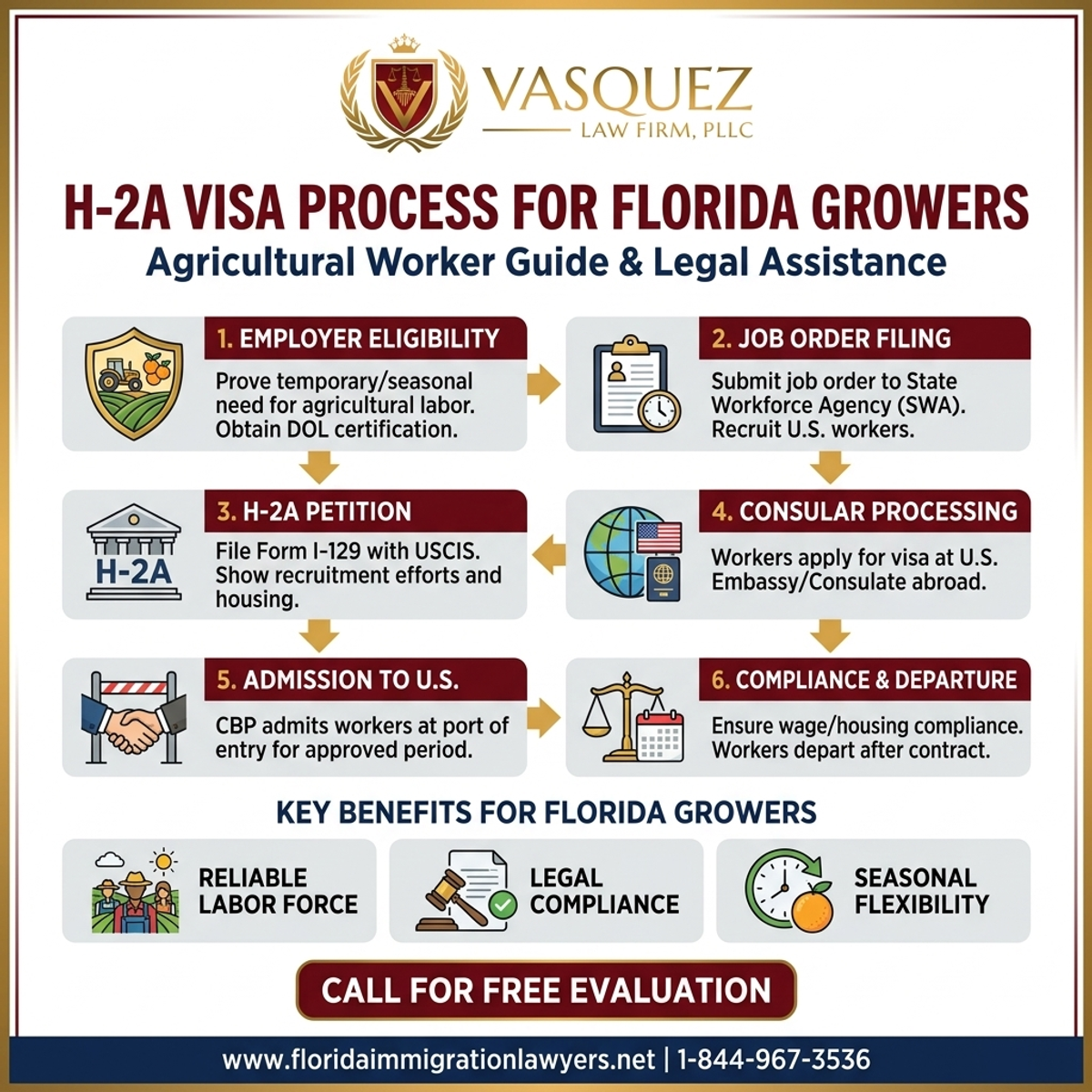
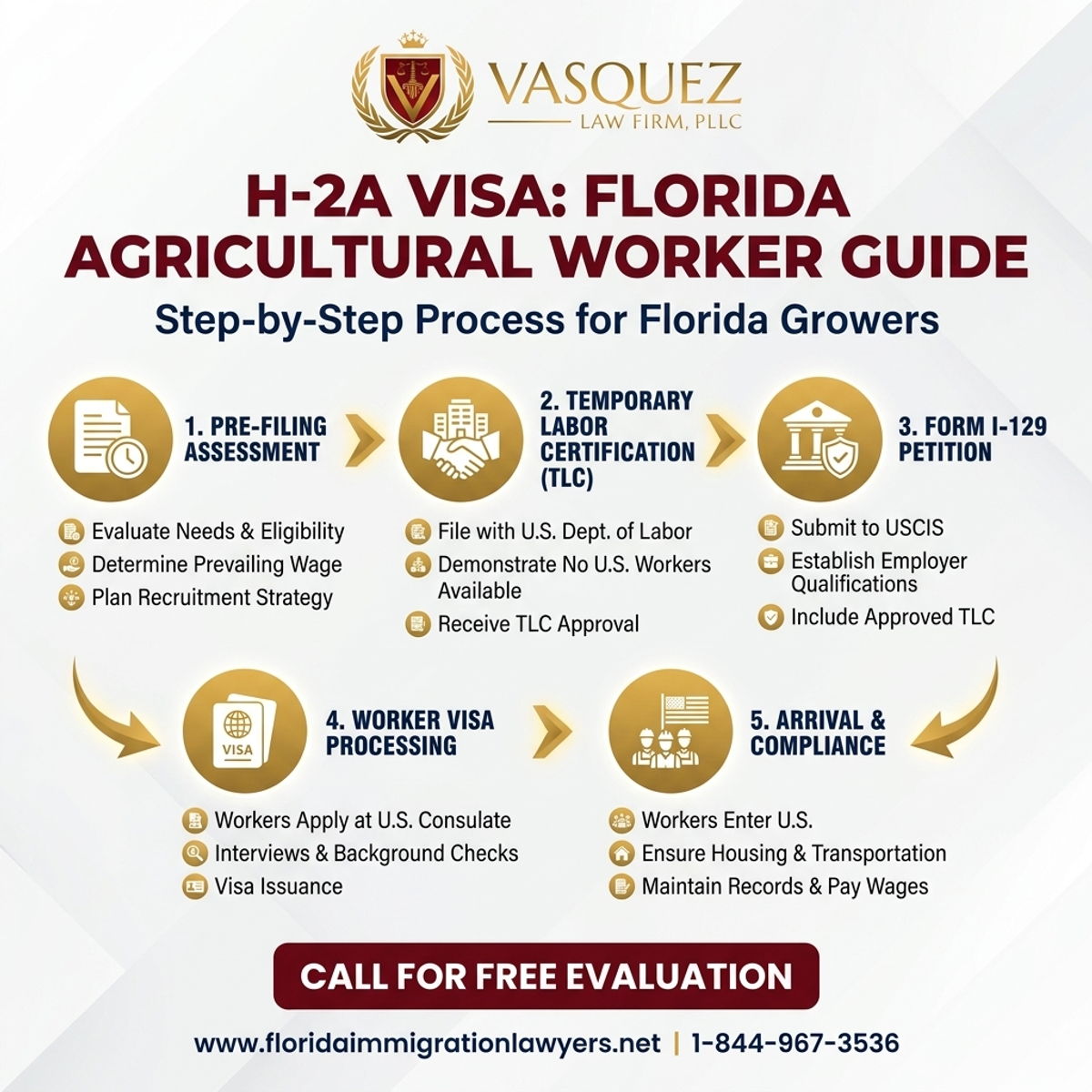
The H-2A application process is multi-faceted, involving several government agencies. Florida growers must meticulously follow each step to ensure timely approval and avoid disruptions to their operations. Understanding this sequence is key to a successful harvest season. What to expect for each stage can vary, but planning ahead is always beneficial.
- Labor Certification Application (ETA Form 9142A) with the Department of Labor (DOL): This is the crucial first step. Employers must submit a Form ETA-9142A, Application for Temporary Employment Certification, to the Department of Labor. This application details the job offer, wage rates, working conditions, and housing arrangements. The DOL reviews this to ensure that U.S. workers are not displaced and that the terms of employment meet federal standards. What to expect: This stage typically involves a review by the DOL's Office of Foreign Labor Certification (OFLC) and can take several weeks, requiring prompt responses to any requests for information.
- Temporary Employment Certification: After the initial application, employers must conduct specific recruitment efforts to test the U.S. labor market. This includes advertising in newspapers, contacting former U.S. employees, and coordinating with the local State Workforce Agency (SWA). If insufficient U.S. workers apply or are qualified, the DOL issues a Temporary Employment Certification. What to expect: This recruitment phase is strictly regulated, and documentation of all efforts is paramount. Any misstep here can lead to denial, delaying the entire process.
- I-129 Petition for Nonimmigrant Worker with USCIS: Once the DOL certifies the need, the employer files Form I-129, Petition for a Nonimmigrant Worker, with U.S. Citizenship and Immigration Services (USCIS). This petition asks USCIS to approve the H-2A classification for the foreign workers. It must include the approved DOL certification and supporting documentation. What to expect: USCIS processing times can vary significantly, especially for the Florida Service Center. Premium processing is available for an additional fee, offering a faster decision, which many Florida growers utilize given the time-sensitive nature of agriculture.
- Visa Interview and Processing (for workers outside the U.S.): If the workers are outside the United States, they must apply for an H-2A visa at a U.S. embassy or consulate in their home country. This typically involves an interview with a consular officer. The Department of State oversees this stage. What to expect: Workers should be prepared to demonstrate their intent to return home after their temporary employment. Delays can occur due to administrative processing or security checks.
- Worker's Entry and Compliance: Upon visa approval, workers can enter the U.S. for the approved period. Employers must then adhere to all terms and conditions outlined in the certified application, including providing housing, transportation, and paying the agreed-upon wages. What to expect: Continuous compliance is crucial. Employers must maintain detailed records and be prepared for potential audits by the DOL or other agencies.
Essential Document Checklist for H-2A Visa Petitions
Preparing a complete and accurate set of documents is paramount for a successful H-2A visa petition. Any missing or incorrect information can lead to delays, requests for evidence (RFEs), or even denial, which can be catastrophic for Florida growers during critical harvest periods. This checklist outlines the key documents and information generally required for the H-2A application process. Ensure all documents are organized and readily available.
- Form ETA-9142A: Application for Temporary Employment Certification, accurately completed and signed. This includes a detailed job description, wage offer, and work schedule.
- Proof of Temporary Need: Documentation demonstrating that the employer's need for the workers is seasonal or temporary, typically less than one year. This might include crop cycles or historical seasonal employment patterns.
- Recruitment Efforts Documentation: Comprehensive records of all attempts to recruit U.S. workers, including copies of advertisements, job orders placed with the State Workforce Agency, and a recruitment report summarizing responses and reasons for non-hire.
- Housing Plan and Inspection: Detailed plans for safe and sanitary housing for H-2A workers, along with proof of a satisfactory housing inspection by the appropriate state or local authority. This is a critical compliance aspect for Florida growers.
- Transportation Plan: Documentation outlining how workers will be transported from their home country to the job site and daily transportation between housing and the worksite. Employers are generally responsible for these costs.
- Wage Offer Documentation: Proof that the offered wage meets or exceeds the Adverse Effect Wage Rate (AEWR) for Florida, the prevailing wage, the federal minimum wage, or the state minimum wage, whichever is highest.
- Employer Business Documents: Copies of the employer's business license, federal employer identification number (EIN), and other relevant business registration documents for Florida.
- Employer's Federal Tax ID Number: Essential for all federal filings.
- Worker Information (if known): While not always required at the initial DOL stage, for the USCIS I-129 petition, specific worker names and biographical data will be needed.
- Prior H-2A Approvals: Copies of any previous H-2A certifications or approvals, if applicable, to demonstrate a history with the program.
Step-by-Step Process — H-2A Visa for Florida Growers: Agricultural Worker Guide
H-2A Visa Timelines and Processing Expectations in 2026
Understanding the typical timelines for the H-2A visa process is vital for Florida growers to plan their planting and harvest schedules effectively. Delays can be costly, impacting crop yields and market opportunities. While exact processing times can fluctuate due to caseloads, government policy changes, and specific case complexities, a general framework can help you anticipate the duration of each stage.
The Department of Labor (DOL) labor certification process typically takes 60-90 days from the initial filing of Form ETA-9142A to the issuance of the Temporary Employment Certification. This includes the mandatory recruitment period for U.S. workers, which often lasts around 30 days. It is crucial to file the DOL application between 75 and 45 calendar days before the start date of employment. Filing too early or too late can lead to rejection or significant delays. For example, a Florida grower needing workers by October 1st should aim to file their DOL application no later than July 15th.
Once the DOL certification is received, the USCIS I-129 petition processing time varies. Regular processing at USCIS can take anywhere from 2 to 5 months, sometimes longer. Given the seasonal nature of agricultural work, many Florida growers opt for premium processing, which guarantees a decision within 15 calendar days for an additional fee. This can significantly shorten the overall timeline and is often a worthwhile investment to secure workers promptly for critical harvests. After USCIS approval, if workers are outside the U.S., consular processing at a U.S. embassy or consulate can take 1-4 weeks, depending on the country and individual circumstances, including potential administrative processing.
Overall, from the initial DOL filing to workers arriving on the farm, the H-2A process can take 3 to 6 months without premium processing. With premium processing for the USCIS stage, this can be reduced to 2.5 to 4 months. These estimates are critical for Florida growers, especially those in West Palm Beach and surrounding agricultural hubs, who often have very specific windows for harvesting their crops. Planning well in advance and submitting a complete, accurate application package minimizes the risk of delays. Staying informed about any potential policy shifts affecting processing, such as those announced by USCIS or the Department of State, is also important.
Cost Factors and Fee Breakdown for the H-2A Program
Engaging in the H-2A program involves various costs that Florida growers must budget for. These fees cover government processing, recruitment, and employer-mandated responsibilities, ensuring compliance with federal regulations. Understanding the financial commitment upfront is essential for effective business planning and maintaining profitability, particularly for farms in competitive markets across Florida.
- Department of Labor (DOL) Fees: There is a filing fee for the Application for Temporary Employment Certification (ETA Form 9142A). This fee is typically a base amount plus a per-worker fee, with a maximum cap. (Note: specific fee amounts are subject to change by the DOL and should be verified on their official website).
- USCIS Filing Fees: The primary fee here is for Form I-129, Petition for a Nonimmigrant Worker. As with DOL fees, this amount can change.
- Premium Processing Fee (Optional): If a Florida grower opts for expedited processing of the I-129 petition, there is a significant additional fee. This guarantees a decision within 15 calendar days and is often crucial for time-sensitive agricultural needs.
- Visa Application Fees (Consular Fees): Each H-2A worker applying for a visa at a U.S. embassy or consulate must pay a non-refundable visa application fee. While this is typically the worker's responsibility, employers often assist or cover this cost to facilitate recruitment.
- Recruitment Costs: Employers incur costs for advertising the job openings in newspapers and other media as part of the U.S. worker recruitment efforts. These can vary based on advertising rates in relevant markets.
- Transportation Costs: H-2A regulations require employers to provide and/or pay for the reasonable cost of transportation and subsistence from the worker's home country to the place of employment in Florida, and back at the end of the contract period. This includes visa-related travel expenses.
- Housing Costs: Employers must provide housing at no cost to the H-2A workers. This includes rent, utilities, and other related charges. This can be a significant expense, especially if new housing needs to be built or existing facilities upgraded to meet federal and state standards.
- Legal Fees: Engaging an experienced immigration attorney, like Florida Immigration Lawyers, is a critical investment. Legal fees cover assistance with preparing and filing applications, ensuring compliance, responding to RFEs, and overall strategic guidance throughout the complex H-2A process. These fees vary based on the complexity of the case and the number of workers.
Key Statistics — H-2A Visa for Florida Growers: Agricultural Worker Guide
Do not navigate this complex process alone. The financial and legal implications of the H-2A program are substantial. Contact Florida Immigration Lawyers today for expert guidance and to ensure your H-2A application is handled correctly from the start. We offer tailored solutions for Florida growers.
Common Mistakes Florida Growers Make in the H-2A Process
The H-2A program is highly regulated, and even minor errors can lead to significant delays, denials, or severe penalties. Florida growers must be vigilant to avoid these common mistakes that can jeopardize their access to essential agricultural labor. Understanding these pitfalls can save considerable time, money, and stress.
- Inadequate U.S. Worker Recruitment Efforts: Failing to conduct thorough and documented recruitment as required by the DOL can lead to denial of labor certification. Growers must prove they genuinely tested the U.S. labor market.
- Incorrect Wage Offer: Offering less than the Adverse Effect Wage Rate (AEWR) for Florida, the prevailing wage, or minimum wage (whichever is highest) is a common error. This can result in DOL denial and potential back pay liabilities.
- Non-Compliant Worker Housing: Providing housing that does not meet federal and state safety and health standards is a major violation. Unapproved housing can lead to immediate program debarment and fines.
- Late Filing of Applications: Missing the strict filing windows for the DOL (75-45 days before start date) or USCIS petitions can result in rejection or insufficient time for processing, meaning workers arrive late or not at all.
- Incomplete or Inaccurate Documentation: Submitting applications with missing forms, incorrect information, or insufficient supporting evidence will trigger Requests for Evidence (RFEs) or outright denials, causing significant delays.
- Misclassifying Work as Temporary/Seasonal: Applying for H-2A workers for year-round or non-agricultural tasks is a serious violation. The need must be genuinely temporary or seasonal.
- Failure to Maintain Required Records: Employers must keep detailed records of recruitment, wage payments, housing inspections, and worker hours. Lack of proper record-keeping can lead to issues during audits.
- Not Understanding Employer Responsibilities: Overlooking obligations such as providing transportation, tools, and certain benefits can result in non-compliance and penalties.
- Ignoring Adverse Effect Wage Rate (AEWR) Updates: The AEWR changes annually. Failing to adjust wages accordingly can lead to underpayment claims and penalties.
- Lack of Attorney Review: Attempting to navigate the complex H-2A process without legal counsel often leads to errors that could have been easily avoided, costing more in the long run.
When to Call Florida Immigration Lawyers for H-2A Visa Assistance
The H-2A visa program is a lifeline for many Florida growers, but its complexity demands expert navigation. While some growers may attempt to manage the process independently, there are specific situations where the specialized knowledge of an immigration attorney is not just beneficial, but essential. Florida Immigration Lawyers are uniquely positioned to assist growers across the state, including those in West Palm Beach, with these critical needs.
You should contact our firm if you are a first-time H-2A applicant. The initial learning curve is steep, and a single error can derail your entire season. We can guide you through every step, ensuring your foundational application is strong. If you have previously faced denials, received Requests for Evidence (RFEs), or encountered audits from the Department of Labor (DOL) or USCIS, our team can help identify the root causes of these issues and formulate a strategy for successful reapplication or compliance. We understand the specific nuances of Florida’s agricultural sector and its regulatory environment.
Furthermore, if you are planning to expand your H-2A operations, require a large number of workers, or have unique seasonal needs that deviate from standard patterns, our attorneys can provide strategic advice. We also offer invaluable assistance with ongoing compliance, helping you maintain meticulous records and stay updated on ever-changing regulations (e.g., 20 CFR Part 655). If you anticipate any litigation, such as wage disputes or compliance investigations, having experienced legal representation is critical. Do not risk your harvest or your business's future by going it alone. Explore our business immigration services or simply contact us for a consultation.
About Florida Immigration Lawyers
Florida Immigration Lawyers is a leading law firm dedicated to providing comprehensive immigration solutions to individuals and businesses across the entire state of Florida. With a deep understanding of both federal immigration law and the unique needs of Florida's diverse population and economy, we are committed to delivering exceptional legal representation. Our experienced attorneys specialize in a wide array of immigration matters, including H-2A visas for agricultural growers, family immigration, asylum, deportation defense, and naturalization, ensuring that our clients receive personalized and effective strategies.
We pride ourselves on our client-centered approach, offering compassionate support and clear communication throughout every stage of the legal process. Our firm understands the profound impact immigration issues can have on livelihoods and families, which is why we are available 24/7 to address urgent concerns. We offer free consultations to discuss your specific situation and outline the best path forward. Whether you are a Florida grower in West Palm Beach seeking to secure your workforce or an individual pursuing citizenship, Florida Immigration Lawyers is your trusted partner. We are dedicated to protecting your rights and achieving your immigration goals. Visit our immigration practice area page to learn more about how we can help.
Sources and References
- U.S. Citizenship and Immigration Services (USCIS)
- U.S. Department of State (travel.state.gov)
- U.S. Department of Labor (DOL) - H-2A Program
- 8 U.S.C. Chapter 12 - Immigration and Nationality Act (INA)
- INA § 101(a)(15)(H)(ii)(a) - Definition of H-2A Nonimmigrant
- 20 CFR Part 655 - Temporary Employment of H-2A Agricultural Workers in the United States
Related services: immigration practice areas, family immigration services, citizenship and naturalization.
This article provides general legal information and is not intended as legal advice. Every case is unique, and outcomes depend on specific facts and circumstances. Contact an attorney for advice about your particular situation.
Securing your agricultural workforce with H-2A visas is a critical undertaking for Florida growers. Do not leave your harvest to chance. For dedicated and experienced legal assistance, reach out to Florida Immigration Lawyers today at 1-844-967-3536 for a free consultation. Se Habla Espanol - Estamos aqui para ayudarle.
Do Not Navigate This Process Alone
Our experienced immigration attorneys are ready to fight for you. Get a free, confidential consultation today.
Se Habla Español
Frequently Asked Questions

William J. Vásquez
Founding Attorney · Vasquez Law Firm
U.S. Air Force veteran and immigration attorney with thousands of cases resolved. J.D., NCCU School of Law. AILA member. Admitted to the 4th, 5th, and 11th Circuit Courts.
Available 24/7 - Free Evaluations
Related Legal Services
Our Florida immigration attorneys can help you with immigration practice areas, free immigration consultation and experienced immigration attorneys. Call today at 1-844-967-3536 for a free consultation.
Related Links
Related Topics
Free Legal Consultation
Discuss your case with our experienced attorneys. We're available 24/7.
Se Habla Español - Estamos aquí para ayudarle.
Related Articles
Biometrics Appointment in Florida: What to Expect in 2026
Navigating a biometrics appointment in Florida is crucial for your USCIS process. Learn what to expect, how to prepare, and common pitfalls to avoid. Florida Immigration Lawyers are here to help with personalized guidance and support.
Withholding of Removal Explained: Florida Defense in 2026
For those in Florida facing deportation and fearing persecution or torture in their home country, understanding withholding of removal is critical. This form of protection prevents removal to a dangerous country, though it differs significantly from asylum in its eligibility criteria and benefits. It requires proving a "more likely than not" chance of persecution based on protected grounds or torture, a higher standard than asylum's "well-founded fear." While withholding of removal does not lead to a Green Card, it offers mandatory protection if the stringent criteria are met, even for some individuals barred from asylum. The process involves complex legal proceedings before an immigration judge, often in Miami or Orlando immigration courts. A comprehensive application, detailed testimony, and robust supporting evidence, including country conditions reports and affidavits, are essential. Given the high stakes and intricate legal requirements, securing the expertise of a Florida immigration lawyer is paramount to building a strong defense and navigating the path to safety.
US Visa Policy Changes July 2026: What Students in Florida
As of July 2026, international students in Florida seeking a change of status to an F-1 student visa must prepare for potential adjustments to U.S. visa policies. This comprehensive guide from Florida Immigration Lawyers explores the anticipated policy changes, detailing their potential impact on application requirements, processing times, and eligibility criteria. We provide a step-by-step overview of the change of status process, including a document checklist, expected timelines, and cost considerations. Understanding these complexities and avoiding common mistakes is crucial for a successful application. With potential changes approaching, proactive planning and expert legal guidance are more important than ever. Our firm is dedicated to helping students in Tampa and across Florida navigate these challenges, offering tailored advice and robust representation. Learn how to protect your academic future and ensure a smooth transition to F-1 student status.
Dual Citizenship Lawyer: Your 2026 Guide to Naturalization
Achieving U.S. citizenship is a profound milestone, but the path to naturalization, especially with dual citizenship in mind, is fraught with legal intricacies and a critical interview process. This comprehensive guide from Florida Immigration Lawyers demystifies the journey, offering essential citizenship interview tips and highlighting the invaluable role of a dual citizenship lawyer. We cover eligibility, document preparation, timelines, and common pitfalls, all tailored for Florida residents in areas like Pembroke Pines. Discover how expert legal counsel can prepare you for your naturalization interview, address dual nationality concerns, and ensure a smooth, successful application. From initial assessment to interview representation, we provide the support needed to navigate USCIS requirements confidently. Call Florida Immigration Lawyers for a free consultation to start your journey.