H-1B Visa Florida Employers Guide 2026: Sponsoring Talent Effectively
Navigating the H-1B visa process can be complex for Florida employers looking to hire skilled foreign talent. This comprehensive guide provides essential information for 2026, covering eligibility, the step-by-step application, necessary documentation, timelines, and associated costs. Whether your business is in Homestead or elsewhere in Florida, understanding these nuances is crucial for successful H-1B sponsorship. Learn how to avoid common pitfalls and ensure compliance. We delve into the H-1B visa lottery, specific requirements for employers, and common questions.
For Florida employers, the H-1B visa program allows you to temporarily employ foreign workers in specialty occupations requiring theoretical or technical expertise. This guide outlines the intricate process for 2026, from initial eligibility to petition filing and compliance. Understanding the H-1B visa requirements and timelines is crucial for businesses in Homestead and across Florida to secure top talent.
- The H-1B visa is for specialty occupations requiring a bachelor's degree or higher.
- Employers must file a Labor Condition Application (LCA) before the H-1B petition.
- The H-1B visa program operates through an annual lottery due to high demand.
- Timely preparation and accurate documentation are vital for a successful application.
- Seeking legal guidance from Florida Immigration Lawyers can streamline the complex process.
H-1B Visa Florida Employers Guide 2026: Sponsoring Talent Effectively
As a Florida employer, are you looking to bring specialized foreign talent to your team in 2026? The H-1B visa program is a critical pathway for businesses, including those in vibrant communities like Homestead, to fill highly skilled positions that demand specific expertise. Navigating the complexities of the H-1B visa application process can seem daunting, but with the right knowledge and guidance, your business can successfully secure the talent it needs.
This comprehensive guide is designed specifically for Florida businesses like yours, offering a detailed roadmap through the H-1B visa requirements, timelines, and costs. We will cover everything from determining employer and employee eligibility to understanding the annual H-1B visa lottery and preparing your petition. Our goal is to empower you with the information necessary to make informed decisions and avoid common pitfalls.
The global talent pool offers immense opportunities for growth and innovation for Florida's economy. Understanding how to leverage the H-1B visa program is key to tapping into this resource. Let's explore how your business can effectively sponsor an H-1B work visa. Do you need immediate assistance with an H-1B visa matter? Call Florida Immigration Lawyers at 1-844-967-3536 for a free consultation.
Understanding the H-1B Visa for Florida Employers
The H-1B visa is a nonimmigrant visa that permits U.S. employers to temporarily employ foreign workers in specialty occupations. These occupations generally require a bachelor's degree or its equivalent in a specific field as a minimum entry requirement. This can include fields like IT, engineering, medicine, education, and more.
For Florida businesses, the H-1B program is vital for attracting and retaining highly skilled professionals, especially in growing sectors across the state. The H-1B visa allows an individual to work for a sponsoring employer for an initial period of up to three years, extendable to a maximum of six years. Some exceptions allow for extensions beyond six years, particularly for those on the path to permanent residency.
Eligibility for an H-1B visa involves criteria for both the employer and the prospective employee. The employer must demonstrate a legitimate need for a specialty occupation worker. The employee must meet the educational and professional requirements for that specialty occupation. This includes holding a U.S. bachelor's degree or its foreign equivalent, or having a state license in a specialty occupation field, or possessing work experience equivalent to a bachelor's degree.
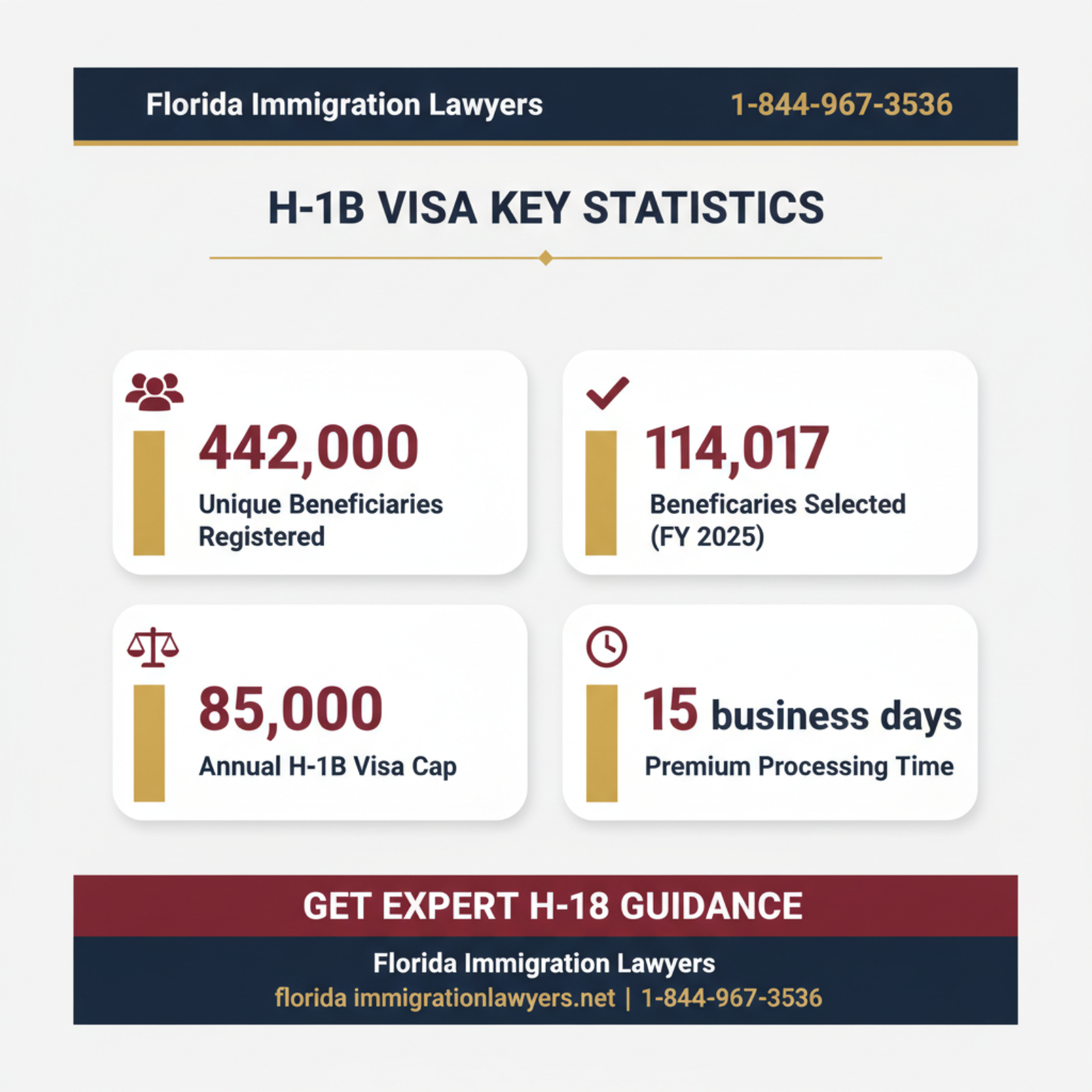
The H-1B visa program is subject to an annual numerical cap, currently set at 65,000 visas, with an additional 20,000 visas reserved for those with a U.S. master's degree or higher. This cap often leads to a highly competitive H-1B visa lottery, making strategic planning crucial for Florida employers. Certain organizations, such as non-profit research organizations and universities, are cap-exempt. You can find more details on cap-exempt employers on the USCIS website.
The H-1B Visa Application Process for Florida Businesses
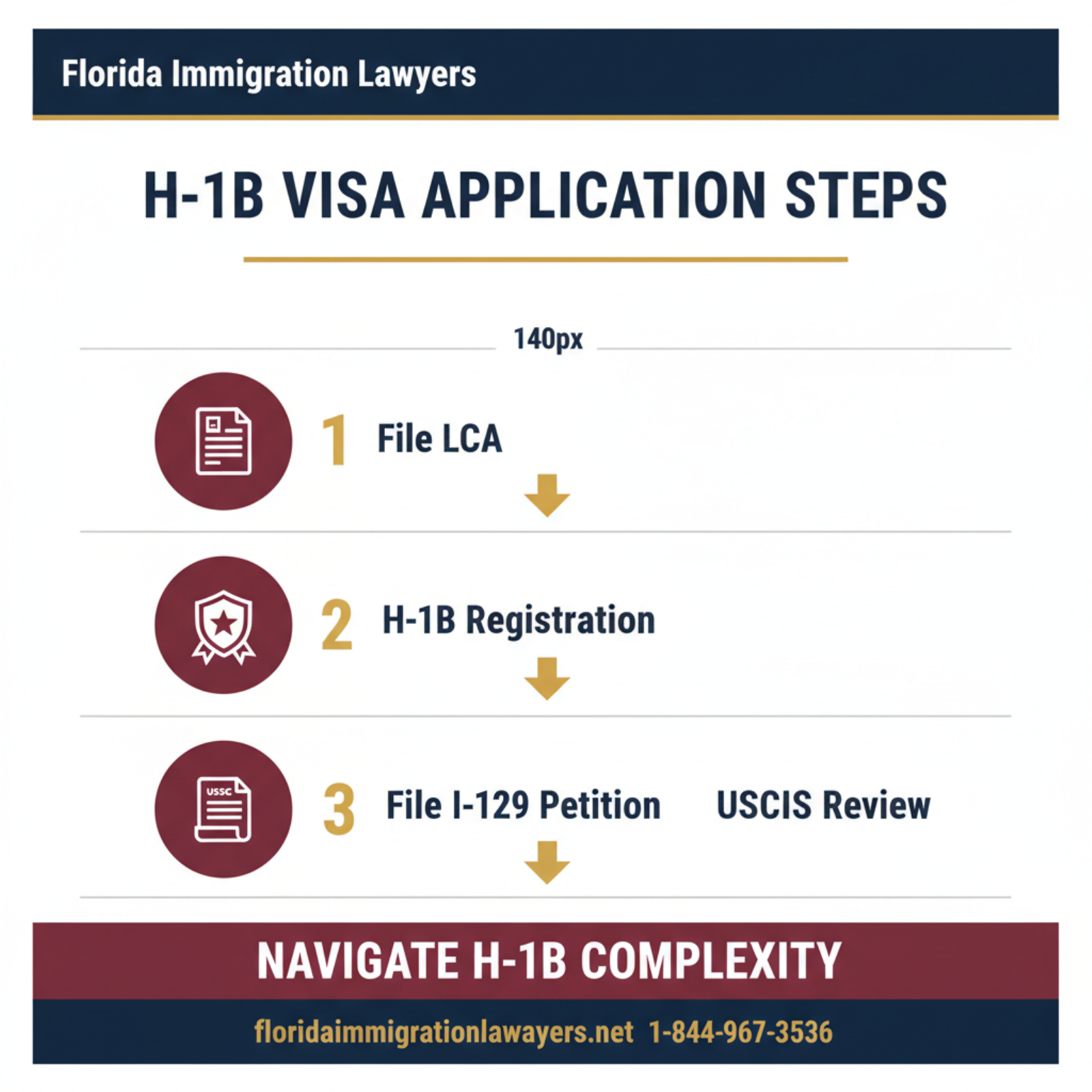
Sponsoring an H-1B work visa for a foreign national involves several critical steps. As a Florida employer, understanding each stage will help you navigate the process efficiently and compliantly. This guide details the typical H-1B visa application journey.
Step 1: Determine Eligibility and Job Requirements
- Identify a Specialty Occupation: Ensure the position you are offering qualifies as a specialty occupation. This means the job typically requires a bachelor's degree or higher in a specific field. For example, a software engineer position would generally qualify.
- Assess Employee Qualifications: Verify that the prospective employee meets the educational or experience requirements for the specialty occupation. This usually involves a bachelor's degree or its foreign equivalent, or extensive specialized work experience.
- Meet Wage Requirements: You must offer the H-1B worker at least the prevailing wage for the occupation in the area of employment, or the actual wage paid to other employees with similar experience and qualifications, whichever is higher. This protects both U.S. and foreign workers.
Step 2: File a Labor Condition Application (LCA)
- Prepare and File Form ETA-9035: Before filing the H-1B petition, you must submit a Labor Condition Application (LCA) to the U.S. Department of Labor (DOL). This form attests that you will pay the prevailing wage, provide working conditions that will not adversely affect other workers, and notify employees of the H-1B filing.
- Obtain LCA Certification: The DOL reviews the LCA for completeness and accuracy. Once certified, typically within 7 business days, you can proceed to the next step. Without a certified LCA, USCIS will not accept your H-1B petition. More information on LCAs can be found on the Department of Labor's website.
Step 3: H-1B Cap Registration and Lottery (if applicable)
- Register for the H-1B Lottery: If the H-1B cap is expected to be met, USCIS conducts an electronic registration process. Employers must register each prospective H-1B worker during a designated registration period, typically in March, for the fiscal year starting October 1st.
- Await Lottery Results: USCIS conducts a lottery if demand exceeds the available H-1B visas. Selected registrants are then invited to file an H-1B petition. This H1B visa lottery process makes early planning essential for Florida businesses.
Step 4: File Form I-129, Petition for a Nonimmigrant Worker
- Prepare the H-1B Petition: For selected registrants (or cap-exempt employers), prepare Form I-129, Petition for a Nonimmigrant Worker, along with supporting documentation. This is the core H-1B visa application.
- Submit to USCIS: File the complete petition package with the appropriate USCIS Service Center (e.g., California or Vermont Service Center). Include the certified LCA, educational documents, employment letters, and other evidence. Ensure all documents are translated if not in English.
Step 5: Await USCIS Decision and Consular Processing/Change of Status
- Receive USCIS Decision: USCIS will review your petition. This may involve requests for evidence (RFEs) if more information is needed. If approved, USCIS sends an I-797 Approval Notice.
- Consular Processing or Change of Status:
- Consular Processing: If the beneficiary is outside the U.S., they will attend an interview at a U.S. embassy or consulate in their home country to obtain the H-1B visa stamp.
- Change of Status: If the beneficiary is already in the U.S. in a different nonimmigrant status (e.g., F-1 student), and USCIS approved a change of status, they can begin working on the H-1B start date (typically October 1st).
Essential Documents for H-1B Visa Sponsorship
Accurate and complete documentation is paramount for a successful H-1B visa application. Florida employers sponsoring H-1B workers must compile a thorough packet of materials for both the U.S. Department of Labor and USCIS. Missing or incorrect documents can lead to delays or denials.
Employer-Specific Documents:
- Certified Labor Condition Application (LCA) Form ETA-9035.
- Employer's Federal Employer Identification Number (FEIN).
- Company financial statements, tax returns, or annual reports to demonstrate ability to pay the H-1B worker.
- Detailed job description, including duties, responsibilities, and minimum H1B visa requirements for the specialty occupation.
- Evidence of the employer-employee relationship (e.g., offer letter, employment contract).
- Organizational charts, if relevant, to show the position within the company.
- Copy of business license or articles of incorporation for Florida businesses.
Employee-Specific Documents:
- Copies of all academic degrees (bachelor's, master's, etc.) and transcripts.
- Foreign degree evaluations, if applicable, to show equivalency to a U.S. degree.
- Professional licenses or certifications required for the occupation.
- Resumes or CVs detailing work experience.
- Letters of experience from previous employers.
- Copies of passport, previous U.S. visas, and I-94 arrival/departure records.
- Any previous USCIS approval notices (e.g., I-797 for F-1 OPT or previous H-1B).
- Marriage certificate and birth certificates for any dependents (H-4 visa applicants).
Remember, all foreign language documents must be accompanied by a certified English translation. Organizing these materials meticulously is a significant step towards a smooth H-1B visa application process for your Florida business.
H-1B Visa Timelines and Processing Expectations for 2026
Planning is crucial for the H-1B visa process, especially given the annual cap and lottery. Understanding the typical timelines will help your Florida business prepare effectively for 2026. The H-1B cap registration usually occurs in March, with the new fiscal year starting October 1st.
Key Dates and Periods:
- March (Early): H-1B Cap Electronic Registration Period opens. This is typically a short window, often lasting about two weeks. Employers in Homestead and across Florida must register prospective employees during this time.
- Late March: USCIS announces selected registrations for the H-1B visa lottery. Only those selected can proceed to file a petition.
- April 1st - June 30th (approx.): Filing window for H-1B cap-subject petitions for selected registrants. This 90-day period is critical for submitting the full H-1B visa application package.
- October 1st: The earliest date an approved H-1B worker can begin employment for the new fiscal year. This is the official start of the H-1B fiscal year.
Processing Times:
- LCA Processing: Typically 5-7 business days for DOL certification.
- USCIS I-129 Petition Processing: Standard processing times can vary significantly, ranging from a few months to over a year, depending on the service center workload and current USCIS policies. You can check current processing times on the USCIS website.
- Premium Processing: For an additional fee, employers can opt for premium processing, which guarantees USCIS action (approval, denial, RFE, or notice of intent to deny) within 15 calendar days. This service is often available for H-1B petitions, providing a faster decision.
Due to the competitive nature of the H-1B visa lottery and fluctuating processing times, starting your preparation early in the year is highly recommended. For Florida businesses, particularly those in rapidly expanding sectors, proactive planning for the H-1B visa program is essential to secure talent by the October 1st start date.
Understanding H-1B Visa Costs and Fees
Sponsoring an H-1B visa involves several fees that Florida employers must consider. These costs can vary based on the size of your company and whether you utilize premium processing. It's important to budget appropriately for the H-1B visa application process.
Primary Fees for H-1B Petitions:
- USCIS Filing Fee (Form I-129): This is the base fee for filing the petition for a nonimmigrant worker.
- American Competitiveness and Workforce Improvement Act (ACWIA) Fee: This fee varies based on the size of the employer. For employers with 25 or fewer full-time equivalent employees, it's one amount; for those with 26 or more, it's a higher amount. This fee funds U.S. worker training and education programs.
- Fraud Prevention and Detection Fee: This fee applies to all initial H-1B petitions and to petitions for H-1B workers changing employers.
- Public Law 114-113 Fee (if applicable): This additional fee applies to employers who employ 50 or more employees in the U.S., with more than 50 percent of those employees in H-1B or L-1 nonimmigrant status. This is often referred to as the "50/50 rule" fee and is a significant cost. This is the fee sometimes inaccurately referred to as the "$100,000 fee" when discussing high costs for certain employers.
- Premium Processing Fee (optional): If you choose premium processing for expedited review, an additional fee is required.
Additional Potential Costs:
- Attorney Fees: Legal fees for preparing and filing the H-1B petition. While not legally mandated, retaining an experienced immigration attorney like Florida Immigration Lawyers is highly recommended to ensure compliance and maximize success.
- Educational Credential Evaluations: If the foreign degree is not from a U.S. institution, an evaluation by a recognized agency is often necessary.
- Translation Services: Costs associated with translating foreign language documents into English.
- Travel Expenses: For beneficiaries undergoing consular processing, travel to a U.S. embassy or consulate may incur costs.
It's generally the employer's responsibility to pay the USCIS filing fees and the ACWIA fee. The fraud prevention and detection fee is also typically paid by the employer. While some costs, like attorney fees, can sometimes be negotiated, it is crucial to understand the legal requirements regarding who pays which fees. Employers should consult 8 CFR 214.2(h)(4)(iii)(B) for detailed regulations on employer obligations for fees and wages.
Common Mistakes to Avoid in H-1B Visa Sponsorship
The H-1B visa process is complex, and even minor errors can lead to significant delays, requests for evidence (RFEs), or outright denials. Florida employers should be aware of these common mistakes to ensure a smoother H-1B visa application journey.
- Failing to Meet Prevailing Wage Requirements: Not paying the H-1B worker at least the prevailing wage for the occupation in the specific geographic area, or the actual wage paid to other similar employees, is a critical compliance issue. This can result in DOL investigations and penalties.
- Incorrectly Defining a Specialty Occupation: Submitting an H-1B petition for a position that does not clearly require a bachelor's degree or higher in a specific field can lead to a denial. The job duties must align with specialty occupation criteria.
- Incomplete or Inaccurate LCA: Errors or omissions on the Labor Condition Application (LCA), Form ETA-9035, will cause delays in certification from the Department of Labor, preventing the H-1B petition from being filed with USCIS.
- Missing H-1B Cap Registration Deadline: For cap-subject petitions, failing to register during the designated electronic registration period in March means your petition cannot be considered for that fiscal year. This is a common and costly mistake for Florida businesses.
- Insufficient Documentation: Submitting a petition without all required supporting documents, such as academic transcripts, degree evaluations, employment letters, or company financials, will almost certainly result in an RFE and prolong the process.
- Lack of Evidence of Employer-Employee Relationship: USCIS scrutinizes whether a valid employer-employee relationship exists, especially for third-party placements. Failure to provide sufficient evidence of control over the H-1B worker can lead to denial.
- Not Responding to RFEs Promptly and Thoroughly: Receiving a Request for Evidence (RFE) means USCIS needs more information. Failing to respond within the deadline or providing an inadequate response can lead to denial.
- Failing to Notify USCIS of Material Changes: If there are significant changes to the H-1B worker's employment (e.g., job duties, work location, employer merger), an amended H-1B petition may be required. Not filing an amendment can jeopardize the worker's status.
- Ignoring Public Access File Requirements: Employers are required to maintain a public access file for each H-1B worker, containing specific documents related to the LCA. Failure to do so can result in penalties during a DOL audit.
- Misunderstanding Cap-Exemptions: Incorrectly assuming your organization or a specific H-1B petition is cap-exempt can lead to a rejected petition if it's actually subject to the annual lottery.
When to Call a Lawyer for Your H-1B Visa Needs
While this guide provides a comprehensive overview, the H-1B visa process is intricate and constantly evolving. There are specific scenarios where the expertise of an experienced immigration attorney, like those at Florida Immigration Lawyers, becomes invaluable for your Florida business.
Consider seeking legal counsel if your case involves:
- Complex Specialty Occupation Definitions: If the job duties for your position are not clearly defined as a specialty occupation, an attorney can help articulate the requirements to USCIS.
- Previous Denials or RFEs: If your business has previously faced H-1B denials or received complex RFEs, legal assistance is crucial to address underlying issues and strengthen future petitions.
- Unusual Employment Structures: For third-party placements, consulting arrangements, or other non-traditional employment models, proving a valid employer-employee relationship can be challenging.
- Changes in Employment: If an H-1B employee's job duties, work location, or salary change significantly, an attorney can advise if an amended petition is required and help file it correctly.
- Compliance Audits: If your business is subject to a Department of Labor (DOL) audit regarding H-1B compliance, legal representation is essential to protect your interests.
- H-1B Cap-Exempt Eligibility: Determining if your organization qualifies for a cap-exempt H-1B petition can be complex. An attorney can assess your eligibility and guide you through the process.
- Navigating the H-1B Visa Lottery: While the lottery itself is random, an attorney ensures your registration is accurate and complete, and your subsequent petition is strong if selected.
The immigration landscape is dynamic, with laws and policies subject to frequent changes. Relying on outdated information or attempting to navigate the system without professional guidance can lead to costly errors and delays. Florida Immigration Lawyers are dedicated to helping businesses throughout Florida, including Homestead, successfully manage their immigration needs. We offer tailored advice and comprehensive support for all aspects of the H-1B visa program, from initial strategy to petition filing and post-approval compliance. Protect your business and secure your talent by partnering with us. For more information on how we can help with business immigration matters, visit our practice area page.
About Florida Immigration Lawyers
Florida Immigration Lawyers is a leading law firm dedicated to providing exceptional immigration legal services across the entire state of Florida. Our team of experienced attorneys understands the unique challenges faced by individuals and businesses in the complex world of U.S. immigration law. We are committed to offering compassionate, client-focused representation and achieving the best possible outcomes for our clients.
We specialize in a broad range of immigration matters, including work visas like the H-1B visa, family-based immigration, business immigration, deportation defense, asylum, citizenship, and more. Our attorneys are well-versed in the latest immigration policies and procedures, ensuring that our advice is always current and relevant. Whether you are an individual seeking to live and work in Florida or a business looking to sponsor foreign talent, we are here to guide you.
Why choose Florida Immigration Lawyers? We pride ourselves on our deep legal expertise, personalized approach, and unwavering dedication to our clients. We offer transparent communication and work diligently to simplify complicated legal processes for you. Our firm serves all of Florida, including Homestead, Miami, Orlando, Tampa, and beyond, providing accessible and effective legal solutions.
Contact us today:
Phone: 1-844-967-3536
Website: https://www.floridaimmigrationlawyers.net
We are available 24/7 for your convenience and offer free consultations to discuss your specific immigration needs. For a direct consultation, you may contact us here.
Sources and References
- U.S. Citizenship and Immigration Services (USCIS) - H-1B Specialty Occupations
- USCIS Processing Times
- U.S. Department of Labor (DOL) - H-1B Program
- 8 U.S.C. § 1101 et seq. - Immigration and Nationality Act (INA)
- 8 CFR Part 214.2(h) - Petitions for Nonimmigrant Workers
- 20 CFR Part 655 - Temporary Employment of Aliens in Specialty Occupations
This article provides general legal information and is not intended as legal advice. Every case is unique, and outcomes depend on specific facts and circumstances. The immigration laws and regulations are subject to frequent changes. Contact an attorney for advice about your particular situation and the most current information. Florida Immigration Lawyers are not responsible for any actions taken based on the information provided herein without direct legal consultation.
Florida Immigration Lawyers
Legal Team
Our experienced attorneys at Florida Immigration Lawyers have been serving clients across Florida for over 20 years. We specialize in immigration, personal injury, criminal defense, workers compensation, and family law.