Motion to Reopen Immigration Case Florida: Your 2026 Guide
Understanding a motion to reopen an immigration case in Florida is crucial for individuals facing deportation or adverse decisions. This legal mechanism allows you to ask an Immigration Judge or the Board of Immigration Appeals to reconsider your case based on new, material evidence or changed circumstances. Strict deadlines and complex legal requirements apply, making expert legal guidance essential. Whether you're in Kissimmee, Orlando, or anywhere in Florida, learning about eligibility, the filing process, and common pitfalls can significantly impact your future. Florida Immigration Lawyers is here to provide the support and expertise needed to navigate this challenging process, offering a potential path to a second chance.

A motion to reopen immigration case Florida allows you to ask an Immigration Judge or the Board of Immigration Appeals (BIA) to reconsider a previous decision in your removal proceedings. This typically requires presenting new facts or evidence that were not available or presented at the original hearing. It's a critical tool for those seeking to challenge an adverse immigration decision, especially in complex deportation cases across Florida.
- Motions to reopen generally require new, material evidence.
- Strict deadlines, usually 90 days, apply from the final order date.
- Exceptions exist for `in absentia` orders or asylum claims.
- It's filed with the Immigration Court or the BIA, depending on jurisdiction.
- Legal assistance is crucial due to the complexity and high stakes.
Motion to Reopen Immigration Case Florida: Your 2026 Guide
Imagine receiving a final order of removal or deportation, feeling like all hope is lost. This can be a devastating experience for you and your family, especially if you have deep roots in Florida. Perhaps new evidence has emerged, or you missed a crucial hearing due to circumstances beyond your control. In such challenging times, the immigration system offers a potential pathway for relief: the motion to reopen immigration case Florida.
For individuals and families across Florida, from Kissimmee to Miami, understanding your options is paramount. A motion to reopen can be a powerful legal tool, potentially offering a second chance to present your case and avoid deportation. However, these motions are complex, governed by strict rules and deadlines, and require compelling new evidence or a valid legal argument.
This comprehensive guide from Florida Immigration Lawyers will walk you through the intricacies of filing a motion to reopen your immigration case in Florida. We will cover eligibility, the step-by-step process, necessary documentation, and common pitfalls to avoid. Our goal is to empower you with the knowledge needed to navigate this critical phase of your immigration journey. If you find yourself facing an adverse immigration decision, do not delay. Call Florida Immigration Lawyers at 1-844-967-3536 for a free consultation to discuss your specific situation and explore your options. You can also learn more about our general immigration services.
Understanding a Motion to Reopen Immigration Case in Florida
A motion to reopen is a formal request made to an Immigration Judge (IJ) or the Board of Immigration Appeals (BIA) to reconsider a decision previously made in your immigration case. This mechanism is crucial when new facts or evidence become available that could significantly alter the outcome of your case. It essentially asks the court or board to revisit proceedings that they have already concluded, providing a vital opportunity for justice.
In Florida, where many individuals face complex immigration challenges, understanding the purpose and scope of a motion to reopen is essential. This legal remedy is distinct from an appeal, which challenges the legal correctness of a decision based on the existing record. A motion to reopen, conversely, introduces new information that was not part of the original record or was previously unavailable.
The legal framework for motions to reopen is primarily found in the Immigration and Nationality Act (INA) and its corresponding regulations. Specifically, INA § 240(c)(7) and 8 CFR § 1003.23 (for Immigration Courts) and 8 CFR § 1003.2 (for the BIA) outline the rules governing these motions. These statutes and regulations define who can file, when they can file, and what must be included in the motion. For anyone in Florida facing an order of removal, this process can feel overwhelming, underscoring the importance of skilled legal guidance.
Eligibility Requirements for a Motion to Reopen
To successfully file a motion to reopen immigration case Florida, you must meet stringent eligibility criteria. Generally, you need to demonstrate that there are new, material facts that were not available and could not have been discovered or presented at the previous hearing. This new evidence must be relevant and significant enough to potentially change the outcome of your case.
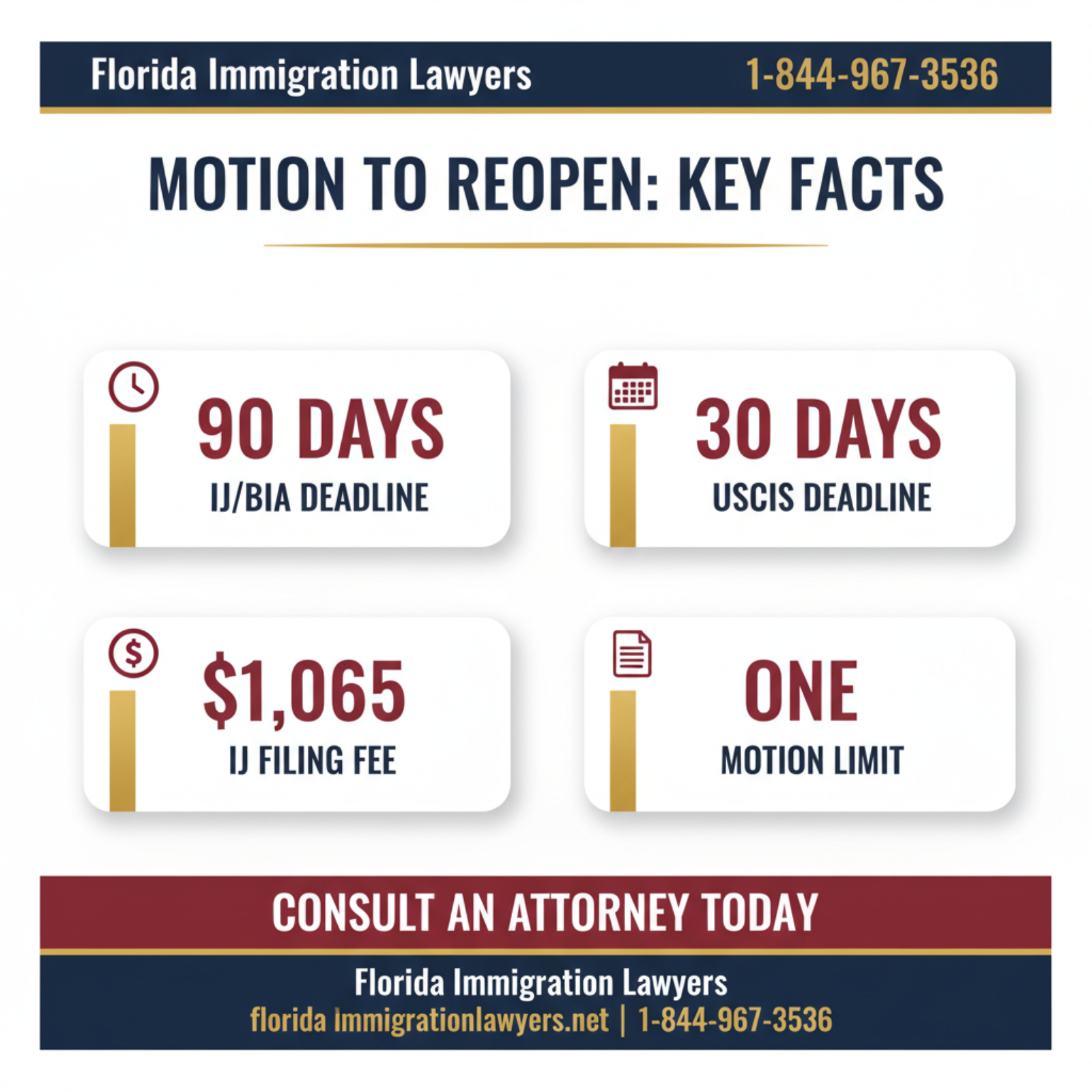
A critical aspect of eligibility is the strict time limit. Typically, a motion to reopen must be filed within 90 days of the date of the final administrative order of removal or deportation. This deadline is strictly enforced, and missing it can result in your motion being denied, regardless of the strength of your new evidence. However, there are important exceptions to this 90-day rule that can offer relief in specific situations.
Special Circumstances for Reopening Your Case
Several exceptions can extend or waive the 90-day filing deadline for a motion to reopen:
- `In Absentia` Orders: If you received an order of removal `in absentia` (meaning you were ordered removed because you failed to appear at a hearing), you may have up to 180 days to file a motion to reopen. You must demonstrate that your failure to appear was due to exceptional circumstances, such as serious illness, death of a close relative, or a natural disaster. Alternatively, you may argue that you did not receive proper notice of the hearing. This is a common situation for many in Florida who might have moved or had issues with mail delivery.
- Asylum Claims: There is no time limit for filing a motion to reopen to apply for asylum, withholding of removal, or protection under the Convention Against Torture, if the motion is based on changed country conditions in your home country. This exception requires compelling evidence that conditions have materially changed in a way that directly impacts your fear of persecution or torture.
- Joint Motions: If the government (DHS counsel) agrees, you can file a joint motion to reopen, which is not subject to the 90-day time limit or the one-motion limit. This often occurs when there is a change in law or policy, or when the government acknowledges a procedural error.
- Motions Based on Fraud or Misrepresentation: In rare cases, if the original decision was procured by fraud or misrepresentation, there may be grounds to reopen the case without strict time limits.
Understanding these exceptions is vital, as they can provide a lifeline even after the standard deadline has passed. Each exception has its own specific requirements and evidentiary burdens. Consulting with an attorney is essential to determine if any of these special circumstances apply to your situation and to build a strong argument.
The Step-by-Step Process to File a Motion to Reopen in Florida
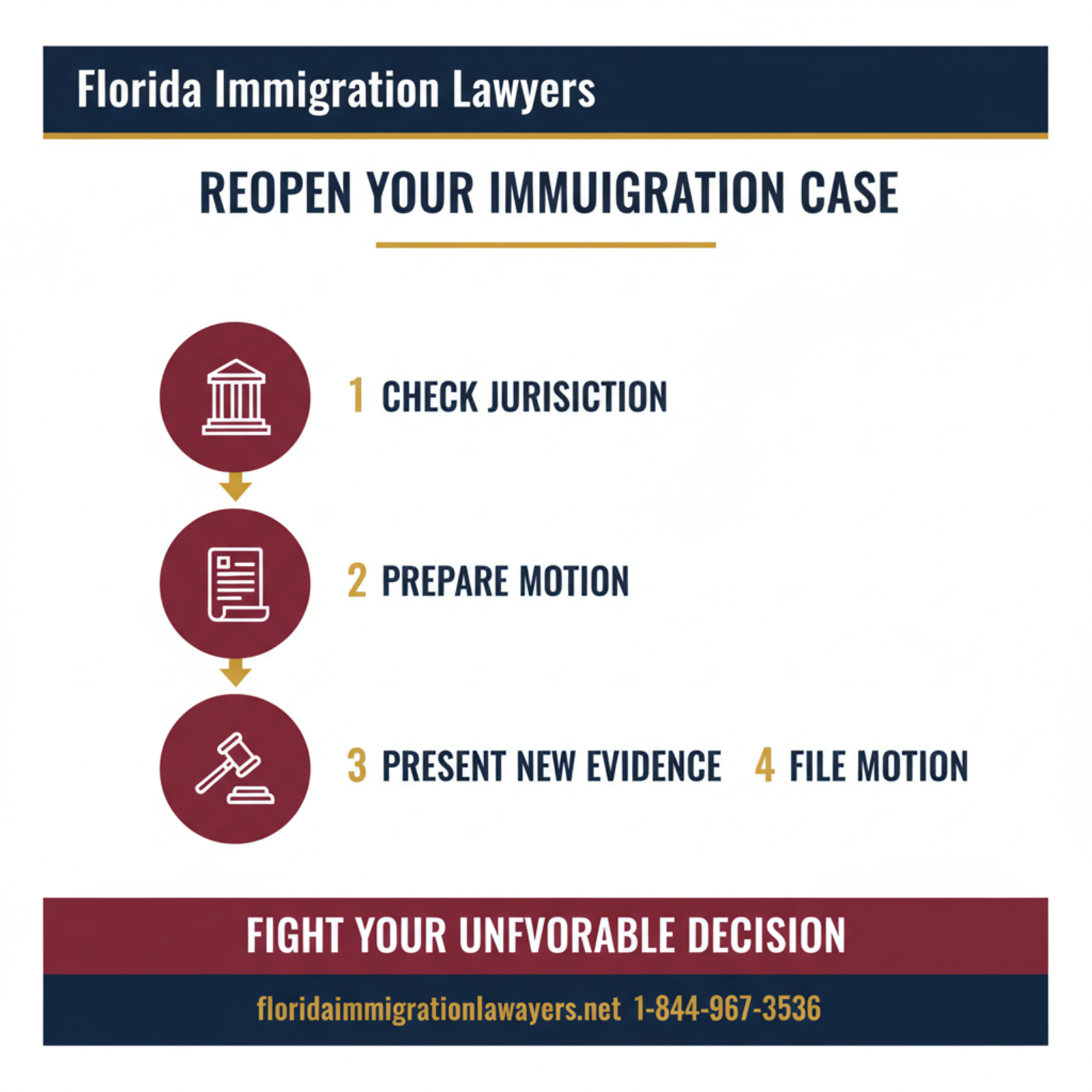
Filing a motion to reopen immigration case Florida is a detailed process that requires careful preparation and adherence to strict legal procedures. Here is a general step-by-step guide:
-
Determine Jurisdiction: Immigration Court or BIA? Your first step is to identify where to file your motion. If the Immigration Judge issued the last decision in your case and no appeal was filed, you generally file with the Immigration Court (e.g., Orlando Immigration Court or Miami Immigration Court). If the Board of Immigration Appeals (BIA) issued the last decision, your motion must be filed with the BIA in Falls Church, Virginia. This distinction is crucial for proper filing.
-
Gather New Evidence and Facts: The cornerstone of a successful motion to reopen is compelling new evidence. This evidence must be material, meaning it is relevant to the issues in your case and could potentially change the outcome. It also must be evidence that was not available or could not have been presented at the previous hearing. This might include new documents, expert opinions, affidavits from witnesses, or proof of changed country conditions. For those seeking asylum, this is particularly important.
-
Draft the Motion and Legal Arguments: The motion itself is a formal legal document that includes a written argument explaining why your case should be reopened. It must clearly state the new facts, provide legal citations supporting your request, and explain how the new evidence or changed circumstances warrant a different decision. You must also explain why this evidence was not presented earlier. This requires a strong understanding of immigration law and persuasive writing.
-
Prepare Supporting Documents: Attach all supporting evidence as exhibits to your motion. This includes affidavits, birth certificates, marriage certificates, medical records, police reports, or any other documents that substantiate your claims. All documents not in English must be accompanied by a certified English translation. For an approved I-130 after a removal order, this is vital evidence.
Step-by-Step Process Guide -
File with the Court/BIA and Serve the Government: Submit the original motion and all supporting documents, along with the required filing fee or a fee waiver request, to the appropriate court or board. You must also serve a copy of the motion and all exhibits on the opposing counsel, typically the Department of Homeland Security (DHS) Office of Chief Counsel. Proof of service must be filed with the court. This is a critical procedural step; failure to properly serve the government can lead to denial.
-
Monitor for a Decision: After filing, the court or BIA will review your motion. They may issue a decision based solely on the written filings, or they may request a response from the government. In some cases, they might schedule a hearing to hear oral arguments. The processing time can vary significantly. You can monitor the status of your case through the Executive Office for Immigration Review (EOIR) website. Learn more about the EOIR process at justice.gov/eoir.
Essential Documents for Your Motion to Reopen
Preparing a thorough package of documents is crucial for a successful motion to reopen immigration case Florida. The evidence must be new, material, and previously unavailable. Here is a checklist of documents typically required or highly beneficial:
- Form EOIR-42B: This is the official form for a motion to reopen with the Immigration Court. For the BIA, it’s typically a written motion.
- Affidavits: Sworn statements from you, family members, or other witnesses, detailing new facts or circumstances.
- New Documentary Evidence: This could include medical records (especially for `in absentia` cases due to illness), police reports, birth certificates, marriage certificates, or divorce decrees if your family situation has changed.
- Expert Witness Statements: For complex cases or asylum claims, an expert's opinion on country conditions or psychological evaluations can be powerful.
- Proof of Changed Country Conditions: For asylum-based motions, current reports from human rights organizations, government agencies, or news articles demonstrating a significant change in your home country.
- Approved Petitions: If you now have an approved immigrant petition (e.g., an approved I-130), this is critical new evidence.
- Proof of Notice Issues: If filing an `in absentia` motion, evidence such as returned mail, affidavits from postal workers, or testimony that you did not receive proper notice of your hearing.
- Prior Applications: Copies of any previous applications for relief you filed.
- Filing Fee or Fee Waiver Request: The appropriate fee or Form EOIR-26A (Motion for Fee Waiver) must be included.
- Proof of Service: Documentation showing that you served a copy of your motion to DHS counsel.
Organizing these documents meticulously and ensuring they directly support your legal arguments is paramount. Any missing or improperly presented evidence can jeopardize your motion.
Timeline and Processing Expectations for Motions to Reopen in Florida
The processing time for a motion to reopen immigration case Florida can vary significantly. There is no guaranteed timeline, as it depends on several factors:
- Jurisdiction: Motions filed with the BIA generally take longer than those filed with an Immigration Court.
- Court Backlog: Immigration Courts in Florida, like Orlando or Miami, often have heavy dockets, which can delay processing.
- Complexity of the Case: More complex cases requiring extensive review or additional evidence may take longer.
- Government Response: If DHS counsel requests time to respond to your motion, this will extend the timeline.
- Judge/Board Member Discretion: The individual judge or board member assigned to your case can also influence processing speed.
Typically, you can expect a decision anywhere from several months to over a year. While awaiting a decision, you may be able to request a stay of removal, which temporarily halts any deportation efforts. This is not automatic and must be specifically requested, usually through a separate motion to stay removal.
What Happens After You File?
Once you file your motion to reopen, the Immigration Court or BIA will review it. They will assess whether you have met the legal requirements, particularly concerning the newness and materiality of your evidence and adherence to filing deadlines. If the motion is granted, your case will be reopened, and you will typically be scheduled for a new hearing before an Immigration Judge to present your case or apply for relief from removal. If the motion is denied, you may have limited options, potentially including an appeal to a higher court in certain circumstances.
Cost Factors and Fee Breakdown for Immigration Cases in Florida
When considering a motion to reopen immigration case Florida, it is important to understand the potential costs involved. These generally fall into two main categories:
-
Government Filing Fees: The Executive Office for Immigration Review (EOIR) charges a filing fee for a motion to reopen. This fee is subject to change, so it is crucial to check the most current fee schedule on the EOIR website before filing. If you cannot afford the fee, you may be eligible for a fee waiver by submitting Form EOIR-26A, Motion for Fee Waiver, along with supporting documentation demonstrating your financial hardship. Certain motions, such as those solely for asylum, may be exempt from fees.
-
Legal Fees: Working with an experienced immigration attorney is highly recommended for motions to reopen due to their complexity. Legal fees can vary depending on the complexity of your case, the amount of evidence to be gathered, and the attorney's experience. Attorneys may charge an hourly rate or a flat fee for these services. During your initial consultation, your attorney should provide a clear breakdown of their fees and any associated costs.
Additional costs might include fees for obtaining certified copies of documents, translation services for non-English documents, and potentially expert witness fees if your case requires specialized testimony. While these costs can seem daunting, investing in proper legal representation can significantly increase your chances of success and prevent costly errors.
Do not navigate this process alone. Contact Florida Immigration Lawyers today to discuss your specific circumstances and how we can assist you with your motion to reopen. We offer personalized legal strategies for clients throughout Florida.
Common Mistakes to Avoid When Filing a Motion to Reopen
Filing a motion to reopen immigration case Florida is fraught with potential pitfalls. Avoiding these common mistakes is crucial for the success of your motion:
-
Missing the Filing Deadline: The 90-day deadline (or 180 days for `in absentia` orders) is strictly enforced. Filing even one day late can result in an automatic denial, regardless of the merits of your case. Always file well in advance.
-
Failing to Present "New" and "Material" Evidence: Simply re-submitting old evidence or presenting evidence that would not change the outcome is insufficient. The evidence must be genuinely new, relevant, and impactful. Consequences: Your motion will be denied for failing to meet the evidentiary standard.
-
Filing with the Wrong Jurisdiction: Filing with the Immigration Court when the BIA had the last decision, or vice-versa, will lead to your motion being rejected. Consequences: Wasted time, missed deadlines, and potential loss of opportunity.
-
Not Properly Serving DHS Counsel: You must serve a copy of your motion and all exhibits to the Department of Homeland Security (DHS) Office of Chief Counsel and file proof of service with the court. Consequences: Your motion can be denied for procedural deficiencies.
-
Not Explaining Why Evidence Was Previously Unavailable: If you are presenting new evidence, you must clearly explain why you could not have presented it at the original hearing. Consequences: The court may find your evidence lacks the "previously unavailable" element.
-
Submitting Incomplete or Incorrect Forms: Using outdated forms or omitting required information can cause delays or outright rejection. Consequences: Your motion may be rejected, wasting valuable time and potentially missing deadlines.
-
Not Requesting a Stay of Removal (if applicable): If you are under an order of removal, filing a motion to reopen does not automatically stop your deportation. You typically need to file a separate motion to request a stay of removal. Consequences: You could be deported while your motion is pending.
-
Exceeding Page Limits: Both the Immigration Court and the BIA have strict page limits for motions and briefs. Consequences: The court may reject your filing or only consider the first few pages.
-
Lack of Legal Argument: A motion is not just a collection of documents; it requires a clear, concise, and persuasive legal argument. Consequences: The court may not understand the legal basis for your request, leading to denial.
-
Failing to Address "People Also Ask" Questions: The court expects you to address all relevant legal points. Consequences: Your motion may be seen as incomplete or not fully argued.
-
Attempting to Handle it Alone: The legal complexities, strict deadlines, and high stakes of a motion to reopen make it extremely difficult for non-attorneys to succeed. Consequences: A high likelihood of denial due to technical errors or weak legal arguments, potentially leading to deportation.
When to Call a Lawyer for Your Motion to Reopen Immigration Case
Given the complexities, strict deadlines, and high stakes involved, it is almost always advisable to seek legal counsel when considering a motion to reopen immigration case Florida. Here are specific scenarios where contacting an experienced immigration attorney at Florida Immigration Lawyers is not just helpful, but often critical:
- You have received an order of removal or deportation: This is a clear red flag that immediate legal action may be required.
- You missed a previous immigration hearing (`in absentia` order): An attorney can help you gather evidence of exceptional circumstances or lack of notice.
- New, material evidence has become available: An attorney can assess if your new evidence meets the "new and material" standard and prepare a compelling argument.
- You believe there was an error of law or fact in your previous decision: While a motion to reopen focuses on new facts, sometimes a strong argument can be made regarding the application of law, which an attorney can skillfully craft.
- You are facing a tight deadline (especially the 90-day rule): Time is of the essence, and an attorney can act swiftly to prepare and file your motion correctly.
- Your case involves complex legal issues: This includes criminal convictions, asylum claims based on changed country conditions, or intricate family immigration matters.
- You have previously been denied a motion to reopen: While generally only one motion to reopen is allowed, an attorney can evaluate if any rare exceptions apply or if a different strategy is possible.
- You are unsure about the jurisdiction (Immigration Court vs. BIA): An attorney will correctly identify where to file your motion.
Florida Immigration Lawyers has extensive experience in deportation defense and handling complex motions to reopen for clients throughout Florida. We understand the nuances of immigration law and are committed to protecting your rights and fighting for your future. Do not risk your immigration status by attempting to navigate this challenging process alone.
About Florida Immigration Lawyers
Florida Immigration Lawyers is a leading immigration law firm dedicated to serving individuals and families across the entire state of Florida. With years of specialized experience, our compassionate and skilled legal team is committed to providing exceptional legal representation for a wide range of immigration matters. We understand the profound impact immigration decisions have on your life and are here to offer steadfast support and expert guidance.
Our services include deportation defense, asylum claims, family-based immigration, business immigration, citizenship applications, and complex litigation such as motions to reopen and appeals. We pride ourselves on our client-focused approach, ensuring that you receive personalized attention and strategic advice tailored to your unique circumstances. We are available 24/7 to address your urgent legal needs and offer free, confidential consultations to help you understand your options.
Choosing Florida Immigration Lawyers means partnering with a firm that genuinely cares about your outcome. We are fluent in English and Spanish, ensuring clear communication and culturally sensitive representation. Let us be your trusted advocates in navigating the complexities of U.S. immigration law. You can reach us directly at 1-844-967-3536 or visit our website at https://www.floridaimmigrationlawyers.net to learn more.
Sources and References
- U.S. Citizenship and Immigration Services (USCIS)
- Executive Office for Immigration Review (EOIR)
- 8 U.S.C. Chapter 12 - Immigration and Nationality Act (INA)
- INA § 240(c)(7) - Motions to Reopen
- 8 CFR § 1003.2 - Motions to Reopen before the Board of Immigration Appeals
- 8 CFR § 1003.23 - Motions to Reopen before the Immigration Court
- U.S. Department of State - Bureau of Consular Affairs
This article provides general legal information and is not intended as legal advice. Every case is unique, and outcomes depend on specific facts and circumstances. Contact an attorney for advice about your particular situation.
A motion to reopen can be your last, best chance to remain in the United States and protect your future in Florida. Do not let deadlines or complexities deter you. Take the crucial step of seeking professional legal guidance today. Contact Florida Immigration Lawyers for a free consultation at 1-844-967-3536. Se Habla Español - Estamos aquí para ayudarle.
Do Not Navigate This Process Alone
Our experienced immigration attorneys are ready to fight for you. Get a free, confidential consultation today.
Se Habla Español
Frequently Asked Questions
Florida Immigration Lawyers
Immigration Attorney | Founder, Vasquez Law Firm
U.S. Air Force veteran and immigration attorney with thousands of cases resolved. J.D., NCCU School of Law. AILA member. Admitted to the 4th, 5th, and 11th Circuit Courts.
Available 24/7 - Free Evaluations
Related Legal Services
Our Florida immigration attorneys can help you with deportation defense, citizenship and naturalization and family immigration services. Call today at 1-844-967-3536 for a free consultation.
Related Links
Related Topics
Free Legal Consultation
Discuss your case with our experienced attorneys. We're available 24/7.
Se Habla Español - Estamos aquí para ayudarle.
Related Articles
Stokes Interview: Navigating Marriage Fraud in Florida
A Stokes interview is a specialized, separate interview conducted by USCIS when there are suspicions of marriage fraud in a green card application. This rigorous process involves individual questioning of spouses, focusing on inconsistencies in their testimonies to determine the authenticity of their marital bond. For couples in Florida, navigating this high-stakes interview requires meticulous preparation, extensive documentation, and often the strategic guidance of an experienced immigration lawyer. Understanding the process, preparing for detailed questions, and presenting a strong case are crucial for overcoming marriage fraud allegations and securing your immigration future. Florida Immigration Lawyers stands ready to assist you.
Immigration Attorney Gainesville: North Florida Legal Help
For those in Gainesville, Alachua County, and throughout North Florida, navigating U.S. immigration law requires expert guidance. An experienced immigration attorney can simplify complex processes, from family-based petitions and employment visas to critical asylum claims and deportation defense. This comprehensive guide outlines the essential services provided by an immigration attorney, details necessary documentation, clarifies processing timelines, and discusses associated costs. We also highlight common mistakes to avoid and crucial scenarios where legal counsel is indispensable. Florida Immigration Lawyers serves all of Florida, including Gainesville and St. Petersburg, providing dedicated legal support to help you achieve your immigration goals. Contact us for a free consultation to discuss your specific needs.
Military Naturalization Expedited at Florida Bases
Explore expedited military naturalization processes for service members at Florida bases like MacDill. Learn about eligibility, steps, and common mistakes. Contact Florida Immigration Lawyers for a free consultation.
Protect Yourself from Immigration Scams in Florida
Learn how to protect against immigration scams in Florida, focusing on St. Petersburg. This guide covers identifying scams, verifying credentials, and getting legal help. Call Florida Immigration Lawyers at 1-844-967-3536 for assistance.