H-2B Visa for Florida Hospitality Workers
Explore the H-2B visa for seasonal workers in Florida's hospitality sector. Learn the process, avoid common mistakes, and discover when to seek legal help. Contact Florida Immigration Lawyers today for support.

H-2B Visa for Florida Hospitality Workers | VLF Florida
Florida’s vibrant hospitality industry thrives on a unique blend of sunshine, tourism, and dedicated service. For many businesses, particularly those facing seasonal demands, securing a reliable workforce is paramount. This is where the H-2B visa program plays a critical role, offering a pathway for U.S. employers to bring in foreign nationals to fill temporary non-agricultural jobs. At VLF Florida, we understand the complexities of U.S. immigration law and are committed to guiding both employers and workers through the intricate H-2B visa process, ensuring compliance and successful outcomes.
The H-2B visa is specifically designed for non-immigrant workers who come to the United States temporarily to perform non-agricultural labor or services. This includes a wide array of roles within the hospitality sector, such as hotel staff, restaurant workers, resort employees, and theme park attendants, all of whom are vital to Florida's booming tourism economy. Navigating the requirements, deadlines, and regulations of this program can be challenging, but with expert legal assistance, it becomes a streamlined journey.
Understanding the H-2B Visa Program
The H-2B visa program is a crucial lifeline for U.S. employers who anticipate a shortage of domestic workers to meet their temporary labor needs. Unlike permanent visas, the H-2B is strictly for temporary employment, which can be seasonal, peak load, intermittent, or a one-time occurrence. For Florida’s hospitality businesses, which often experience significant fluctuations in demand based on tourist seasons, events, and holidays, the H-2B program provides the flexibility to staff up when needed without committing to year-round employment for positions that are only temporary.
The program is administered by U.S. Citizenship and Immigration Services (USCIS) in conjunction with the Department of Labor (DOL) and the Department of State (DOS). It requires employers to demonstrate that there are not enough U.S. workers who are able, willing, qualified, and available to perform the temporary work, and that employing H-2B workers will not adversely affect the wages and working conditions of similarly employed U.S. workers. This dual requirement underscores the program's intent: to supplement the U.S. workforce, not replace it. Understanding these foundational principles is the first step toward a successful H-2B application, and VLF Florida is here to demystify each stage of the process.
Eligibility Requirements for H-2B Workers
For a foreign national to be eligible for an H-2B visa, several criteria must be met. Primarily, the worker must have a job offer from a U.S. employer for a temporary non-agricultural position. The job must be one for which the employer has demonstrated a temporary need, as defined by the H-2B regulations. Typically, these are roles that do not require a bachelor's degree or higher, making it accessible to a broad range of skilled and unskilled workers.
- Nationality: Workers must be from eligible countries designated by the Department of Homeland Security (DHS) in consultation with the Department of State. This list is updated annually.
- Job Offer: A legitimate job offer from a U.S. employer for a temporary, non-agricultural position is essential.
- Intent to Return: Applicants must demonstrate their intent to return to their home country upon the expiration of their H-2B visa.
- No Prior Violations: Generally, individuals who have previously violated U.S. immigration laws may be ineligible.
- Qualifications: Workers must meet the minimum job requirements specified by the employer, which may include specific skills, experience, or certifications relevant to the hospitality role.
It's important for prospective H-2B workers to understand these requirements thoroughly to avoid delays or denials. VLF Florida provides comprehensive guidance to ensure workers meet all necessary qualifications.
Eligibility Requirements for Florida Hospitality Employers
Employers in Florida's hospitality sector seeking to utilize the H-2B program must meet stringent requirements to prove their temporary need for foreign workers. The core of an employer's eligibility hinges on demonstrating that their need for labor is truly temporary and falls into one of four categories:
- Seasonal Need: The need is traditionally tied to a season of the year by an event or pattern, and recurs annually (e.g., peak tourist season in Florida).
- Peak Load Need: The employer regularly employs permanent workers, but needs to supplement its permanent staff due to a temporary increase in business.
- Intermittent Need: The employer has not employed permanent workers to perform the services or labor, and occasionally needs temporary workers for short periods.
- One-Time Occurrence: The employer has not employed workers to perform the services or labor in the past, or a permanent employee is temporarily absent, and the temporary workers are needed for a short, non-recurring period.
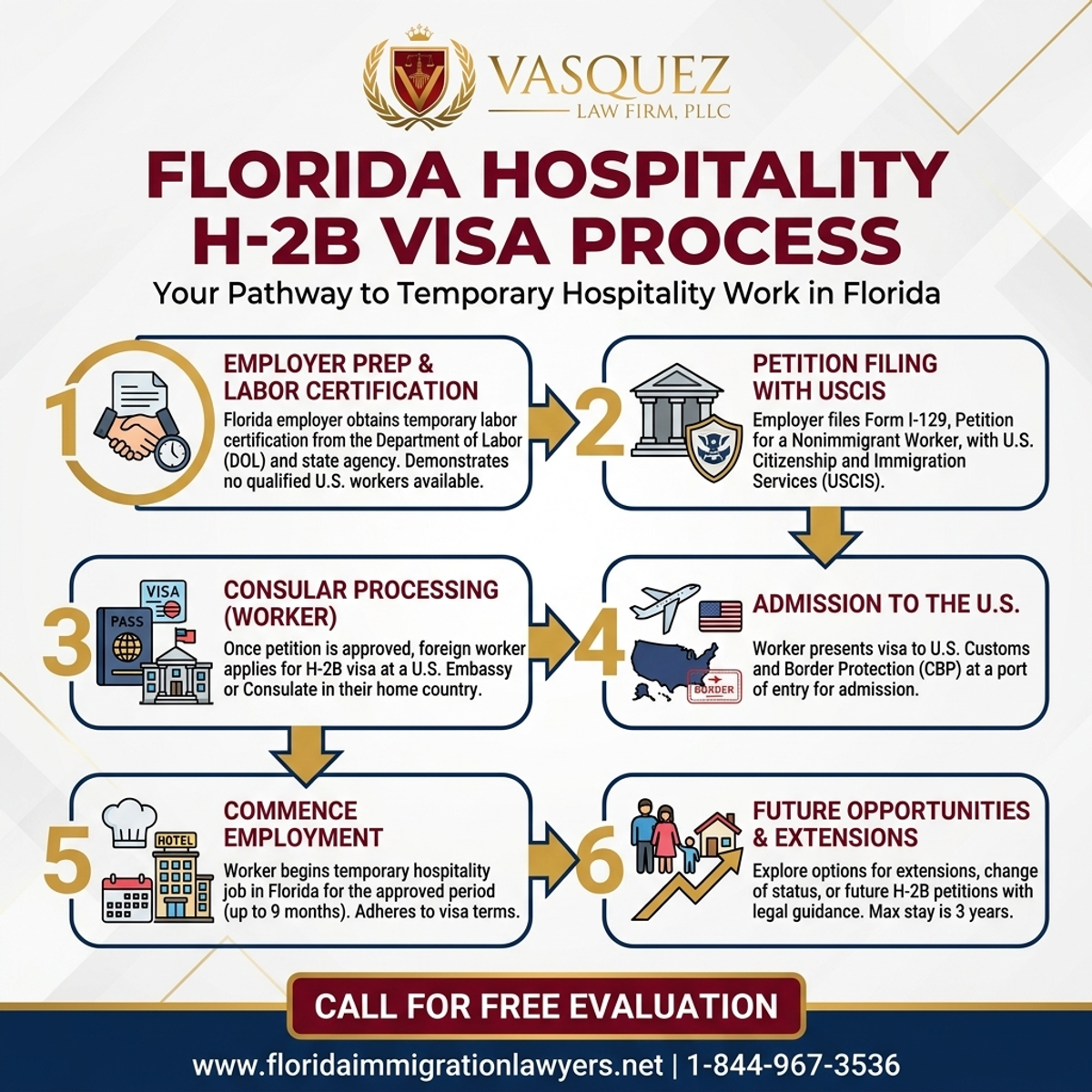
Step-by-Step Process — H-2B Visa for Florida Hospitality Workers | VLF Florida
Beyond demonstrating temporary need, employers must also undertake extensive recruitment efforts to test the U.S. labor market. This involves advertising the job domestically and offering prevailing wages to ensure U.S. workers are not displaced. Furthermore, employers must file a Temporary Labor Certification (TLC) with the Department of Labor, outlining the job details, wages, and working conditions. Compliance with all DOL and USCIS regulations is critical, and any misstep can jeopardize the entire application process. Our team at VLF Florida specializes in assisting Florida hospitality businesses in meticulously preparing and filing all necessary documentation, ensuring adherence to every regulatory detail.
The H-2B Visa Application Process: A Step-by-Step Guide
The H-2B visa application process is multi-faceted and involves several government agencies. Employers must navigate a series of steps, each with its own deadlines and requirements. Understanding this roadmap is crucial for a successful outcome:
Temporary Labor Certification (TLC) from the Department of Labor (DOL)
This is the initial and often most time-consuming step. The employer must first submit a Form ETA-9142B, Application for Temporary Employment Certification, to the DOL. This application details the job offer, wages, working conditions, and the employer's temporary need. Crucially, the employer must conduct a rigorous recruitment process, including advertising the job in the U.S. and contacting former U.S. employees, to demonstrate that there are no qualified U.S. workers available for the position. The DOL reviews these efforts to ensure the U.S. labor market is not adversely affected. Once approved, the DOL issues a Temporary Labor Certification.
Petition Filing with U.S. Citizenship and Immigration Services (USCIS)
With the certified TLC in hand, the employer then files Form I-129, Petition for a Nonimmigrant Worker, with USCIS. This petition includes the certified TLC, a copy of the job offer, and other supporting documentation proving the employer's eligibility and the temporary nature of the work. USCIS reviews the petition to ensure all immigration requirements are met. Due to the annual cap on H-2B visas, timing is critical for this step, as petitions must be filed and approved before the cap is reached for the relevant fiscal half-year.
Visa Interview and Consular Processing
Once the I-129 petition is approved by USCIS, prospective H-2B workers who are outside the U.S. must apply for an H-2B visa at a U.S. embassy or consulate in their home country. This involves completing Form DS-160, Online Nonimmigrant Visa Application, paying the visa fees, and attending an interview. During the interview, consular officers will verify the applicant's eligibility, their intent to return home after their temporary employment, and ensure they are not inadmissible to the U.S. on other grounds.
Admission to the U.S.
Upon successful completion of the consular processing, the H-2B visa is affixed to the worker's passport. The worker can then travel to the United States. At the port of entry, U.S. Customs and Border Protection (CBP) officers will review their documents and grant admission for the period authorized by the H-2B visa. It’s important for workers to carry all relevant documents, including their visa, passport, and a copy of the I-797 approval notice.
Each stage of this process requires meticulous attention to detail and adherence to strict guidelines. VLF Florida provides end-to-end support, from preparing initial applications to advising on consular interviews, ensuring a smooth and efficient journey for both employers and workers.
Key Benefits of the H-2B Visa for Florida's Hospitality Sector
The H-2B visa program offers substantial advantages that significantly benefit Florida's hospitality industry and its economy:
- Addresses Labor Shortages: Florida's tourism sector often experiences peak seasons where the demand for workers outstrips the local supply. The H-2B program allows businesses to fill these critical gaps, ensuring they can maintain high service standards and meet customer expectations, especially during busy periods like spring break or winter holidays.
- Boosts Local Economy: By enabling businesses to operate at full capacity, the H-2B program contributes directly to the local economy. Increased staffing means more services can be provided, leading to higher revenue for businesses, more spending in local communities, and ultimately, a stronger economic environment for Florida.
- Provides Opportunities for Foreign Workers: For foreign nationals, the H-2B visa offers a valuable opportunity to work legally in the U.S., gain international experience, and earn wages that may be significantly higher than those available in their home countries. This can lead to improved economic conditions for their families and communities back home.
- Maintains Competitiveness: In a highly competitive global tourism market, Florida businesses must consistently deliver exceptional experiences. The H-2B program helps them maintain optimal staffing levels, ensuring they remain competitive by providing excellent service without compromising quality due to understaffing.
- Flexibility for Seasonal Businesses: Many hospitality businesses in Florida are inherently seasonal. The H-2B visa provides the necessary flexibility to scale their workforce up or down according to seasonal demand, optimizing operational costs and efficiency.
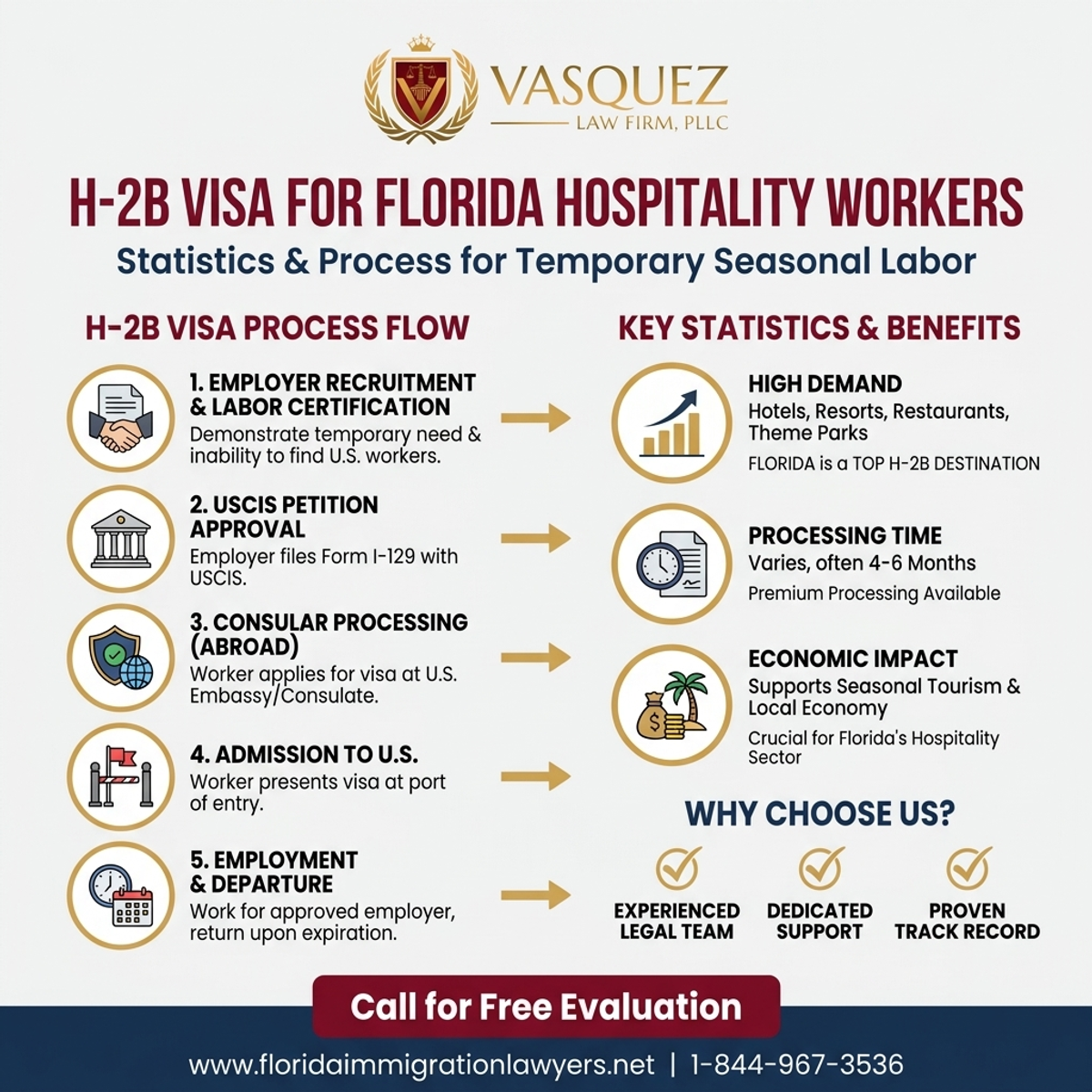
Key Statistics — H-2B Visa for Florida Hospitality Workers | VLF Florida
These benefits highlight the H-2B program's integral role in sustaining and growing Florida's vital hospitality sector, making it a win-win for employers, workers, and the state's economy.
Common Challenges and Pitfalls in the H-2B Process
While the H-2B program offers significant advantages, it is not without its complexities and potential pitfalls. Employers and workers must be aware of these challenges to navigate the process successfully:
- Annual Cap Limitations: One of the most significant challenges is the annual statutory cap of 66,000 H-2B visas per fiscal year, split evenly between the first and second halves of the fiscal year. Demand often far exceeds this cap, leading to lotteries and early exhaustion of available visas. This makes timely filing absolutely critical.
- Strict Deadlines: The H-2B process is characterized by numerous strict deadlines, from filing the Temporary Labor Certification to submitting the I-129 petition. Missing any of these dates can result in delays or outright denial of the application.
- Compliance Issues: Employers must adhere to a complex web of regulations from the DOL, USCIS, and DOS. This includes ensuring prevailing wages are paid, maintaining proper working conditions, and fulfilling all recruitment obligations. Non-compliance can lead to severe penalties, including fines, debarment from the program, and even criminal charges.
- Recruitment Burdens: The requirement to prove a lack of available U.S. workers through extensive recruitment efforts can be time-consuming and resource-intensive for employers. Documenting these efforts meticulously is essential.
- Potential for Fraud and Abuse: Unfortunately, the program can be susceptible to fraud and abuse by unscrupulous recruiters or employers. Both workers and employers must be vigilant to avoid scams and ensure all dealings are legitimate and compliant with U.S. law.
- Changing Regulations: Immigration laws and policies can change, sometimes with little notice. Staying updated on the latest regulations and requirements is a constant challenge for employers.
Given these complexities, engaging experienced legal counsel like VLF Florida is not just beneficial but often essential to mitigate risks and ensure a smooth application process.
Worker Rights and Protections Under the H-2B Program
H-2B visa holders, despite being temporary foreign workers, are entitled to significant rights and protections under U.S. law. It is crucial for both workers and employers to understand these safeguards to ensure a fair and lawful working environment:
- Fair Wages: H-2B workers must be paid at least the prevailing wage for their occupation and geographic area, or the federal or state minimum wage, whichever is higher. Employers are prohibited from making illegal deductions from wages.
- Safe Working Conditions: Workers are entitled to a safe and healthy workplace, free from harassment, discrimination, and hazardous conditions. This includes access to necessary safety equipment and training.
- Protection Against Discrimination: H-2B workers are protected by U.S. anti-discrimination laws, meaning they cannot be discriminated against based on race, color, religion, sex, national origin, age, disability, or other protected characteristics.
- Right to Legal Representation: Workers have the right to seek legal advice and representation without fear of retaliation from their employer.
- No Unlawful Fees: Employers are generally prohibited from collecting recruitment fees from H-2B workers. Workers should not pay fees to recruiters or employers for obtaining an H-2B job.
- Access to Housing Information: If housing is provided or arranged by the employer, it must meet federal and state standards, and workers must be informed of the terms and conditions of such housing.
- Ability to Report Violations: Workers have the right to report any violations of their rights or the H-2B program rules to appropriate government agencies without fear of reprisal.
VLF Florida is dedicated to ensuring that H-2B workers are aware of their rights and that employers uphold their responsibilities, fostering a fair and equitable system for all participants.
Beyond H-2B: Comprehensive Immigration Support from VLF Florida
While the H-2B visa program addresses specific temporary labor needs, the landscape of U.S. immigration law is vast and complex, encompassing a multitude of pathways and challenges. At VLF Florida, our expertise extends far beyond seasonal worker visas. We offer comprehensive legal services tailored to a wide array of immigration matters, recognizing that individuals and families often face diverse and evolving needs. Whether you are an employer seeking to navigate the intricacies of various visa categories or an individual pursuing a new life in the United States, our dedicated team is equipped to provide strategic guidance and robust representation.
Our practice areas cover the full spectrum of U.S. immigration law, from family-based petitions and employment-based visas to naturalization and humanitarian relief. We understand that each case is unique and requires a personalized approach. For those facing particularly vulnerable circumstances, such as individuals fleeing persecution in their home countries, we provide compassionate and effective representation in asylum cases. Seeking asylum is a critical legal process that requires meticulous documentation and compelling advocacy, and our attorneys are adept at navigating these sensitive situations with the utmost care and professionalism.
Furthermore, we recognize that unforeseen challenges can arise, leading to situations where an individual's right to remain in the U.S. is threatened. In such critical moments, our firm offers vigorous deportation defense. Facing deportation can be an incredibly stressful and life-altering experience, and having skilled legal counsel is paramount to protecting your rights and exploring all available avenues to remain in the country. Our attorneys work tirelessly to build strong defense strategies, challenging allegations, and advocating for our clients through every stage of removal proceedings. From initial consultations to court appearances, we stand by our clients, providing clarity and support in their most challenging times. VLF Florida is committed to being your trusted partner, offering holistic immigration solutions that address both immediate needs and long-term aspirations.
How VLF Florida Can Assist with Your H-2B Visa Journey
Navigating the H-2B visa process demands precision, up-to-date knowledge of immigration law, and a proactive approach. At VLF Florida, we provide unparalleled legal expertise to both employers and workers in the Florida hospitality sector. Our experienced attorneys are dedicated to simplifying this complex journey, ensuring compliance, and maximizing your chances of success.
For employers, we offer comprehensive services including:
- Assessing temporary need and employer eligibility.
- Preparing and filing the Temporary Labor Certification (TLC) with the Department of Labor.
- Guiding through the recruitment process and documentation requirements.
- Filing Form I-129, Petition for a Nonimmigrant Worker, with USCIS.
- Responding to Requests for Evidence (RFEs) and handling appeals.
- Ensuring ongoing compliance with all H-2B regulations to avoid penalties.
For H-2B workers, we provide assistance with:
- Understanding eligibility and job offer terms.
- Preparing for consular interviews and completing visa applications.
- Advising on rights and protections under the H-2B program.
- Addressing any issues that may arise during their stay in the U.S.
Our commitment is to provide personalized, efficient, and effective legal solutions. Don't let the intricacies of immigration law deter you from securing the workforce or employment opportunities you need. Contact VLF Florida today for a free consultation and let our expertise pave the way for your H-2B visa success.
Conclusion
The H-2B visa program is an indispensable tool for Florida's hospitality industry, enabling businesses to meet seasonal demands and contributing significantly to the state's economic vitality. While the process is rigorous, with the right legal guidance, it can be a smooth and successful endeavor for both employers and temporary workers. VLF Florida stands ready to be your trusted partner, offering expert advice and dedicated representation across all facets of H-2B visas and broader immigration law. Secure your future and ensure compliance by partnering with our experienced team. Call us today to discuss your specific needs and embark on a clear path forward.
Sources and References
- U.S. Citizenship and Immigration Services (USCIS)
- Executive Office for Immigration Review (EOIR)
- U.S. Department of State - Bureau of Consular Affairs
- Immigration and Nationality Act (INA), 8 U.S.C. Chapter 12
Do Not Navigate This Process Alone
Our experienced immigration attorneys are ready to fight for you. Get a free, confidential consultation today.
Se Habla Español
Frequently Asked Questions

William J. Vásquez
Founding Attorney · Vasquez Law Firm
U.S. Air Force veteran and immigration attorney with thousands of cases resolved. J.D., NCCU School of Law. AILA member. Admitted to the 4th, 5th, and 11th Circuit Courts.
Available 24/7 - Free Evaluations
Related Legal Services
Our Florida immigration attorneys can help you with deportation defense, citizenship and naturalization and family immigration services. Call today at 1-844-967-3536 for a free consultation.
Related Links
Related Topics
Free Legal Consultation
Discuss your case with our experienced attorneys. We're available 24/7.
Se Habla Español - Estamos aquí para ayudarle.
Related Articles
Biometrics Appointment in Florida: What to Expect in 2026
Navigating a biometrics appointment in Florida is crucial for your USCIS process. Learn what to expect, how to prepare, and common pitfalls to avoid. Florida Immigration Lawyers are here to help with personalized guidance and support.
Withholding of Removal Explained: Florida Defense in 2026
For those in Florida facing deportation and fearing persecution or torture in their home country, understanding withholding of removal is critical. This form of protection prevents removal to a dangerous country, though it differs significantly from asylum in its eligibility criteria and benefits. It requires proving a "more likely than not" chance of persecution based on protected grounds or torture, a higher standard than asylum's "well-founded fear." While withholding of removal does not lead to a Green Card, it offers mandatory protection if the stringent criteria are met, even for some individuals barred from asylum. The process involves complex legal proceedings before an immigration judge, often in Miami or Orlando immigration courts. A comprehensive application, detailed testimony, and robust supporting evidence, including country conditions reports and affidavits, are essential. Given the high stakes and intricate legal requirements, securing the expertise of a Florida immigration lawyer is paramount to building a strong defense and navigating the path to safety.
US Visa Policy Changes July 2026: What Students in Florida
As of July 2026, international students in Florida seeking a change of status to an F-1 student visa must prepare for potential adjustments to U.S. visa policies. This comprehensive guide from Florida Immigration Lawyers explores the anticipated policy changes, detailing their potential impact on application requirements, processing times, and eligibility criteria. We provide a step-by-step overview of the change of status process, including a document checklist, expected timelines, and cost considerations. Understanding these complexities and avoiding common mistakes is crucial for a successful application. With potential changes approaching, proactive planning and expert legal guidance are more important than ever. Our firm is dedicated to helping students in Tampa and across Florida navigate these challenges, offering tailored advice and robust representation. Learn how to protect your academic future and ensure a smooth transition to F-1 student status.
Dual Citizenship Lawyer: Your 2026 Guide to Naturalization
Achieving U.S. citizenship is a profound milestone, but the path to naturalization, especially with dual citizenship in mind, is fraught with legal intricacies and a critical interview process. This comprehensive guide from Florida Immigration Lawyers demystifies the journey, offering essential citizenship interview tips and highlighting the invaluable role of a dual citizenship lawyer. We cover eligibility, document preparation, timelines, and common pitfalls, all tailored for Florida residents in areas like Pembroke Pines. Discover how expert legal counsel can prepare you for your naturalization interview, address dual nationality concerns, and ensure a smooth, successful application. From initial assessment to interview representation, we provide the support needed to navigate USCIS requirements confidently. Call Florida Immigration Lawyers for a free consultation to start your journey.