H-1B Visa Fee Increase Florida 2026: New Costs & Your
The H-1B visa program is vital for many skilled professionals and U.S. employers in Florida. As we approach 2026, significant fee increases from USCIS are impacting application costs and strategies. This comprehensive guide will help you understand the new financial landscape for H-1B visas, detailing changes, processing expectations, and common pitfalls. We focus on how these updates specifically affect individuals and businesses across Florida, including West Palm Beach. Learn how to prepare for these changes and safeguard your immigration journey.

The H-1B visa fee increase in Florida for 2026 introduces significant changes for employers and skilled workers. These adjustments by USCIS include higher base fees, potential premium processing hikes, and new surcharges impacting the overall cost of H-1B petitions. Understanding these changes is crucial for successful application planning and budgeting in the coming year.
- New USCIS fees affect H-1B base petition, registration, and premium processing.
- Employers in Florida must budget for higher H-1B sponsorship costs in 2026.
- Strategic planning and early preparation are essential for navigating these changes.
- Consulting an experienced Florida immigration lawyer is highly recommended.
- Compliance with new fee structures is vital to avoid application delays or rejections.
H-1B Visa Fee Increase Florida 2026: New Costs & Your Options
Are you an employer in Florida looking to sponsor a skilled foreign worker, or a professional hoping to secure an H-1B visa in the Sunshine State? The landscape of U.S. immigration is constantly evolving, and 2026 brings significant changes to the H-1B visa program, particularly regarding associated fees. These adjustments by U.S. Citizenship and Immigration Services (USCIS) are set to impact thousands of individuals and businesses across Florida, from Miami to Jacksonville, including our vibrant community in West Palm Beach.
Navigating these new regulations and increased costs can feel overwhelming. You might be wondering how these changes will affect your application, your budget, or your company's ability to attract top talent. This comprehensive guide will break down everything you need to know about the H-1B visa fee increase for 2026, offering clarity and actionable insights to help you prepare effectively.
We understand the complexities and anxieties that come with immigration processes. Our goal is to empower you with accurate, up-to-date information so you can make informed decisions. We will cover the specific fee changes, outline the application process, provide essential checklists, and discuss potential timelines. We will also highlight common mistakes to avoid and explain when seeking legal counsel is not just helpful, but critical.
The H-1B visa remains a cornerstone for many industries, particularly in technology, healthcare, and engineering, sectors vital to Florida's economy. Understanding these changes is paramount for a successful outcome. If you have immediate concerns or need personalized guidance, do not hesitate. Call Florida Immigration Lawyers at 1-844-967-3536 for a free consultation with an experienced immigration attorney today. We are here to help you navigate this complex journey.
Understanding the H-1B Visa Program and Recent Fee Adjustments
The H-1B visa program allows U.S. employers to temporarily employ foreign workers in specialty occupations. These occupations generally require a bachelor's degree or higher in a specific field. The H-1B program is crucial for filling skill gaps in the U.S. workforce, contributing significantly to innovation and economic growth in states like Florida.
USCIS periodically reviews and adjusts its fees to recover the costs of processing immigration petitions and applications. The recent H-1B visa fee increase for 2026 reflects these operational costs, alongside efforts to modernize systems and enhance efficiency. These fee changes are outlined in the final rule published by USCIS, affecting various forms and services.
Specifically, the 2026 fee structure introduces changes to the base filing fee for Form I-129, Petition for a Nonimmigrant Worker, which is used for H-1B petitions. It also impacts the H-1B Registration Fee, the American Competitiveness and Workforce Improvement Act (ACWIA) fee, and the Fraud Prevention and Detection Fee. Additionally, premium processing fees are subject to adjustment. These increases are designed to ensure the financial solvency of USCIS operations.
For businesses in West Palm Beach and across Florida, these fee adjustments mean a higher financial commitment when sponsoring H-1B workers. It is essential for employers to factor these increased costs into their budgeting and hiring strategies for the upcoming fiscal year. Similarly, beneficiaries should be aware of the total costs involved, even if the employer typically covers most fees.
These changes are part of broader efforts to streamline immigration processes while ensuring the integrity of the system. Understanding the rationale behind these adjustments can help both employers and applicants prepare for the financial implications and administrative requirements associated with the H-1B program in 2026. We at Florida Immigration Lawyers stay abreast of all such updates to provide you with the most current advice.
Step-by-Step Guide to the H-1B Visa Application Process with New Fees
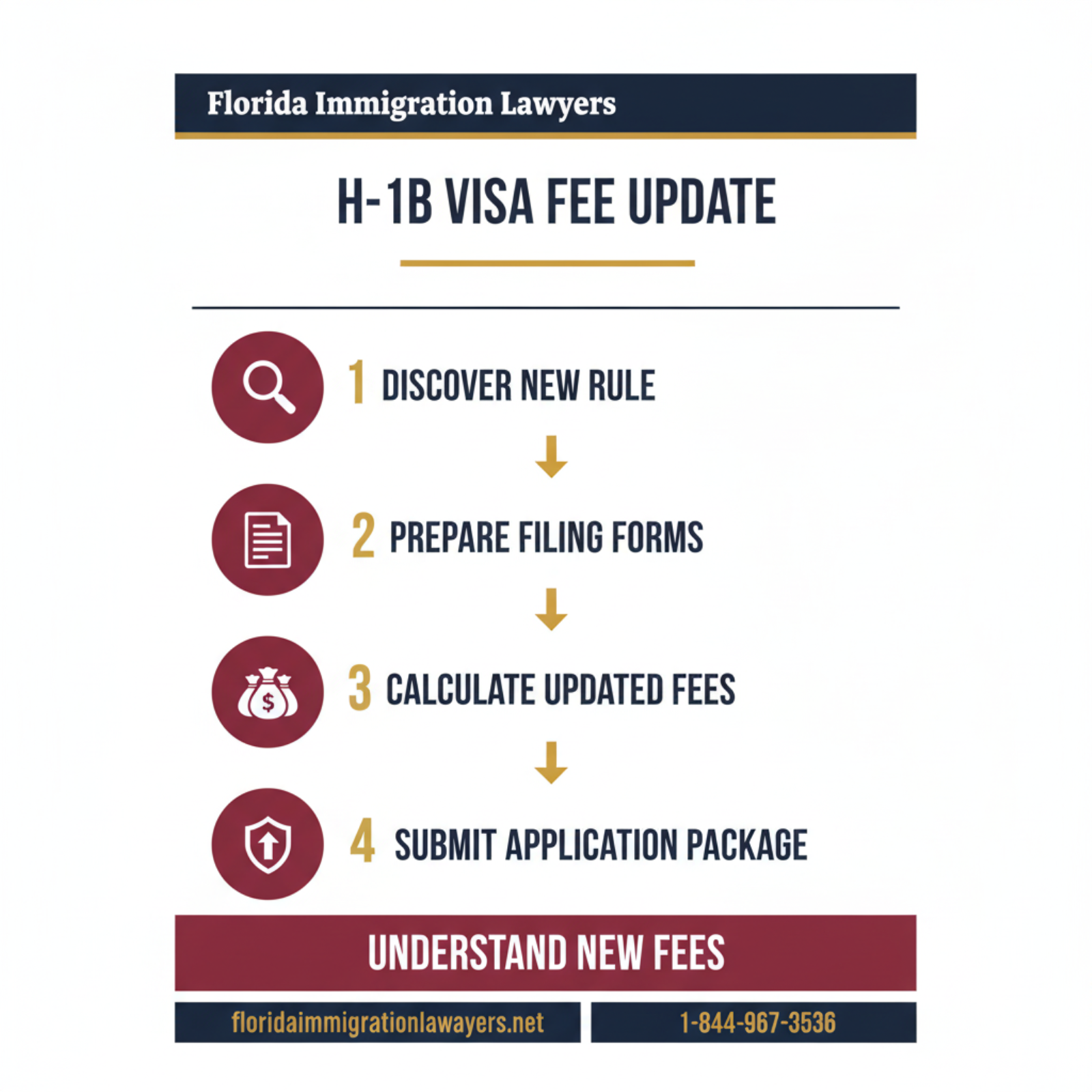
Applying for an H-1B visa involves several critical steps, each with specific requirements and, now, adjusted fees. This guide outlines the typical process, keeping in mind the H-1B visa fee increase for 2026. Careful adherence to each step is vital for a successful application.
H-1B Registration (if applicable):
For cap-subject H-1B petitions, the process begins with electronic registration. Employers must register prospective H-1B workers during a designated period, typically in March, and pay a non-refundable H-1B registration fee for each beneficiary. USCIS conducts a lottery if demand exceeds the annual cap. This fee has seen an increase for 2026.
Labor Condition Application (LCA) Filing:
Once selected in the lottery (for cap-subject cases) or ready to file (for cap-exempt cases), the employer must file a Form ETA-9035, Labor Condition Application, with the U.S. Department of Labor (DOL). The LCA attests that the employer will pay the H-1B worker at least the prevailing wage or the actual wage, whichever is higher, and provide working conditions that will not adversely affect other workers. This step does not incur a direct USCIS fee.
Form I-129 Petition Filing:
After LCA certification, the employer files Form I-129, Petition for a Nonimmigrant Worker, with USCIS. This is the core H-1B petition. This form requires the base filing fee, the ACWIA fee, and the Fraud Prevention and Detection Fee. The base filing fee for Form I-129 has seen a notable H-1B visa fee increase for 2026, making careful budgeting essential.
Supporting documentation, such as the certified LCA, educational credentials, and employment letters, must accompany the petition. All fees must be paid correctly and timely to avoid rejection.
Premium Processing (Optional):
Employers can elect to pay an additional fee for premium processing, which guarantees USCIS action on the petition within 15 calendar days. This fee has also increased for 2026. While optional, premium processing is often utilized when expedited adjudication is necessary, particularly for start dates or critical business needs.
Consular Processing or Change of Status:
If the H-1B petition is approved, the beneficiary will either undergo consular processing at a U.S. embassy or consulate abroad to obtain the H-1B visa stamp, or, if already in the U.S. in a different nonimmigrant status, may apply for a change of status to H-1B. Consular processing involves separate visa application fees payable to the Department of State.
Entry to the U.S. or Status Activation:
Upon visa approval and entry to the U.S., or approval of a change of status, the H-1B worker can begin employment with the sponsoring employer. It is crucial to adhere to all terms and conditions of the H-1B visa, including start dates, job duties, and location. Any material changes may require an amended petition.
Each stage of the H-1B process requires meticulous attention to detail and accurate documentation. The new fee structure makes it even more important to ensure all payments are correct. Our experienced team at Florida Immigration Lawyers can guide you through each step, ensuring compliance and minimizing potential pitfalls.
Essential Document Checklist for Your H-1B Petition
A complete and accurate submission of documents is paramount for a successful H-1B petition, especially with the heightened scrutiny and increased costs associated with the H-1B visa fee increase. Missing or incorrect documents can lead to delays, Requests for Evidence (RFEs), or even outright denials. Here is a general checklist of documents typically required:
- Certified Labor Condition Application (LCA) Form ETA-9035.
- Form I-129, Petition for a Nonimmigrant Worker, with all required supplements.
- Proof of H-1B Registration selection (for cap-subject petitions).
- Employer's Federal Employer Identification Number (FEIN).
- Detailed letter from the employer describing the job offer, duties, salary, and the need for a specialty occupation worker.
- Beneficiary's educational documents: diplomas, degrees, transcripts, and any foreign degree evaluations.
- Beneficiary's resume or CV.
- Copies of beneficiary's passport, previous visas, and I-94 arrival/departure record.
- Evidence of beneficiary's professional licenses or certifications, if applicable.
- Employer's financial statements, tax returns, and business plans to demonstrate ability to pay the proffered wage.
- Copies of any previous USCIS approval notices (e.g., I-797s).
- Organizational charts and project descriptions to illustrate the specialty occupation nature of the role.
- Photographs (passport-style) of the beneficiary, if required for consular processing.
- Any other documents requested by USCIS or deemed relevant to the specific case.
Remember, this is a general list. Your specific case may require additional documentation. Organizing these documents meticulously and ensuring their authenticity is crucial. An immigration attorney can help you compile a robust application package tailored to your circumstances, minimizing the risk of issues.
H-1B Visa Timeline and Processing Expectations in 2026
Understanding the timeline for an H-1B visa application is vital for both employers and beneficiaries, especially with the potential for increased processing volumes and the impact of the new H-1B visa fee increase. While specific dates can vary, here is a general overview of what to expect for the 2026 fiscal year.
H-1B Cap-Subject Timeline:
- March (2025 for FY2026): H-1B electronic registration period opens. Employers submit registrations and pay the registration fee.
- Late March (2025): USCIS conducts the H-1B lottery (if necessary) and announces selections.
- April 1 - June 30 (2025): Selected employers file their Form I-129 H-1B petitions. This is when the main filing fees, including the increased amounts for 2026, are due.
- October 1 (2025): The earliest start date for approved H-1B petitions for the new fiscal year.
Processing Times:
Standard processing times for Form I-129 can range from 3 to 6 months or even longer, depending on the USCIS service center workload and current policies. These times are estimates and can fluctuate significantly. You can check current processing times on the USCIS website for specific service centers.
If premium processing is utilized (with the increased fee), USCIS guarantees a response (approval, denial, RFE, or notice of intent to deny) within 15 calendar days. This can significantly shorten the initial waiting period for adjudication.
For beneficiaries undergoing consular processing abroad, additional time for interview scheduling and visa stamp issuance at the U.S. embassy or consulate must be factored in. This can add several weeks to months to the overall timeline, depending on the country and current backlogs.
It is important to start the H-1B process well in advance of any desired start date, especially for cap-subject cases. Proactive planning helps mitigate delays and ensures all steps are completed thoroughly. An immigration attorney can help you manage these timelines and prepare for potential scenarios.
Cost Factors and H-1B Visa Fee Breakdown for 2026
The H-1B visa fee increase for 2026 represents a substantial financial commitment for sponsoring employers. Understanding each component of these fees is essential for accurate budgeting. Please note that specific fee amounts are subject to change and should always be verified on the official USCIS website before filing. The figures mentioned here reflect the general categories of fees that have seen adjustments.
Key H-1B Fees (Subject to 2026 Increases):
- H-1B Registration Fee: This non-refundable fee is paid by the employer for each beneficiary registered in the lottery.
- Form I-129 Base Filing Fee: The primary fee for filing the H-1B petition itself. This has seen a significant increase.
- American Competitiveness and Workforce Improvement Act (ACWIA) Fee: This fee is required for most employers, with different amounts for employers with 25 or fewer full-time equivalent employees versus those with 26 or more.
- Fraud Prevention and Detection Fee: A flat fee required for all initial H-1B petitions and for petitions filed by new employers.
- Public Law 114-113 Fee (for certain employers): This additional fee applies to employers who employ 50 or more employees in the U.S., with 50% or more of those employees in H-1B or L-1 nonimmigrant status.
- Premium Processing Fee: An optional fee to expedite processing to 15 calendar days. This fee has also increased for 2026.
- Attorney Fees: Legal fees for professional assistance from an immigration lawyer. These vary depending on the complexity of the case and the firm's rates.
- Consular Processing Fees: If the beneficiary is outside the U.S., there will be separate visa application fees paid to the Department of State for consular interview and visa stamp issuance.
Employers in Florida, including those in West Palm Beach, must meticulously calculate these costs. Many employers choose to cover all or most of these fees as part of their sponsorship commitment. However, it is important to understand which fees an employer can legally require an H-1B worker to pay (which are very few, primarily the visa application fee at the consulate) and which they cannot.
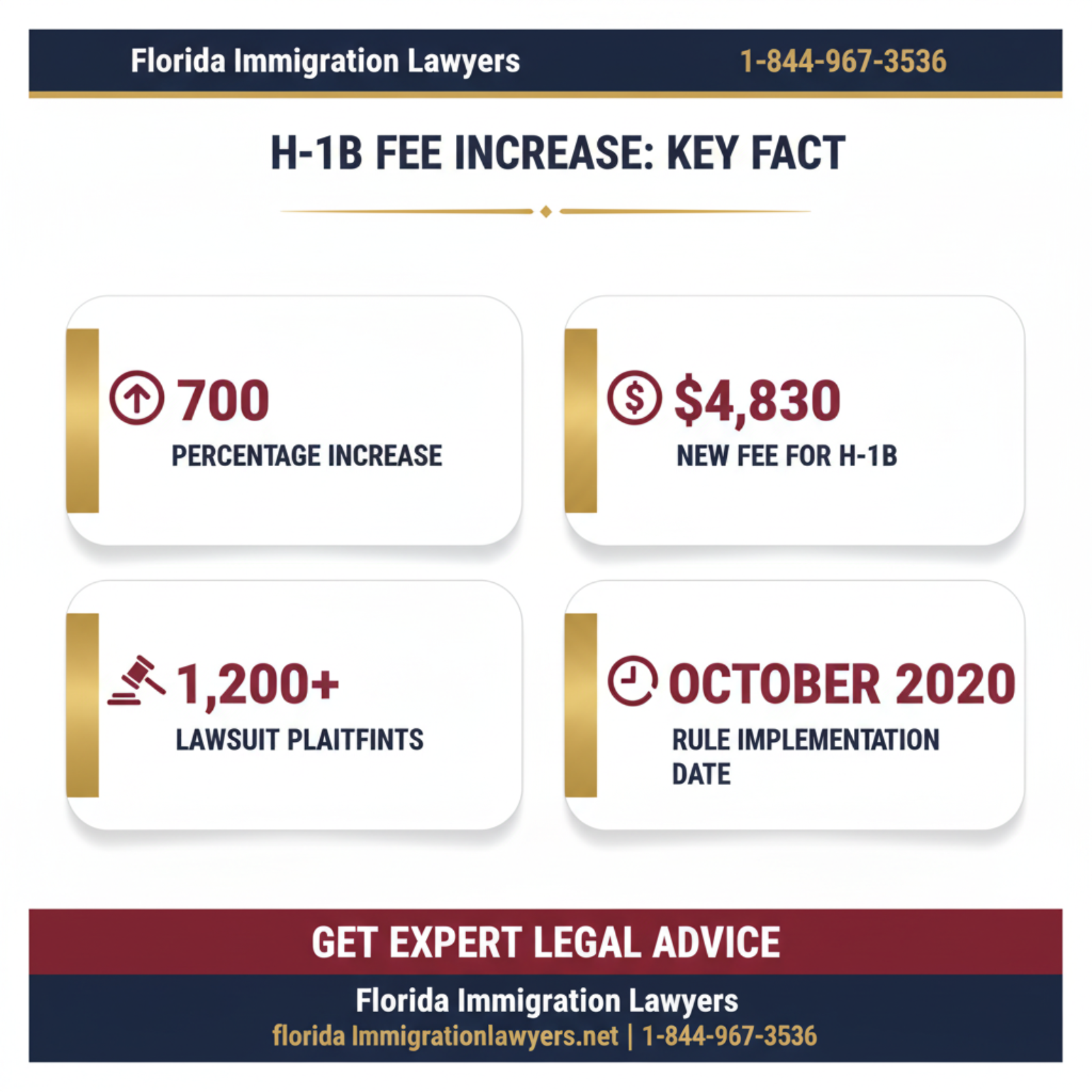
The total cost of an H-1B petition can easily run into several thousands of dollars, excluding attorney fees. The recent H-1B visa fee increase makes prudent financial planning more critical than ever. We recommend consulting with an immigration attorney to get a clear estimate of all applicable fees for your specific situation and to ensure compliance with all regulations.
Do not navigate this process alone. Contact Florida Immigration Lawyers today to discuss your H-1B visa options and how the new fee structure impacts your case.
Common Mistakes to Avoid in Your H-1B Visa Application
The H-1B visa application process is intricate, and even minor errors can lead to significant delays or even denial, especially with the new H-1B visa fee increase adding another layer of complexity. Avoiding these common mistakes is crucial for a smooth and successful outcome.
- Incorrect Fee Payment: With the 2026 fee increases, submitting the wrong fee amount is a common pitfall. This can lead to the rejection of your entire petition. Always verify the latest fee schedule on the USCIS website.
- Late Filing: For cap-subject cases, missing the H-1B registration window or the subsequent petition filing deadline (if selected) means waiting another year. Timeliness is critical.
- Incomplete or Inaccurate Documentation: Failing to provide all required supporting documents, or submitting documents with inconsistencies, often results in Requests for Evidence (RFEs), prolonging the process.
- Lack of Specialty Occupation Proof: The H-1B position must clearly qualify as a specialty occupation, requiring at least a bachelor's degree in a specific field. Insufficient evidence can lead to denial.
- Prevailing Wage Issues: Employers must pay the H-1B worker at least the prevailing wage for the occupation in the specific geographic area. Failing to meet this requirement or incorrectly determining the wage can be a major issue.
- Employer-Employee Relationship Concerns: USCIS scrutinizes the employer-employee relationship, especially for third-party placements. Clear evidence of control over the H-1B worker is necessary.
- Ignoring Material Changes: If there are significant changes to the H-1B worker's job duties, location, or employer, an amended petition may be required. Failing to file one can jeopardize the worker's status.
- Misrepresenting Information: Any false statements or fraudulent documents can lead to severe consequences, including denial, future immigration bars, and even criminal penalties.
- Not Responding to RFEs Promptly: If USCIS issues an RFE, failing to respond fully and within the specified deadline will likely result in a denial.
- Lack of Attorney Review: Attempting to navigate the complex H-1B process without legal counsel often leads to avoidable errors. An experienced immigration lawyer provides invaluable guidance.
Each of these mistakes can derail an otherwise strong H-1B application. Given the increased costs and competitive nature of the program, it is more important than ever to ensure your petition is meticulously prepared and compliant. Seeking professional legal assistance from Florida Immigration Lawyers can significantly reduce these risks.
When to Call a Florida Immigration Lawyer for H-1B Visa Assistance
While this guide provides comprehensive information, the complexities of immigration law, especially with the new H-1B visa fee increase and evolving regulations, often necessitate professional legal assistance. Knowing when to call an immigration lawyer can save you time, money, and considerable stress.
You should consider contacting Florida Immigration Lawyers if any of the following scenarios apply to your situation:
- Complex Case Scenarios: If your case involves unusual circumstances, such as a beneficiary with a non-traditional educational background, a new or small employer, or a position that does not clearly fit a specialty occupation definition.
- Previous Denials or Immigration Issues: If either the employer or the beneficiary has a history of immigration petition denials, visa overstays, or other legal issues, an attorney can help address these complexities.
- Navigating New Fee Structures: Understanding precisely which fees apply, their correct amounts, and how to pay them can be confusing. An attorney ensures compliance with the new 2026 fee schedule.
- Responding to Requests for Evidence (RFEs): Receiving an RFE means USCIS needs more information. An attorney can help you formulate a strong, comprehensive response to address all concerns raised.
- Business-Specific Needs: For employers in Florida, particularly in competitive markets like West Palm Beach, an attorney can help develop a strategic approach to H-1B sponsorship, ensuring compliance and maximizing success rates. We also assist with other business immigration needs.
- Appeals or Motions to Reopen: If your H-1B petition has been denied, an attorney can evaluate grounds for appeal or a motion to reopen, potentially salvaging your case.
- Changes in Employment: If an H-1B worker needs to change employers or if there are significant changes to job duties or location, an attorney can advise on filing an amended petition or a new transfer petition.
- General Peace of Mind: Even for straightforward cases, having an expert review your application can provide invaluable assurance that everything is correct and complete.
Our attorneys specialize in immigration law, including family immigration and deportation defense. We are dedicated to providing clear, effective legal strategies tailored to your unique situation. Do not leave your H-1B future to chance. Consult with us today.
Frequently Asked Questions (FAQs) About H-1B Visa Fees
Understanding the costs associated with the H-1B visa, especially with the new fee increases, can be confusing. Here are answers to some commonly asked questions to provide further clarity.
Who pays the H-1B visa fees, especially large sums like $100,000?
Generally, the employer is responsible for paying most of the H-1B petition fees, including the base filing fee, ACWIA fee, and Fraud Prevention and Detection Fee. The H-1B regulations explicitly prohibit employers from passing these costs to the employee. While there have been discussions and proposals for very high fees (like the $100,000 mentioned in some contexts, often related to specific legislative proposals or previous administrative actions that did not become universal law), these are not standard USCIS H-1B fees for 2026. The actual fees are set by USCIS and are published on their official website. Beneficiaries typically only pay the visa application fee at the consulate and potentially fees for premium processing if they request it and the employer agrees.
Do I have to pay $250 to enter the U.S.?
This question likely refers to the I-94 automation fee or similar border crossing fees. For most H-1B visa holders entering the U.S., there is no direct $250 fee to enter beyond the standard visa application fee paid at the consulate. The I-94 Arrival/Departure Record is typically generated automatically for air and sea arrivals and does not usually incur a separate fee at entry for H-1B nonimmigrants. However, fees can apply for specific land border crossings or for certain programs. Always verify specific entry requirements and fees with U.S. Customs and Border Protection (CBP) or the Department of State.
How much is a Green Card?
The cost of a Green Card (lawful permanent residency) varies significantly depending on the specific immigration pathway (e.g., family-based, employment-based, asylum). It involves multiple USCIS filing fees, such as for Form I-130 (Petition for Alien Relative), Form I-140 (Immigrant Petition for Alien Worker), Form I-485 (Application to Register Permanent Residence or Adjust Status), biometric services fees, and potentially medical examination fees or attorney fees. These fees are separate from H-1B visa fees and can total several thousand dollars over the course of the process. For detailed information on specific Green Card costs, you should consult the USCIS website or an immigration attorney.
What is the minimum salary for an H-1B visa?
There isn't a single "minimum salary" for an H-1B visa. Instead, H-1B regulations require employers to pay the H-1B worker at least the "prevailing wage" for the occupational classification in the area of intended employment, or the "actual wage" paid by the employer to other employees with similar experience and qualifications, whichever is higher. The prevailing wage is determined by the U.S. Department of Labor (DOL) based on factors like occupation, industry, and geographic location. This ensures that H-1B workers are not paid less than U.S. workers in similar positions. Employers must certify compliance with this wage requirement on the Labor Condition Application (LCA).
About Florida Immigration Lawyers
Florida Immigration Lawyers is a premier law firm dedicated to providing exceptional immigration legal services across the entire state of Florida. With a deep understanding of U.S. immigration law and a commitment to our clients, we serve individuals, families, and businesses from West Palm Beach to Orlando, Miami to Tallahassee, and beyond.
Our experienced attorneys specialize in a broad range of immigration matters, including employment-based visas like the H-1B, family-based petitions, asylum claims, deportation defense, and citizenship applications. We pride ourselves on offering personalized attention, strategic advice, and vigorous representation to achieve the best possible outcomes for our clients.
We understand that immigration journeys can be challenging. That is why we offer accessible, empathetic, and comprehensive legal support. We are available 24/7, providing free consultations to help you understand your options and develop a clear path forward. Choose Florida Immigration Lawyers for peace of mind and dedicated advocacy in your immigration matters.
Visit our website at https://www.floridaimmigrationlawyers.net or call us directly at 1-844-967-3536 to schedule your free consultation. We are here to help you achieve your immigration goals in Florida.
Sources and References
- U.S. Citizenship and Immigration Services (USCIS) - H-1B Specialty Occupations
- U.S. Citizenship and Immigration Services (USCIS) - Our Fees
- U.S. Department of Labor (DOL) - H-1B Program
- 8 U.S.C. § 1101 et seq. (Immigration and Nationality Act - INA)
- 8 U.S.C. § 1184(g) (Numerical limitations on H-1B visas)
- 8 CFR Part 214 (Regulations relating to Nonimmigrant Classes)
- 20 CFR Part 655 (Labor Condition Applications and Requirements for Employers)
This article provides general legal information and is not intended as legal advice. Every case is unique, and outcomes depend on specific facts and circumstances. Contact an attorney for advice about your particular situation.
Facing the new H-1B visa fee increase in Florida? Do not navigate these complex changes alone. Get the expert legal guidance you need from Florida Immigration Lawyers. Call us today for a free consultation at 1-844-967-3536. Se Habla Español - Estamos aquí para ayudarle.
Do Not Navigate This Process Alone
Our experienced immigration attorneys are ready to fight for you. Get a free, confidential consultation today.
Se Habla Español
Frequently Asked Questions
Florida Immigration Lawyers
Immigration Attorney | Founder, Vasquez Law Firm
U.S. Air Force veteran and immigration attorney with thousands of cases resolved. J.D., NCCU School of Law. AILA member. Admitted to the 4th, 5th, and 11th Circuit Courts.
Available 24/7 - Free Evaluations
Related Legal Services
Our Florida immigration attorneys can help you with citizenship and naturalization, family immigration services and immigration practice areas. Call today at 1-844-967-3536 for a free consultation.
Related Links
Related Topics
Free Legal Consultation
Discuss your case with our experienced attorneys. We're available 24/7.
Se Habla Español - Estamos aquí para ayudarle.
Related Articles
U Visa for Crime Victims in Florida: A Guide | VLF Florida
Discover how crime victims in Florida can benefit from the U visa, providing a pathway to safety and legal status. Learn about eligibility, the application process, and common pitfalls to avoid.
Immediate Relative Petition Florida: A Comprehensive Guide
Learn about the Immediate Relative Petition in Florida, a crucial step for U.S. citizens to sponsor family members. This guide covers eligibility, documentation, and timelines to help you navigate the process successfully.
Change of Status: Navigating Student Visas in Florida
Navigating a change of status for a student visa in Florida can be complex. This guide covers essential steps, common pitfalls, and when to seek legal help. Call Florida Immigration Lawyers for a free consultation.
Criminal Waiver Immigration in Florida: Key Steps | VLF Florida
Discover how a criminal waiver can help you overcome past convictions in Florida's immigration process. Learn about eligibility, necessary documents, and common mistakes to avoid. Call Florida Immigration Lawyers for professional assistance.