Green Card Through Marriage Florida: Your 2026 Guide
Discover how to obtain a green card through marriage in Florida with our comprehensive 2026 guide. We cover essential steps, required documents, typical timelines, and associated costs for spouses of U.S. citizens and lawful permanent residents. Learn about the differences between immediate relatives and preference categories, and understand the crucial role of proving a bona fide marriage. This article also highlights common mistakes to avoid and when to seek professional legal assistance from Florida Immigration Lawyers to ensure a smooth and successful application process.
Obtaining a green card through marriage in Florida involves a multi-step process for spouses of U.S. citizens or lawful permanent residents. This path typically includes filing Form I-130, followed by an application for adjustment of status (Form I-485) or consular processing. The process aims to establish a legitimate marriage and ensure eligibility for permanent residency, often requiring interviews and extensive documentation.
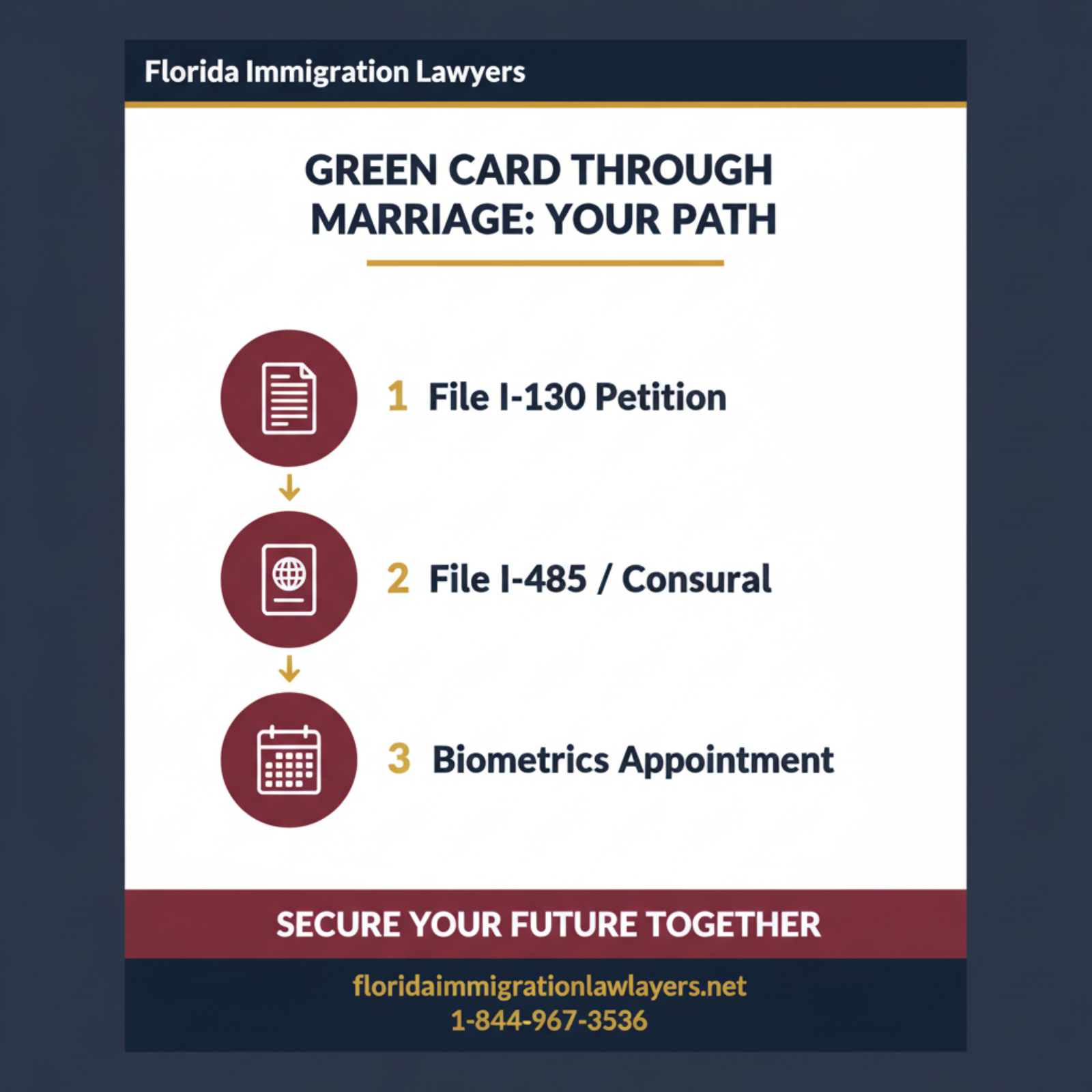
- File Form I-130 (Petition for Alien Relative) with USCIS.
- Submit Form I-485 (Adjustment of Status) or pursue consular processing abroad.
- Attend an interview to verify the legitimacy of your marriage.
- Provide comprehensive documentation proving your relationship is bona fide.
- Conditional green cards are often issued first, requiring a second petition after two years.
Embarking on the journey to secure a green card through marriage in Florida can feel overwhelming. You and your spouse may be eager to build your life together, but the complex immigration system often presents significant hurdles. Understanding each step, from initial petitions to final interviews, is crucial for a successful outcome. This comprehensive guide will walk you through the entire process, specifically tailored for those living in or planning to move to Florida.
We understand the dreams and anxieties that come with seeking permanent residency. Our goal is to demystify the process and provide you with clear, actionable information. If you're ready to begin your application or have questions about your specific situation, do not hesitate. Call Florida Immigration Lawyers at 1-844-967-3536 for a free consultation today. Our experienced team is here to help you navigate the intricacies of Florida immigration law.
Understanding the Green Card Through Marriage Process in Florida
A green card through marriage is a pathway to lawful permanent residency in the United States, available to spouses of U.S. citizens and lawful permanent residents (LPRs). This process is designed to unite families and allow foreign national spouses to live and work permanently in the U.S. The U.S. government scrutinizes these applications closely to prevent marriage fraud, ensuring that the marriage is legitimate and entered into in good faith.
For individuals residing in Florida, the process largely mirrors the national guidelines but involves interactions with local USCIS field offices, such as those in Miami, Orlando, or Tampa. The specific path you take, whether adjustment of status (if you are already in the U.S.) or consular processing (if you are outside the U.S.), depends on your current location and immigration status. Our firm, Florida Immigration Lawyers, specializes in assisting couples throughout Hialeah and across Florida with these critical applications.
Immediate Relatives vs. Preference Categories
The speed and complexity of your green card through marriage application depend significantly on your spouse's status. If your spouse is a U.S. citizen, you are considered an "immediate relative." This means there is no annual cap on the number of visas issued, leading to generally faster processing times compared to other family-based categories. This is a significant advantage for many Florida families.
If your spouse is a lawful permanent resident (LPR), you fall under the F2A preference category. This category is subject to numerical limitations, meaning you may face a waiting period based on visa availability. The Department of State's Visa Bulletin tracks these waiting times. Understanding this distinction is vital for setting realistic expectations for your marriage-based green card timeline.
Step-by-Step Guide to Your Florida Marriage Green Card Application
Navigating the application for a green card through marriage in Florida involves several key stages. Each step requires meticulous attention to detail and accurate submission of forms and supporting documents. Here's a general outline of the process you can expect in 2026:
-
File Form I-130, Petition for Alien Relative: The U.S. citizen or LPR spouse (the petitioner) must file Form I-130 with U.S. Citizenship and Immigration Services (USCIS). This petition formally establishes the qualifying relationship between you and your spouse. You will need to provide evidence of your marriage and your spouse's U.S. citizenship or LPR status. This initial filing is crucial for demonstrating a legitimate relationship.
-
File Form I-485, Application to Register Permanent Residence or Adjust Status (if applicable): If the foreign spouse is physically present in the U.S. and entered legally, they can generally file Form I-485 concurrently with or after the I-130. This is known as "adjustment of status." It allows you to obtain your marriage-based green card without leaving the country. You will also typically file Form I-765 (Application for Employment Authorization) and Form I-131 (Application for Travel Document) at this stage.
-
Attend Biometrics Appointment: After filing, USCIS will schedule an appointment for the foreign spouse to provide fingerprints, photographs, and a signature. These biometrics are used for background checks and identity verification. This is a standard part of the immigration process for all applicants seeking a green card in Florida.
-
Undergo a Medical Examination: The foreign spouse must undergo a medical examination by a USCIS-approved civil surgeon. The surgeon will complete Form I-693, Report of Medical Examination and Vaccination Record, which must be submitted to USCIS. This ensures you meet health-related admissibility requirements, addressing concerns like communicable diseases or certain medical conditions.
-
Attend the Marriage-Based Green Card Interview: Both spouses will typically be required to attend an interview at a local USCIS field office, such as the Miami Field Office. An immigration officer will ask questions about your relationship, daily life, and future plans to determine if your marriage is bona fide. This interview is a critical step in verifying the legitimacy of your green card through marriage Florida application.
-
Receive Decision and Green Card: If your application is approved, the foreign spouse will receive a green card. If the marriage is less than two years old at the time of approval, a conditional green card (valid for two years) will be issued. If the marriage is older than two years, a 10-year permanent green card is issued directly. Understanding this distinction is key for your long-term residency.
Essential Document Checklist for Your Marriage-Based Green Card
Gathering the correct documentation is paramount for a successful green card through marriage Florida application. Missing or incorrect documents can lead to delays or even denials. Be prepared to provide originals and copies of everything. Here's a general list of documents you will need:
- For the U.S. Citizen/LPR Petitioner:
- Proof of U.S. citizenship (e.g., birth certificate, U.S. passport, naturalization certificate) or LPR status (e.g., green card copy).
- Proof of income (e.g., tax returns, W-2s, employment letters) to meet affidavit of support requirements.
- Form I-864, Affidavit of Support.
- For the Foreign National Beneficiary:
- Birth certificate.
- Passport and visa (if applicable).
- Form I-94, Arrival/Departure Record (if applicable).
- Medical examination report (Form I-693).
- Police clearances from any country where you lived for more than six months since age 16.
Step-by-Step Process Guide - For Both Spouses (Proof of Bona Fide Marriage):
- Marriage certificate.
- Divorce decrees or death certificates from any previous marriages for both spouses.
- Joint financial documents (e.g., joint bank accounts, joint credit card statements, joint tax returns, joint utility bills).
- Joint property ownership documents (e.g., deed, lease agreement with both names).
- Insurance policies listing each other as beneficiaries (life, health, auto).
- Children's birth certificates (if any) showing both parents.
- Photographs of your wedding, family, and shared experiences.
- Affidavits from friends and family attesting to the legitimacy of your relationship.
- Any other evidence demonstrating a shared life and commitment.
Timeline and Processing Expectations for a Green Card Through Marriage
The processing time for a green card through marriage in Florida can vary significantly based on several factors, including whether your spouse is a U.S. citizen or an LPR, the specific USCIS field office processing your case (e.g., Miami, Orlando), and the volume of applications. It's important to remember that these are estimates, and individual cases may differ.
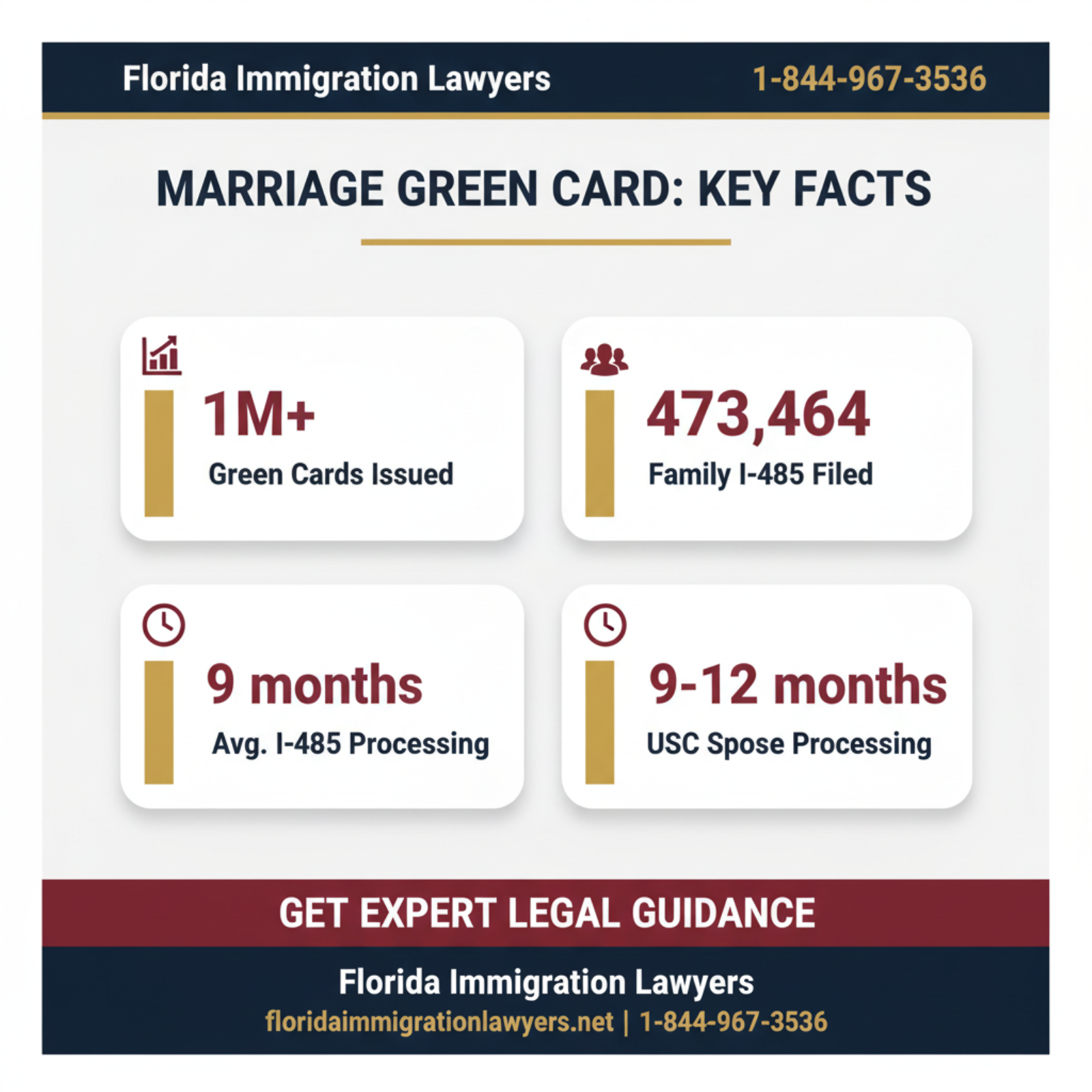
For spouses of U.S. citizens applying for adjustment of status within the U.S., the entire process, from filing the I-130 to receiving the green card, can typically take anywhere from 10 to 18 months in 2026. This includes the time for the I-130 approval, I-485 processing, biometrics, medical exam, and interview scheduling. Work permits (EAD) and travel permits (Advance Parole) are often issued within 6-10 months.
If your spouse is an LPR, the process will generally take longer due to visa bulletin backlogs. After the I-130 is approved, you will need to wait for a visa number to become available in the F2A category, which can add several months or even a few years to the overall timeline. Consular processing, where the foreign spouse applies from abroad, can also have varying timelines depending on the specific U.S. embassy or consulate involved. We recommend checking the USCIS website for current processing times for the offices relevant to your Florida application.
Cost Factors and Fee Breakdown for Your Green Card Application
Applying for a green card through marriage in Florida involves various government filing fees, which are subject to change by USCIS. It's crucial to budget for these expenses in addition to potential legal fees. While we cannot provide exact current fees, here's a breakdown of the typical costs involved in 2026:
- Form I-130, Petition for Alien Relative: There is a fee for filing this initial petition.
- Form I-485, Application to Register Permanent Residence or Adjust Status: This fee covers the primary application for the foreign spouse.
- Biometrics Fee: A separate fee is typically charged for the biometrics appointment.
- Medical Examination: The cost of the medical exam is paid directly to the civil surgeon and varies by provider and location in Florida. This is not a USCIS fee.
- Form I-765 (Employment Authorization) & Form I-131 (Travel Document): If filed concurrently with Form I-485, these fees are often included in the I-485 filing fee. However, always verify current USCIS fee schedules.
- Legal Fees: Hiring an experienced immigration attorney, like those at Florida Immigration Lawyers, is an additional cost but can be invaluable for ensuring accuracy and smooth navigation of the process.
USCIS periodically updates its fee schedule, so always refer to the official USCIS website for the most current amounts before filing. Financial planning is an important part of your marriage-based green card journey.
Do not navigate this complex process alone. The stakes are high when seeking a green card through marriage in Florida. Contact Florida Immigration Lawyers today to ensure your application is handled with precision and care. We are here to support you every step of the way.
Common Mistakes to Avoid When Applying for a Green Card Through Marriage
The path to obtaining a green card through marriage in Florida can be fraught with potential pitfalls. Avoiding common errors is essential to prevent delays, requests for evidence, or even denials. Many of these mistakes stem from a lack of understanding of complex immigration regulations.
-
Failing to Prove a Bona Fide Marriage: USCIS officers are trained to detect marriage fraud. Simply having a marriage certificate is not enough. You must provide extensive evidence of a legitimate, shared life. Without sufficient proof, your application for a marriage-based green card may be denied, leading to significant delays and potential legal issues.
-
Incomplete or Inaccurate Forms: Even minor errors or omissions on forms like I-130 or I-485 can lead to a Request for Evidence (RFE) or outright rejection. This prolongs the process significantly. Double-checking every field and ensuring consistency across all documents is critical for your green card application.
-
Missing Deadlines: Immigration processes are time-sensitive. Missing a deadline for submitting requested documents, attending an interview, or filing subsequent petitions (like I-751 for conditional residents) can have severe consequences, including case closure or even deportation proceedings.
-
Not Disclosing All Immigration History: Attempting to conceal previous immigration violations, arrests, or past visa denials is a serious mistake. USCIS conducts thorough background checks. Any misrepresentation can lead to accusations of fraud and permanent bars from receiving immigration benefits.
-
Inadequate Financial Sponsorship: The U.S. citizen or LPR spouse must meet specific income requirements to financially sponsor the foreign spouse. If the income is insufficient, a joint sponsor is often needed. Failure to provide adequate sponsorship via Form I-864 can result in denial of the green card.
-
Not Updating USCIS of Address Changes: If you move, you are legally required to inform USCIS within 10 days using Form AR-11. Failing to do so can result in missed notices, interview appointments, or RFEs, which can derail your green card through marriage Florida application.
-
Traveling Internationally Without Advance Parole: If you are adjusting status within the U.S. and leave the country without an approved Advance Parole document (Form I-131), your I-485 application may be considered abandoned. This can be a devastating mistake for your Florida immigration process.
-
Failing to Remove Conditions on a Green Card: If you receive a 2-year conditional green card, you must file Form I-751, Petition to Remove Conditions on Residence, within the 90-day period before your conditional green card expires. Failure to do so will result in the expiration of your permanent resident status and potential deportation.
-
Poor Interview Preparation: The interview is a crucial step. Many applicants underestimate its importance or fail to prepare adequately. Being unable to answer basic questions about your spouse, relationship, or shared life can raise red flags and jeopardize your application.
-
Ignoring Legal Advice: Trying to navigate the complex immigration system without professional guidance often leads to mistakes. While online resources are helpful, they cannot replace personalized legal advice tailored to your unique circumstances. This is especially true for intricate cases involving past issues.
When to Call a Florida Immigration Lawyer for Your Marriage Green Card
While some individuals may attempt to file a green card through marriage application on their own, the process is fraught with complexities and potential pitfalls. Hiring an experienced Florida immigration lawyer can significantly increase your chances of success and alleviate much of the stress. You should consider contacting Florida Immigration Lawyers if any of the following scenarios apply to you:
- Complex Immigration History: If either spouse has previous immigration violations, deportations, criminal records, or overstays, your case will be significantly more complicated. An attorney can assess your eligibility for waivers and prepare a robust defense.
- Concerns About Proving a Bona Fide Marriage: If you have limited joint documents, cultural differences, or a significant age gap, an attorney can help you gather and present compelling evidence to prove your marriage is legitimate.
- Previous Denials or RFEs: If you've previously had an immigration application denied or received a Request for Evidence (RFE), an attorney can help identify the issues and strategize for a successful reapplication or response.
- Need for Consular Processing: If the foreign spouse is outside the U.S. or has issues preventing adjustment of status, consular processing involves different forms and procedures. An attorney can guide you through this specific path.
- Fear of the Interview: The USCIS interview can be intimidating. An attorney can prepare you thoroughly, explain potential questions, and in many cases, accompany you to the interview to provide support and address any legal issues.
- Language Barriers: If English is not your first language, navigating legal documents and interviews can be challenging. Our bilingual team at Florida Immigration Lawyers can assist you in Spanish, ensuring clear communication.
- Seeking Efficiency and Peace of Mind: Even in straightforward cases, an attorney ensures all forms are correctly filled, documents are properly organized, and deadlines are met, saving you time and reducing anxiety. We streamline the green card through marriage Florida process for our clients.
Don't leave your future to chance. Florida Immigration Lawyers provides dedicated representation for individuals and families throughout Florida, including Hialeah, Miami, Orlando, and Tampa. We specialize in family immigration and deportation defense, ensuring comprehensive support for your green card journey.
About Florida Immigration Lawyers
Florida Immigration Lawyers is a leading law firm dedicated to providing exceptional legal services to immigrants across the entire state of Florida. With a deep understanding of U.S. immigration law and a compassionate approach, we proudly serve individuals and families from all walks of life, from Hialeah to Jacksonville, and everywhere in between. Our mission is to navigate the complexities of the immigration system on your behalf, striving for the best possible outcomes for your case.
We offer a comprehensive range of immigration services, including family-based petitions, employment visas, asylum claims, citizenship applications, and defense against deportation. Our team of experienced attorneys is committed to offering personalized attention, clear communication, and strategic legal advice tailored to your unique situation. We understand the profound impact immigration matters have on your life and your family's future.
When you choose Florida Immigration Lawyers, you gain a dedicated advocate who will tirelessly work to protect your rights and achieve your immigration goals. We are available 24/7 to answer your urgent questions and offer free, no-obligation consultations to discuss your case. Let us be your trusted partner in your journey to live and thrive in the United States. Call us today at 1-844-967-3536 or visit our website at https://www.floridaimmigrationlawyers.net to learn more about how we can help you.
Sources and References
- U.S. Citizenship and Immigration Services (USCIS) - Green Card for Immediate Relatives
- USCIS Policy Manual
- U.S. Department of State - Visa Bulletin
- 8 U.S.C. Chapter 12 - Immigration and Nationality Act (INA)
- INA Section 201(b) - Immediate Relatives
- INA Section 204 - Petition for Immigrant Status
- INA Section 216 - Conditional Permanent Resident Status
- 8 CFR § 245 - Adjustment of Status
This article provides general legal information and is not intended as legal advice. Every case is unique, and outcomes depend on specific facts and circumstances. Contact an attorney for advice about your particular situation.
Securing a green card through marriage in Florida is a life-changing step. Our dedicated team at Florida Immigration Lawyers is ready to provide the expert guidance and support you need to navigate this journey successfully. Don't face the immigration system alone. Your future in Florida awaits.
Call us today for a free, confidential consultation at 1-844-967-3536. Se Habla Español - Estamos aquí para ayudarle.
Need help with Immigration?
Our Florida immigration attorneys offer free consultations. Call today or schedule online.
Frequently Asked Questions
Florida Immigration Lawyers
Legal Team
Our experienced attorneys at Florida Immigration Lawyers have been serving clients across Florida for over 20 years. We specialize in immigration, personal injury, criminal defense, workers compensation, and family law.