VAWA Immigration Relief Florida: Protecting Abuse Victims
For immigrant abuse victims in Florida, VAWA immigration relief offers a crucial path to safety and legal residency. Learn about eligibility for VAWA self-petitioners, the step-by-step application process, required documents, and what to expect regarding timelines and costs. This guide covers essential information for spouses, children, and parents seeking protection from abusive U.S. citizens or LPRs. Avoid common mistakes and understand when to seek expert legal assistance from Florida Immigration Lawyers for a confidential, free consultation.
VAWA immigration relief in Florida allows certain victims of domestic violence, extreme cruelty, or abuse by a U.S. citizen or Legal Permanent Resident spouse, parent, or adult child to self-petition for legal immigration status without the abuser's knowledge or cooperation. This vital protection helps survivors secure their safety and future, leading to a potential Green Card and independence.
- VAWA helps victims of abuse by U.S. citizens or LPRs.
- You can self-petition without the abuser's involvement.
- Eligibility includes spouses, children, and parents.
- Relief can lead to a Green Card and protection from deportation.
- Consult an experienced immigration attorney in Florida for guidance.
VAWA Immigration Relief Florida: Protecting Abuse Victims
Living in fear and facing abuse is an unimaginable hardship, especially when your immigration status is tied to your abuser. In Florida, a state with a vast and diverse immigrant population, many individuals face unique challenges when seeking safety and legal protection. The Violence Against Women Act (VAWA) offers a crucial pathway to independence and legal residency for victims of domestic violence, extreme cruelty, or abuse.
At Florida Immigration Lawyers, we understand the immense courage it takes to seek help. This comprehensive guide will explain what VAWA immigration relief Florida entails, who is eligible, the application process, and how it can protect you. Our goal is to empower you with the knowledge needed to take the first step towards a safer future. We are committed to supporting immigrant abuse victims throughout Florida.
If you or someone you know in Coral Springs or anywhere in Florida needs assistance, do not hesitate. Call Florida Immigration Lawyers at 1-844-967-3536 for a free, confidential consultation today. We are here to help you navigate this sensitive process and protect your rights.
Understanding VAWA Immigration Relief Florida: A Path to Safety
The Violence Against Women Act (VAWA), enacted in 1994, is a landmark piece of legislation designed to protect victims of domestic violence, dating violence, sexual assault, and stalking. Within the context of immigration law, VAWA offers specific protections for non-citizen victims of abuse. This allows them to apply for lawful permanent residency in the United States without the cooperation or knowledge of their abusive U.S. citizen or lawful permanent resident (LPR) spouse, parent, or adult child. This is often referred to as a VAWA self-petition.
For immigrant abuse victims in Florida, VAWA provides a critical lifeline. It ensures that your immigration status is not held hostage by an abuser. This federal law recognizes the unique vulnerability of immigrants who might fear deportation if they report abuse or leave an abusive relationship. VAWA provides a confidential and secure pathway to a Green Card, offering independence and safety.
The provisions of VAWA are codified primarily under the Immigration and Nationality Act (INA), specifically 8 U.S.C. § 1154(a)(1). This allows eligible individuals to file Form I-360, Petition for Amerasian, Widow(er), or Special Immigrant, on their own behalf. Understanding the intricacies of this law is crucial for anyone seeking VAWA immigration relief Florida.
Who is Eligible for VAWA Self-Petition?
Eligibility for VAWA immigration relief Florida is defined by specific criteria. Generally, you may be eligible to self-petition under VAWA if you are an immigrant who has been abused by a U.S. citizen or lawful permanent resident. This critical protection extends to spouses, children, and parents of abusers.
Spouses of Abusers
You may file a VAWA self-petition as an abused spouse if:
- You are or were married to a U.S. citizen or LPR abuser.
- Your marriage was entered into in good faith, not solely for immigration purposes.
- You or your child have been subjected to battery or extreme cruelty during the marriage.
- You reside or have resided with the abuser.
- You are a person of good moral character.
- In cases of divorce, your petition must generally be filed within two years of the divorce, and the divorce must be related to the abuse.
Even if your abuser loses their U.S. citizenship or LPR status, or if you divorce, you may still be eligible to apply. This flexibility is designed to ensure victims are not penalized for seeking safety.
Children of Abusers
An abused child may also file a VAWA self-petition, or a parent can file on behalf of their child, if:
- The child is under 21, unmarried, and has been subjected to battery or extreme cruelty by a U.S. citizen or LPR parent.
- The child resides or has resided with the abuser.
- The child is a person of good moral character (if 14 or older).
- A child over 21 but under 25 may still qualify if the abuse was the primary reason for the delay in filing.
This provision is crucial for protecting vulnerable young immigrant abuse victims who may not have other avenues for legal status. It offers a path to safety and stability for children in abusive households.
Parents of Abusers
You may be eligible to file a VAWA self-petition as an abused parent if:
- You have been subjected to battery or extreme cruelty by your U.S. citizen son or daughter.
- Your abusive son or daughter is at least 21 years old.
- You reside or have resided with your abuser.
- You are a person of good moral character.
This category acknowledges that parents, too, can be victims of abuse by their adult children. It ensures that protection is extended to all family relationships where abuse occurs.
What Constitutes Battery or Extreme Cruelty Under VAWA?
The terms "battery" and "extreme cruelty" are broadly defined under VAWA. Battery includes physical abuse, while extreme cruelty encompasses a range of severe emotional, psychological, sexual, and financial abuse. This can include threats, intimidation, isolation, control over finances, verbal abuse, or forced sexual acts.
USCIS recognizes that abuse is not always physical. The cumulative effect of various forms of abuse can constitute extreme cruelty, creating a pattern of control and fear. Documenting these experiences, even without physical evidence, is vital for your VAWA self-petition.
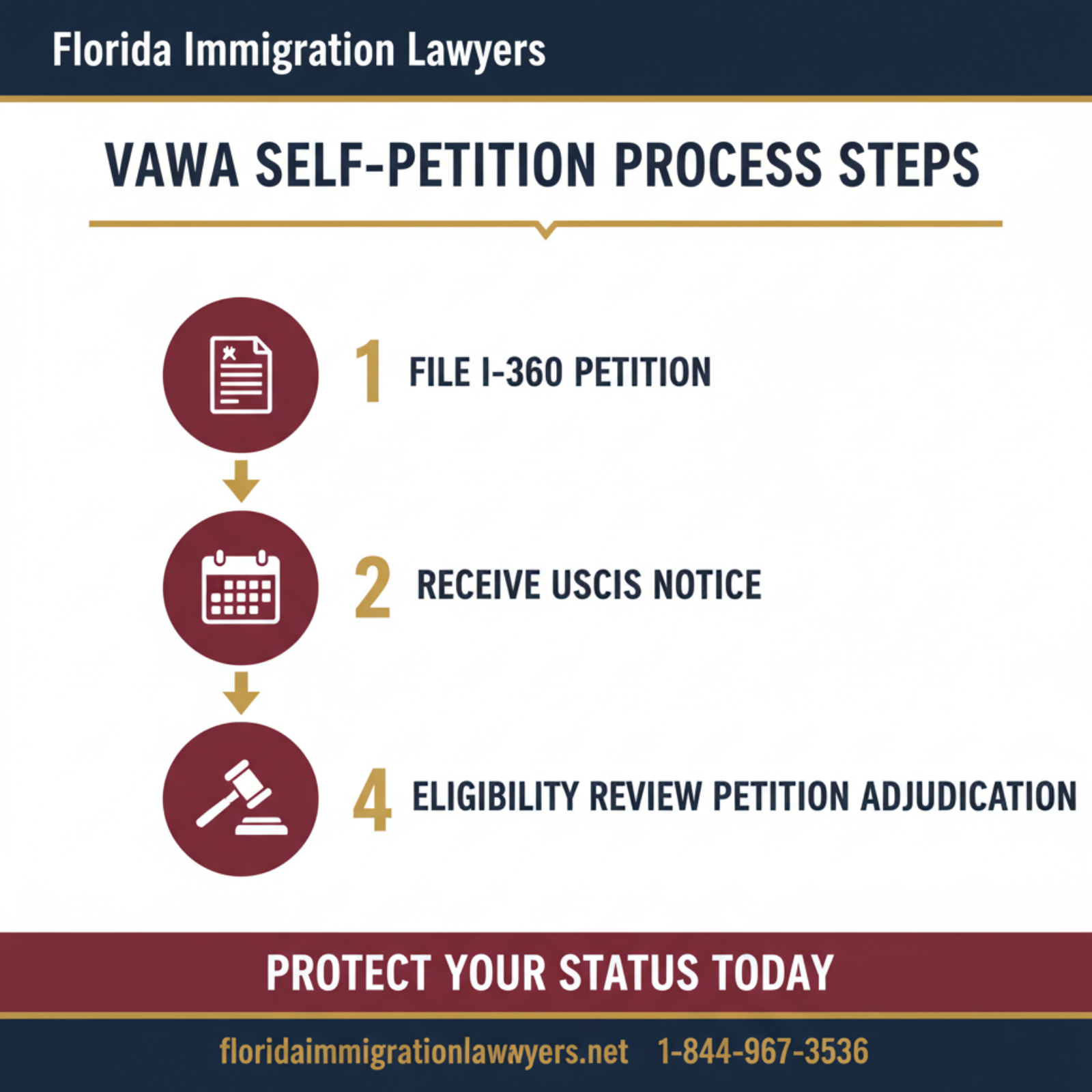
The VAWA Application Process: A Step-by-Step Guide
Applying for VAWA immigration relief Florida involves several critical steps. While the process can seem daunting, particularly for immigrant abuse victims, understanding each stage can help you prepare. Our firm, Florida Immigration Lawyers, guides clients through every step, offering compassionate and expert assistance.
-
Gather Evidence of Abuse and Eligibility: This is the most crucial initial step. You will need to collect any available evidence demonstrating the abuse, your relationship to the abuser, and your good moral character. This can include affidavits, police reports, medical records, court documents, photos, text messages, emails, and witness statements. Even if you do not have official documents, your sworn statement is powerful evidence.
-
Prepare and File Form I-360, Petition for Amerasian, Widow(er), or Special Immigrant: This is the primary form for your VAWA self-petition. It must be meticulously prepared and accompanied by all supporting documentation. This form establishes your eligibility under VAWA. Ensure all sections are completed accurately and truthfully, as any discrepancies could lead to delays or denial.
-
Receive a Prima Facie Determination: After filing Form I-360, USCIS will review your petition. If the evidence presented is sufficient to establish a reasonable possibility of eligibility, USCIS may issue a "prima facie" determination. This means you have presented enough evidence to warrant further consideration. A prima facie determination can allow you to apply for certain public benefits in Florida while your petition is pending.
-
Apply for Work Authorization (Form I-765): Once your I-360 petition is filed and you receive a prima facie determination, you may be eligible to apply for an Employment Authorization Document (EAD). This allows you to work legally in the U.S. while your VAWA petition is being processed, providing crucial financial independence.
-
Receive a Decision on Form I-360: USCIS will thoroughly review your evidence and make a decision on your VAWA self-petition. If approved, you will be granted "deferred action" status, protecting you from deportation and allowing you to proceed to the next stage of obtaining a Green Card. An approved I-360 is a significant step towards stability.
Step-by-Step Process Guide -
Apply for Adjustment of Status (Form I-485): If your I-360 petition is approved and a visa is immediately available, you can then file Form I-485, Application to Register Permanent Residence or Adjust Status. This is the application for your Green Card. This step also involves a medical examination and, in some cases, an interview at a USCIS field office in Florida, such as those in Miami, Orlando, or Tampa.
-
Attend an Interview (If Required): While many VAWA self-petitioners are not required to attend an interview, USCIS reserves the right to request one. If an interview is scheduled, it will typically take place at a local USCIS office. An attorney can help you prepare for this interview and represent you.
-
Receive Your Green Card: Upon approval of your I-485 petition, you will be granted lawful permanent resident status. This means you will receive your Green Card, providing you with the legal right to live and work permanently in the United States and move towards a safer, independent future in Florida.
The entire process for VAWA immigration relief Florida can be complex and emotionally challenging. Having an experienced immigration lawyer by your side is invaluable. We ensure all forms are correctly filed and all necessary evidence is submitted, maximizing your chances of a favorable outcome.
Essential Documents for Your VAWA Petition
Submitting a well-organized and comprehensive package of documents is crucial for a successful VAWA self-petition. While every case is unique, here is a general checklist of documents you will typically need:
- Form I-360, Petition for Amerasian, Widow(er), or Special Immigrant: The completed and signed form.
- Your Sworn Statement (Affidavit): A detailed, personal statement describing the abuse, your relationship with the abuser, the circumstances, and your good moral character. This is often the most critical piece of evidence.
- Proof of Relationship to Abuser: Marriage certificate, birth certificates (for children), or other official documents establishing your relationship to the U.S. citizen or LPR abuser.
- Proof of Abuser's Status: Copy of the abuser's birth certificate, passport, naturalization certificate, or Green Card to prove they are a U.S. citizen or LPR.
- Evidence of Residency: Documents showing you and the abuser lived together (e.g., leases, utility bills, joint bank statements, mail addressed to both).
- Evidence of Abuse (Battery or Extreme Cruelty): This can include:
- Police reports or court records (restraining orders, divorce decrees related to abuse).
- Medical records or psychological evaluations documenting injuries or trauma.
- Affidavits from witnesses (friends, family, clergy, therapists) who observed the abuse or its effects.
- Photographs of injuries or damaged property.
- Emails, text messages, or voicemails from the abuser.
- Records from shelters, support groups, or social service agencies.
- Evidence of Good Moral Character: Police clearances from all places you have lived for six months or more since age 16, character affidavits from friends or family, and a personal statement attesting to your good moral character.
- Birth Certificate: Your own birth certificate.
- Passport-Style Photographs: Required for Form I-360 and later for Form I-485.
- Translation of Foreign Documents: Any document not in English must be accompanied by a certified English translation.
Remember, the more evidence you can provide, the stronger your VAWA self-petition will be. An attorney from Florida Immigration Lawyers can help you identify and organize the most compelling evidence for your specific case.
VAWA Processing Times and Cost Factors
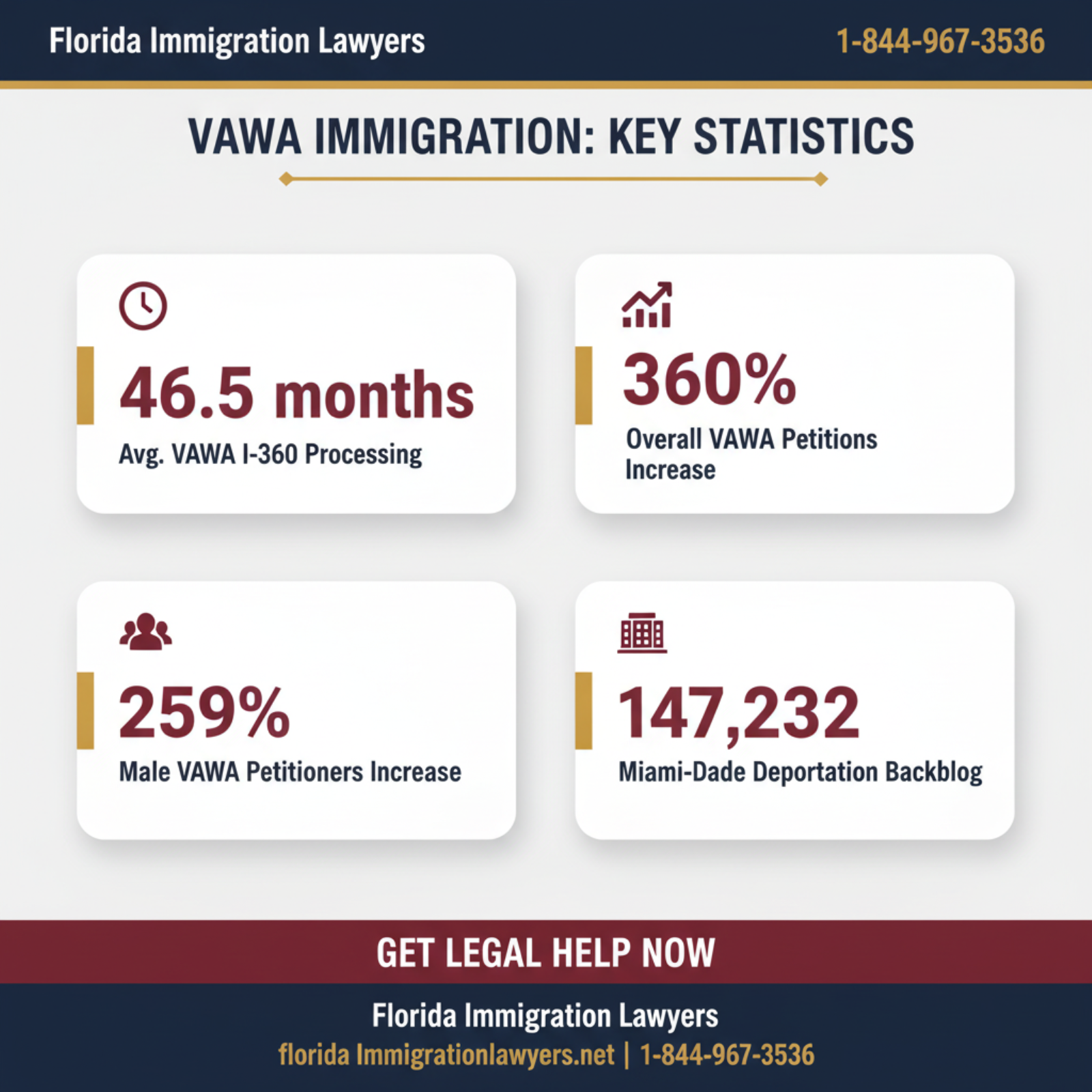
The timeline for VAWA immigration relief Florida can vary significantly based on individual circumstances, the complexity of the case, and USCIS workload. Generally, you can expect the process to take several months to a few years from the initial I-360 filing to the final Green Card approval.
- Form I-360 Processing: Initial review for a prima facie determination can take a few months. The full adjudication of the I-360 can take 18-30 months or longer.
- Employment Authorization Document (EAD): Once your I-360 is filed and you receive a prima facie determination, an EAD application typically takes 5-9 months to process.
- Adjustment of Status (I-485): After I-360 approval, the I-485 processing time can vary greatly, often ranging from 12-24 months, depending on the USCIS field office (e.g., Miami, Orlando, Tampa) and current backlogs.
It is important to note that these are general estimates, and actual times can differ. USCIS processing times are subject to change and can be found on their official website. Staying informed and patient is key, but our firm keeps you updated throughout the process.
Cost Factors and Fee Breakdown
When pursuing VAWA immigration relief Florida, there are typically two main categories of costs:
- USCIS Filing Fees: While the Form I-360 itself has no filing fee for VAWA self-petitioners, other associated applications, such as the Form I-485 (Adjustment of Status) and Form I-765 (Employment Authorization Document), generally have fees. It is crucial to check the most current fee schedule on the USCIS website (uscis.gov) as fees are subject to change. Fee waivers may be available for eligible individuals based on financial hardship.
- Legal Fees: Hiring an experienced immigration attorney, like those at Florida Immigration Lawyers, is an investment in your safety and future. Legal fees cover the attorney's expertise in preparing your petition, gathering evidence, communicating with USCIS, and representing you. While this is an additional cost, the value of professional guidance in such a sensitive and complex matter is immeasurable. Our firm offers transparent fee structures and free consultations to discuss your options.
Do not let concerns about costs deter you from seeking help. Many resources and options are available, and our firm can discuss payment plans and potential fee waivers with you. Your safety and legal status are paramount.
Navigating the complexities of VAWA immigration relief Florida can be overwhelming, especially while healing from abuse. You do not have to navigate this process alone. Our dedicated team at Florida Immigration Lawyers is ready to provide compassionate and expert legal support to immigrant abuse victims across Florida.
Contact Florida Immigration Lawyers today to discuss your situation in confidence. We are committed to helping you achieve safety and independence, and we will stand by you every step of the way.
Common Mistakes to Avoid in Your VAWA Application
Applying for VAWA immigration relief Florida is a detailed legal process where even small errors can cause significant delays or even denial. Avoiding these common pitfalls is essential for a successful outcome:
-
Insufficient Evidence of Abuse: Many applicants underestimate the amount or type of evidence needed. Relying solely on a personal statement without corroborating evidence (even if indirect) can weaken your case. Collect everything you can, no matter how minor it seems.
-
Lack of "Good Faith Marriage" Proof: For spouses, failing to adequately prove the marriage was entered into for love and not just for immigration purposes can be detrimental. Provide joint documents, photos, and affidavits from people who knew you as a couple.
-
Filing Too Late After Divorce: If you are filing as a divorced spouse, you generally have two years from the date of the divorce to file your I-360 petition. Missing this deadline can make you ineligible, unless specific exceptions apply.
-
Not Proving Abuser's Status: You must clearly demonstrate that your abuser was a U.S. citizen or lawful permanent resident at the time of the abuse. Without this proof, your petition cannot be approved.
-
Inconsistent Information: Any discrepancies between your personal statement, supporting documents, and prior immigration applications can raise red flags for USCIS and lead to intense scrutiny or denial.
-
Failing to Establish Good Moral Character: USCIS requires VAWA self-petitioners aged 14 or older to demonstrate good moral character. Undisclosed criminal history, even minor offenses, can jeopardize your petition. Be transparent and seek legal advice on how to address any issues.
-
Ignoring the Residency Requirement: You must prove that you resided with your abuser in the United States. Provide documents showing cohabitation, even if for a short period. This is a crucial element for VAWA immigration relief Florida.
-
Not Responding to USCIS Requests for Evidence (RFEs): If USCIS sends an RFE, it means they need more information. Failing to respond fully and on time can lead to a denial. Understand exactly what is being asked and provide it promptly.
-
Attempting to Navigate Alone: The emotional toll of recounting abuse combined with the legal complexities makes self-representation highly challenging. Many victims, especially in Florida, find the process overwhelming without professional legal help.
-
Not Addressing Previous Immigration Violations: If you have overstayed a visa, entered without inspection, or have other immigration violations, these must be addressed carefully within your VAWA petition. VAWA offers waivers for many such issues, but they must be properly requested.
An experienced attorney at Florida Immigration Lawyers can help you avoid these mistakes, prepare a robust case, and significantly increase your chances of approval for VAWA immigration relief Florida.
When to Call a Florida VAWA Immigration Lawyer
The decision to seek VAWA immigration relief Florida is a courageous one, and having legal representation can make all the difference. While VAWA is designed to be accessible to victims, the immigration system is complex. Here are specific scenarios where contacting Florida Immigration Lawyers is highly recommended:
- Any Stage of the Process: From initial eligibility assessment to filing and responding to USCIS, an attorney provides invaluable guidance.
- Fear of Your Abuser: If you are afraid your abuser will discover your petition or retaliate, a lawyer can help maintain confidentiality and ensure your safety throughout the process.
- Deportation or Removal Proceedings: If you are already in deportation proceedings, filing a VAWA petition can be a powerful defense and may stop deportation. An attorney can help you present your VAWA claim effectively before an immigration judge.
- Complex Abuse Scenarios: Cases involving non-physical abuse, historical abuse, or situations where the abuser's status is unclear require sophisticated legal arguments and evidence gathering.
- Lack of Documentation: If you have limited documents to prove the abuse or your relationship, an attorney can help you build a strong case using sworn affidavits and other forms of credible evidence.
- Prior Immigration Issues: Past visa overstays, previous denials of immigration benefits, or other immigration violations can complicate your VAWA case. A lawyer can assess these issues and determine if waivers are available.
- Criminal History: Even minor criminal offenses can impact your good moral character requirement. An attorney can advise on how to address any criminal records.
- Changes in Relationship Status: If you are divorced from your abuser, or if the abuser lost their status or passed away, specific rules apply. An attorney ensures your petition meets the necessary criteria.
- Need for Confidentiality: VAWA petitions are confidential. An attorney helps ensure your information is protected and that the abuser is not notified of your filing.
At Florida Immigration Lawyers, we specialize in helping immigrant abuse victims in Florida secure their future. We offer compassionate, confidential, and expert legal services. Our team is dedicated to providing you with the peace of mind and strong legal representation you deserve. We can also assist with related family immigration matters once your VAWA petition is approved, helping you and your family achieve lasting stability.
About Florida Immigration Lawyers
Florida Immigration Lawyers is a leading immigration law firm dedicated to serving individuals and families across the entire state of Florida. With a deep understanding of U.S. immigration law and a commitment to our clients, we provide compassionate and effective legal representation for a wide range of immigration matters.
Our experienced attorneys specialize in areas including general immigration, asylum, deportation defense, citizenship, family-based immigration, and business immigration. We pride ourselves on offering personalized attention and strategic legal solutions tailored to your unique circumstances. We understand the challenges you face and are here to be your unwavering advocates.
Why choose Florida Immigration Lawyers? We offer free, confidential consultations to assess your case without obligation. Our team is available 24/7, ensuring you always have access to support when you need it most. We are committed to protecting your rights and helping you achieve your American dream. From our offices, we serve clients in Coral Springs, Miami, Orlando, Tampa, Jacksonville, and all communities throughout Florida.
Visit our website at https://www.floridaimmigrationlawyers.net or call us directly at 1-844-967-3536 to learn more about how we can assist you.
Sources and References
- U.S. Citizenship and Immigration Services (USCIS) - Violence Against Women Act (VAWA)
- Executive Office for Immigration Review (EOIR) - U.S. Department of Justice
- 8 U.S.C. Chapter 12 - Immigration and Nationality Act (INA)
- INA Section 204(a)(1)(A)(iii) - Self-petitioning spouses of U.S. citizens or LPRs
- INA Section 204(a)(1)(A)(iv) - Self-petitioning children of U.S. citizens or LPRs
- INA Section 204(a)(1)(B)(ii) and (iii) - Self-petitioning parents of U.S. citizens
- 8 CFR Part 204 - Petitions, applications, and other requests
This article provides general legal information and is not intended as legal advice. Every case is unique, and outcomes depend on specific facts and circumstances. Immigration laws are complex and subject to change. Contact an attorney for advice about your particular situation and to confirm current legal requirements and procedures.
Taking the step to seek VAWA immigration relief Florida can be life-changing. At Florida Immigration Lawyers, we are honored to stand with you, offering expert legal guidance and unwavering support throughout your journey to safety and stability in Florida.
Your future begins now. Call us for a free, confidential consultation at 1-844-967-3536. We serve clients across Florida, including Coral Springs and surrounding communities. Se Habla Español - Estamos aquí para ayudarle.
Need help with Immigration?
Our Florida immigration attorneys offer free consultations. Call today or schedule online.
Frequently Asked Questions
Florida Immigration Lawyers
Legal Team
Our experienced attorneys at Florida Immigration Lawyers have been serving clients across Florida for over 20 years. We specialize in immigration, personal injury, criminal defense, workers compensation, and family law.