Conditional Green Card Removal Florida: I-751 Guide 2026
If you hold a conditional green card in Florida, removing those conditions is essential to achieve permanent residency. This guide provides a detailed overview of the I-751 process, including eligibility, required documentation, and what to expect from USCIS in 2026. Learn how to gather strong evidence for your marriage, understand processing timelines, and avoid common pitfalls that could jeopardize your status. Whether you're in Tallahassee, Orlando, or anywhere in Florida, securing expert legal guidance is crucial for a successful outcome. Contact Florida Immigration Lawyers for a free consultation to ensure your I-751 petition is handled correctly.
The removal of conditional green card status in Florida involves filing Form I-751, Petition to Remove Conditions on Residence, with USCIS. This crucial step converts your two-year conditional residency to permanent ten-year status, typically based on marriage. You must file within 90 days before your conditional green card expires to avoid complications.
- File Form I-751 jointly with your spouse, or with a waiver.
- Gather strong, comprehensive evidence of a bona fide marriage.
- Consider specific waivers if your marriage ends or you face abuse.
- Seek experienced legal counsel to navigate potential pitfalls.
- Act promptly within the critical 90-day filing window before expiration.
Imagine building a life in beautiful Florida with your loved one, only to realize your immigration status isn't fully secure. Many individuals who obtain a green card through marriage initially receive a **conditional green card**. This two-year status requires a critical step to become permanent: the **conditional green card removal Florida** process. It's a pivotal moment in your immigration journey, especially here in Tallahassee and across the Sunshine State.
The conditional green card is a temporary measure designed by U.S. Citizenship and Immigration Services (USCIS) to ensure the marriage is legitimate, not solely for immigration benefits. Failure to remove these conditions can lead to serious consequences, including losing your legal status and even deportation. Understanding this process is key to securing your future.
Navigating the complexities of USCIS regulations can feel overwhelming, particularly with the ever-evolving immigration landscape. This comprehensive guide will walk you through everything you need to know about removing the conditions on your residence, from understanding the **I-751** form to gathering essential documentation and avoiding common mistakes. We will empower you with the knowledge to approach this process confidently and effectively.
Do not face this challenge alone; our experienced team at Florida Immigration Lawyers is here to help. **Call Florida Immigration Lawyers at 1-844-967-3536 for a free consultation** and let our dedicated professionals assist you with your conditional green card removal Florida petition.
Understanding Your Conditional Green Card and I-751 Petition
When you receive an immigrant visa or adjust your status based on a marriage that is less than two years old, USCIS grants you conditional permanent resident status. This means your green card is valid for only two years. The purpose of this conditional period, established under INA Section 216, is to deter marriage fraud and ensure the authenticity of the marital relationship.
What is a Conditional Green Card?
A conditional green card is essentially a temporary green card. It grants you nearly all the rights and responsibilities of a permanent resident, but with a crucial caveat: your status is temporary. After two years, you must prove to USCIS that your marriage was, and remains, bona fide.
This conditional status is a direct result of federal law, specifically 8 U.S.C. § 1186a, which outlines the requirements for conditional permanent resident status. It’s a mechanism to verify that your marriage was entered into in good faith, not solely for immigration purposes. In Florida, like elsewhere, many individuals start their journey to permanent residency this way.
Why is the I-751 Form So Important?
The Form I-751, Petition to Remove Conditions on Residence, is the cornerstone of converting your conditional status to full, permanent residency. This form, along with extensive supporting documentation, is how you demonstrate to USCIS that your marriage was genuine. Without an approved I-751, your conditional green card will expire, and you could lose your legal status.
Filing the I-751 is your opportunity to provide evidence of your shared life and commitment. It’s the official request to USCIS to remove the conditions and grant you a 10-year green card. This is a critical administrative step that must be completed accurately and on time to avoid adverse immigration consequences.
Eligibility for Conditional Green Card Removal
Generally, you and your spouse must file Form I-751 jointly within the 90-day period immediately preceding the second anniversary of your conditional permanent resident status. This joint petition demonstrates that your marriage is ongoing and genuine. However, there are circumstances where you can file a waiver.
Waivers of the joint filing requirement are available for situations such as the death of your spouse, divorce or annulment (provided the marriage was entered into in good faith), or if you or your child were battered or subjected to extreme cruelty. Additionally, you may be eligible for a waiver if the termination of your status and removal from the U.S. would result in extreme hardship. These waivers are complex and often require strong legal representation.
The Step-by-Step Process for Conditional Green Card Removal in Florida
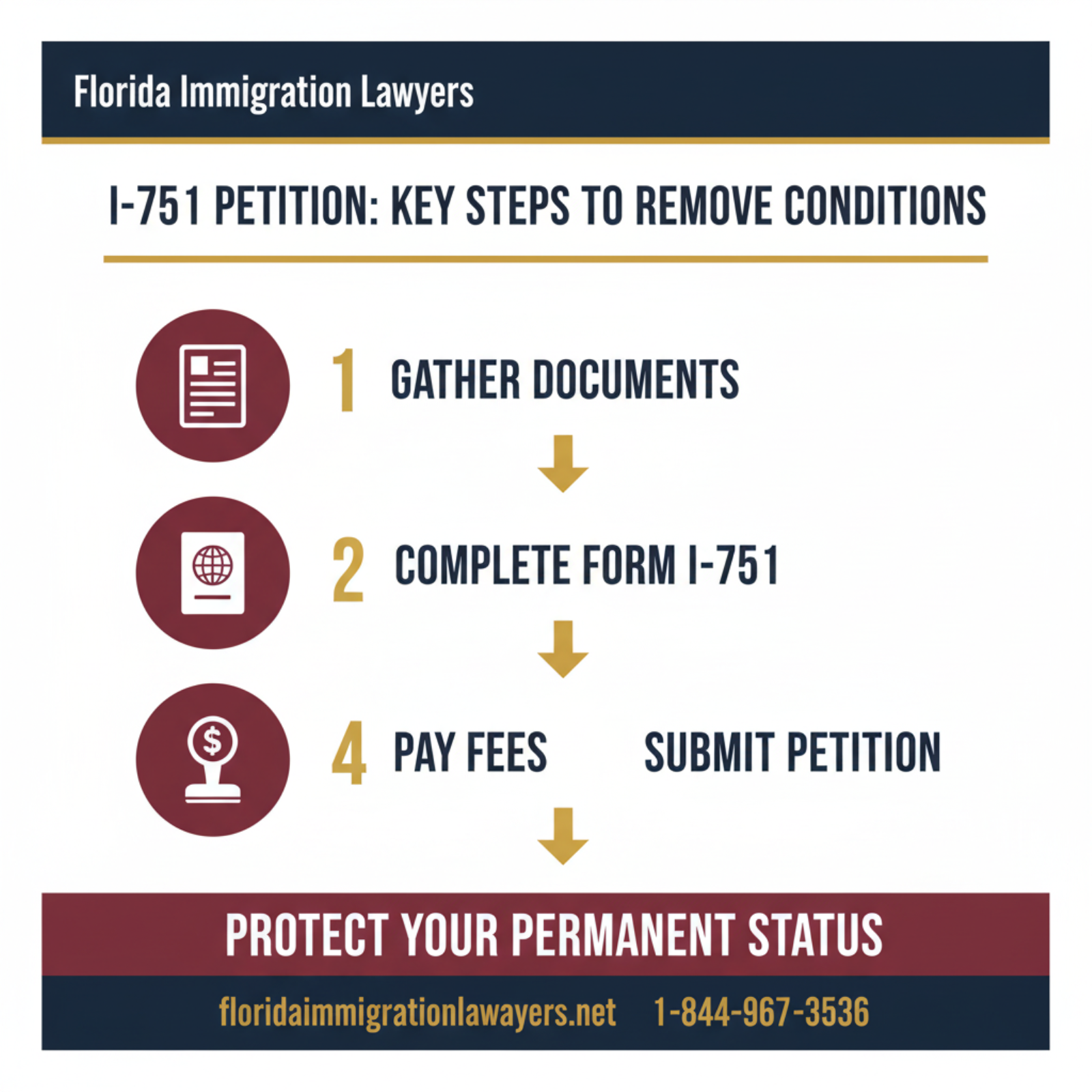
Navigating the **conditional green card removal Florida** process requires careful attention to detail and adherence to USCIS guidelines. Here's a step-by-step guide to help you understand what to expect in 2026:
-
Step 1: Determine Your Filing Eligibility and Strategy
First, confirm your eligibility. Most applicants will file jointly with their spouse. If your marriage has ended, or you face other qualifying circumstances, you will need to determine which waiver applies to your situation. This initial assessment is crucial for a successful petition.
Consider the timing: you must file your I-751 petition during the 90-day window before your conditional green card expires. Filing outside this window can lead to denial and potential removal proceedings. For those in Tallahassee or elsewhere in Florida, accurate timing is paramount.
-
Step 2: Gather Comprehensive Supporting Documentation
This is arguably the most critical step. You must provide compelling evidence to prove your marriage is bona fide. USCIS looks for proof of a shared life, financial commingling, and joint responsibilities. The more evidence you provide, the stronger your case will be.
Begin collecting documents well in advance of the 90-day filing period. Organize your evidence clearly, categorizing it to make it easy for the USCIS officer to review. This preparation will significantly streamline your application.
-
Step 3: Completing and Filing Form I-751
Accurately complete all sections of Form I-751. Ensure all information is consistent with previous immigration applications. Attach all your supporting documentation, copies of your conditional green card, and any other required forms or waivers.
Remember to sign the form in all required places. Submit the completed petition, along with the correct filing fee, to the appropriate USCIS Service Center. Always make copies of your entire submission for your records before mailing it.
-
Step 4: Biometrics Appointment
After filing, USCIS will send you a receipt notice (Form I-797C, Notice of Action), which also extends your conditional resident status, typically for 24 months. Following this, you will receive an appointment notice for biometrics (fingerprints, photos, and signature) at a local Application Support Center (ASC). This is a standard security check.
It is mandatory to attend your biometrics appointment. Failure to do so without proper rescheduling can lead to delays or even denial of your petition. Be sure to bring the appointment notice and a valid photo ID.
-
Step 5: USCIS Review and Potential Interview
USCIS will review your petition and supporting evidence. In many cases, if the evidence is strong and the marriage appears clearly bona fide, USCIS may waive the interview. However, an interview may be required to verify information or if there are concerns about the marriage's legitimacy. Both spouses typically attend joint interviews.
If an interview is required, you will receive an appointment notice specifying the date, time, and location, usually at a USCIS field office in Florida (e.g., Orlando, Tampa, or Miami). Prepare thoroughly for this interview, bringing original documents and being ready to answer questions about your marriage.
-
Step 6: Receiving Your Decision
Upon review of your petition and any interview, USCIS will issue a decision. If approved, you will receive a new 10-year permanent resident card, signifying the successful removal of conditions. If denied, USCIS will send a notice explaining the reasons for denial, which may lead to removal proceedings.
If your I-751 is denied, it is crucial to immediately consult with an experienced **Florida immigration lawyer**. They can help you understand your options, which may include appealing the decision or reapplying under different circumstances. Do not delay in seeking legal advice.
Essential Document Checklist for Your I-751 Petition
To successfully remove the conditions on your green card, you must provide compelling evidence of your bona fide marriage. This evidence should demonstrate that you and your spouse have continuously maintained a shared life since your marriage. Here's a comprehensive checklist:
- Proof of Joint Finances:
- Joint bank account statements (checking, savings)
- Joint credit card statements
- Joint tax returns (federal and state)
- Joint utility bills (electricity, water, gas, internet)
- Joint insurance policies (health, life, auto, home)
- Joint ownership of assets (real estate deeds, vehicle titles)
- Joint debts (mortgage statements, loan agreements)
- Proof of Joint Residency:
- Lease agreements or mortgage statements showing both names
- Utility bills addressed to both spouses at the same address
- Driver's licenses or state IDs showing the same address
- Mail addressed to both spouses at the same address
- Evidence of Children:
- Birth certificates of children born during the marriage
- School records or medical records for joint children
- Photographs showing the family together
- Affidavits from Third Parties:
- Letters from friends, family, or employers attesting to the bona fides of your marriage (must be notarized and include their contact information)
Step-by-Step Process Guide - Other Supporting Evidence:
- Photographs of you and your spouse together over time (wedding, vacations, family events, holidays)
- Travel itineraries and tickets for joint trips
- Correspondence between spouses (emails, letters, text messages)
- Wedding invitations, cards, and receipts
- Evidence of combined social life (membership cards, invitations)
- Any other documentation demonstrating the ongoing nature of your marital relationship
Remember, USCIS values quality and quantity. Submit a wide range of documents that cover the entire two-year conditional period. Organizing your evidence clearly and concisely will greatly aid the USCIS officer reviewing your **I-751** petition.
Timeline and Processing Expectations for I-751 in 2026
The processing time for Form I-751, Petition to Remove Conditions on Residence, can vary significantly. As of 2026, applicants in Florida and across the U.S. should prepare for a potentially lengthy process. Understanding these timelines helps manage expectations and plan your future effectively.
Typical Processing Times for Conditional Green Card Removal
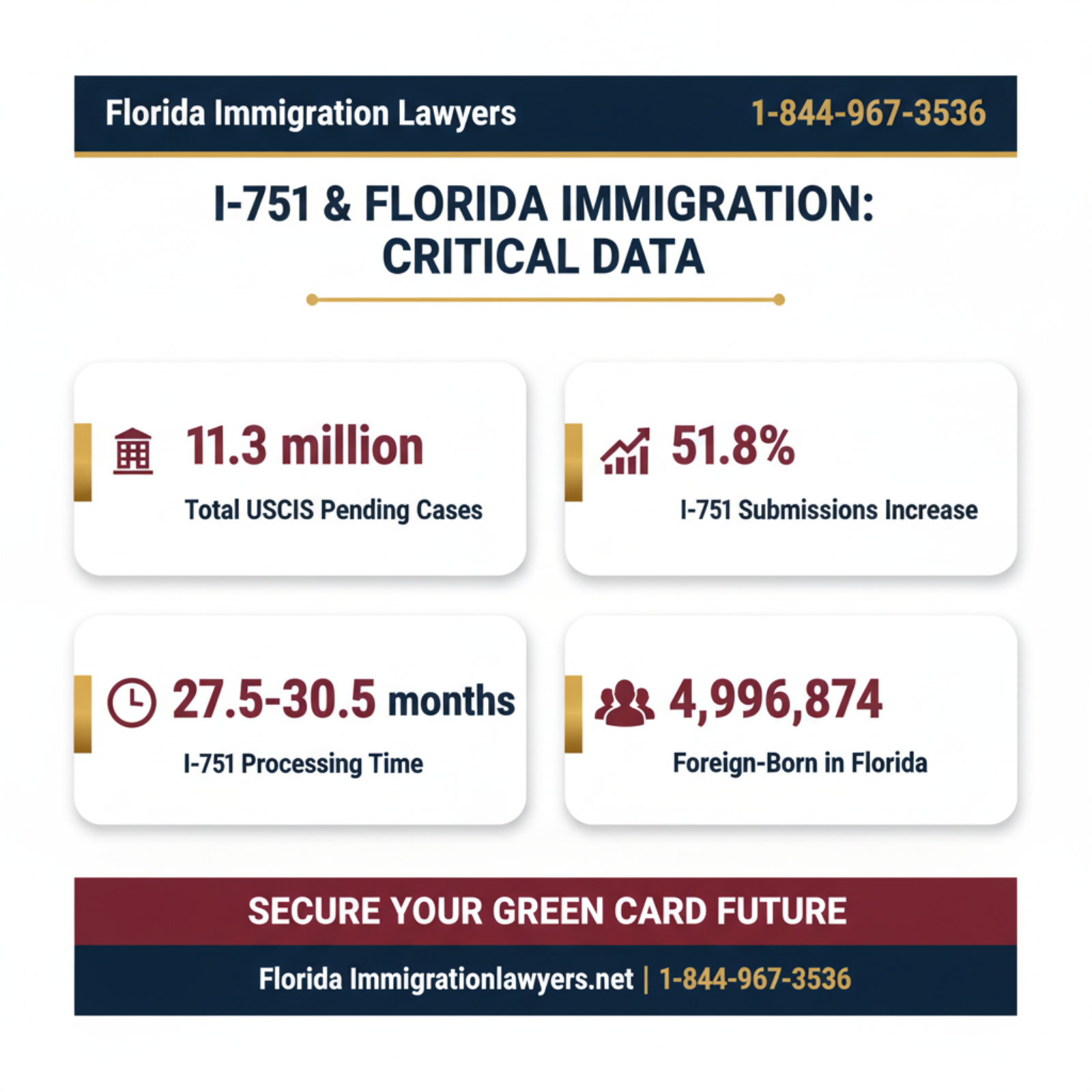
While USCIS processing times fluctuate, an I-751 petition can typically take anywhere from 12 to 24 months, or even longer in some complex cases. These times are influenced by the specific USCIS Service Center handling your case, current backlogs, and the thoroughness of your initial submission. USCIS aims to process petitions efficiently, but high volumes can cause delays.
Upon filing, you will receive a receipt notice that automatically extends your conditional resident status, usually for 24 months. This allows you to continue working and traveling while your petition is pending. It is crucial to keep this notice with your expired conditional green card.
Factors Affecting Processing Speed
Several factors can influence how quickly your **conditional green card removal Florida** petition is processed. A well-organized, complete application with strong evidence tends to move faster. Conversely, missing documents, requests for evidence (RFEs), or the need for an interview can significantly prolong the process.
USCIS service center workload and policy changes also play a role. For instance, the demand for immigration services in a highly populated state like Florida, with its diverse immigrant communities, can sometimes impact local processing times. Staying informed about current USCIS processing times on their official website is always recommended.
What Happens After Filing?
After you file your Form I-751, you will receive a receipt notice (I-797C) confirming your filing and extending your status. Next comes the biometrics appointment. Following biometrics, your case will be under review. You might receive an RFE if more information is needed, or a notice for an interview if USCIS deems it necessary.
Ultimately, USCIS will mail you a decision. If approved, you will receive your new 10-year green card. If denied, you will be informed of the reasons and your options, which typically involve appearing before an immigration judge in removal proceedings. This underscores the importance of a meticulously prepared petition.
Cost Factors and Fee Breakdown for I-751 Filings
Understanding the costs associated with filing Form I-751 is an important part of your **conditional green card removal Florida** planning. While we cannot provide specific, current fee amounts (as they are subject to change by USCIS), we can outline the types of fees you should anticipate.
USCIS Filing Fees
The primary cost will be the USCIS filing fee for Form I-751 itself. This fee is paid directly to USCIS. You can find the most current fee schedule on the official USCIS website. It is crucial to use the exact fee amount and the correct payment method to avoid rejection of your application.
These fees generally cover the administrative costs of processing your petition. USCIS updates its fee schedule periodically, so always verify the latest amounts before submitting your application. Incorrect fees are a common reason for application delays or rejections.
Biometrics Service Fees
In addition to the I-751 filing fee, there is typically a separate biometrics service fee. This fee covers the cost of collecting your fingerprints, photograph, and signature at an Application Support Center. This fee is usually paid at the same time as the I-751 filing fee.
The biometrics fee is a mandatory component of the application process. It ensures that USCIS can conduct necessary background checks and identity verification. Ensure both the I-751 and biometrics fees are paid correctly according to USCIS guidelines.
Legal Fees for Professional Assistance
While not a direct USCIS fee, engaging an experienced **Florida immigration lawyer** is a significant investment that can greatly benefit your case. Legal fees cover the attorney's expertise in preparing your petition, organizing evidence, drafting affidavits, responding to RFEs, and representing you at interviews.
The cost of legal representation can vary depending on the complexity of your case, whether waivers are needed, and the specific services provided. For many, the peace of mind and increased likelihood of approval that comes with professional legal assistance far outweighs the cost. Our firm, Florida Immigration Lawyers, offers transparent fee structures and free initial consultations to discuss your needs.
Common Mistakes to Avoid During I-751 Conditional Green Card Removal
The **conditional green card removal Florida** process is fraught with potential pitfalls. Avoiding these common mistakes can significantly improve your chances of a successful outcome and prevent delays or denials:
- Filing Too Late or Too Early: The 90-day window before your conditional green card expires is strict. Filing outside this period without a valid reason will likely lead to denial and could initiate removal proceedings. Always mark your calendar and prepare well in advance.
- Insufficient Evidence of a Bona Fide Marriage: This is perhaps the most frequent mistake. Applicants often submit too little evidence or evidence that doesn't strongly demonstrate a shared life. USCIS needs to see a continuous pattern of commingling finances, shared responsibilities, and social integration. A lack of compelling evidence can trigger an interview or RFE.
- Failing to Update Your Address with USCIS: Moving without notifying USCIS of your new address can result in missed notices, RFEs, or interview appointments. This can lead to your petition being considered abandoned or denied without you even knowing it. Always update your address promptly using Form AR-11.
- Assuming a Divorce Means Automatic Denial: While a joint filing is preferred, divorce does not automatically doom your petition. If your marriage ended in good faith, you can apply for a waiver. Many people mistakenly believe they have no option after divorce and fail to file, leading to loss of status.
- Not Disclosing All Relevant Information: Hiding or misrepresenting facts, even seemingly minor ones, can be considered immigration fraud. This can lead to severe penalties, including denial, future immigration bars, and even criminal charges. Transparency is always the best policy.
- Attending the Interview Unprepared (If Required): If USCIS calls you for an interview, it's a critical step. Failing to review your submitted documents, not bringing originals, or giving inconsistent answers can raise red flags. Be prepared to discuss your marriage and provide any requested documentation.
- Ignoring Requests for Evidence (RFEs): USCIS often sends RFEs when they need more information or clarification. Ignoring an RFE or responding inadequately will almost certainly lead to a denial. Respond thoroughly and on time.
- Having a Criminal Record: Any arrests or convictions, even minor ones, can impact your immigration status. Failing to disclose them or seeking legal advice regarding their impact is a serious error. Certain crimes can make you deportable or inadmissible.
- Incorrectly Filing a Waiver: If you are filing a waiver (e.g., due to divorce, abuse, or extreme hardship), it must be properly documented and justified. An improperly filed or insufficiently supported waiver will be denied. These are complex and often require legal expertise.
- Failing to Seek Legal Counsel: Many applicants attempt the **I-751** process alone, only to find themselves overwhelmed by the legal complexities. An experienced **Florida immigration lawyer** can identify potential issues, strengthen your evidence, and guide you through every step, significantly increasing your chances of success.
- Not Keeping Copies of Everything: Always keep a complete copy of your submitted petition, all supporting documents, and all correspondence from USCIS. This serves as your record and is invaluable if any issues arise or if documents are lost.
- Assuming USCIS Knows Your History: USCIS officers review vast numbers of cases. Do not assume they remember or have easy access to every detail of your prior applications. Provide clear, concise, and complete information with every submission.
When to Call a Lawyer for Your Conditional Green Card Removal Florida Case
While this guide provides valuable information, specific situations often require professional legal assistance. If your **conditional green card removal Florida** case involves complexities, consulting an attorney is crucial. Our team at Florida Immigration Lawyers regularly assists clients in Tallahassee and throughout Florida with **I-751** petitions, especially in challenging circumstances.
Seeking legal counsel early can prevent costly mistakes and provide peace of mind. An experienced **Tallahassee immigration lawyer** understands the nuances of immigration law and can offer tailored advice for your unique situation. We are here to help you navigate the system effectively.
You should consider contacting us immediately if you are facing any of the following scenarios:
- Divorce or Annulment: If your marriage ended, you will need to file a waiver. This process is highly complex and requires strong documentation to prove the marriage was bona fide at its inception. Our attorneys can help you gather the necessary evidence and present a compelling case.
- Abuse or Extreme Hardship: Special waivers are available for conditional residents who have been battered or subjected to extreme cruelty by their spouse, or if removal from the U.S. would result in extreme hardship. These are sensitive cases that benefit immensely from empathetic and expert legal guidance.
- Insufficient Documentation: If you struggle to gather enough evidence to prove your bona fide marriage, an attorney can help you identify alternative forms of evidence and strategize how to present your case most effectively.
- Previous Denials or Complex History: A prior denial of an immigration benefit or a complicated immigration history (e.g., previous overstays, misrepresentations) significantly increases the complexity of your I-751 petition. Legal expertise is essential to address these issues.
- Criminal Issues: Any arrests, charges, or convictions, even if seemingly minor, can jeopardize your immigration status. An attorney can assess the impact of your criminal record on your eligibility and advise on the best course of action to protect your green card.
- Receipt of a Request for Evidence (RFE): An RFE indicates that USCIS needs more information. Responding correctly and comprehensively within the given deadline is vital. Our lawyers can help you understand the RFE and prepare a robust response.
- Notice of Intent to Deny (NOID): A NOID is a critical warning sign that USCIS intends to deny your petition. You have a limited time to respond and present arguments against the denial. This is a serious situation where immediate legal intervention is paramount.
- Deportation Proceedings: If you are placed in removal proceedings due to the expiration of your conditional status or a denied I-751, an immigration attorney can represent you in court and explore all possible defenses and avenues for relief.
Our dedicated **Florida immigration lawyers** are here to protect your rights and guide you through every step of the **conditional green card removal** process. We understand the nuances of immigration law and are committed to helping you achieve permanent residency. Trust us to advocate tirelessly on your behalf.
About Florida Immigration Lawyers
Florida Immigration Lawyers is a premier law firm dedicated to serving individuals and families across the entire state of Florida. With a deep understanding of U.S. immigration law, our experienced attorneys provide compassionate and effective legal representation for a wide range of immigration matters. From family-based visas and business immigration to asylum claims and deportation defense, we are committed to achieving favorable outcomes for our clients.
We pride ourselves on our client-focused approach, offering personalized strategies tailored to your unique circumstances. Our firm is available 24/7, providing free consultations to discuss your case and outline your best path forward. We speak Spanish fluently, ensuring that language is never a barrier to receiving top-tier legal advice. Trust Florida Immigration Lawyers to be your steadfast advocate in the complex world of immigration. Visit us at https://www.floridaimmigrationlawyers.net or call **1-844-967-3536** today.
Our attorneys regularly assist clients with their I-751 petitions, ensuring all documentation is meticulously prepared and submitted. We serve all areas of Florida, including Tallahassee, Orlando, Miami, Tampa, and Jacksonville, bringing our expertise to your local community. Your journey to permanent residency is our priority.
Sources and References
- U.S. Citizenship and Immigration Services (USCIS) - Form I-751, Petition to Remove Conditions on Residence
- USCIS Policy Manual - Volume 6, Part G, Chapter 2 (Conditional Permanent Residence)
- Executive Office for Immigration Review (EOIR)
- 8 U.S.C. § 1186a - Conditional permanent resident status for certain alien spouses and sons and daughters
- 8 CFR § 216.4 - Petition by entrepreneur to remove conditions
- Immigration and Nationality Act (INA) Section 216 - Conditional Resident Status
- U.S. Department of State - Family-Based Immigrant Visas
This article provides general legal information and is not intended as legal advice. Every case is unique, and outcomes depend on specific facts and circumstances. Laws are subject to change. Contact an attorney for advice about your particular situation.
Securing your permanent residency through the **conditional green card removal Florida** process is a monumental step. Don't leave your future to chance or navigate the complex legal landscape alone. Our dedicated **Florida Immigration Lawyers** are here to provide expert guidance and robust representation, ensuring your **I-751** petition is as strong as possible.
We offer free consultations to discuss your specific needs and develop a tailored strategy that aligns with your goals. Take the first step towards securing your permanent status today. Call us at **1-844-967-3536** to get started and benefit from our extensive experience. **Se Habla Español - Estamos aquí para ayudarle.**
Need help with Immigration?
Our Florida immigration attorneys offer free consultations. Call today or schedule online.
Frequently Asked Questions
Florida Immigration Lawyers
Legal Team
Our experienced attorneys at Florida Immigration Lawyers have been serving clients across Florida for over 20 years. We specialize in immigration, personal injury, criminal defense, workers compensation, and family law.