Public Charge Rule Florida Immigrants 2026: Navigating Eligibility
For Florida immigrants, understanding the public charge rule is essential for green card applications in 2026. This guide explains which benefits count, who is exempt, and how a holistic assessment impacts your case. Learn to avoid common mistakes and navigate the complexities of this immigration rule. Florida Immigration Lawyers offers expert legal assistance to ensure your path to permanent residency is secure. Contact us today for a free consultation to discuss your specific situation and concerns about inadmissibility.
The public charge rule assesses whether an individual seeking admission or adjustment of status is likely to become primarily dependent on specific government benefits. In Florida, understanding this immigration rule is crucial for applicants seeking a green card. The 2026 rule focuses on a holistic review of factors, not just benefit receipt, to determine potential inadmissibility. It aims to ensure self-sufficiency without deterring access to essential health and safety nets.
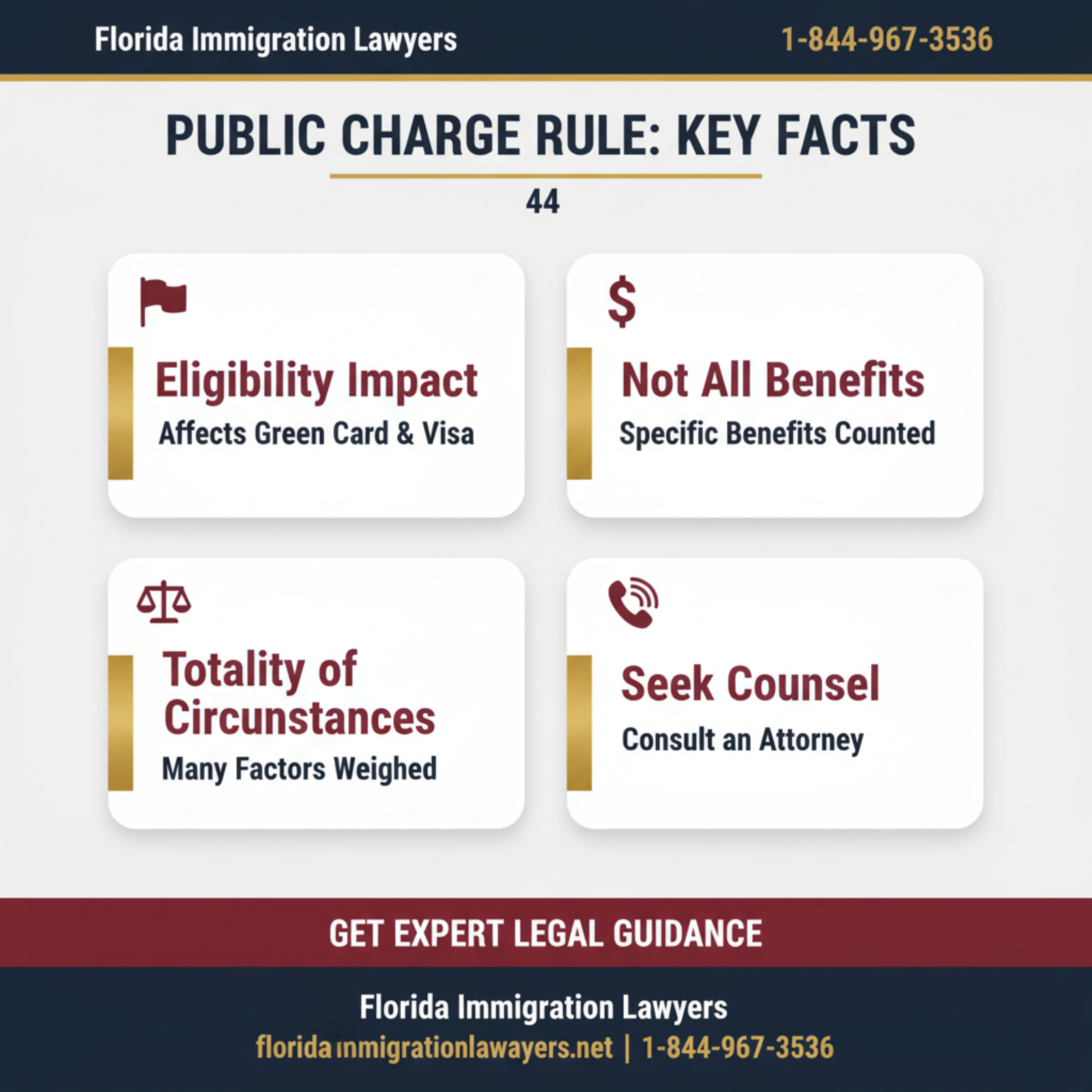
- The public charge rule applies to most applicants for green cards and certain visas.
- It focuses on specific cash assistance and long-term institutional care.
- Most health, nutrition, and housing florida benefits are generally NOT considered.
- A holistic assessment considers age, health, education, skills, and financial resources.
- Consulting an attorney is vital to navigate the complexities and avoid inadmissibility.
Understanding the Public Charge Rule Florida Immigrants Face in 2026
Are you an immigrant in Florida, perhaps in areas like Hialeah, concerned about how using public benefits might affect your immigration status? The public charge rule is a complex but critical aspect of U.S. immigration law. It can significantly impact your eligibility for a green card or certain visas.
This article will demystify the public charge rule 2026. We will explain what it is, who it affects, and what government benefits are considered. We provide a comprehensive guide for immigrants in Florida, focusing on practical steps and common pitfalls to avoid. Our goal is to empower you with the knowledge to navigate this process successfully.
Understanding these regulations is essential for your future in the United States. Do not leave your immigration journey to chance. Call Florida Immigration Lawyers at 1-844-967-3536 for a free consultation today. We are here to help you understand this vital immigration rule and protect your path forward.
What is the Public Charge Rule? An Overview for Florida Residents
The public charge rule is a long-standing principle in U.S. immigration law. It aims to identify individuals likely to become primarily dependent on the government for subsistence. This determination is made when an immigrant applies for admission into the U.S. or for adjustment of status to become a lawful permanent resident, often referred to as getting a green card.
The current policy, finalized in 2022 and effective in 2026, clarifies and narrows the scope of what constitutes a "public charge." It provides more certainty for immigrants and their families. This rule helps prevent inadmissibility based on the likelihood of relying on specific public assistance.
For Florida immigrants, including those in vibrant communities like Hialeah, Miami, Orlando, and Tampa, understanding the nuances of this immigration rule is paramount. Your eligibility for a green card or visa depends on demonstrating that you are not likely to become a public charge.
Who Does the Public Charge Rule Apply To?
The public charge rule generally applies to individuals seeking lawful permanent resident status (a green card) and those applying for certain types of nonimmigrant visas. However, it does not apply to everyone. Certain categories of immigrants are exempt from this assessment.
Exemptions typically include refugees, asylees, certain victims of trafficking (T visa holders), victims of qualifying criminal activity (U visa holders), and special immigrant juveniles. These individuals are not subject to the public charge ground of inadmissibility. If you are unsure if you are exempt, seeking legal counsel is advisable.
What Benefits Are Considered for Public Charge Determinations?
Under the 2026 final immigration rule, only a narrow set of public benefits are considered in a public charge determination. These include:
- Supplemental Security Income (SSI)
- Temporary Assistance for Needy Families (TANF) cash assistance
- State, Tribal, territorial, or local cash assistance programs for income maintenance
- Long-term institutionalization at government expense (e.g., in a nursing home or mental health institution)
It is crucial to note that receiving these benefits does not automatically lead to a public charge determination. USCIS considers a range of factors in a holistic assessment. For Florida residents, understanding which florida benefits are relevant is key.
What Benefits Are NOT Considered?
The vast majority of public benefits are NOT considered in a public charge determination. This is a critical point for many immigrants who worry about accessing essential services. These non-countable florida benefits include:
- Medicaid and other health insurance and health services (except for long-term institutionalization at government expense)
- Food Stamps or other nutrition programs, such as SNAP (Supplemental Nutrition Assistance Program)
- Housing assistance, including Section 8 and public housing
- Child Care Services
- Emergency medical care
- Disaster relief
- Foster care and adoption assistance
- Student loans and financial aid
- Unemployment compensation
- Social Security, government pensions, and other earned benefits
- Benefits received by family members who are U.S. citizens
This extensive list means that using many common safety net programs will not negatively impact your green card application under the public charge rule 2026. This clarity helps ensure that immigrants can access necessary support without fear of jeopardizing their immigration future.
The Public Charge Assessment: A Step-by-Step Guide for Florida Immigrants
When you apply for a green card in Florida, USCIS will conduct a comprehensive assessment to determine if you are likely to become a public charge. This is not a simple check of benefit usage but a multi-faceted review. Here’s a general step-by-step guide on how the assessment typically works:
- Submission of Form I-485 and Supporting Documents: You will file Form I-485, Application to Adjust Status, along with various supporting documents. These include financial documents, proof of identity, and other evidence relevant to your eligibility.
- Review of Affidavit of Support (Form I-864): For most family-based immigration categories and some employment-based categories, a U.S. citizen or lawful permanent resident sponsor must file Form I-864, Affidavit of Support. This form legally binds the sponsor to financially support the immigrant. This is a crucial factor in demonstrating that you are not likely to become a public charge.
- Holistic Review of Statutory Factors: USCIS officers consider several factors in their holistic assessment. These factors include your age, health, family status, assets, resources, financial status, education, and skills. They also consider the affidavit of support.
- Age: Your age can be a factor. For instance, very young children or elderly individuals may be considered differently based on their ability to work and support themselves.
- Health: Your physical and mental health are assessed. This involves submitting a medical examination report (Form I-693) completed by a USCIS-approved civil surgeon.
- Family Status: The size of your household and the number of dependents you have are considered. This helps assess your financial obligations and support structure.
- Assets, Resources, and Financial Status: USCIS will review your income, savings, property, and other financial holdings. This demonstrates your ability to be self-sufficient.
- Education and Skills: Your educational background, work experience, and language proficiency (especially English) are important. These factors indicate your potential to secure employment and contribute economically in Florida.
- Interview with USCIS: You will typically attend an interview at a USCIS field office in Florida, such as the one in Miami or Orlando. During this interview, the officer may ask questions related to your financial situation and your understanding of the public charge rule.
- Decision: Based on all the evidence and the holistic assessment, USCIS will make a decision on your application. If it is determined that you are likely to become a public charge, your application may be denied due to inadmissibility.
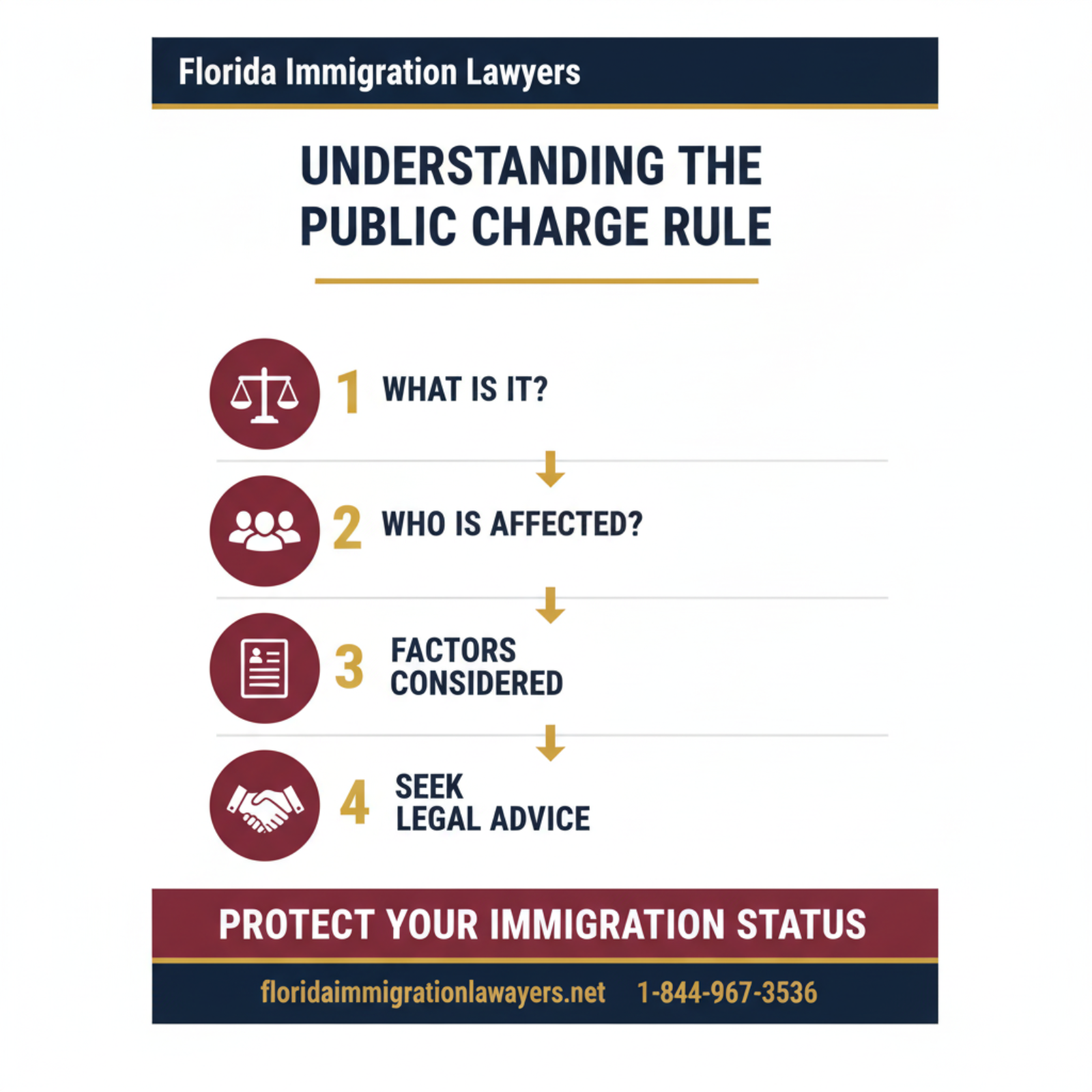
Navigating this complex assessment requires careful preparation and a thorough understanding of the immigration rule. For those seeking a green card public charge determination, the support of experienced legal counsel is invaluable.
Essential Document Checklist for Public Charge Assessment
To successfully navigate the public charge assessment, especially for your green card application in Florida, you will need to gather a comprehensive set of documents. This checklist is general; your specific situation may require additional evidence. Always consult with your attorney for a tailored list.
- Form I-485, Application to Adjust Status: The primary application form.
- Form I-864, Affidavit of Support: Completed by your financial sponsor, if applicable. This is crucial for family-based cases.
- Proof of Income and Employment:
- Recent tax returns (federal and state)
- Pay stubs or employment verification letters
- Bank statements demonstrating savings and financial stability
- Proof of assets (e.g., property deeds, investment accounts)
- Education and Skills Documentation:
- Diplomas, degrees, or certificates
- Professional licenses or certifications
- Resumes or curriculum vitae detailing work history
- Proof of English language proficiency (if applicable, though not always required)
- Health Records:
- Form I-693, Report of Medical Examination and Vaccination Record, completed by a USCIS-approved civil surgeon.
- Identity and Biographic Documents:
- Birth certificate
- Passport and visa copies
- Marriage certificate (if applicable)
- Photos meeting USCIS specifications
- Evidence of Family Status:
- Birth certificates of dependents
- Proof of custody or legal guardianship, if relevant
- Any Evidence of Non-Public Charge Status:
- Proof of private health insurance
- Letters from employers
- Evidence of community involvement or volunteer work
Organizing these documents thoroughly is vital. Incomplete applications can lead to delays or even denial based on the public charge rule. Ensure all financial and personal details are accurately reflected to support your case for a green card.
Timeline and Processing Expectations for Public Charge Cases in Florida
The timeline for public charge assessments, as part of a green card application, can vary significantly. Factors such as the specific USCIS field office (e.g., Miami, Orlando, Tampa), the complexity of your case, and current processing backlogs all play a role. It is important to set realistic expectations.
Generally, after filing your Form I-485, you can expect to receive a receipt notice within a few weeks. Biometrics appointments typically follow within a few months. The medical exam must be completed by a USCIS-approved civil surgeon in Florida, and the results submitted. This is a critical part of the public charge rule 2026 assessment.
Interviews are common for adjustment of status applicants. These can take place several months to over a year after filing, depending on the office and case volume. For example, processing times at the USCIS Miami Field Office or the Orlando Field Office can differ. You can check current processing times on the USCIS website for specific forms and offices. Delays are common, so patience is key.
The entire process, from filing to final decision, can range from 10 months to several years. The thoroughness of your documentation and the strength of your sponsor's affidavit of support can impact the speed of your case. An experienced immigration attorney can help you monitor your case and respond to any requests for evidence promptly, potentially mitigating delays related to the immigration rule.
Cost Factors and Fee Breakdown for Public Charge-Related Filings
When preparing for your green card application and the associated public charge assessment, you must account for various costs. These fees are subject to change, so always verify the latest amounts on the USCIS website before filing. We will not provide specific dollar amounts here due to their fluctuating nature.
The primary costs typically include the filing fee for Form I-485, Application to Adjust Status. There is also a biometric services fee. If an Affidavit of Support (Form I-864) is required, there is generally no separate filing fee for this form, but it is integral to the financial aspect of your application.
Beyond USCIS fees, you should budget for additional expenses. These include the cost of the mandatory medical examination (Form I-693) by a USCIS-approved civil surgeon, which varies by provider. You may also incur costs for obtaining necessary documents, such as birth certificates, marriage licenses, and criminal records, especially if they need translation or certification.
Legal fees for an experienced immigration attorney are another significant consideration. While an upfront investment, legal representation can be invaluable in navigating the complexities of the public charge rule, ensuring all forms are correctly filed, and preparing you for interviews. This investment helps to avoid costly mistakes and potential denials related to inadmissibility.
Do not navigate this complex process alone. The stakes are too high for your future in Florida. Contact Florida Immigration Lawyers today to ensure your application is strong and compliant with all regulations. Our team is ready to assist you.
Common Mistakes Florida Immigrants Make Regarding the Public Charge Rule
Understanding and complying with the public charge rule is critical for immigrants in Florida. Making mistakes can lead to significant delays or even denial of your green card application. Here are some common pitfalls to avoid:
- Misunderstanding Which Benefits Count: Many immigrants mistakenly believe that using any government benefit, such as SNAP or Medicaid, will make them a public charge. This is a widespread misconception that causes unnecessary fear. Only specific cash assistance and long-term institutional care are considered.
- Failing to Provide a Sufficient Affidavit of Support: For many family-based cases, a robust Form I-864, Affidavit of Support, from a financially qualified sponsor is crucial. An insufficient affidavit or a sponsor who does not meet income requirements can lead to denial.
- Not Disclosing All Relevant Information: Attempting to hide past receipt of countable benefits or other financial information can be detrimental. USCIS conducts thorough background checks; any misrepresentation can result in a finding of fraud and permanent inadmissibility.
- Ignoring the Holistic Factors: Focusing solely on benefit usage and neglecting other factors like education, skills, age, and health is a mistake. USCIS performs a holistic review. Strong evidence in these other areas can mitigate concerns about past benefit use.
- Failing to Get a Timely Medical Examination: The Form I-693 medical exam is mandatory. Delays in completing it with a USCIS-approved civil surgeon in Florida can hold up your application and potentially lead to a Request for Evidence (RFE) or denial.
- Not Updating USCIS on Changes: If your financial situation, family status, or address changes during the application process, failing to inform USCIS can cause issues. Keep all information current to avoid miscommunications or delays.
- Assuming the Rule Hasn't Changed: The public charge rule has evolved over time. Relying on outdated information or advice from non-legal sources can be dangerous. Always refer to the latest USCIS guidance, especially for the public charge rule 2026.
- Not Preparing for the Interview: The USCIS interview is a chance to explain your situation. Being unprepared to answer questions about your financial stability, employment prospects, and understanding of the immigration rule can weaken your case.
- Ignoring the Impact of Family Members' Benefits: While benefits received by U.S. citizen family members generally do not count against the applicant, understanding whose benefits are assessed is important. Clarify this with an attorney.
- Failing to Seek Legal Counsel: This is perhaps the biggest mistake. The public charge rule is complex. An experienced Florida immigration attorney can provide tailored advice, ensure proper documentation, and represent your best interests, significantly increasing your chances of success.
When to Call Florida Immigration Lawyers for Public Charge Assistance
The complexities of the public charge rule and its potential impact on your green card application mean that legal guidance is often essential. You should consider contacting Florida Immigration Lawyers if any of the following scenarios apply to you:
- You have received countable public benefits: If you or your dependent family members have received SSI, TANF, or long-term institutional care at government expense, it is crucial to discuss your situation with an attorney. We can assess the impact and help prepare your case.
- You are unsure if a benefit you received is countable: With so many different state and federal programs, it is easy to be confused. Our lawyers can clarify which florida benefits are relevant to the public charge determination.
- You are concerned about potential inadmissibility: If you fear your financial situation or past benefit use might lead to a denial, we can help you understand your risks and strategize to mitigate them.
- You need to prepare a strong Affidavit of Support (Form I-864): Ensuring your sponsor meets all requirements and the affidavit is correctly filed is paramount. We can guide your sponsor through this critical process.
- You received a Request for Evidence (RFE) or Notice of Intent to Deny (NOID): These notices from USCIS indicate that there are issues with your application. Responding correctly and promptly is vital, and an attorney’s help is indispensable.
- You have a complex financial history: If your income is inconsistent, you have significant assets, or other unique financial circumstances, an attorney can help present your financial picture clearly and favorably.
- You are applying for a green card in Florida and want to ensure compliance: Even if you believe your case is straightforward, a review by an expert can catch potential issues before they arise. We serve clients across Florida, including Hialeah, Miami, and Orlando. For more information on citizenship or deportation defense, explore our website.
Do not wait until problems arise. Proactive legal consultation can save you time, stress, and potentially your immigration future. Florida Immigration Lawyers are experts in this immigration rule and are dedicated to serving our community.
About Florida Immigration Lawyers
Florida Immigration Lawyers is a leading law firm dedicated to providing comprehensive immigration services across the entire state of Florida. Our experienced attorneys understand the profound impact immigration decisions have on individuals and families. We are committed to offering compassionate, effective, and results-oriented legal representation.
We specialize in a wide range of immigration matters, including family-based immigration, business immigration, asylum claims, deportation defense, citizenship applications, and visa services. Our firm prides itself on staying abreast of the latest changes in immigration rule and policy, including the current public charge rule 2026, to best serve our diverse clientele.
Why choose Florida Immigration Lawyers? We offer personalized attention, clear communication, and a deep understanding of both federal immigration law and the specific needs of Florida's immigrant communities, including those in Hialeah. We are available 24/7 to address your urgent concerns and provide free consultations to discuss your case.
Your journey to a new life in the U.S. is our priority. Let us be your trusted legal partners. Call us today at 1-844-967-3536 or visit our website at https://www.floridaimmigrationlawyers.net to learn how we can assist you.
Sources and References
- USCIS Policy Manual: Public Charge
- U.S. Citizenship and Immigration Services (USCIS) - Public Charge
- Executive Office for Immigration Review (EOIR)
- Immigration and Nationality Act (INA) Section 212(a)(4) - Public Charge Inadmissibility
- 8 U.S.C. § 1182(a)(4) - Classes of excludable aliens - Public charge
- 8 CFR § 212.21 - Public charge: Definitions
- 8 CFR § 212.22 - Public charge: Public charge inadmissibility determination
This article provides general legal information and is not intended as legal advice. Every case is unique, and outcomes depend on specific facts and circumstances. Contact an attorney for advice about your particular situation.
Do not let the complexities of the public charge rule deter you from pursuing your American dream. Florida Immigration Lawyers is here to provide the expert guidance and support you need. Schedule your free consultation now by calling 1-844-967-3536. Se Habla Español - Estamos aquí para ayudarle.
Need help with Immigration?
Our Florida immigration attorneys offer free consultations. Call today or schedule online.
Frequently Asked Questions
Florida Immigration Lawyers
Legal Team
Our experienced attorneys at Florida Immigration Lawyers have been serving clients across Florida for over 20 years. We specialize in immigration, personal injury, criminal defense, workers compensation, and family law.