Canada Open Work Permit August 2025: Florida Application...
Considering a Canada Open Work Permit in August 2025 from Florida? Learn the process, requirements, and how Florida Immigration Lawyers can help. Schedule a free consultation.

Are you a resident of Florida dreaming of new career opportunities and a vibrant life in Canada? The Canada Open Work Permit for August 2025 could be your gateway to achieving that dream. This comprehensive guide will walk you through everything you need to know about applying for an Open Work Permit from Florida, covering eligibility, the application process, required documents, and how expert legal assistance can streamline your journey. Canada is renowned for its welcoming immigration policies, diverse job market, and high quality of life, making it an increasingly popular destination for professionals and skilled workers worldwide. Understanding the nuances of the application process, especially when applying from the United States, is crucial for a successful outcome.
Understanding the Canada Open Work Permit
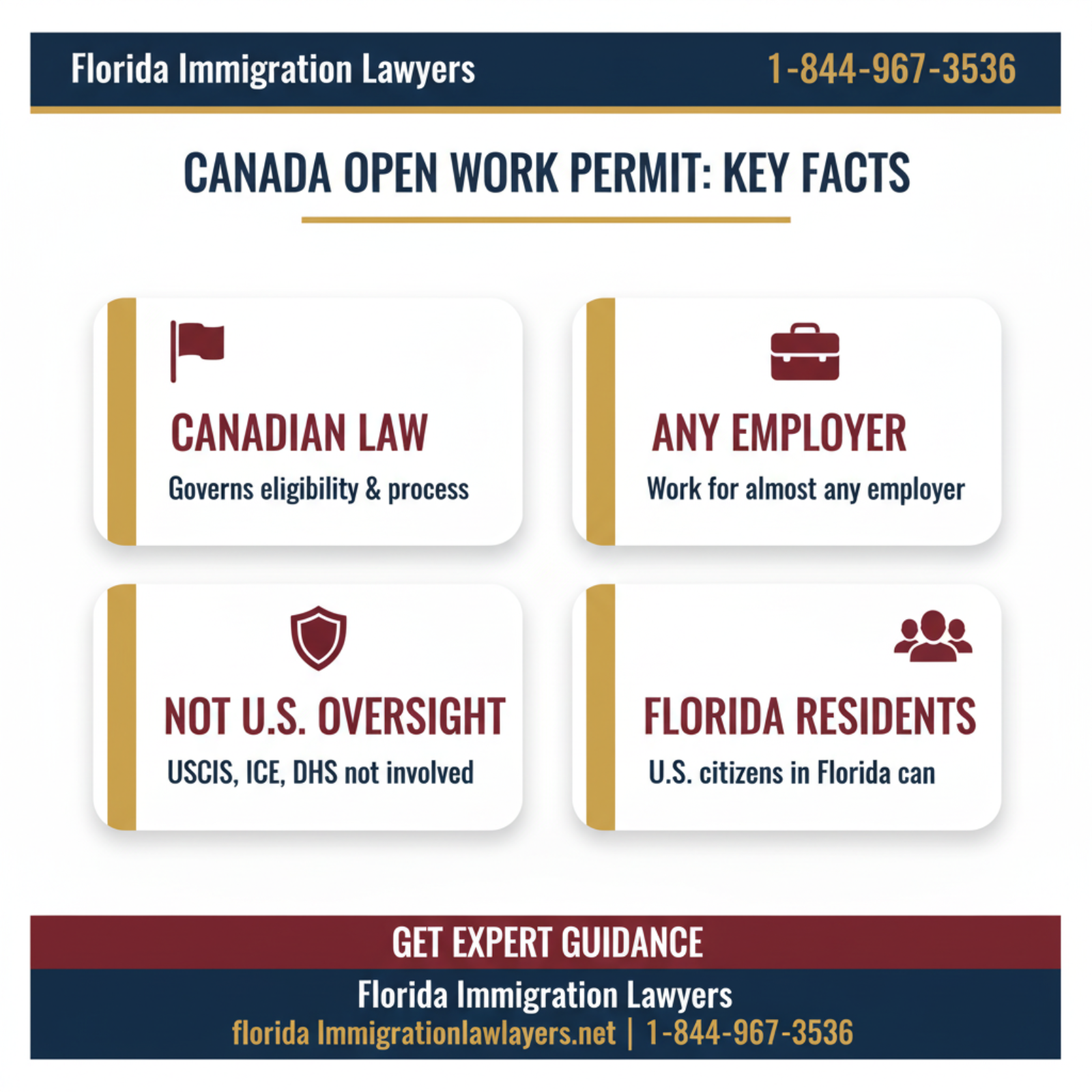
A Canada Open Work Permit is a specific type of work permit that does not require a Labour Market Impact Assessment (LMIA) or a specific job offer from a Canadian employer. Unlike a "closed" work permit, which ties you to a particular employer, an Open Work Permit allows you to work for almost any employer in Canada, in almost any occupation. This flexibility is a significant advantage, giving you the freedom to explore various job opportunities and gain valuable Canadian work experience. It's an ideal pathway for individuals seeking to enter the Canadian job market without the initial hurdle of securing a pre-approved job.
Eligibility for an Open Work Permit typically falls under several categories, including spouses or common-law partners of international students or skilled workers, international students who have graduated from a designated learning institution in Canada, individuals awaiting a decision on their permanent residency application, and certain temporary residents. For Florida residents, understanding which category applies to you is the first critical step. The Canadian government's immigration policies are designed to attract global talent, and the Open Work Permit is a testament to this commitment, offering a flexible route for qualified individuals to contribute to the Canadian economy and society.
Beyond immediate employment, securing an Open Work Permit can be a strategic move for those with long-term aspirations of Canadian permanent residency. The Canadian work experience gained through an Open Work Permit can significantly boost your eligibility under programs like Express Entry, specifically the Canadian Experience Class. This pathway allows individuals to accumulate valuable points for their skills, language proficiency, and adaptability, making the transition from temporary worker to permanent resident smoother and more attainable. For example, a software engineer from Orlando securing an Open Work Permit could work for two years in Toronto, gaining invaluable experience that directly contributes to their Express Entry profile.
The flexibility of an Open Work Permit also extends to professional development. It allows you to accept contract work, explore different industries, or even start your own business, provided you meet the necessary regulatory requirements. This adaptability is particularly appealing for professionals looking to diversify their skill set or test the waters in Canada's dynamic job market before committing to a specific long-term role. It empowers you to shape your career path rather than being dictated by a single employer, fostering a sense of independence and opportunity rarely found in other immigration streams.
Eligibility Requirements for Florida Applicants
While the Canada Open Work Permit offers flexibility, specific eligibility criteria must be met. For applicants residing in Florida, these requirements are generally consistent with those for other international applicants, with some considerations regarding documentation and submission from the U.S. Key requirements typically include:
- Valid Passport: You must hold a valid passport from your country of citizenship.
- Medical Examination: Depending on where you have lived or traveled, and the type of work you intend to do, you may need to undergo a medical examination.
- Police Certificates: You may be required to provide police certificates to prove you have no criminal record.
- Proof of Funds: You must demonstrate that you have sufficient funds to support yourself and any accompanying family members upon arrival in Canada.
- Intent to Depart: You must satisfy an immigration officer that you will leave Canada at the end of your authorized stay.
- No Inadmissibility: You must not be inadmissible to Canada for security, health, or financial reasons.
- Specific Program Eligibility: You must qualify under one of the specific streams that grant Open Work Permits (e.g., Post-Graduation Work Permit, Spousal Open Work Permit, Bridging Open Work Permit).
It's crucial to thoroughly review the specific requirements for the category under which you are applying. For instance, if you are applying as a spouse of a Canadian student, you will need to provide proof of your spouse's study permit and enrollment. Navigating these specific requirements can be complex, and this is where expert guidance, particularly from those familiar with immigration law, becomes invaluable.
Let's delve deeper into some of these requirements. For "Proof of Funds," IRCC generally expects applicants to demonstrate financial stability to avoid becoming a public charge. While there isn't a fixed amount for all Open Work Permit categories, it's advisable to show at least CAD$1,000 to CAD$2,000 per month for yourself, plus additional funds for any accompanying family members. This could be evidenced through bank statements, investment portfolios, or a letter from an employer showing a job offer with a substantial salary, even if not required for the permit itself. For example, a family from Miami applying for a Spousal Open Work Permit might need to show combined savings of at least CAD$15,000 to cover initial living expenses.
Regarding "Specific Program Eligibility," understanding your pathway is paramount. Common Open Work Permit streams include the Post-Graduation Work Permit (PGWP) for international students who have completed eligible programs in Canada, the Spousal Open Work Permit (SOWP) for spouses or common-law partners of certain skilled workers or international students, and the Bridging Open Work Permit (BOWP) for those who have applied for permanent residence and are awaiting a decision. Each stream has unique conditions; for instance, a PGWP requires specific educational credentials, while a SOWP hinges on your partner's status in Canada. Incorrectly identifying your stream can lead to immediate refusal, highlighting the need for meticulous self-assessment or professional advice.
Being deemed "inadmissible" to Canada is a significant hurdle. This can occur due to a range of factors, including serious criminal convictions (even minor offenses can impact admissibility), health conditions that could pose a risk to public health or safety, or excessive demand on Canada's health or social services, or misrepresentation on past applications. If you have any concerns about potential inadmissibility, it is highly recommended to consult with an immigration lawyer. They can assess your situation, advise on potential remedies, and help prepare a strong case, especially for complex scenarios that might otherwise lead to a refusal. For Florida residents, connecting with Florida Immigration Lawyers at 1-844-967-3536 can provide clarity on such sensitive issues.
The Application Process from Florida for August 2025
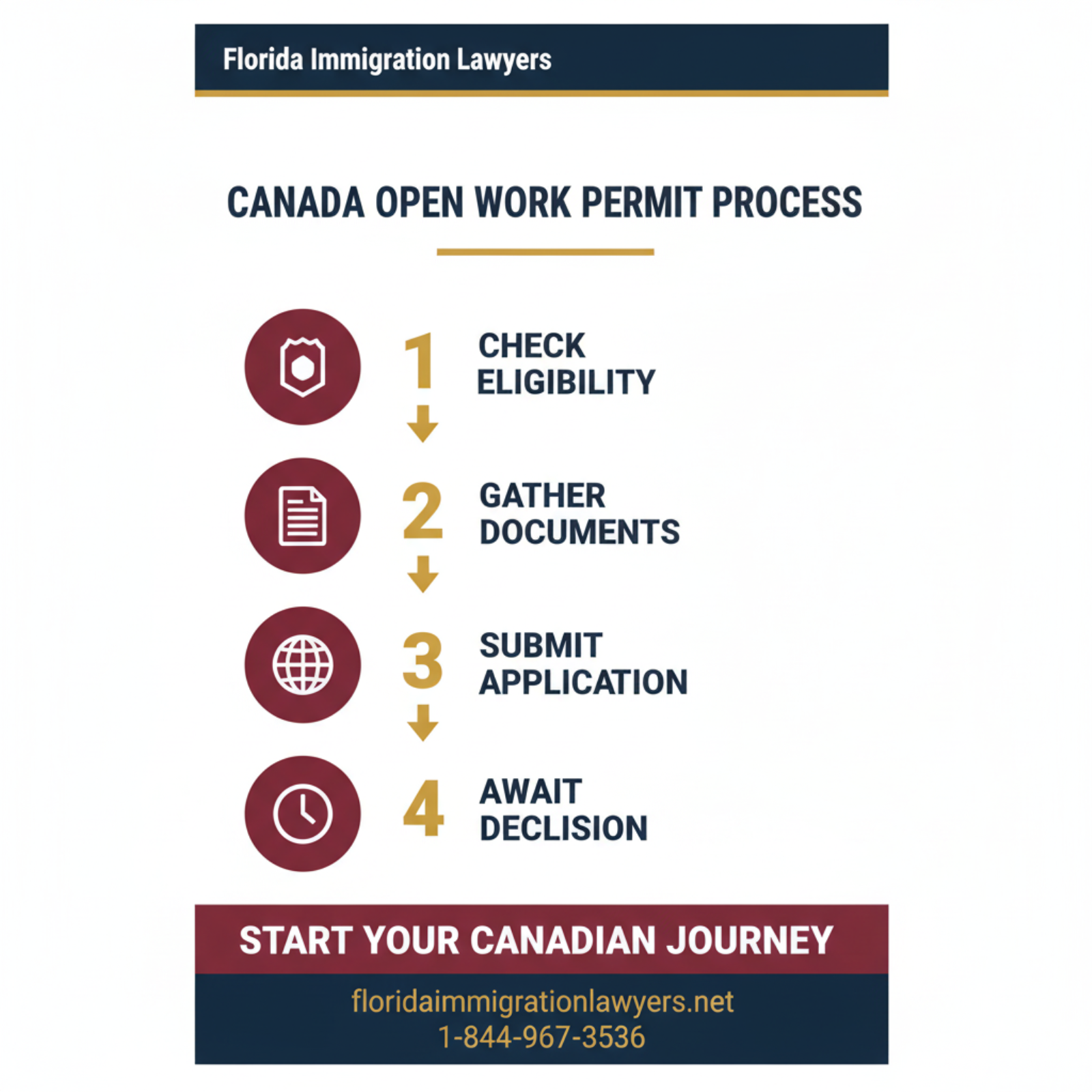
Applying for a Canada Open Work Permit from Florida involves several steps, primarily conducted online, but with specific considerations for U.S.-based applicants. Here’s a general outline of the process:
- Determine Eligibility: Use the official "Come to Canada" tool on the IRCC website to confirm your eligibility for an Open Work Permit. This tool will guide you to the correct application package.
- Gather Documents: Collect all necessary documents as per your specific eligibility stream. This includes identity documents, educational certificates, proof of funds, and any other supporting documentation. Ensure all documents are translated into English or French if they are in another language.
- Complete the Application Forms: Fill out all required application forms accurately and completely. Any errors or omissions can lead to delays or rejection.
- Pay Fees: Pay the application processing fees online. The standard work permit fee and the open work permit holder fee are typically required.
- Submit Application Online: Upload all your documents and the completed forms to your IRCC secure online account.
- Biometrics: After submitting your application, you will receive a Biometric Instruction Letter (BIL). You will need to provide your biometrics (fingerprints and photo) at a designated Service Canada location or a U.S. Application Support Center (ASC) if available and authorized.
- Interview (If Required): In some cases, you may be called for an interview by an immigration officer.
- Receive Decision: If your application is approved, you will receive a Port of Entry (POE) Letter of Introduction. This letter is not your work permit but allows you to receive it upon arrival in Canada.
The August 2025 timeframe suggests planning ahead, as processing times can vary. Staying informed about any updates from Immigration, Refugees and Citizenship Canada (IRCC) is vital. For detailed information on U.S. immigration processes that might indirectly affect your Canadian application, you can consult uscis.gov.
When gathering documents, precision is key. Ensure all scans are clear, legible, and adhere to IRCC's file size and format specifications. For example, a blurry scan of your passport or an unreadable bank statement could lead to your application being returned as incomplete. Organize your documents logically, using clear file names, and double-check that every required document for your specific stream is included. A practical tip is to create a checklist based on the IRCC document guide and tick off each item as you prepare it, preventing oversight.
The biometrics step is a critical part of the process for most applicants. As a Florida resident, you will receive a Biometric Instruction Letter (BIL) after submitting your online application. This letter will direct you to an authorized collection service. While Service Canada locations are primarily within Canada, U.S. applicants typically use U.S. Application Support Centers (ASCs) or specific biometric collection points designated by IRCC. It's essential to schedule your appointment promptly after receiving the BIL, as there's usually a 30-day deadline to provide your biometrics. Failing to do so can result in application processing delays or even refusal. For instance, an applicant in Tampa would need to locate their nearest ASC and book an appointment, ensuring they bring their BIL and valid photo ID.
After you submit your application and provide biometrics, the waiting period begins. You can monitor the status of your application through your IRCC online account. If an interview is required, it will typically be conducted remotely via video conference or phone. This is an opportunity for the immigration officer to clarify information or assess your intent. Be prepared to answer questions about your reasons for wanting to work in Canada, your financial situation, and your ties to Florida. Should your application be approved, the Port of Entry (POE) Letter of Introduction is your golden ticket. Keep it safe, as you will present it to a Canadian Border Services Agency (CBSA) officer upon your arrival in Canada, who will then issue your physical Open Work Permit.
Essential Documents for Your Application
A successful Open Work Permit application hinges on providing a complete and accurate set of documents. While the exact list can vary based on your specific category, here are the core documents typically required:
- Passport: A valid passport with at least six months validity beyond your intended stay in Canada.
- Digital Photo: Adhering to IRCC specifications.
- Proof of Funds: Bank statements, pay stubs, or a letter from an employer demonstrating your financial stability.
- Family Information Form: Details about your family members, whether they are accompanying you or not.
- Educational Documents: Diplomas, degrees, transcripts (if applicable to your stream, e.g., Post-Graduation Work Permit).
- Marriage Certificate/Common-Law Declaration: If applying as a spouse or common-law partner.
- Medical Exam Confirmation: If required, proof that you have undergone a medical examination by an IRCC-approved panel physician.
- Police Certificates: From any country where you have lived for six months or more since the age of 18.
- Letter of Explanation: A detailed letter explaining your purpose for seeking an Open Work Permit, your ties to your home country (Florida, in this case), and your intent to comply with Canadian immigration laws.
Ensuring every document is correctly filled out, signed, and uploaded in the specified format is paramount. Missing or incorrect documents are among the most common reasons for application delays or refusals. It's also wise to keep abreast of international travel regulations, which can be found on sites like travel.state.gov, especially if you plan to travel internationally before your Canadian journey.
The "Letter of Explanation" is often underestimated but can be a powerful tool. This is your opportunity to tell your story, clarify any ambiguities in your application, and demonstrate your genuine intent. For instance, if you have a gap in your employment history, this letter can explain it. If you have strong family ties in Florida that ensure your return, articulate them clearly. It should be concise, professional, and persuasive, reinforcing your eligibility and commitment to Canadian immigration laws. A well-crafted letter can significantly strengthen your application, especially in complex cases, and is a key area where legal guidance from Florida Immigration Lawyers can be beneficial.
For any documents not originally in English or French, certified translations are mandatory. This means a professional translator must translate the document, and the translation must be accompanied by an affidavit from the translator and a certified copy of the original document. Do not attempt to translate documents yourself, as this will not be accepted. For example, if your birth certificate is in Spanish, you’ll need a certified English or French translation. Failure to provide proper translations is a common reason for application rejection, so ensure this step is handled by a reputable service.
Finally, consistency across all your submitted documents is crucial. Your name, date of birth, and other personal details must match exactly on your passport, educational certificates, and application forms. Even minor discrepancies can raise red flags and lead to requests for additional information, causing significant delays. Before submission, perform a thorough review of all documents, perhaps even having a trusted friend or legal professional like those at Florida Immigration Lawyers review it, to catch any inconsistencies or errors. This meticulous approach can save you time and stress in the long run.
Processing Times and Fees
Processing times for Canada Open Work Permits can fluctuate based on the volume of applications, the specific category you apply under, and the completeness of your submission. IRCC provides estimated processing times on its official website, which are updated regularly. These times can range from a few weeks to several months. For example, a Spousal Open Work Permit might be processed faster than a more complex Bridging Open Work Permit. It's crucial to check the most current estimates for your specific application type and country of residence (U.S.) to manage your expectations.
Several factors can influence how quickly your application is processed. These include the current backlog of applications, the efficiency of the visa office handling your file, and whether you are applying from within Canada or from abroad. Submitting a complete application with all required documents and accurate information is the single most effective way to minimize delays. Any missing documents, errors, or requests for additional information will inevitably extend the processing period. For instance, if you forget to include a police certificate from a country you lived in, IRCC will pause your application until it's provided, adding weeks or months to your wait.
Regarding fees, there are typically two main components for an Open Work Permit: the work permit processing fee and the open work permit holder fee. As of current guidelines, the work permit processing fee is CAD$155, and the open work permit holder fee is CAD$100, totaling CAD$255. Additionally, most applicants will need to pay a biometrics fee, which is CAD$85 for an individual or CAD$170 for a family applying together. These fees are non-refundable, even if your application is refused. It’s important to check the IRCC website for the most up-to-date fee schedule, as these amounts can change without prior notice.
Payment of fees is usually done online through the IRCC portal using a credit or debit card. Ensure you have sufficient funds and that your card is authorized for international transactions. Retain a copy of your payment receipt as proof. Some specific programs or circumstances might offer fee exemptions, but these are rare and typically apply to humanitarian or vulnerable person cases. Always verify the exact fees applicable to your situation before proceeding with payment.
Given the August 2025 target, starting your application process well in advance is highly recommended. This allows ample time to gather all necessary documents, complete medical exams if required, and account for potential processing delays. Proactive planning, coupled with regular checks of the IRCC processing times tool, will help you stay on track. If you find yourself facing unexpected delays or require clarification on your application status, contacting IRCC directly or seeking assistance from experienced Florida Immigration Lawyers can provide valuable support and insights.
The Role of Immigration Lawyers in Your Journey
Navigating the complexities of Canadian immigration, especially when applying for an Open Work Permit from Florida, can be daunting. The rules, required documents, and eligibility criteria are constantly evolving, and a single mistake can lead to significant delays or even refusal. This is where the expertise of an immigration lawyer becomes invaluable. A qualified lawyer can offer personalized guidance, ensuring your application is complete, accurate, and aligned with the latest IRCC guidelines.
Immigration lawyers can assist in several critical ways. They can conduct a thorough eligibility assessment, helping you identify the most suitable Open Work Permit stream and proactively address any potential issues, such as past inadmissibility concerns or complex family situations. They will meticulously review all your documents, ensuring they meet IRCC's stringent requirements, are correctly translated, and consistently presented. This attention to detail significantly reduces the risk of rejection due to errors or omissions, which are common pitfalls for self-applicants.
Furthermore, should IRCC request additional information, an interview, or if your case presents unique challenges, your lawyer can prepare you for these interactions and even represent you. Their experience in dealing with immigration officers and understanding the nuances of immigration law can be a decisive factor in the success of your application. For Florida residents considering this life-changing move, connecting with dedicated Florida Immigration Lawyers can provide peace of mind and significantly streamline your path to a Canada Open Work Permit. Don't hesitate to call 1-844-967-3536 for expert assistance tailored to your specific needs.
Do Not Navigate This Process Alone
Our experienced immigration attorneys are ready to fight for you. Get a free, confidential consultation today.
Se Habla Español
Frequently Asked Questions
Florida Immigration Lawyers
Immigration Attorney | Founder, Vasquez Law Firm
U.S. Air Force veteran and immigration attorney with thousands of cases resolved. J.D., NCCU School of Law. AILA member. Admitted to the 4th, 5th, and 11th Circuit Courts.
Available 24/7 - Free Evaluations
Related Legal Services
Our Florida immigration attorneys can help you with citizenship and naturalization, family immigration services and immigration practice areas. Call today at 1-844-967-3536 for a free consultation.
Related Links
Related Topics
Free Legal Consultation
Discuss your case with our experienced attorneys. We're available 24/7.
Se Habla Español - Estamos aquí para ayudarle.
Related Articles
Deportation Defense Lawyer Orlando: Fight Removal Proceedings
Facing deportation in Orlando or anywhere in Florida is a frightening prospect. This comprehensive guide explains removal proceedings, common grounds for deportation, and the vital role of a deportation defense lawyer. Learn about the step-by-step process, critical documents, various relief options like asylum or cancellation of removal, and common mistakes to avoid. Florida Immigration Lawyers offers expert legal assistance to protect your rights and fight for your ability to remain in the U.S. Contact us for a free consultation and personalized guidance.
H-2A Visa for Florida Agricultural Workers | VLF Florida
Explore how the H-2A visa program supports Florida's agricultural sector by allowing growers to hire temporary foreign workers. Understand the application process, eligibility requirements, and common pitfalls. Florida Immigration Lawyers are here to assist you.
Refugee Resettlement in Florida: A Guide | VLF Florida
Discover the essential steps for refugee resettlement in Florida with our comprehensive guide. Learn about eligibility, documentation, and local resources to aid your transition. Call Florida Immigration Lawyers at 1-844-967-3536 for expert assistance.
Understanding Immigration Lawyer Costs in Florida 2026
Discover the costs associated with hiring an immigration lawyer in Florida in 2026. Learn about the factors that influence pricing and how to choose the right attorney for your needs. Call for a free consultation today.
