Green Card Re-Entry Permit: Avoid Abandonment in Florida
For Lawful Permanent Residents (LPRs) in Florida, understanding the nuances of a re-entry permit (Form I-131) is vital to avoid green card abandonment. This permit is an essential travel document that proves your intent to maintain U.S. residency, especially for trips lasting one year or more. Without it, you risk losing your permanent resident status upon re-entry. This guide covers eligibility, the step-by-step application process, required documents, processing timelines, and associated costs. Whether you are traveling for family, work, or study, securing a re-entry permit protects your future in Florida. Learn how to prevent common mistakes and when to seek expert legal guidance from Florida Immigration Lawyers to ensure your green card is secure.

A re-entry permit is a critical document for Lawful Permanent Residents (LPRs) in Florida who plan to travel outside the United States for an extended period, typically one year or more. It serves as evidence that you do not intend to abandon your permanent resident status, preventing potential issues upon your return to U.S. ports of entry. Without a re-entry permit, prolonged absence can lead to a presumption of green card abandonment, potentially resulting in denial of re-entry and even initiation of deportation proceedings. Applying for Form I-131, Application for Travel Document, is essential to protect your permanent residency.
- A re-entry permit prevents the presumption of green card abandonment for LPRs traveling abroad.
- It is crucial for stays outside the U.S. lasting one year or longer.
- The permit is applied for using Form I-131, Application for Travel Document.
- Failure to obtain one can lead to re-entry denial and loss of permanent residency.
- Consulting an immigration lawyer is highly recommended for this complex process.
For many Lawful Permanent Residents (LPRs) living in Florida, the dream of international travel, extended family visits, or even temporary work assignments abroad is a cherished possibility. Florida's vibrant international communities, particularly in areas like Orlando, Miami, and Tampa, often mean that LPRs have strong ties to their home countries. However, prolonged absences from the United States can inadvertently jeopardize your hard-earned green card status. Understanding the rules surrounding green card abandonment and the crucial role of a re-entry permit is vital for protecting your future in the U.S.
This comprehensive guide from Florida Immigration Lawyers will walk you through everything you need to know about preventing green card abandonment, specifically focusing on the application process for a re-entry permit (Form I-131). We will cover who needs this document, the step-by-step application process, necessary documentation, expected timelines, and associated costs. Our goal is to empower you with the knowledge to travel confidently, knowing your permanent residency is secure. Do not risk losing your green card due to misunderstandings or procedural errors. Call Florida Immigration Lawyers at 1-844-967-3536 for a free consultation to discuss your specific travel plans and ensure your permanent resident status remains protected.
Understanding Green Card Abandonment and Re-Entry Permits in Florida
As a Lawful Permanent Resident, you have the privilege of living and working permanently in the United States. This status, however, comes with certain responsibilities, including maintaining your intent to reside permanently in the U.S. The U.S. government views prolonged absences from the country as a potential indicator that you have abandoned this intent. Generally, if an LPR stays outside the U.S. for six months to one year, they may face increased scrutiny at the port of entry. Stays of one year or more create a strong presumption of green card abandonment under 8 CFR § 211.1(b).
This is where the re-entry permit, issued on Form I-131, Application for Travel Document, becomes indispensable. A re-entry permit is an official document that allows a Lawful Permanent Resident to remain outside the United States for up to two years without being considered to have abandoned their permanent resident status. It essentially serves as a waiver of the presumption of abandonment that would otherwise arise from extended travel. For Florida residents, especially those with business interests or family abroad, this permit offers peace of mind and protection.
Without a re-entry permit, an LPR returning to a U.S. port of entry after a long absence may be subject to a hearing before an immigration judge. During this hearing, the LPR would have to prove that they did not intend to abandon their residency, which can be a difficult and stressful process often leading to deportation defense proceedings. The permit itself states that the LPR is not considered to have abandoned their status solely due to the length of their absence. This makes it a vital tool for maintaining your status, particularly for Florida’s diverse population who frequently travel internationally.
Who Needs a Re-Entry Permit (Form I-131)?
Not every Lawful Permanent Resident who travels internationally needs a re-entry permit. This document is specifically designed for LPRs who anticipate being outside the United States for an extended period. The general rule of thumb is that if you plan to be abroad for one year or more, you absolutely need a re-entry permit. However, even if your trip is expected to last between six months and one year, obtaining a permit can be a wise precautionary measure to avoid potential challenges upon re-entry.
Common scenarios that necessitate a re-entry permit include:
- Long-Term Family Visits: Many Florida LPRs have elderly parents or extended family abroad whom they wish to care for or visit for prolonged periods.
- Overseas Employment or Business Assignments: If your employer in Florida sends you abroad for a temporary assignment, or if you manage international business ventures, a permit protects your status.
- Academic Pursuits or Research: LPRs pursuing advanced degrees or conducting research overseas for more than a year will benefit from this permit.
- Medical Treatment: If you require specialized medical care in your home country that will keep you abroad for an extended duration.
- Military Deployment: LPRs serving in the U.S. armed forces who are deployed overseas for an extended period.
It is important to understand that a re-entry permit does not guarantee re-entry if you are found to be inadmissible for other reasons, such as criminal convictions or security concerns. However, it effectively removes the presumption of abandonment of residency due to the length of your absence. For Florida residents in Orlando, Tampa, or Miami, who often travel internationally, this permit is a crucial safeguard for maintaining their LPR status. Consulting with an immigration law firm like Florida Immigration Lawyers can help you determine if your specific travel plans warrant an I-131 application.
Step-by-Step Guide to Applying for a Re-Entry Permit (Form I-131)
Applying for a re-entry permit requires careful attention to detail and adherence to USCIS procedures. The process begins with filing Form I-131, Application for Travel Document. Here is a detailed step-by-step guide to help Florida LPRs navigate this application:
- Determine Your Eligibility: First, confirm you are a Lawful Permanent Resident or a conditional permanent resident. You must be physically present in the U.S. when you file Form I-131.
- Complete Form I-131 Accurately: Download the latest version of Form I-131 from the USCIS website. Fill out all sections completely and truthfully. Pay close attention to Part 2, where you indicate you are applying for a re-entry permit, and Part 3, which asks for your travel plans.
- Gather Required Supporting Documents: Collect all necessary documents, including copies of your green card, passport identity page, and two passport-style photos. Refer to the official USCIS instructions for a comprehensive list.
- Prepare Your Statement of Intent (Optional but Recommended): While not strictly required, including a cover letter explaining the purpose of your extended travel and demonstrating your intent to return to the U.S. and maintain your residency can be beneficial. Highlight your ties to Florida, such as property, employment, and family.
- Calculate and Include the Correct Filing Fee: Check the current filing fee for Form I-131 on the USCIS website. Fees change, so always verify the latest amount. You will typically need to include a separate fee for biometrics.
- Mail Your Application: Send your completed Form I-131, supporting documents, and fees to the correct USCIS lockbox facility. The mailing address depends on your state of residence (Florida applicants will use a specific address) and the delivery method.
- Attend Your Biometrics Appointment: After filing, USCIS will send you a notice to attend a biometrics appointment at an Application Support Center (ASC). For Florida residents, this could be at an ASC in Orlando, Jacksonville, or Miami. You must attend this appointment to have your fingerprints, photograph, and signature taken. This step is mandatory, and you must be in the U.S. for it.
- Await a Decision: After biometrics, USCIS will process your application. You may or may not be called for an interview. If approved, your re-entry permit will be mailed to the address provided on your application, either in the U.S. or to a U.S. embassy or consulate abroad.
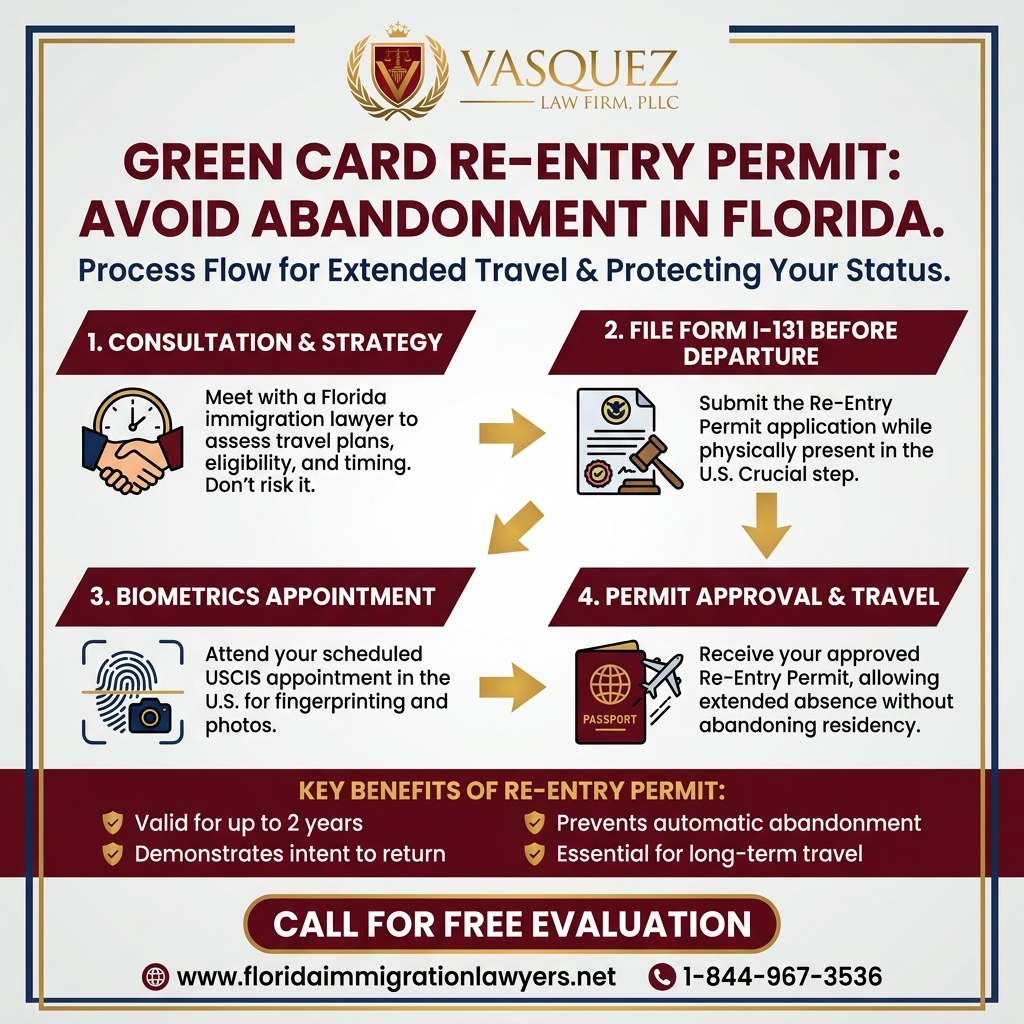
The entire process can take several months, so it is crucial to apply well in advance of your planned departure. Our experienced attorneys at Florida Immigration Lawyers can assist you with each step, ensuring your application is complete and accurate, minimizing potential delays or denials.
Essential Documents for Your I-131 Application
A successful application for a re-entry permit (Form I-131) hinges on providing all required supporting documentation. Missing or incorrect documents can lead to significant delays or even outright denial. For LPRs in Florida, preparing a thorough package is key. Here is a comprehensive checklist of documents typically required:
- Copy of Your Permanent Resident Card (Green Card): Provide a clear, legible copy of the front and back of your Form I-551, Permanent Resident Card.
- Proof of Identity: A copy of the biographical page of your valid passport.
- Two Passport-Style Photographs: These must be recent (taken within 30 days of filing), unmounted, full-face, passport-style photos with a white background. Write your name and A-number lightly on the back of each photo.
- Evidence of Your Intent to Return to the U.S. (Highly Recommended): While not always explicitly requested, providing evidence of your ties to Florida and the U.S. can strengthen your case. This includes:
- Copies of U.S. tax returns (Form 1040) for the past several years.
- Proof of property ownership or lease agreements in Florida.
- Letters from U.S. employers confirming your employment and anticipated return.
- Bank statements or investment accounts in the U.S.
- Proof of family members residing in the U.S. (e.g., birth certificates, marriage certificates of U.S. citizen or LPR relatives).
- Evidence of U.S. driver's license, voter registration, or professional licenses in Florida.
- Explanation of Travel Purpose (Optional but Recommended): A detailed letter explaining why you need to travel for an extended period and why you intend to return. For example, caring for an ailing parent, a temporary work assignment, or educational pursuits.
- Proof of Previous Re-Entry Permits (if applicable): If you have previously been issued a re-entry permit, include a copy of the previous permit.
Ensure all copies are clear and legible. If any documents are not in English, they must be accompanied by a certified English translation. Organizing your documents carefully and submitting a complete package from the outset can significantly streamline the processing of your re-entry permit application. Florida Immigration Lawyers can help you compile this essential documentation to ensure accuracy and completeness.
Processing Timelines and Expectations for Florida Applicants
The processing time for a re-entry permit (Form I-131) can vary significantly based on USCIS workload, policy changes, and the completeness of your application. While USCIS does not provide state-specific processing times for I-131, Florida applicants will generally experience similar national averages. As of 2026, processing times for Form I-131 can range anywhere from 7 to 15 months or even longer. It is crucial to check the USCIS website for the most current processing times, as these can change frequently.
Here’s a general timeline and what Florida LPRs can expect:
- Filing and Receipt Notice: Within 2-4 weeks of mailing your application, you should receive a Form I-797C, Notice of Action, confirming that USCIS has received your Form I-131. This notice will contain your receipt number, which you can use to track your case online.
- Biometrics Appointment: Typically, 3-8 weeks after receiving your receipt notice, USCIS will send you an appointment notice for biometrics. This appointment will be at a local Application Support Center (ASC) in Florida, such as the one in Orlando, Tampa, or Miami. You must attend this appointment. You cannot leave the U.S. before attending your biometrics appointment.
- Application Review: After biometrics, your application will be reviewed by a USCIS officer. This is often the longest part of the process. During this stage, USCIS may send a Request for Evidence (RFE) if they need additional information or clarification. Responding promptly and thoroughly to an RFE is critical to avoid further delays or denial.
- Decision: Once a decision is made, you will receive a Form I-797, Approval Notice, and your re-entry permit will be mailed to the address you provided. If you requested the permit to be sent to a U.S. embassy or consulate abroad, USCIS will forward it there.
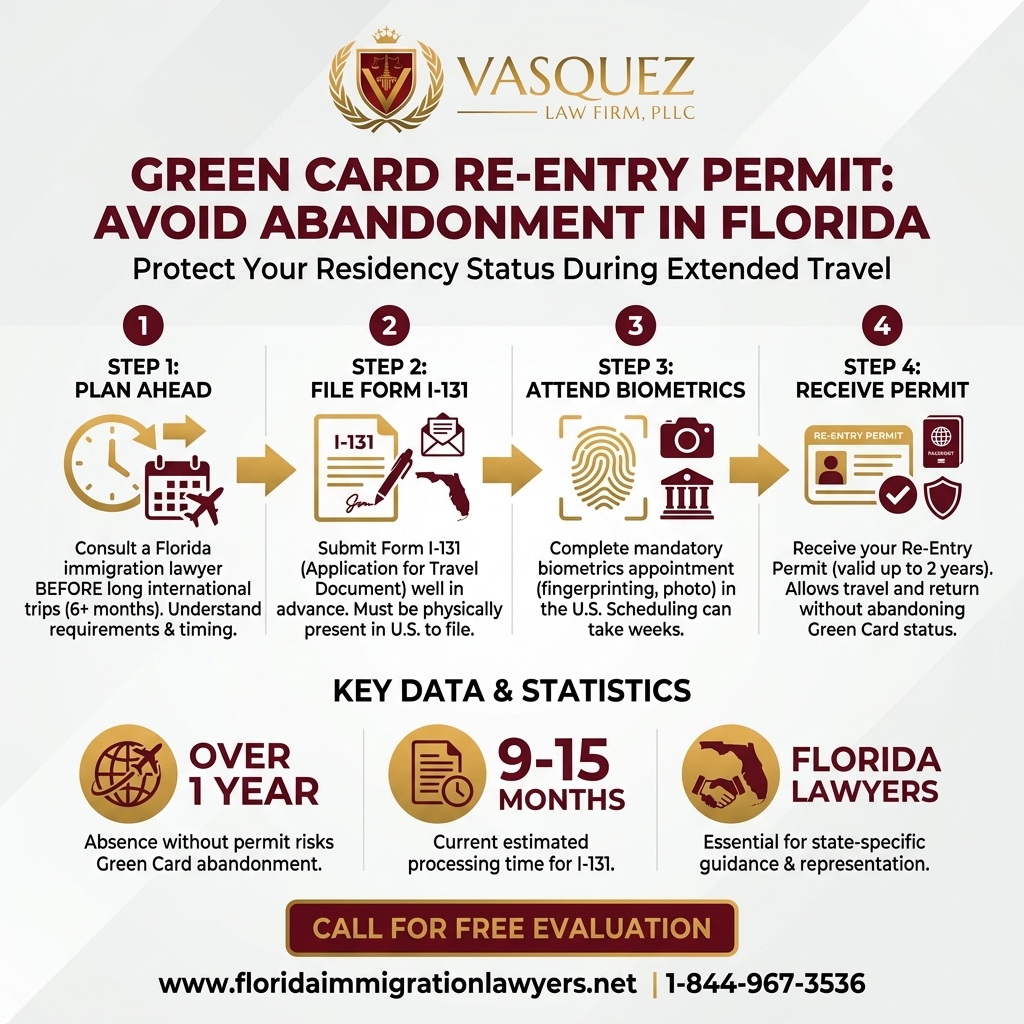
Given these timelines, it is highly advisable to apply for your re-entry permit several months, ideally 10-12 months, before your anticipated departure date. This allows sufficient time for processing and ensures you receive the permit before you need to leave. If you have an urgent need to travel, consulting with an immigration attorney can help explore any limited options, though expedited processing for I-131 is rare and granted only in extreme emergencies. Our team understands the urgency for Florida residents and can help manage expectations throughout the process.
Cost Factors and Fee Breakdown for a Re-Entry Permit
Understanding the costs associated with obtaining a re-entry permit is an important part of the planning process for Florida LPRs. The total cost typically includes USCIS filing fees, biometrics fees, and potentially legal fees if you choose to work with an attorney. It is crucial to always check the official USCIS website for the most current fee schedule, as these amounts are subject to change without notice.
Here’s a breakdown of the typical costs as of 2026:
- Form I-131 Filing Fee: This is the primary fee for processing your application for a travel document.
- Biometrics Services Fee: A separate fee is required for the collection of your fingerprints, photograph, and signature at a USCIS Application Support Center.
These two fees are generally paid together when you submit your Form I-131 application. You should submit a single check or money order for the total amount, made payable to the "U.S. Department of Homeland Security." Do not send cash through the mail. Ensure the amounts are correct, as incorrect payments can lead to your application being rejected and returned, causing significant delays.
Beyond the government fees, you may also incur:
- Attorney Fees: While it is possible to file Form I-131 yourself, the complexity of immigration law and the severe consequences of green card abandonment make legal representation highly advisable. An experienced immigration attorney, like those at Florida Immigration Lawyers, can ensure your application is accurate, complete, and submitted with all necessary supporting evidence. This minimizes the risk of RFEs or denials and provides peace of mind. Attorney fees will vary based on the complexity of your case and the services provided.
- Photocopying and Mailing Costs: You will need to make copies of all documents for your records and send your application via certified mail or a courier service for tracking purposes.
- Translation Fees: If any of your supporting documents are not in English, you will need to pay for certified translations.
Investing in legal assistance can often save you time, stress, and potential costs associated with a rejected or denied application. Our firm offers transparent fee structures and can discuss all potential costs during your free consultation.
Maintaining Your Permanent Residency While Abroad
Obtaining a re-entry permit is a crucial step in preventing the presumption of green card abandonment, but it is not the only factor USCIS considers. Even with a valid re-entry permit, Lawful Permanent Residents (LPRs) must continue to demonstrate their intent to maintain the United States as their permanent home. For Florida LPRs, especially those with strong ties to their home countries, actively maintaining connections to the U.S. is essential.
Here are key ways to demonstrate your continuing intent and ties to the U.S. while traveling abroad:
- Maintain Financial Ties: Keep U.S. bank accounts active, file U.S. income tax returns as a resident, and maintain investments in the U.S. Ensure you have a valid U.S. credit history.
- Retain Property in the U.S.: Continue to own or lease a home in Florida. If you rent it out, show intent to return.
- Keep Family in the U.S.: If your spouse and unmarried children reside in the U.S., this is a strong indicator of your intent to return.
- Maintain a U.S. Driver's License and Voter Registration: These show a continued connection to a specific state, such as Florida.
- Return to the U.S. Periodically: Even with a re-entry permit, try to make shorter visits back to the U.S. when possible. This further reinforces your intent to maintain residency.
- Avoid Actions Indicating Abandonment: Do not declare yourself a non-resident for U.S. tax purposes, surrender your green card, or take steps to become a citizen of another country (unless that country allows dual nationality and you still maintain strong U.S. ties).
The U.S. government looks at the totality of circumstances when assessing intent. A re-entry permit is strong evidence, but it should be supported by a pattern of behavior consistent with maintaining U.S. permanent residency. For LPRs in Florida, particularly those in international hubs like Orlando, it's easy to develop strong ties abroad. Therefore, conscious effort to maintain and document your U.S. connections is paramount. Our team at Florida Immigration Lawyers can provide personalized advice on how to best demonstrate your intent throughout your travels.
Common Mistakes to Avoid When Applying for a Re-Entry Permit
Applying for a re-entry permit can seem straightforward, but many Lawful Permanent Residents make critical errors that can jeopardize their application or even their green card status. Being aware of these common pitfalls can help Florida LPRs avoid unnecessary complications:
- Filing While Outside the U.S.: You absolutely must be physically present in the United States when you file Form I-131. Filing from abroad will result in rejection of your application.
- Failing to Attend Biometrics: The biometrics appointment is mandatory. If you leave the U.S. before attending your scheduled appointment, your application will likely be denied. You must be in Florida (or elsewhere in the U.S.) for this crucial step.
- Incomplete or Inaccurate Application: Missing information, incorrect dates, or failure to sign the form can lead to RFEs or outright rejection, causing significant delays.
- Incorrect Filing Fees: Submitting the wrong fee amount or an improperly prepared check/money order will cause your application to be returned unprocessed. Always verify current fees on the USCIS website.
- Not Providing Sufficient Evidence of Ties to the U.S.: While not always explicitly required, failing to submit evidence of your continued ties to Florida and the U.S. can weaken your case, especially if your intent is questioned.
- Waiting Too Long to Apply: Processing times can be extensive (7-15 months or more). Applying just before your planned departure can mean your permit isn't ready in time, forcing you to either delay travel or risk abandonment.
- Assuming a Re-Entry Permit Guarantees Re-Entry: A re-entry permit only waives the presumption of abandonment due to extended absence. It does not protect against other grounds of inadmissibility, such as criminal history or misrepresentation.
- Not Consulting an Attorney for Complex Cases: If you have a history of long absences, previous immigration issues, or complex travel plans, attempting to navigate the I-131 process alone can be risky. An attorney can identify potential red flags and help mitigate them.
- Ignoring the Two-Year Limit: A re-entry permit is typically valid for two years. If your travel extends beyond this period, you may need to apply for a new permit (if eligible) or risk green card abandonment.
When to Call a Lawyer for Your Re-Entry Permit Application
While some Lawful Permanent Residents may successfully file Form I-131 independently, the stakes involved in protecting your green card status are incredibly high. The potential for green card abandonment and subsequent deportation defense proceedings makes consulting an experienced immigration attorney a prudent decision. Florida Immigration Lawyers are here to provide the expert guidance you need, especially in these situations:
- Prior Long Absences: If you have previously spent significant time outside the U.S. (e.g., more than six months in a single trip) without a re-entry permit, your intent to maintain residency may already be under scrutiny.
- Complex Travel Plans: If your travel involves multiple countries, uncertain return dates, or work assignments that might extend beyond two years, legal advice is essential for strategic planning.
- Criminal History or Other Inadmissibility Issues: A re-entry permit does not cure inadmissibility. If you have any criminal convictions, past immigration violations, or other issues that could make you inadmissible, you need an attorney to assess your overall situation before traveling.
- Receipt of a Request for Evidence (RFE): If USCIS sends an RFE regarding your I-131 application, it means they need more information. An attorney can help you understand the RFE and craft a comprehensive, timely response.
- Denial of a Previous Application: If your re-entry permit application was previously denied, an attorney can help you understand the reasons for denial and advise on the best course of action.
- Uncertainty About Ties to the U.S.: If you are unsure whether your ties to Florida and the U.S. are strong enough to demonstrate intent to return, an attorney can help you gather and present compelling evidence.
- Family-Based Immigration Concerns: If your absence might impact family-based immigration petitions for relatives, an attorney can provide crucial advice.
Our firm, Florida Immigration Lawyers, is dedicated to helping LPRs in Orlando and throughout Florida protect their immigration status. We understand the nuances of the law and can provide tailored advice for your unique circumstances. Do not risk your permanent residency; let our team help you secure your future in the U.S.
About Florida Immigration Lawyers
Florida Immigration Lawyers is a leading immigration law firm committed to providing exceptional legal services to individuals and families across the entire state of Florida. With a deep understanding of U.S. immigration law and a compassionate approach, we proudly serve clients from Orlando, Miami, Tampa, Jacksonville, and all surrounding areas. Our dedicated team of attorneys specializes in a wide range of immigration matters, including green card applications, re-entry permits, asylum, deportation defense, citizenship, and business immigration.
We understand that navigating the U.S. immigration system can be complex and overwhelming. That is why we are committed to providing personalized, strategic, and accessible legal representation. Our attorneys are available 24/7 to answer your questions and provide support. We offer free, no-obligation consultations to discuss your case and outline the best path forward. When you choose Florida Immigration Lawyers, you choose a partner who will advocate tirelessly for your rights and your future in the United States.
Sources and References
- U.S. Citizenship and Immigration Services (USCIS)
- U.S. Department of State - Green Card Abandonment
- Executive Office for Immigration Review (EOIR)
- 8 U.S.C. § 1101(a)(20) - Immigration and Nationality Act (INA) - Definition of "Lawfully Admitted for Permanent Residence"
- 8 CFR § 211.1(b) - Documentary requirements for immigrants; waivers
- 8 CFR § 223.2 - Reentry permit
- Immigration and Nationality Act (INA) § 223 - Travel Documents
Related services: immigration practice areas, free immigration consultation.
This article provides general legal information and is not intended as legal advice. Every case is unique, and outcomes depend on specific facts and circumstances. Contact an attorney for advice about your particular situation.
Do not leave your permanent resident status to chance. If you are an LPR in Florida planning extended travel abroad, securing a re-entry permit is a crucial step. Protect your future and your ability to return home to Florida without complications. Our dedicated team at Florida Immigration Lawyers is ready to assist you. Call us today at 1-844-967-3536 for a free consultation. Se Habla Espanol - Estamos aqui para ayudarle.
Do Not Navigate This Process Alone
Our experienced immigration attorneys are ready to fight for you. Get a free, confidential consultation today.
Se Habla Español
Frequently Asked Questions
Florida Immigration Lawyers
Immigration Attorney | Founder, Vasquez Law Firm
U.S. Air Force veteran and immigration attorney with thousands of cases resolved. J.D., NCCU School of Law. AILA member. Admitted to the 4th, 5th, and 11th Circuit Courts.
Available 24/7 - Free Evaluations
Related Legal Services
Our Florida immigration attorneys can help you with asylum protection, deportation defense and citizenship and naturalization. Call today at 1-844-967-3536 for a free consultation.
Related Links
Related Topics
Free Legal Consultation
Discuss your case with our experienced attorneys. We're available 24/7.
Se Habla Español - Estamos aquí para ayudarle.
Related Articles
I-601A Provisional Waiver in Florida: What You Need to Know
Discover how the I-601A provisional waiver can help you stay with your family during the immigration process in Florida. Learn about eligibility, application steps, and common pitfalls. Call Florida Immigration Lawyers at 1-844-967-3536 for a free consultation.
U Visa for Crime Victims in Florida: Essential Guide
Discover the essentials of the U visa for crime victims in Florida, a crucial immigration relief option. Learn about eligibility, application steps, and common pitfalls. Contact Florida Immigration Lawyers at 1-844-967-3536 for expert guidance.
Fiance Visa K-1 Process in Florida | FL Immigration Lawyers
Learn how to bring your fiancé to Florida with a K-1 visa. Understand the process, requirements, and common pitfalls. Contact us for a free consultation.
I-601 Waiver Guide for Florida Immigrants | VLF Florida
Facing inadmissibility issues in Florida? Discover how the I-601 waiver can help you stay in the U.S. by demonstrating extreme hardship to a qualifying relative. Learn about eligibility, process, and common mistakes to avoid. Contact Florida Immigration Lawyers for expert guidance.