Criminal Waiver Florida: I-601 for Immigrants with
A criminal conviction can significantly complicate immigration goals in Florida, potentially leading to inadmissibility. Fortunately, a criminal waiver, such as Form I-601, offers a pathway to overcome certain grounds of inadmissibility. This crucial application allows individuals to request forgiveness for past offenses, typically by demonstrating extreme hardship to a qualifying U.S. citizen or lawful permanent resident relative. The process is intricate, demanding meticulous documentation, a deep understanding of immigration law, and a compelling presentation of evidence. From identifying the specific grounds of inadmissibility to gathering comprehensive proof of hardship and navigating USCIS interviews, each step requires precision. Florida Immigration Lawyers specializes in guiding clients through this challenging journey, providing expert legal counsel to maximize the chances of a successful waiver approval. If you have a criminal record and are pursuing immigration benefits in Florida, understanding your eligibility for an I-601 waiver is the first step toward securing your future. Contact us for a free consultation.

A criminal waiver, most commonly Form I-601, Application for Waiver of Grounds of Inadmissibility, allows certain individuals with past criminal convictions to overcome inadmissibility to the United States. This is a critical process for many immigrants in Florida who might otherwise be denied green cards, visas, or entry due to specific criminal offenses. The waiver requires demonstrating extreme hardship to a qualifying U.S. citizen or lawful permanent resident relative, or meeting other statutory criteria. Navigating this complex legal pathway successfully often necessitates the expertise of an experienced immigration attorney. Understanding the specific grounds of inadmissibility and the evidence needed for a compelling waiver application is paramount to a favorable outcome.
- An I-601 waiver addresses specific grounds of inadmissibility, including certain criminal convictions.
- Applicants must typically prove extreme hardship to a qualifying U.S. citizen or LPR relative.
- The process involves extensive documentation and a thorough review by USCIS or a consular officer.
- Legal counsel is highly recommended to assess eligibility and prepare a strong application.
- Successful waivers can pave the way for permanent residency or other immigration benefits.
Navigating the complex landscape of U.S. immigration law can be daunting, especially when a past criminal conviction complicates your path to legal status. Many individuals in Florida, including those in vibrant communities like Pembroke Pines, find themselves in this challenging situation. A criminal record, even for minor offenses, can render you 'inadmissible' to the United States, potentially barring you from obtaining a visa, a green card, or even re-entry after travel. This is where the crucial concept of a criminal waiver, often through Form I-601, Application for Waiver of Grounds of Inadmissibility, becomes vital.
Understanding the nuances of these waivers is not just about filling out forms; it is about strategically presenting your case, demonstrating rehabilitation, and proving extreme hardship to qualifying family members. Without a clear understanding of the law and the process, you risk significant delays or outright denial. At Florida Immigration Lawyers, we understand the stakes involved for you and your family. Our dedicated team helps individuals throughout Florida overcome these hurdles, providing compassionate and effective legal representation. Do not let a past mistake define your future. Call Florida Immigration Lawyers at 1-844-967-3536 for a free consultation to discuss your specific situation.
Understanding the Criminal Waiver Process in Florida
A criminal conviction can trigger grounds of inadmissibility under Section 212(a)(2) of the Immigration and Nationality Act (INA), which means you are ineligible to receive a visa or adjust your status. These grounds can range from crimes involving moral turpitude (CIMT) to controlled substance offenses, multiple criminal convictions, and even prostitution-related activities. The impact of these provisions is significant for many Florida residents, including those seeking family-based immigration or employment-based visas. For example, a minor theft conviction from years ago in Miami-Dade County could still pose a serious obstacle to obtaining a green card.
Fortunately, the INA provides mechanisms to overcome certain grounds of inadmissibility through a criminal waiver. The most common waiver for criminal grounds is the Form I-601. This application allows U.S. Citizenship and Immigration Services (USCIS) or a consular officer to excuse specific inadmissibility issues if certain conditions are met. The waiver is not a pardon for the crime itself, but rather a request for the immigration authorities to overlook the inadmissibility caused by the conviction, allowing you to proceed with your immigration application. The decision to grant a waiver is discretionary, meaning the government has the final say, making a strong, well-prepared case absolutely essential.
In Florida, where diverse communities and international connections are prevalent, understanding these waivers is particularly important. Many individuals applying for a visa at a U.S. embassy abroad, or adjusting status through a USCIS field office in Orlando or Tampa, may encounter inadmissibility issues. The process requires a deep understanding of both immigration and criminal law, as the exact nature of the conviction, the sentencing, and any post-conviction relief can significantly impact waiver eligibility. Our firm, serving clients across Florida, including Pembroke Pines, specializes in navigating these complex intersections to build robust waiver petitions.
What is a Crime Involving Moral Turpitude (CIMT)?
A Crime Involving Moral Turpitude (CIMT) is a broad category of offenses that immigration law considers morally reprehensible. While there is no definitive list, CIMTs generally involve fraud, larceny, or intent to harm persons or things, or offenses that are inherently base, vile, or depraved, and contrary to the accepted rules of morality and the duties owed between persons or to society in general. Examples often include theft, fraud, aggravated assault, or certain drug offenses. However, determining if a specific crime is a CIMT can be highly complex and depends on the specific elements of the criminal statute and the underlying facts of the case, requiring a thorough legal analysis.
Controlled Substance Offenses and Waivers
Controlled substance offenses are a serious ground of inadmissibility, outlined in INA Section 212(a)(2)(A)(i)(II). Generally, a conviction for any controlled substance offense, or even an admission of having committed such an offense, can make an individual inadmissible. While waivers for a single offense of simple possession of 30 grams or less of marijuana may be available under INA 212(h), other drug offenses typically do not have waivers unless specific, very narrow circumstances apply. The government takes drug-related crimes very seriously, and these cases often present the most significant challenges for waiver applicants, requiring meticulous legal strategy.
Eligibility Criteria for an I-601 Criminal Waiver
Eligibility for an I-601 criminal waiver largely hinges on the specific ground of inadmissibility you are trying to overcome and your relationship to a qualifying U.S. citizen or lawful permanent resident (LPR) relative. For waivers related to certain criminal grounds, such as crimes involving moral turpitude (CIMT) or a single offense of simple possession of marijuana, you must typically demonstrate that your denial of admission would result in extreme hardship to your qualifying relative. This relative can be your U.S. citizen or LPR spouse, parent, or in some cases, a child. The definition of extreme hardship is not easily met and requires substantial evidence.
Extreme hardship means more than the usual separation or financial difficulties that naturally arise when a family member is denied immigration benefits. USCIS considers a wide range of factors, including the qualifying relative's health issues (physical and mental), financial burdens, educational disruption, loss of emotional support, cultural adjustment difficulties if forced to relocate, and any special needs of children. For instance, if your U.S. citizen spouse in Pembroke Pines, Florida, has a serious medical condition requiring your daily care and financial support, this could contribute to an argument for extreme hardship. The cumulative effect of these factors is often what makes a case for extreme hardship compelling.
Furthermore, for some criminal offenses, such as certain drug-related convictions, waivers are extremely limited or unavailable. However, for a single offense of simple possession of 30 grams or less of marijuana, a waiver may be available under INA 212(h) if you can demonstrate extreme hardship to a qualifying U.S. citizen or LPR spouse, parent, son, or daughter. Additionally, if the criminal offense occurred more than 15 years ago, and you have been rehabilitated, and your admission would not be contrary to the national welfare, safety, or security of the United States, a waiver might be possible even without a qualifying relative. Each case is unique, and a thorough assessment of your criminal history and family ties is essential to determine eligibility for any waiver.
Step-by-Step Guide to Filing a Criminal Waiver Application
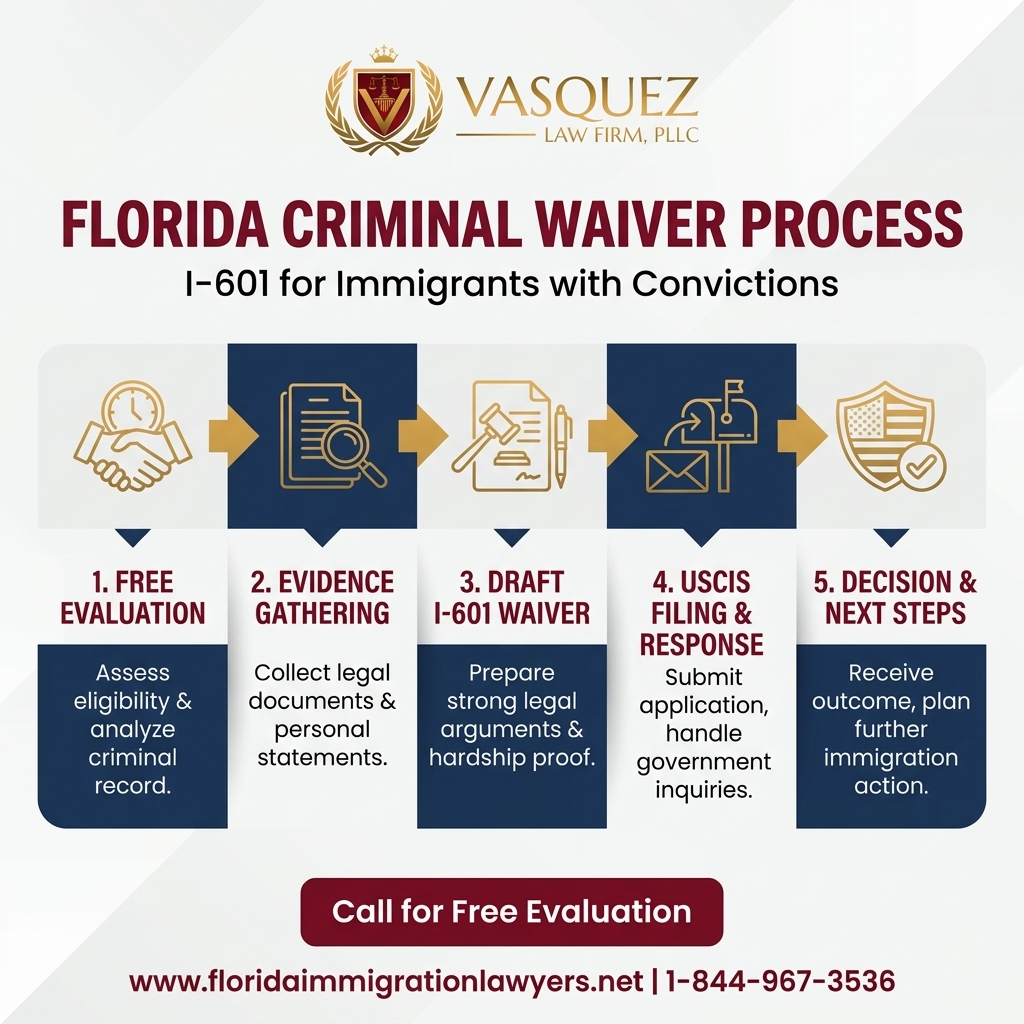
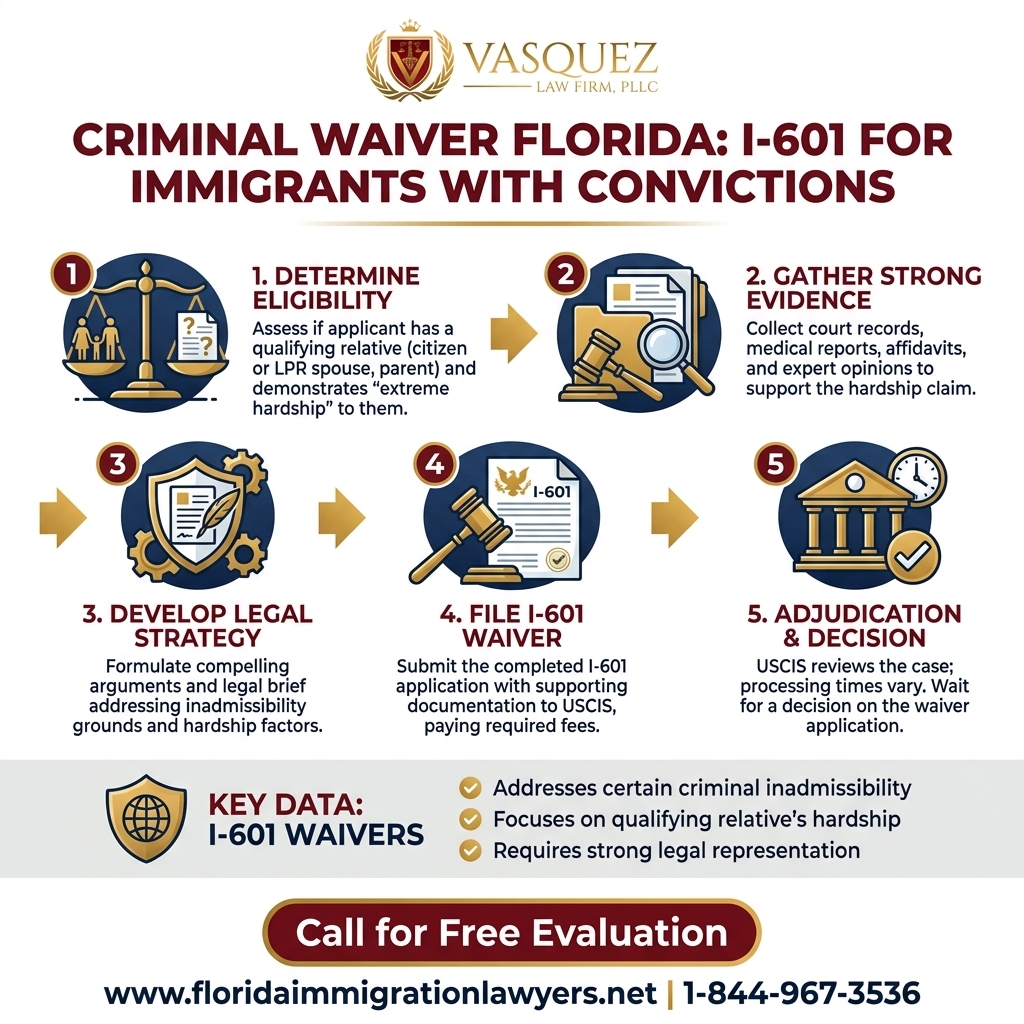
Filing a criminal waiver application, particularly Form I-601, is a multi-faceted process that demands precision and thoroughness. Missing a step or submitting incomplete documentation can lead to significant delays or even denial, jeopardizing your immigration future. Here is a general step-by-step guide to help you understand what is involved:
-
Determine Eligibility and Ground of Inadmissibility: The first critical step is to accurately identify the specific ground of inadmissibility you need to waive. This requires a detailed review of your criminal history, including all arrests, charges, and dispositions. Understanding if your conviction falls under a CIMT, a controlled substance offense, or another category is paramount. An immigration attorney can help you obtain and analyze your criminal records and determine if a waiver is even an option for your specific situation. This initial assessment is foundational to building a successful case.
-
Gather Evidence of Extreme Hardship: If your waiver requires demonstrating extreme hardship, this is where you build the core of your case. Collect comprehensive documentation proving the severe impact your inadmissibility would have on your qualifying U.S. citizen or LPR relative. This includes medical records, psychological evaluations, financial statements, employment letters, school records, affidavits from family and community members, and any other evidence that illustrates the profound emotional, financial, and physical burdens your relative would face without you. For instance, if your U.S. citizen child in Orlando has special educational needs that you uniquely support, detailed school reports and therapist letters would be crucial.
-
Prepare Form I-601 and Supporting Documents: Complete Form I-601 accurately and thoroughly. Attach all supporting evidence meticulously organized and clearly labeled. This often includes certified copies of court documents, police reports, proof of rehabilitation (e.g., certificates from counseling, community service, employment history), character letters, and a detailed legal brief explaining why the waiver should be granted. Ensure all foreign-language documents are accompanied by certified English translations. The quality and organization of your submission can significantly influence the adjudicator's impression of your case.
-
File the Application: The filing location for Form I-601 depends on whether you are applying for adjustment of status within the U.S. or for an immigrant visa through consular processing abroad. If you are adjusting status, you will typically file with USCIS. If you are consular processing, the I-601 is usually filed with USCIS after an interview at a U.S. embassy or consulate, or sometimes directly with the consulate itself, depending on the specific circumstances and location. Always check the most current USCIS filing instructions for the correct address and procedures. For those in Florida, this might mean coordinating with a U.S. consulate in a foreign country or a local USCIS field office.
-
Attend Biometrics Appointment and Interview (if applicable): After filing, you will likely receive a notice for a biometrics appointment at a local Application Support Center (ASC) in Florida (e.g., Miami, Jacksonville). For consular processing cases, you will attend an interview at the U.S. embassy or consulate abroad. During this interview, the consular officer will review your application, ask questions about your criminal history, and assess your waiver eligibility. For adjustment of status cases, a USCIS officer may interview you at a field office such as the one in Hialeah or Tampa.
-
Receive a Decision: Processing times for I-601 waivers can vary significantly, ranging from several months to over a year. USCIS or the consular officer will review all submitted evidence and make a discretionary decision. If approved, you can proceed with your immigrant visa or adjustment of status application. If denied, you may have options to appeal the decision to the Board of Immigration Appeals (BIA) or refile, depending on the reasons for denial. A denial is not necessarily the end of the road, but it requires immediate and strategic legal action.
Required Documents for Your I-601 Waiver Petition
A successful criminal waiver petition hinges on a meticulously prepared and thoroughly documented application. Gathering all necessary documents can be a lengthy process, often requiring coordination with various agencies and individuals. Here is a comprehensive list of documents typically required for an I-601 waiver, especially for those in Florida:
- Completed Form I-601, Application for Waiver of Grounds of Inadmissibility: Ensure all sections are filled out accurately and completely, signed, and dated.
- Proof of Filing Fee: Check the USCIS website for the current fee amount and acceptable payment methods. Do not include exact fee amounts here as they change.
- Official Criminal Records: This is critical. You must provide certified copies of all arrest records, police reports, court dispositions, sentencing orders, and any other relevant documents for every criminal offense, regardless of how minor or old the offense is. This includes records from Florida state courts (e.g., Broward County, Palm Beach County) and federal courts.
- Evidence of Rehabilitation: Documents demonstrating your rehabilitation, such as certificates from drug or alcohol counseling, proof of community service, employment history, character letters from employers, religious leaders, or community members, and evidence of consistent tax payments.
- Proof of Qualifying Relationship: Marriage certificates (for spouses), birth certificates (for parents/children), and any other documents proving your relationship to the U.S. citizen or LPR relative on whom your extreme hardship claim is based.
- Extreme Hardship Evidence: This is the most crucial part for many waivers. It includes:
- Medical records and psychological evaluations for the qualifying relative, detailing any physical or mental health conditions.
- Financial documents, such as tax returns, pay stubs, bank statements, and debt records, illustrating financial dependence or hardship.
- Letters from doctors, therapists, employers, and community leaders explaining the impact of your absence on the qualifying relative.
- School records for children, especially if they have special needs or would face significant educational disruption.
- Evidence of cultural, social, and linguistic ties to the U.S. for the qualifying relative, demonstrating hardship if forced to relocate.
- Affidavits from the qualifying relative and other family members detailing emotional and practical reliance on you.
- Identity and Nationality Documents: Copies of your passport, birth certificate, and any previous visa or immigration documents.
- Photographs: Passport-style photographs meeting USCIS specifications.
- Translations: All documents not in English must be accompanied by a complete and certified English translation.
- Legal Brief: A comprehensive legal argument prepared by your attorney, summarizing your case, explaining the legal basis for the waiver, and referencing all supporting evidence.
Do not navigate this process alone. The stakes are too high. Contact Florida Immigration Lawyers today at 1-844-967-3536 for a free consultation. Our team is ready to assist you throughout Florida, including Pembroke Pines and surrounding areas, ensuring your application is complete and compelling.
Timeline and Processing Expectations for I-601 Waivers
The timeline for an I-601 criminal waiver can be a source of significant anxiety for applicants and their families. Unfortunately, there is no fixed processing time, and it can vary widely based on several factors: the specific USCIS service center handling your case, the complexity of your criminal history, the volume of applications, and whether you are applying through adjustment of status or consular processing. Generally, applicants should prepare for a waiting period that can range from several months to well over a year, sometimes even longer in complex cases.
For those undergoing consular processing, the I-601 waiver is often adjudicated after an interview at a U.S. embassy or consulate abroad. This means that after your initial visa interview, if an inadmissibility ground is identified, you will be instructed to file the I-601. The waiver application is then typically forwarded to a USCIS international office or a specific service center for adjudication. The processing time at these centers can be lengthy, and you will remain outside the U.S. during this period. For example, individuals from Latin American countries who have their interview in Ciudad Juarez, Mexico, would typically have their I-601 processed by a USCIS office that serves that region.
If you are applying for adjustment of status within the United States, your I-601 waiver may be filed concurrently with your adjustment application (Form I-485) or after an interview at a local USCIS field office in Florida, such as the one in Miami, Orlando, or Tampa. In these cases, the waiver is adjudicated by a domestic USCIS officer. The processing times for domestic I-601s can also vary, but sometimes they are processed more quickly than those filed through consular channels, especially if the entire package is adjudicated by the same officer. It is crucial to regularly check the USCIS website for current processing times, but always remember these are estimates and not guarantees.
Delays can occur if USCIS issues a Request for Evidence (RFE) because your initial submission was incomplete or lacked sufficient proof of extreme hardship. Responding promptly and thoroughly to an RFE is critical to avoid further delays or potential denial. Furthermore, if your case involves complex legal issues or requires extensive background checks, the processing time may be extended. Maintaining patience and having realistic expectations about the timeline, while working closely with your immigration attorney, are key strategies to manage this waiting period effectively. Your attorney can help monitor your case status and respond to any inquiries from USCIS or the Department of State (which oversees consular processing via travel.state.gov).
Cost Factors and Attorney Fees for a Criminal Waiver
Understanding the financial implications of pursuing a criminal waiver is an important part of the planning process for many families in Florida. The costs associated with an I-601 waiver can be categorized into government filing fees and legal fees, along with other potential expenses. It is important to note that government filing fees are set by USCIS and are subject to change, so it is always essential to verify the most current amounts directly on the USCIS website or through your attorney. We advise against publishing specific fee amounts here as they are not static.
Beyond the government filing fee, the most significant cost will typically be the attorney fees for legal representation. Given the complexity and discretionary nature of I-601 waivers, hiring an experienced immigration attorney is highly recommended, if not essential. An attorney will assess your eligibility, help you gather and organize all necessary documentation, draft compelling legal arguments, prepare you for interviews, and represent you throughout the process. The total legal fees can vary widely depending on the complexity of your criminal history, the amount of evidence required to prove extreme hardship, the attorney's experience, and the specific services included.
Factors that can influence attorney fees include: the number of criminal convictions, the severity of those convictions, whether the case involves a CIMT or a controlled substance offense, the need for expert witness testimony (e.g., psychological evaluations), and the overall time commitment required from the legal team. For example, a case involving multiple old convictions across different jurisdictions in Florida or other states, requiring extensive record retrieval and analysis, will likely incur higher fees than a simpler case with a single, clear conviction. Many firms, including Florida Immigration Lawyers, offer a free initial consultation to discuss your case and provide an estimate of legal fees. Our goal is to provide transparent and fair pricing for our comprehensive services.
Additional costs to consider may include fees for obtaining certified court records, police reports, medical evaluations, psychological assessments, translation services for foreign documents, and travel expenses if interviews are required outside of your immediate area or abroad. While these costs can add up, viewing them as an investment in your future and your ability to remain with your family in Florida is important. Attempting to navigate the I-601 waiver process without legal guidance can prove more costly in the long run through denials, appeals, or prolonged separation from family. We work with clients across Florida, from Pembroke Pines to Pensacola, to make this process as manageable as possible.
Common Mistakes to Avoid in Your Criminal Waiver Application
Applying for a criminal waiver is a high-stakes process where even small errors can have significant consequences. Avoiding common pitfalls is crucial for a successful outcome. Here are some mistakes frequently seen in I-601 waiver applications:
-
Failing to Disclose All Criminal History: This is perhaps the most serious mistake. Even if a charge was dismissed, expunged, or occurred many years ago, you must disclose every single arrest, charge, and conviction to USCIS. Failure to do so can lead to a finding of misrepresentation, which is a separate and often more difficult ground of inadmissibility to waive. Be completely transparent, even if you believe the record is minor or irrelevant.
-
Insufficient Evidence of Extreme Hardship: Many applicants underestimate what constitutes "extreme hardship." Simply stating that your family will miss you or face financial difficulties is rarely enough. You must provide extensive, objective, and specific documentation that demonstrates hardship beyond the normal separation and inconvenience. This includes detailed medical records, psychological evaluations, financial statements, and compelling affidavits.
-
Not Understanding the Specific Ground of Inadmissibility: Different criminal convictions trigger different grounds of inadmissibility, and not all are waivable. Misidentifying the exact legal basis for your inadmissibility can lead to filing the wrong waiver form or submitting an application for which you are not eligible. A thorough legal analysis of your criminal record is essential before filing.
-
Submitting Incomplete or Poorly Organized Documentation: USCIS officers review thousands of applications. A disorganized, incomplete, or confusing submission can lead to RFEs (Requests for Evidence), delays, or even denial. All documents should be clearly labeled, indexed, and presented in a logical order, with certified English translations for non-English documents.
-
Attempting to Navigate the Process Without Legal Counsel: The I-601 waiver process is incredibly complex, involving intricate legal arguments, statutory interpretations, and a high level of discretion. Without an experienced immigration attorney, you risk misinterpreting laws, failing to present a compelling case, or making critical procedural errors. This is not a process for self-representation.
-
Lack of Evidence of Rehabilitation: While not always a statutory requirement, demonstrating rehabilitation is often crucial in discretionary waiver applications, especially for serious offenses. Providing evidence of positive life changes, community involvement, consistent employment, and remorse can significantly strengthen your case and demonstrate that you are not a risk to the U.S.
-
Poor Interview Preparation: If an interview is required (either at USCIS or a consulate), being unprepared can be detrimental. Applicants must be ready to discuss their criminal history, the circumstances surrounding their convictions, and the details of their extreme hardship claim truthfully and consistently. Inconsistent statements can undermine your credibility and lead to denial.
-
Missing Deadlines or Ignoring RFEs: Immigration processes are strict about deadlines. Missing a deadline for filing a response to an RFE or an appeal can result in automatic denial or termination of your application. Always respond promptly and thoroughly to any communication from USCIS or the consulate.
When to Call a Lawyer for Your Criminal Waiver in Florida
The decision to seek legal counsel for a criminal waiver is often one of the most critical steps you can take to protect your immigration future. While some immigration processes might seem straightforward, an I-601 waiver is anything but. The discretionary nature of the waiver, combined with the severe consequences of denial, means that professional legal guidance is almost always essential. You should consider contacting Florida Immigration Lawyers immediately if any of the following scenarios apply to you:
- You Have Any Criminal Record: Even a seemingly minor arrest or conviction from years ago, whether in Florida or elsewhere, can trigger inadmissibility. Do not assume your record is insignificant. An attorney can analyze your criminal history and determine if it makes you inadmissible and if a waiver is available.
- You Have Been Told You Are Inadmissible: If a USCIS officer, consular officer, or another legal professional has informed you that you are inadmissible to the U.S. due to criminal grounds, it is time to consult an expert. We can review the specific finding and advise on the best course of action.
- You Are Required to File Form I-601 (or another waiver): If you know you need to file an I-601 waiver, the complexity of the application, the need to prove extreme hardship, and the volume of required documentation make legal representation invaluable.
- You Have a Complex Criminal History: Multiple convictions, convictions for serious offenses, or criminal records from multiple jurisdictions (e.g., Broward County, federal courts, or other states) significantly increase the complexity of your case. An attorney can help untangle these records and present them appropriately.
- You Have Received a Request for Evidence (RFE) or Notice of Intent to Deny (NOID): These notices indicate that USCIS has concerns about your application. Responding effectively to an RFE or NOID often requires legal expertise to address the specific issues raised by the agency and provide compelling additional evidence.
- You Are Facing Deportation or Removal Proceedings: If a criminal conviction has led to you being placed in removal proceedings before an Executive Office for Immigration Review (EOIR) immigration judge in Florida (e.g., Miami Immigration Court, Orlando Immigration Court), a criminal waiver may be a defense. This is a highly specialized area, and you absolutely need deportation defense counsel.
- You Are Unsure About Any Aspect of the Waiver Process: If you feel overwhelmed, confused, or uncertain about any step, from gathering documents to understanding legal terms, seeking professional help is the safest route.
Florida Immigration Lawyers has extensive experience in handling complex criminal waiver cases for clients across Florida, including Pembroke Pines, Fort Lauderdale, and West Palm Beach. We understand the nuances of the law, the expectations of USCIS and consular officers, and how to build a strong, persuasive case on your behalf. Our team is committed to helping you navigate these challenges with confidence and compassion. Contact us today.
About Florida Immigration Lawyers
Florida Immigration Lawyers is a leading immigration law firm dedicated to serving individuals and families across the entire state of Florida. With a deep understanding of U.S. immigration laws and the unique challenges faced by immigrants, we are committed to providing exceptional legal representation and compassionate support. Our firm specializes in a wide range of immigration matters, including family-based petitions, employment visas, asylum applications, naturalization, and crucial defense against deportation and removal. We pride ourselves on offering personalized strategies tailored to each client's specific needs and circumstances.
Our experienced attorneys are well-versed in handling complex cases, such as those involving criminal inadmissibility and the need for a criminal waiver. We know that a single conviction can have profound implications for your immigration journey, and we are here to fight for your rights and your future. We serve clients from all corners of Florida, from the bustling cities of Miami and Orlando to the smaller communities like Pembroke Pines, ensuring that expert legal help is accessible to everyone. We offer free consultations to help you understand your options and begin building a strong case. Contact us at 1-844-967-3536 or visit our website at https://www.floridaimmigrationlawyers.net to learn more about how we can assist you. Our team is available 24/7, and we proudly offer bilingual services (Se Habla Español) to ensure clear and effective communication with our diverse clientele.
Sources and References
- U.S. Citizenship and Immigration Services (USCIS)
- Executive Office for Immigration Review (EOIR)
- U.S. Department of State (travel.state.gov)
- Immigration and Nationality Act (INA) Section 212(a)(2) - Grounds of Inadmissibility: Criminal and Related Grounds
- Immigration and Nationality Act (INA) Section 212(h) - Waiver of Certain Criminal Grounds of Inadmissibility
- Immigration and Nationality Act (INA) Section 212(i) - Waiver of Fraud or Misrepresentation Inadmissibility
- 8 U.S.C. Chapter 12 - Immigration and Nationality Act
- 8 CFR (Code of Federal Regulations) Part 212 - Documentary Requirements: Nonimmigrants; Waivers; Admission of Certain Inadmissible Aliens; Parole
Related services: immigration practice areas, family immigration services.
This article provides general legal information and is not intended as legal advice. Every case is unique, and outcomes depend on specific facts and circumstances. Contact an attorney for advice about your particular situation.
Do not let a past criminal conviction prevent you from achieving your American dream. The path to a criminal waiver, especially Form I-601, can be complex and emotionally taxing, but you do not have to face it alone. Our experienced immigration attorneys at Florida Immigration Lawyers are here to provide the dedicated legal support and representation you need to navigate this challenging process successfully. We are committed to helping individuals and families across Florida secure their future. For a free, confidential consultation, call us today at 1-844-967-3536. Se Habla Español - Estamos aqui para ayudarle.
If you need legal assistance, learn more about experienced immigration attorneys in Orlando, or call us at 1-844-967-3536 for a free consultation.
Do Not Navigate This Process Alone
Our experienced immigration attorneys are ready to fight for you. Get a free, confidential consultation today.
Se Habla Español
Frequently Asked Questions
Florida Immigration Lawyers
Immigration Attorney | Founder, Vasquez Law Firm
U.S. Air Force veteran and immigration attorney with thousands of cases resolved. J.D., NCCU School of Law. AILA member. Admitted to the 4th, 5th, and 11th Circuit Courts.
Available 24/7 - Free Evaluations
Related Legal Services
Our Florida immigration attorneys can help you with immigration practice areas, free immigration consultation and experienced immigration attorneys. Call today at 1-844-967-3536 for a free consultation.
Related Links
Related Topics
Free Legal Consultation
Discuss your case with our experienced attorneys. We're available 24/7.
Se Habla Español - Estamos aquí para ayudarle.
Related Articles
L-1 Visa Intracompany Transfers in Florida | VLF Florida
Learn about the L-1 visa process for intracompany transfers in Florida. Our guide covers eligibility, documentation, timeline, and common pitfalls. Contact Florida Immigration Lawyers for a free consultation.
L-1 Visa Transfer for Florida Companies | VLF Florida
Discover the intricacies of L-1 visa transfers for Florida companies. Understand eligibility, documentation, and common pitfalls. Call us for guidance.
DED Eligibility for Venezuela and Haiti in Florida
Deferred Enforced Departure (DED) offers temporary protection for eligible Venezuelans and Haitians in Florida. Learn about eligibility, application steps, and common mistakes. Contact Florida Immigration Lawyers for guidance.
USCIS Office Locations in Florida: St. Petersburg Guide
Finding the right USCIS office in Florida, particularly in St. Petersburg, is crucial for managing your immigration needs effectively. Discover office locations, learn how to schedule appointments, and understand the services offered to ensure your immigration process is smooth. Contact Florida Immigration Lawyers at 1-844-967-3536 for a free consultation.