Green Card Through Marriage in Florida: Your 2026 Guide
Planning to obtain a green card through marriage in Florida? This detailed 2026 guide from Florida Immigration Lawyers covers everything you need to know, from eligibility requirements and the crucial bona fide marriage evidence to a step-by-step application process. We break down document checklists, estimated timelines for USCIS processing in Florida, and the various costs involved. Learn about the 2-year conditional green card rule and common mistakes to avoid. Discover when professional legal assistance is essential, especially for complex cases or specific situations. Get expert advice for your spouse visa journey in Florida.
Obtaining a green card through marriage in Florida typically involves proving a legitimate marital relationship to U.S. Citizenship and Immigration Services (USCIS). The process includes filing petitions, submitting detailed documentation, attending interviews, and potentially adjusting your immigration status. Spouses of U.S. citizens or lawful permanent residents may be eligible to live and work permanently in the United States.
- File Form I-130 Petition for Alien Relative.
- Submit Form I-485 for Adjustment of Status (if in the U.S.).
- Attend a mandatory USCIS interview to verify your marriage.
- Provide extensive evidence of a bona fide marital relationship.
- Be aware of conditional green cards for new marriages.
Are you married to a U.S. citizen or a lawful permanent resident and dreaming of building your life together permanently in Florida? The journey to obtaining a green card through marriage in Florida can seem complex, filled with forms, interviews, and specific legal requirements. Understanding each step is crucial for a successful outcome.
This comprehensive guide from Florida Immigration Lawyers will walk you through the entire process for 2026, from initial petitions to receiving your permanent resident card. We will cover eligibility, required documents, timelines, and common pitfalls to avoid. For personalized guidance, call Florida Immigration Lawyers at 1-844-967-3536 for a free consultation. We are here to help you navigate your path to a green card.
Understanding the Green Card Through Marriage Process in Florida
A marriage-based green card allows a foreign national spouse of a U.S. citizen or lawful permanent resident (LPR) to live and work permanently in the United States. This is a cornerstone of family immigration, enabling families to remain together. The process is designed to confirm the legitimacy of your marriage and your eligibility for permanent residency.
In Florida, like other states, the application process is overseen by U.S. Citizenship and Immigration Services (USCIS). Whether you reside in Coral Springs, Miami, Orlando, or anywhere else in the Sunshine State, the federal immigration laws apply. However, specific USCIS field offices may handle your interview, impacting local processing nuances.
Who is Eligible for a Marriage-Based Green Card?
Eligibility for a marriage-based green card primarily depends on your spouse's immigration status. If your spouse is a U.S. citizen, the process often involves an immediate relative petition, which typically has no visa quota limitations. This can sometimes lead to faster processing compared to other categories.
If your spouse is a lawful permanent resident (green card holder), you will apply under the family-preference category (specifically, F2A). While still a strong pathway, this category is subject to annual visa limits and wait times, as indicated by the Department of State's Visa Bulletin. Both paths require proving a genuine, or bona fide, marriage. (See USCIS Green Card for Spouse for more details).
The Concept of Bona Fide Marriage
USCIS places significant emphasis on ensuring that your marriage is genuine and not entered into solely for immigration benefits. This is known as a bona fide marriage. You will need to provide substantial evidence demonstrating that you and your spouse have built a life together, share responsibilities, and intend to remain married.
Evidence can include joint bank accounts, shared leases or property deeds, birth certificates of children born to the marriage, joint insurance policies, and affidavits from friends and family. The strength of this evidence is critical to your application's success. Your intention to establish a life together is paramount, as outlined in the Immigration and Nationality Act (INA) Section 201(b)(2)(A)(i).
Step-by-Step Guide to Your Marriage-Based Green Card Application
The process for obtaining a green card through marriage involves several distinct stages. Understanding these steps will help you prepare and submit a complete and compelling application. Depending on whether the foreign national spouse is already in the U.S. or abroad, the process will follow either Adjustment of Status or Consular Processing.
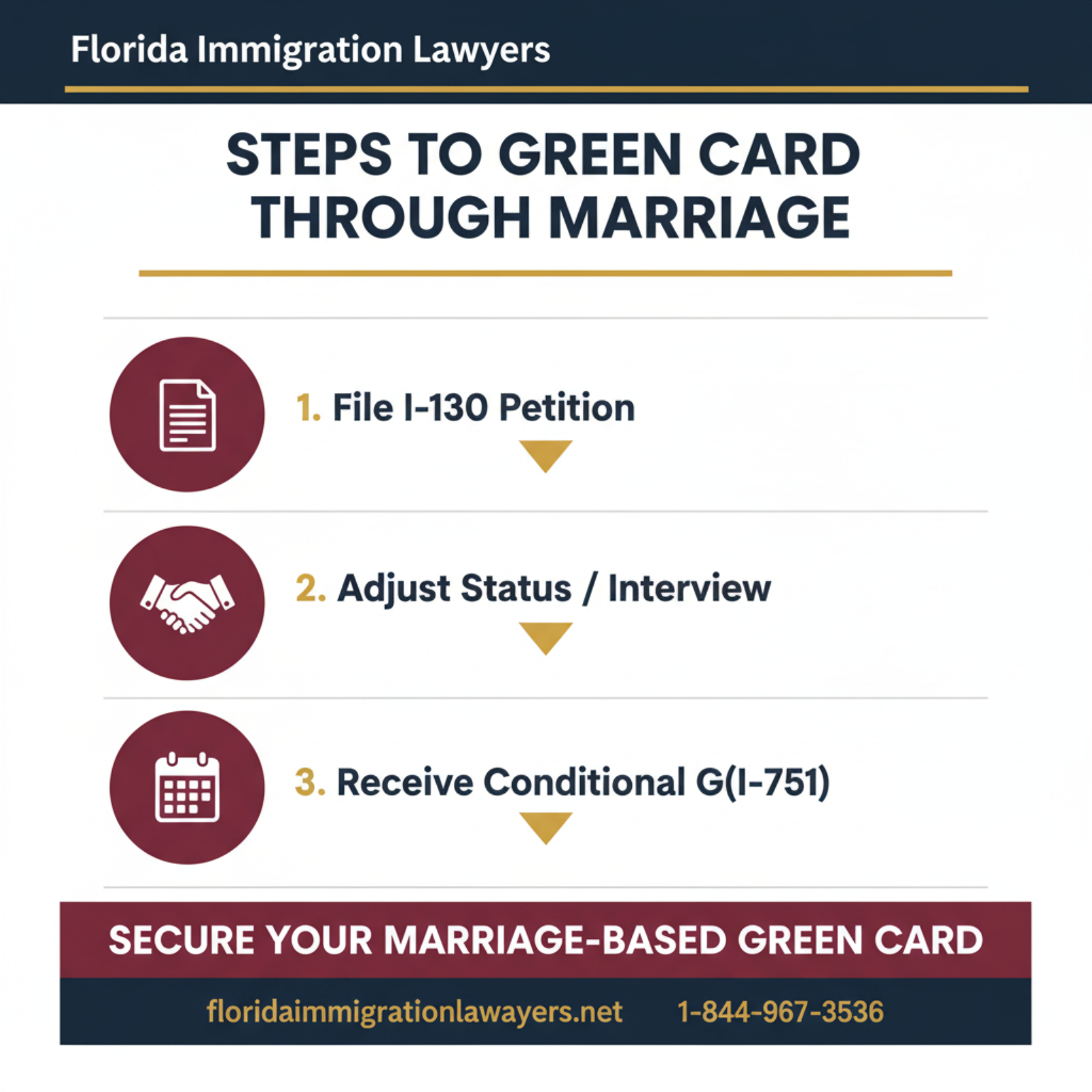
- File Form I-130, Petition for Alien Relative: The U.S. citizen or LPR spouse (the petitioner) must file this form with USCIS. This petition establishes the qualifying relationship between you and your spouse. You will need to submit your marriage certificate, proof of your spouse's U.S. citizenship or LPR status, and evidence of your bona fide marriage. This is the foundational step for a spousal petition.
- File Form I-485, Application to Register Permanent Residence or Adjust Status (if in the U.S.): If the foreign national spouse is already in the United States and entered legally, they can generally file Form I-485 concurrently with, or after, the I-130. This process is called adjustment of status. With this application, you will also file supporting forms such as Form I-765 (Application for Employment Authorization) and Form I-131 (Application for Travel Document). USCIS Policy Manual, Volume 7, Part A, Chapter 3 provides detailed guidance on adjustment of status eligibility.
- Consular Processing (if outside the U.S.): If the foreign national spouse is outside the United States, or ineligible for adjustment of status, the approved I-130 petition is sent to the National Visa Center (NVC). The NVC will then guide the applicant through collecting civil documents and submitting an immigrant visa application (Form DS-260). The interview will be scheduled at a U.S. embassy or consulate in the applicant's home country. This pathway is common for those applying for a spouse visa Florida from abroad.
- Undergo Biometrics Appointment: After filing your adjustment of status application, you will receive an appointment notice for biometrics. This involves having your fingerprints, photograph, and signature taken. These are used for background checks and identity verification.
- Complete a Medical Examination: All applicants for a green card must undergo a medical examination performed by a USCIS-approved civil surgeon. The results, sealed in an envelope, must be submitted with your application or brought to your interview. This ensures you meet health-related admissibility standards.
- Attend the Green Card Interview: Both spouses are typically required to attend an interview with a USCIS officer. This interview is a critical step where the officer will review your application, ask questions about your marriage, and assess the legitimacy of your relationship. Be prepared to answer questions individually and together, and bring all original supporting documents.
- Receive Your Green Card: If your application is approved, you will receive a green card. If your marriage is less than two years old at the time of approval, you will receive a conditional green card (CR1/CR6), valid for two years. You must then file Form I-751, Petition to Remove Conditions on Residence, within the 90-day period before your conditional green card expires, to obtain a permanent 10-year green card. This addresses the '2 year rule' for green cards, as specified in INA § 216.
Essential Document Checklist for Your Spouse Visa Petition
Gathering the correct documentation is paramount for a successful green card through marriage application. Missing or incorrect documents can lead to delays or even denials. Organize your documents carefully and make copies of everything you submit. Here is a general checklist:
- For the U.S. Citizen/LPR Petitioner:
- Proof of U.S. citizenship (birth certificate, passport, naturalization certificate) or LPR status (green card copy).
- Proof of income (tax returns, W-2s, employment letters) to meet the Affidavit of Support requirements (Form I-864).
- Copy of any previous divorce decrees or death certificates for prior marriages.
- For the Immigrant Spouse:
- Birth certificate.
- Passport and visa (if applicable, for those adjusting status).
- Form I-94 Arrival/Departure Record (if adjusting status).
- Copy of any previous divorce decrees or death certificates for prior marriages.
- Medical examination results from a USCIS-approved civil surgeon.
Step-by-Step Process Guide - For Both Spouses (Evidence of Bona Fide Marriage):
- Marriage certificate.
- Joint bank account statements.
- Joint lease agreements or property deeds.
- Utility bills in both names.
- Joint insurance policies (health, life, auto).
- Photographs of the couple together over time, with family, and at events.
- Affidavits from friends, family, or employers attesting to the legitimacy of the marriage.
- Birth certificates of any children born to the marriage.
- Correspondence (letters, emails, text messages) demonstrating ongoing relationship.
- Joint credit card statements.
Navigating Timelines and Processing Expectations in Florida
One of the most common questions we hear at Florida Immigration Lawyers is, "How long does it take to get a marriage-based green card in Florida?" The answer is not always straightforward, as processing times can vary significantly. Factors include the specific USCIS field office handling your case (e.g., Miami, Orlando, Tampa), the completeness of your application, and current USCIS backlogs.
Typical Processing Times
For spouses of U.S. citizens (immediate relatives) adjusting status in Florida, the process can generally take anywhere from 10 to 18 months from filing the I-130 and I-485 concurrently to receiving the green card. Consular processing for immediate relatives typically ranges from 8 to 14 months after the I-130 approval. These are estimates for 2026, and actual times may fluctuate.
For spouses of lawful permanent residents (F2A category), the process will include additional wait times due to visa availability. You must wait for your priority date to become current according to the Department of State's Visa Bulletin. This could add several months or even years to the overall timeline, depending on demand and country of origin.
The 2-Year Conditional Green Card Rule
What is the 2-year rule for green cards? If your marriage is less than two years old on the day your green card is approved, USCIS will issue a conditional green card. This card is valid for two years. This rule, outlined in INA § 216, is designed to further deter marriage fraud.
To remove these conditions and receive a permanent 10-year green card, you and your spouse must file Form I-751, Petition to Remove Conditions on Residence, within the 90-day period immediately preceding the expiration date on your conditional green card. Failing to file on time or providing insufficient evidence can lead to serious immigration consequences, including potential deportation proceedings.
Understanding the Costs of a Marriage-Based Green Card Application
The financial aspect of applying for a green card through marriage is an important consideration for many couples in Florida. It is crucial to budget for various fees associated with the application process. Please note that USCIS fees are subject to change, and specific amounts are not provided here. Always check the official USCIS website for the most current fee schedule.
Breakdown of Potential Costs
- USCIS Filing Fees: These are mandatory fees paid directly to USCIS for processing your forms. They typically include fees for Form I-130 (Petition for Alien Relative), Form I-485 (Application to Register Permanent Residence or Adjust Status), and the biometrics services fee. If you receive a conditional green card, you will later pay a fee for Form I-751 (Petition to Remove Conditions on Residence). These fees are non-refundable, as specified in 8 CFR § 103.7.
- Medical Examination Fees: You must pay for a medical exam conducted by a USCIS-approved civil surgeon. These fees vary by provider and are separate from USCIS filing fees.
- Translation Fees: If any of your supporting documents are not in English, they must be accompanied by a certified English translation. There will be costs associated with these translation services.
- Attorney Fees: While not mandatory, retaining an experienced immigration attorney from Florida Immigration Lawyers can significantly improve your chances of success and reduce stress. Attorney fees cover legal advice, document preparation, representation at interviews, and overall case management.
- Travel Expenses: You may incur travel costs for appointments, interviews, or gathering documents, especially if residing in areas like Coral Springs or other parts of Florida requiring travel to a USCIS field office.
Understanding these potential costs upfront can help you plan financially for your immigration journey. While the fees can seem substantial, they are an investment in your future together in the United States.
Do not navigate this complex process alone. The stakes are high, and even minor errors can lead to significant delays or denials. Contact Florida Immigration Lawyers today to ensure your application is handled with precision and care. We are dedicated to helping families throughout Florida achieve their immigration goals.
Common Mistakes to Avoid During Your Marriage Green Card Application
Applying for a marriage-based green card is a detailed process where small errors can have significant consequences. Being aware of common mistakes can help you avoid unnecessary delays or even denial of your application.
- Insufficient Proof of Bona Fide Marriage: This is perhaps the most critical mistake. Failing to provide enough compelling evidence that your marriage is genuine, such as joint financial documents, shared living arrangements, and photos, can lead to intense scrutiny or denial. USCIS officers are trained to identify fraudulent marriages and will be thorough in their investigation.
- Incomplete or Incorrect Forms: Submitting forms with missing information, unchecked boxes, or incorrect details is a common pitfall. USCIS may reject your application outright or issue a Request for Evidence (RFE), significantly delaying your case. Always double-check every entry and ensure all required fields are completed.
- Missing Deadlines: Strict deadlines apply throughout the immigration process, especially for filing Form I-751 to remove conditions on a conditional green card. Missing these deadlines without a valid reason can result in the termination of your conditional resident status and initiation of removal (deportation) proceedings.
- Not Disclosing Full Immigration History: Attempting to conceal previous immigration violations, arrests, or other pertinent history can be detrimental. USCIS has access to extensive databases. Lying or omitting information can lead to findings of misrepresentation, which can result in permanent bars to immigration benefits. Transparency is vital.
- Failure to Update Address with USCIS: If you move, you must notify USCIS within 10 days using Form AR-11. Failure to do so can result in missed notices, interview appointments, or requests for evidence, leading to delays or even denial if you don't respond to official communications.
- Poor Interview Preparation: The green card interview is a crucial step. Many applicants fail to adequately prepare, leading to inconsistent answers or an inability to present additional evidence. This can raise doubts about the legitimacy of the marriage. Practice answering common questions and organize your documents beforehand.
- Not Seeking Legal Counsel: Navigating immigration law without professional assistance can be overwhelming and risky. An experienced immigration lawyer can identify potential issues, ensure proper documentation, and represent you effectively, significantly increasing your chances of success. This is especially true for complex cases or those involving previous immigration challenges.
- Entering Marriage While on a Tourist Visa with Intent to Adjust: Entering the U.S. on a non-immigrant visa (like a tourist visa) with the pre-conceived intent to marry a U.S. citizen and adjust status is considered visa fraud. While marrying after entering on a tourist visa is permissible if intent to immigrate was not present at entry, USCIS scrutinizes such cases carefully.
When to Call a Florida Immigration Lawyer for Your Spouse Visa
While some couples manage to navigate the green card through marriage process on their own, there are many situations where the expertise of a Florida immigration lawyer is invaluable. The immigration system is notoriously complex, and even minor missteps can have profound consequences.
Specific Scenarios Where Legal Help is Crucial:
- Complex Immigration History: If the immigrant spouse has previous visa overstays, illegal entries, past deportations, or any criminal record, consulting an attorney is essential. These issues can trigger inadmissibility grounds that require waivers or specialized legal strategies.
- Previous Marriages or Divorces: If either spouse has been married previously, especially multiple times, USCIS may scrutinize the current marriage more closely. An attorney can help ensure all divorce decrees are properly documented and presented.
- Insufficient Evidence of Bona Fide Marriage: If you struggle to gather strong joint evidence of your marriage, an attorney can advise on alternative forms of proof and help strengthen your case before the interview.
- Requests for Evidence (RFEs) or Notices of Intent to Deny (NOIDs): Receiving an RFE or NOID indicates that USCIS has concerns about your application. Responding effectively requires legal expertise to address the specific issues raised by the agency.
- Interview Concerns: If you are nervous about the interview or believe there might be challenging questions, having an attorney present can provide reassurance and ensure your rights are protected.
- K-1 Visa Situations: For those who entered on a K-1 (fiancé) visa and subsequently married, the adjustment of status process has specific requirements that an attorney can help manage.
- Removal of Conditions (I-751) Challenges: If your marriage has ended, or you are experiencing abuse, an attorney can help you file Form I-751 with a waiver, allowing you to remove conditions without your spouse's joint signature.
Florida Immigration Lawyers has extensive experience with family immigration cases, including those involving marriage-based green cards in Coral Springs and across Florida. We understand the nuances of USCIS procedures and are prepared to advocate fiercely for our clients. Don't risk your future; let our team provide the expert guidance you need. We are familiar with the local USCIS field offices and their specific requirements, giving you a distinct advantage.
Frequently Asked Questions About Marriage-Based Green Cards in Florida
How long does it take to get a marriage-based green card in Florida?
The processing time for a marriage-based green card in Florida can vary significantly. For spouses of U.S. citizens, it typically ranges from 10 to 18 months for adjustment of status and 8 to 14 months for consular processing, from the initial petition to receiving the green card. However, these are estimates and can change based on USCIS workload, the specific field office (e.g., Miami, Orlando, Tampa), and the complexity of your case. Spouses of LPRs may experience longer wait times due to visa availability.
How long does an immigrant have to be married to get a green card?
There is no minimum duration an immigrant must be married before applying for a green card. You can apply as soon as you are legally married. However, if your marriage is less than two years old at the time your green card is approved, USCIS will issue a conditional green card valid for two years. You will then need to file Form I-751 to remove these conditions and receive a permanent green card.
What is the 2-year rule for green cards?
The 2-year rule for green cards applies to marriages that are less than two years old when the green card is approved. In such cases, USCIS grants a conditional green card, valid for two years. To obtain a permanent 10-year green card, you and your spouse must jointly file Form I-751, Petition to Remove Conditions on Residence, within the 90-day period before your conditional green card expires. This process requires demonstrating that your marriage is genuine and ongoing.
What are the new rules for a marriage-based green card?
As of early 2026, there have been no major fundamental changes to the eligibility requirements or overall framework for marriage-based green cards. However, immigration policies and processing procedures are always subject to updates by USCIS and other agencies. It is crucial to stay informed through official USCIS channels or consult with an immigration attorney for the most current information. Florida Immigration Lawyers constantly monitors these changes to provide accurate and up-to-date advice.
About Florida Immigration Lawyers
Florida Immigration Lawyers is a leading immigration law firm dedicated to serving individuals and families across the entire state of Florida, including Coral Springs and surrounding communities. We understand the profound impact immigration matters have on your life and are committed to providing compassionate, effective, and client-focused legal representation.
Our experienced team specializes in a wide range of immigration services, from family-based petitions like the green card through marriage to complex deportation defense, asylum claims, and citizenship applications. We pride ourselves on our deep knowledge of immigration law and our unwavering dedication to achieving the best possible outcomes for our clients.
Why choose Florida Immigration Lawyers? We offer personalized attention, clear communication, and a strategic approach to every case. We are available 24/7 to address your concerns and provide free consultations to help you understand your options. Trust us to be your steadfast advocates throughout your immigration journey.
Phone: 1-844-967-3536
Website: https://www.floridaimmigrationlawyers.net
Sources and References
- U.S. Citizenship and Immigration Services (USCIS) - Green Card for Spouse
- U.S. Department of State - Visa Bulletin
- Executive Office for Immigration Review (EOIR)
- 8 U.S.C. Chapter 12 - Immigration and Nationality Act (INA)
- INA § 201(b)(2)(A)(i) - Immediate Relative of a U.S. Citizen
- INA § 216 - Conditional Permanent Resident Status for Certain Alien Spouses and Sons and Daughters
- 8 CFR § 103.7 - Fees for Applications and Petitions
- USCIS Policy Manual, Volume 7, Part A, Chapter 3 - Adjustment of Status Eligibility
This article provides general legal information and is not intended as legal advice. Every case is unique, and outcomes depend on specific facts and circumstances. Contact an attorney for advice about your particular situation.
Your journey to a permanent life in Florida with your spouse is a significant one. Do not leave your future to chance. Let the experienced immigration attorneys at Florida Immigration Lawyers guide you through every step of securing your green card through marriage. We offer free, confidential consultations to discuss your specific case and explore your best options.
Call us today at 1-844-967-3536 to schedule your free consultation. Se Habla Español - Estamos aquí para ayudarle.
Frequently Asked Questions
Florida Immigration Lawyers
Legal Team
Our experienced attorneys at Florida Immigration Lawyers have been serving clients across Florida for over 20 years. We specialize in immigration, personal injury, criminal defense, workers compensation, and family law.