2026 Winter Olympics Ice Hockey: Florida Immigration Pathways
Discover essential immigration pathways for athletes, coaches, and support staff involved with the 2026 Winter Olympics ice hockey, focusing on Florida's role. This guide covers P-1 and O-1 visas, application steps, document checklists, and timelines. Learn how to avoid common mistakes and when to seek expert legal assistance for your 2026 Winter Olympics immigration Florida journey. Florida Immigration Lawyers offers free consultations to help you navigate these complex processes.
The 2026 Winter Olympics in Milano Cortina will draw global attention, including many individuals who may need U.S. immigration guidance, especially those with ties to Florida. Athletes, coaches, and support staff often require specific visas like the P-1 or O-1 to train, compete, or reside in the U.S. Understanding these pathways is crucial for anyone involved.
- Specialized visas (P-1, O-1) are common for athletes and support personnel.
- Florida's strategic location makes it a hub for international sports figures.
- Complex immigration processes require expert legal assistance.
- Early preparation is vital for timely visa approvals.
- Family members may also be eligible for derivative visas.
Imagine the thrill of the 2026 Winter Olympics, the roar of the crowd as ice hockey teams battle for gold. For many involved, from athletes to essential support staff, their journey to the U.S., or their ability to train and prepare here, depends on navigating complex immigration laws. Florida, with its vibrant international communities and world-class training facilities, often plays a significant role in this global event, even if the games are held elsewhere.
This comprehensive guide explores the immigration pathways available for individuals connected to the 2026 Winter Olympics ice hockey events, focusing on how Florida residents and those with Florida ties can prepare. We will delve into visa categories, application processes, and crucial considerations to ensure your journey is smooth and successful. Our goal is to provide clear, actionable information for anyone seeking to understand 2026 Winter Olympics immigration Florida requirements.
If you are an athlete, coach, or support professional involved with the 2026 Winter Olympics and need immigration assistance, call Florida Immigration Lawyers at 1-844-967-3536 for a free consultation. Our experienced team is ready to help you understand your options and navigate the complexities of U.S. immigration law.
Understanding Immigration Pathways for 2026 Winter Olympics Ice Hockey Professionals in Florida
While the 2026 Winter Olympics will primarily take place in Milano Cortina, Italy, the United States, particularly Florida, serves as a crucial hub for international athletes and support personnel. Many individuals participating in or associated with the 2026 Winter Olympics ice hockey events may train in Florida, reside here, or require specific visas for U.S. travel related to their Olympic endeavors.
Florida is home to major sports teams, including the NHL's Florida Panthers and Tampa Bay Lightning, attracting a diverse array of international talent. This makes our state a natural focal point for discussing Florida Winter Olympics immigration. Understanding the appropriate visa category is the first critical step for any foreign national seeking to enter or remain in the U.S. for sports-related activities.
Key Visa Categories for Athletes and Support Staff
Several nonimmigrant visa categories are specifically designed for individuals with extraordinary abilities in athletics or those who are essential support personnel. The most common options include the P-1 and O-1 visas, each with distinct eligibility criteria.
The P-1 visa requirements are for internationally recognized athletes, individually or as part of a team, who are coming to the U.S. to participate in a specific athletic competition. This category is often ideal for Olympic-level ice hockey players. Essential support personnel accompanying P-1 athletes may also be eligible for P-1S visas.
The O-1 extraordinary ability visa is for individuals who possess extraordinary ability in the sciences, arts, education, business, or athletics, demonstrated by sustained national or international acclaim. This visa is suitable for top-tier athletes, coaches, or trainers who do not fit the P-1 criteria or whose accomplishments are truly exceptional. O-2 visas are available for essential support personnel to O-1 visa holders.
For shorter visits, such as scouting or negotiations, a B-1 (Visitor for Business) visa might be appropriate. However, it does not permit participation in competitive events or receiving remuneration from a U.S. source, making it unsuitable for active Olympic participation or training. Our firm specializes in helping clients determine the most suitable visa pathway for their unique circumstances related to 2026 Winter Olympics immigration Florida.
A Step-by-Step Guide to Securing Your Sports-Related Visa for the 2026 Winter Olympics
The process of obtaining a U.S. visa for an international athlete or support professional can be intricate. This step-by-step guide outlines the typical journey, emphasizing the importance of meticulous preparation, especially for those pursuing 2026 Winter Olympics immigration Florida.
-
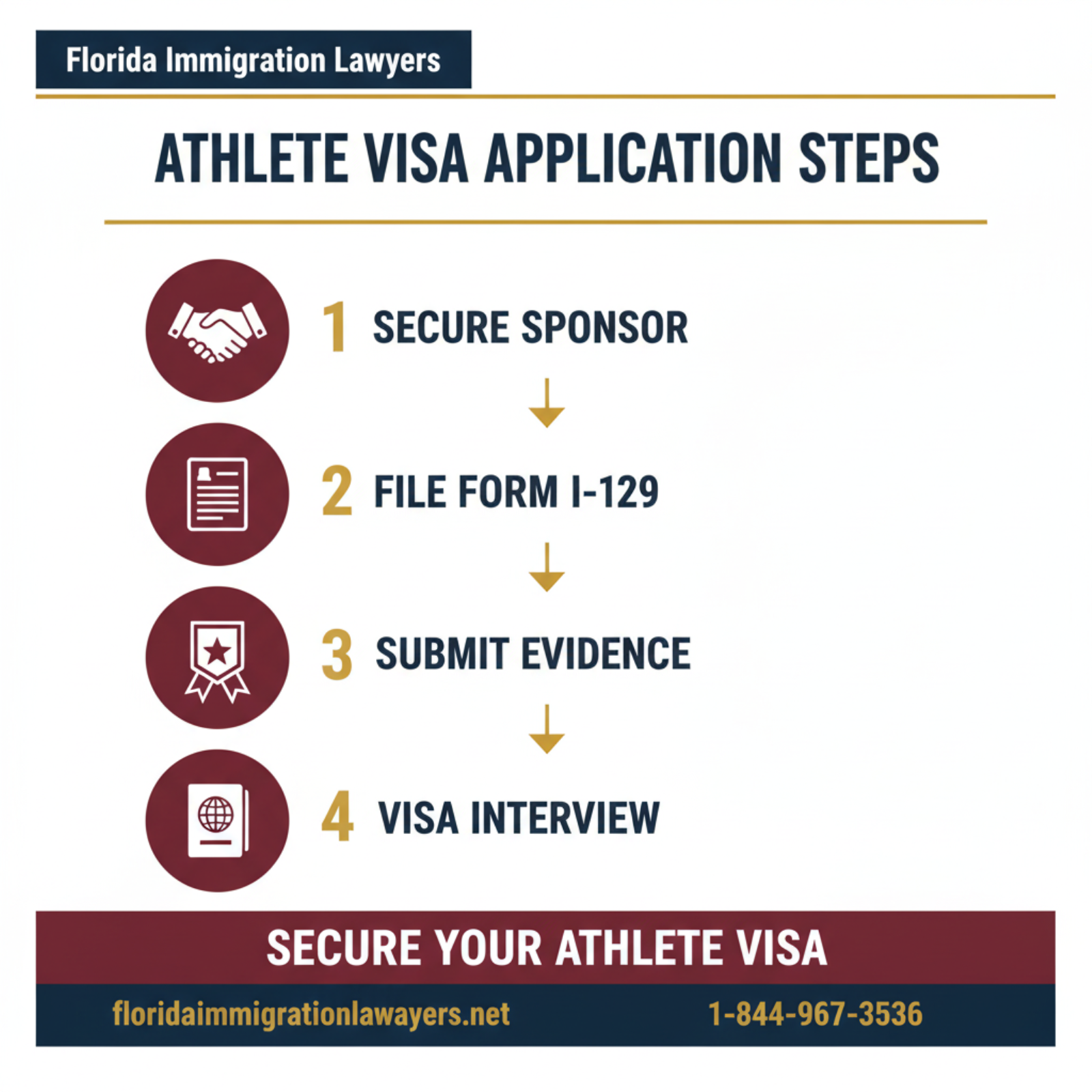
Step 1: Determine Eligibility and Visa Category. Before initiating any application, it is crucial to assess which visa category best fits your qualifications and planned activities in the U.S. For 2026 Winter Olympics ice hockey participants, this typically involves deciding between a P-1 or O-1 visa. Consulting with an experienced Florida immigration lawyer can help you navigate the specific criteria for each visa type. This initial assessment ensures your application aligns with U.S. immigration law, as outlined in the Immigration and Nationality Act (INA) sections 101(a)(15)(P) and 101(a)(15)(O).
-
Step 2: Secure a U.S. Employer or Agent. For most nonimmigrant worker visas, including P-1 and O-1, you must have a U.S. employer or an authorized U.S. agent file a petition on your behalf. This entity will serve as your sponsor and must demonstrate a legitimate need for your services. This is a crucial step for any athlete or support staff aiming for 2026 Winter Olympics immigration Florida, as the petitioning entity must have a clear itinerary and purpose for your U.S. stay.
-
Step 3: File Form I-129, Petition for a Nonimmigrant Worker, with USCIS. Your U.S. employer or agent must file Form I-129, Petition for a Nonimmigrant Worker, with U.S. Citizenship and Immigration Services (USCIS). This petition must include extensive documentation proving your eligibility for the chosen visa category. USCIS adjudicates these petitions, ensuring all regulatory requirements under 8 CFR 214.2(p) for P visas and 8 CFR 214.2(o) for O visas are met. Premium processing is available for an additional fee, potentially expediting the USCIS review.
-
Step 4: Attend Visa Interview at a U.S. Embassy or Consulate Abroad (if applicable). Once USCIS approves the I-129 petition, foreign nationals residing outside the U.S. must apply for a visa stamp at a U.S. Embassy or Consulate in their home country. This involves completing Form DS-160, paying the visa application fee, and attending an interview. During the interview, you will need to demonstrate your intent to return to your home country after your authorized stay. For those already in Florida and seeking to change or extend their status, this step may be bypassed, depending on their current immigration situation.
-
Step 5: Travel to the U.S. and Maintain Status. Upon receiving your visa, you can travel to the U.S. It is vital to comply with all terms and conditions of your visa, including the authorized period of stay and the activities permitted. Overstaying your visa or working without authorization can lead to severe immigration consequences. For those involved in the 2026 Winter Olympics immigration Florida, maintaining valid status throughout your stay is paramount.
Essential Document Checklist for 2026 Winter Olympics Immigration Applications
A thoroughly prepared application package is critical for success in any immigration process, especially for specialized visas like those for athletes. Gathering the correct documents efficiently can significantly impact the speed and outcome of your 2026 Winter Olympics immigration Florida application.
-
Valid Passport: Your passport must be valid for at least six months beyond your intended period of stay in the United States.
-
Birth Certificate: A certified copy of your birth certificate is often required for identity verification.
-
Marriage Certificate (if applicable): If you are applying for derivative visas for your spouse, a certified marriage certificate is essential.
-
Letters of Support: Official letters from sports organizations, national federations, agents, or teams detailing your role, achievements, and the specific event (e.g., related to the 2026 Winter Olympics ice hockey) you will participate in. These letters should attest to your international recognition or extraordinary ability.
-
Evidence of Extraordinary Ability or International Recognition: This is crucial for P-1 and O-1 visas. It includes awards, rankings, media articles, press clippings, testimonials from experts, contracts, and evidence of high salary or other remuneration for services. For ice hockey players, this could include national team selections, professional league stats, or significant achievements in international competitions.
-
Contracts and Itineraries: Copies of contracts with U.S. entities (teams, agents, promoters) outlining the terms of employment and a detailed itinerary of your activities in the U.S., including training camps in Florida, competition dates, and other engagements related to the 2026 Winter Olympics.
Step-by-Step Process Guide -
Educational Credentials: While not always a primary requirement for athletic visas, any relevant educational background or coaching certifications can strengthen your application.
-
Biographic Data and Photos: Passport-style photographs, fingerprints, and other biographic information as required by USCIS and the Department of State.
-
Financial Proof: Evidence that you or your petitioner can financially support your stay in the U.S. This might include bank statements, employment verification, or tax records.
-
Prior Visa and Immigration Documents: Copies of previous U.S. visas, I-94 records, and any other immigration-related documents.
Navigating Timelines and Processing Expectations for 2026 Winter Olympics Immigration in Florida
Understanding the timelines associated with U.S. immigration applications is paramount, especially when facing the fixed schedule of an event like the 2026 Winter Olympics. Processing times can vary significantly based on several factors, and early preparation is always recommended for 2026 Winter Olympics immigration Florida.
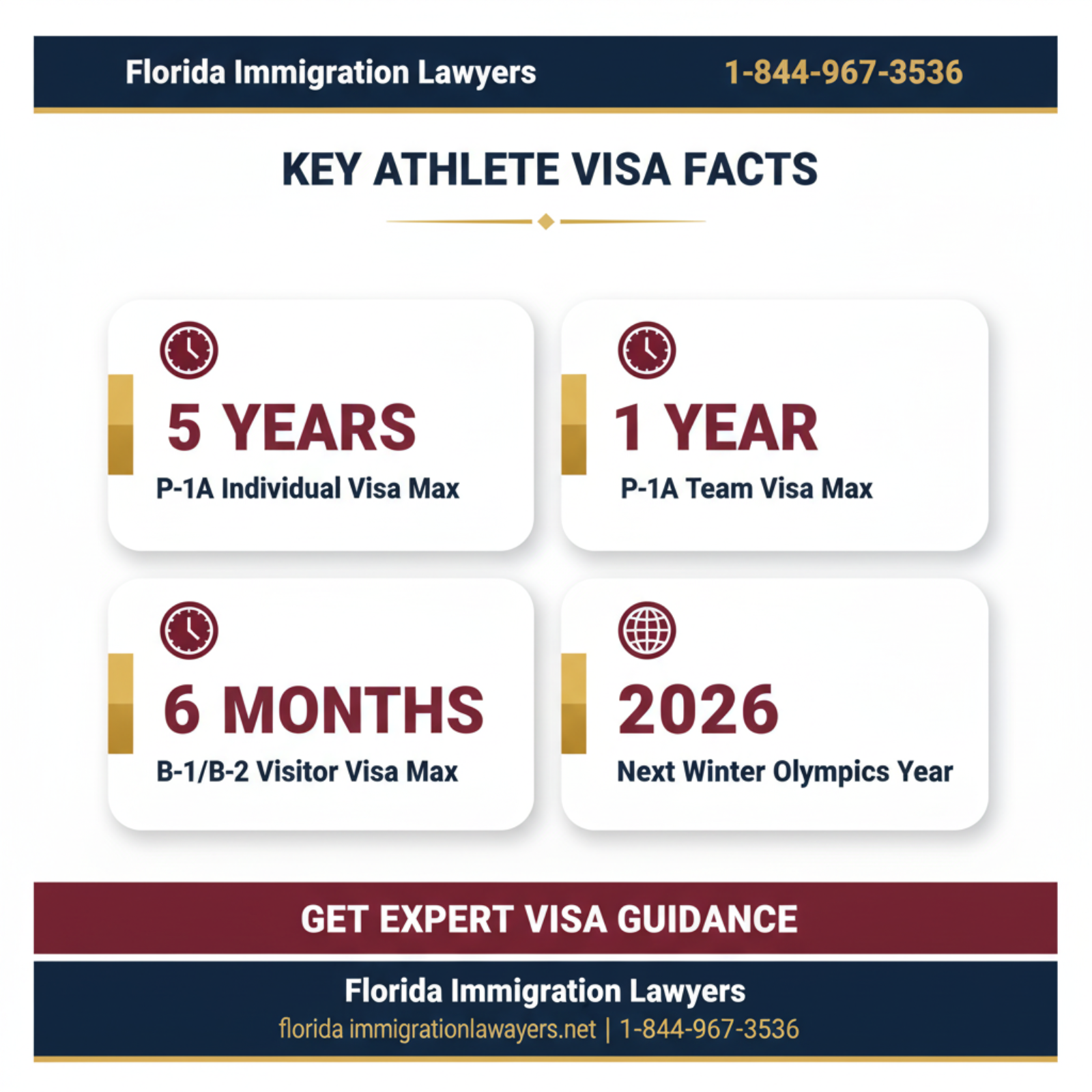
USCIS processing times depend on the specific service center handling your petition and their current workload. These times are regularly updated on the USCIS website. For P-1 and O-1 visa petitions, regular processing can take several months, which is a critical consideration given the Olympic schedule.
Expediting Your Application: Premium Processing
For those with urgent deadlines, USCIS offers a premium processing service for Form I-129. For an additional fee, USCIS guarantees a response (approval, denial, Request for Evidence, or Notice of Intent to Deny) within 15 calendar days. This option is highly recommended for athletes and support staff whose participation in the 2026 Winter Olympics ice hockey events hinges on timely visa approval.
After USCIS approves the I-129 petition, the next step involves consular processing at a U.S. Embassy or Consulate abroad. Interview wait times can vary widely by country, from a few days to several weeks or even months. It is essential to check the specific wait times for the consulate where you plan to apply. If you are already in Florida and eligible for an adjustment of status or extension, the consular interview step may be avoided.
Factors that can influence processing times include the completeness of your application, responses to Requests for Evidence (RFEs), background checks, and the overall volume of applications. Working with a knowledgeable Florida immigration lawyer can help mitigate delays by ensuring your application is comprehensive and accurate from the outset. Our team stays current with USCIS policy changes and processing trends affecting Florida Winter Olympics immigration cases.
Understanding Cost Factors and Fee Breakdown for Immigration to Florida
The cost of pursuing U.S. immigration for 2026 Winter Olympics ice hockey participation involves several components. While specific fee amounts are subject to change by government agencies, understanding the types of expenses helps in planning your budget. Florida Immigration Lawyers are committed to transparent fee structures for our legal services.
Government filing fees are mandatory and paid directly to USCIS or the Department of State. These include fees for Form I-129, the premium processing fee (if opted for), and the visa application fee (DS-160). These fees vary by visa type and are non-refundable, regardless of the application outcome.
Legal and Ancillary Expenses
Attorney fees constitute a significant portion of the total cost. These fees cover the expert legal advice, preparation of petitions, compilation of supporting documentation, communication with government agencies, and representation throughout the process. Our firm offers competitive and transparent fees for 2026 Winter Olympics immigration Florida cases, tailored to the complexity of your situation.
Additional expenses may include biometric service fees, medical examination fees (if required, particularly for green card applications), translation costs for foreign-language documents, and travel expenses for consular interviews. These ancillary costs should be factored into your overall financial planning. We advise against providing specific filing fee amounts due to their fluctuating nature, recommending clients always check official government websites for the most current figures.
Do not navigate this complex immigration process alone, especially when your participation in significant events like the 2026 Winter Olympics is at stake. Contact Florida Immigration Lawyers today to ensure your application is handled correctly and efficiently. Our team is dedicated to providing personalized legal support for all your Florida Winter Olympics immigration needs.
Common Mistakes to Avoid in 2026 Winter Olympics Immigration Applications
Navigating the U.S. immigration system can be fraught with potential pitfalls. Avoiding common mistakes is crucial for a successful outcome, particularly for time-sensitive applications related to the 2026 Winter Olympics ice hockey. Here are common errors and their consequences:
-
1. Underestimating Processing Times: Many applicants fail to account for potential delays at USCIS and consulates, leading to missed deadlines. This can result in inability to participate in training or competitions for the 2026 Winter Olympics.
-
2. Insufficient Evidence of Eligibility: A common pitfall is not providing enough documentation to prove extraordinary ability or international recognition for P-1 or O-1 visas. This can result in Requests for Evidence (RFEs) or outright denials, delaying your 2026 Winter Olympics immigration Florida plans.
-
3. Incorrect Visa Category Selection: Applying for the wrong visa type can lead to immediate rejection and wasted time and money. For instance, a P-1 visa is for internationally recognized athletes, while an O-1 is for individuals of extraordinary ability, and misclassification can be detrimental.
-
4. Providing Inconsistent Information: Any discrepancies across forms, supporting documents, or during interviews can raise red flags with immigration officers. This can lead to intense scrutiny, delays, or even accusations of misrepresentation.
-
5. Failing to Disclose Prior Immigration Issues: Attempting to hide past visa overstays, denials, or other immigration violations can lead to severe consequences. These include permanent bars from the U.S. or visa revocation, jeopardizing your participation in the 2026 Winter Olympics.
-
6. Not Responding to RFEs Promptly: If USCIS sends a Request for Evidence, a timely and comprehensive response is critical. Failing to do so within the specified timeframe will result in a denial of your petition.
-
7. Overlooking Family Member Visas: Often, athletes and professionals forget to apply for derivative visas for their spouses and minor children. This oversight can complicate family reunification and disrupt personal arrangements in Florida.
-
8. Neglecting to Update Address with USCIS: Moving without informing USCIS through Form AR-11 can cause important notices to be missed. This could lead to a denial without your knowledge or even the initiation of deportation defense proceedings if you are out of status.
-
9. Relying Solely on Online Information: Immigration laws are dynamic, complex, and constantly subject to change. Information found online may be outdated or not apply to your specific situation, leading to critical errors in your application for 2026 Winter Olympics immigration Florida.
-
10. Attempting to Self-Represent in Complex Cases: While possible for some, complex immigration cases, especially those involving international sports and the high stakes of the 2026 Winter Olympics, often benefit significantly from professional legal guidance. A lawyer ensures all legal requirements are met.
-
11. Violating Visa Terms: Overstaying a visa, working without authorization, or engaging in activities inconsistent with your visa type can lead to deportation and future entry bans. Strict adherence to visa conditions is vital for those involved in Florida Winter Olympics immigration.
-
12. Lack of Professional Consultation: Not seeking advice from an experienced immigration lawyer can lead to preventable errors and missed opportunities. A lawyer can proactively identify potential issues and strategize solutions for your 2026 Winter Olympics immigration Florida case.
When to Call a Florida Immigration Lawyer
The complexities of U.S. immigration law, particularly for specialized categories like athlete visas, make legal counsel invaluable. You should consider contacting Florida Immigration Lawyers if any of the following scenarios apply to your situation regarding 2026 Winter Olympics immigration Florida:
-
You are unsure which visa category best suits your role in the 2026 Winter Olympics ice hockey events. Determining the correct pathway (P-1, O-1, or another) is crucial for success.
-
You have a complex immigration history, including prior visa denials, overstays, or other violations. These issues require careful legal analysis and strategic planning to overcome.
-
You are an employer or agent seeking to petition for multiple athletes or support staff for the 2026 Winter Olympics. Managing multiple applications requires significant expertise.
-
You need to expedite your application process due to tight deadlines for the 2026 Winter Olympics and require assistance with premium processing or other urgent requests.
-
You are seeking to bring family members to Florida with you under derivative visas. Ensuring your family's immigration status is correctly handled is a specialized area of family immigration law.
-
You receive a Request for Evidence (RFE) from USCIS or a notice of intent to deny. A lawyer can help formulate a comprehensive and timely response to these critical communications.
-
You are concerned about potential deportation defense issues or maintaining your legal status while in Florida. Our firm can provide guidance and representation.
-
You are an individual of extraordinary ability seeking an O-1 visa, and need assistance compiling compelling evidence of your national or international acclaim for 2026 Winter Olympics immigration Florida.
-
You desire long-term residency options in the U.S. after your participation in the 2026 Winter Olympics. Our immigration law services extend to green cards and citizenship pathways.
-
You simply want peace of mind knowing your application for 2026 Winter Olympics immigration Florida is handled professionally and accurately. Our attorneys are here to provide that assurance.
Frequently Asked Questions About 2026 Winter Olympics Immigration in Florida
Where will the 2026 Winter Olympics ice hockey events be held?
While the 2026 Winter Olympics, including ice hockey, will primarily take place in Milano Cortina, Italy, Florida remains a crucial hub for many athletes, coaches, and support staff for training, residency, and logistical purposes before and after the games. Our state's advanced sports facilities and international connectivity make it a prime location for Olympic-bound individuals.
What NHL teams are located in Florida?
Florida is proudly home to two prominent NHL teams: the Florida Panthers, based in Sunrise, and the Tampa Bay Lightning. These teams significantly contribute to Florida's vibrant hockey culture and may host Olympic-bound athletes for training or related events. Their presence also underscores Florida's connection to professional ice hockey.
How does immigration law apply to athletes selected for the USA hockey team for the 2026 Olympics?
Players selected for the USA hockey team who are U.S. citizens do not need visas. However, foreign national athletes playing for other countries, or even U.S. citizens with foreign spouses/family, will need to ensure proper immigration status for any U.S. training, travel, or related activities. Foreign national athletes typically require P-1 visas for internationally recognized athletes. Early planning with an immigration attorney is essential for all involved in 2026 Winter Olympics immigration Florida.
Have any NHL teams ceased to exist?
Historically, several NHL teams have relocated or ceased operations since the league's inception, such as the Quebec Nordiques (now the Colorado Avalanche) or the Hartford Whalers (now the Carolina Hurricanes). While an interesting historical note, this fact does not directly impact current immigration requirements for the 2026 Winter Olympics. The focus for participants should be on current U.S. immigration laws and securing appropriate visas for their involvement in 2026 Winter Olympics immigration Florida.
About Florida Immigration Lawyers
Florida Immigration Lawyers is a leading immigration law firm dedicated to serving clients throughout the entire state of Florida. Our team of highly skilled and compassionate attorneys specializes in a wide array of immigration services, from complex visa applications to deportation defense, green cards, and citizenship processes. We understand the unique needs of athletes, professionals, and their families seeking to establish or maintain their status in the U.S., including those involved in high-profile events like the 2026 Winter Olympics.
We pride ourselves on providing personalized, client-focused legal solutions. Our commitment to excellence means we are available 24/7 to address your concerns, offering free consultations to discuss your specific situation. Whether you are an athlete, coach, or support staff member seeking a P-1 or O-1 visa, or a family navigating the complexities of U.S. immigration, our firm is here to guide you every step of the way. Trust Florida Immigration Lawyers to protect your rights and help you achieve your immigration goals in Florida.
Visit us at https://www.floridaimmigrationlawyers.net or call us directly at 1-844-967-3536 to schedule your free consultation. We serve all of Florida and are ready to assist you.
Sources and References
- U.S. Citizenship and Immigration Services (USCIS) - Athletes and Artists
- U.S. Department of State - All Visa Categories
- Executive Office for Immigration Review (EOIR)
- Immigration and Nationality Act (INA) - 8 U.S.C. Chapter 12
- 8 U.S.C. § 1101(a)(15)(P) - Definition of P nonimmigrant
- 8 U.S.C. § 1101(a)(15)(O) - Definition of O nonimmigrant
- 8 CFR Part 214.2(p) - P nonimmigrants
- 8 CFR Part 214.2(o) - O nonimmigrants
- USCIS Policy Manual
This article provides general legal information and is not intended as legal advice. Every case is unique, and outcomes depend on specific facts and circumstances. Contact an attorney for advice about your particular situation. Immigration laws are subject to change and should always be verified with official government sources or a qualified legal professional.
Your journey to the 2026 Winter Olympics, whether as an athlete, coach, or essential support staff, deserves expert legal guidance. Do not leave your immigration status to chance. Contact Florida Immigration Lawyers today for a free, confidential consultation. Our dedicated team is ready to assist you with all your immigration needs across Florida. Call us at 1-844-967-3536. Se Habla Español - Estamos aquí para ayudarle.
Need help with Immigration?
Our Florida immigration attorneys offer free consultations. Call today or schedule online.
Frequently Asked Questions
Florida Immigration Lawyers
Legal Team
Our experienced attorneys at Florida Immigration Lawyers have been serving clients across Florida for over 20 years. We specialize in immigration, personal injury, criminal defense, workers compensation, and family law.