Immigration Court Proceedings Florida: Your 2026 Guide
Facing immigration court proceedings in Florida, including removal proceedings before an immigration judge, can be a complex and stressful experience. This guide from Florida Immigration Lawyers provides a comprehensive overview of the process, from understanding the role of EOIR to navigating hearings and avoiding common mistakes. We cover essential documents, timelines, cost factors, and when to seek legal assistance. With Florida-specific context and actionable advice, our goal is to empower you with the knowledge needed to protect your rights and pursue a favorable outcome. Learn how our dedicated team can provide expert representation across Florida.
Immigration court proceedings in Florida involve formal hearings before an immigration judge to determine an individual's immigration status, often in response to removal proceedings initiated by the Department of Homeland Security. These complex legal battles, overseen by the Executive Office for Immigration Review (EOIR), can lead to deportation or grant relief, such as asylum or cancellation of removal. Understanding the process and your rights is crucial.
- Immigration court cases address an individual's eligibility to remain in the U.S.
- Proceedings are managed by the Executive Office for Immigration Review (EOIR).
- An immigration judge presides over hearings, making critical decisions.
- Legal representation significantly impacts case outcomes.
- Relief from removal, like asylum or adjustment of status, may be available.
Are you or a loved one facing the daunting prospect of immigration court proceedings Florida? The journey through the U.S. immigration system can feel overwhelming, especially when your future in the country hangs in the balance. Understanding the intricacies of removal proceedings, the role of an immigration judge, and the procedures of the Executive Office for Immigration Review (EOIR) is essential for anyone in Naples or across Florida navigating this challenging time.
This comprehensive guide from Florida Immigration Lawyers will demystify the immigration court process, from initial notices to final decisions. We aim to provide clarity on what to expect, how to prepare, and the crucial steps involved in your case. Your peace of mind and successful outcome are our top priorities. Call Florida Immigration Lawyers at 1-844-967-3536 for a free consultation to discuss your specific situation today.
Understanding Immigration Court Proceedings in Florida
What is Immigration Court?
Immigration court is a specialized administrative court system within the U.S. Department of Justice. Its primary function is to hear cases involving foreign nationals who the Department of Homeland Security (DHS) alleges are removable from the United States. These courts handle a wide range of issues, including asylum claims, applications for various forms of relief from deportation, and bond determinations.
For individuals in Florida, understanding the local context of these courts is vital. Florida hosts several key immigration courts, including those in Miami, Orlando, and the Krome Service Processing Center. Each immigration court operates under the same federal laws but may have unique local procedures or practices.
The Role of EOIR and Immigration Judges
The Executive Office for Immigration Review (EOIR) is the component of the Department of Justice responsible for adjudicating immigration cases. The EOIR oversees the immigration courts, the Board of Immigration Appeals (BIA), and the Office of the Chief Administrative Hearing Officer. Its mission is to fairly, expeditiously, and uniformly administer and interpret immigration laws.
Within the EOIR structure, an immigration judge is a crucial figure. These judges are administrative judges who preside over hearings in immigration courts. They have the authority to decide whether foreign nationals are removable from the U.S. and whether they are eligible for any form of relief from removal proceedings, such as asylum, withholding of removal, or cancellation of removal. Their decisions are based on evidence presented, testimony, and applicable immigration laws.
Why You Might Be in Immigration Court
There are several common reasons why an individual might find themselves in immigration court proceedings Florida. The most frequent reason is the issuance of a Notice to Appear (NTA) by DHS. An NTA is a charging document that initiates removal proceedings, alleging that a non-citizen is inadmissible or deportable under U.S. immigration law.
Reasons for receiving an NTA can include overstaying a visa, violating the terms of a visa, committing certain criminal offenses, or attempting to enter the U.S. without authorization. Even lawful permanent residents can be placed in removal proceedings if they commit certain crimes or violate immigration laws. It is a serious matter that demands immediate attention and legal guidance.
The Step-by-Step Process of Immigration Court Hearings
Navigating the immigration court system can be complex and intimidating. Understanding the typical stages can help you prepare mentally and strategically. While each case is unique, the general procedural framework remains consistent across Florida immigration courts.
-
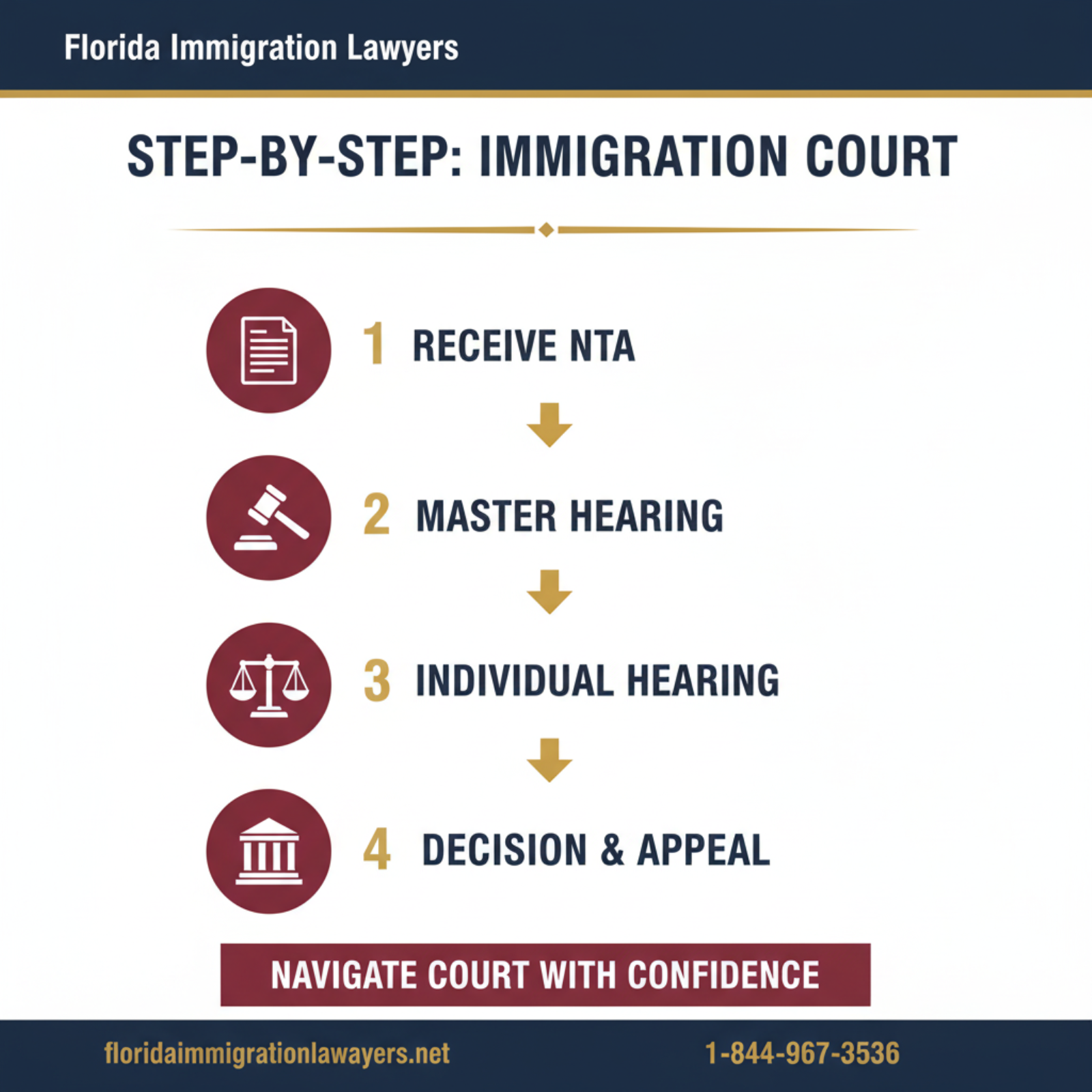
Notice to Appear (NTA) and Initial Filing: The process begins when DHS issues and files an NTA with the immigration court. This document outlines the allegations against you and the charges of removability. It also provides the date and location of your first hearing.
It is critical to receive and review your NTA carefully. This document is the foundation of your removal proceedings. If you receive an NTA, it is imperative to seek legal counsel immediately to understand the charges and prepare your defense.
-
Master Calendar Hearings (MCH): Your first appearance before an immigration judge is typically a Master Calendar Hearing. These are preliminary hearings where the judge addresses multiple cases simultaneously. During an MCH, you will acknowledge receipt of the NTA, plead to the allegations and charges, designate countries for deportation (if ordered), and inform the court of any applications for relief you intend to file.
Master Calendar Hearings are procedural but crucial. This is your first opportunity to formally respond to the charges and request additional time to find legal representation or prepare your case. The immigration judge will set deadlines for filing applications and supporting documents.
-
Filing Applications for Relief: If you are eligible for relief from removal, such as asylum, cancellation of removal, or adjustment of status, you must file the appropriate application by the deadline set by the immigration judge. These applications require extensive documentation and detailed personal information.
Common forms of relief include asylum (INA § 208), withholding of removal (INA § 241(b)(3)), Convention Against Torture (CAT) relief, cancellation of removal for certain non-LPRs (INA § 240A(b)), and adjustment of status to lawful permanent resident. Each form of relief has specific eligibility requirements that must be met.
-
Individual Hearings (Merits Hearings): If you apply for relief, the immigration judge will schedule an Individual Hearing. This is a longer, evidentiary hearing where you present your case in detail. You and your attorney will present evidence, call witnesses, and provide testimony to support your application for relief.
DHS counsel will also present their case, cross-examine you and your witnesses, and introduce their own evidence to argue for your removal. The immigration judge will hear all arguments and evidence before making a decision. This hearing is the core of your immigration court proceedings Florida case.
-
Decision by the Immigration Judge: After the Individual Hearing, the immigration judge will issue a decision. This decision can be delivered orally at the end of the hearing or in writing at a later date. The judge will either grant the relief you requested (allowing you to remain in the U.S.) or deny it and order you removed (deported) from the country.
The judge's decision is a critical moment in your case. If relief is granted, you will likely proceed with the necessary steps to adjust your status. If denied, you will face an order of removal, which can have severe consequences for your future.
-
Appeals to the Board of Immigration Appeals (BIA): If either you or DHS are dissatisfied with the immigration judge's decision, you generally have 30 days to file an appeal with the Board of Immigration Appeals (BIA). The BIA is the highest administrative body for interpreting and applying immigration laws.
The BIA reviews the record of the proceedings, legal arguments, and the judge's decision. They do not typically hear new evidence or testimony. The BIA can affirm, reverse, or remand the judge's decision. Further appeals may be possible to a U.S. Court of Appeals.
Essential Document Checklist for Your Immigration Court Case
Preparing for immigration court proceedings Florida requires meticulous organization and a thorough collection of documents. The specific documents you need will depend on the nature of your case and the type of relief you are seeking. However, certain documents are almost universally required or highly beneficial.
Here is a general checklist to help you get started:
- Your Notice to Appear (NTA): This is the foundational document initiating your removal proceedings.
- Identity Documents: Passport, birth certificate, national identity card, driver's license, or state ID.
- Proof of Entry and Status: I-94 arrival/departure record, visa stamps, previous USCIS notices, or other entry documents.
- Marriage Certificate (if applicable): If your case involves family-based relief, such as family immigration petitions.
- Birth Certificates of Children (if applicable): Especially if claiming U.S. citizen children for cancellation of removal.
- Proof of Residence in the U.S.: Leases, utility bills, school records, employment records, tax returns showing continuous presence.
- Financial Documents: Tax returns, pay stubs, bank statements, employment letters to demonstrate financial stability or hardship.
- Criminal Records: Certified copies of any arrest records, court dispositions, or police reports, even for minor offenses.
- Medical Records: Especially relevant for asylum claims or humanitarian relief.
- Affidavits from Witnesses: Statements from family, friends, employers, or community leaders attesting to your character, hardship, or specific events.
- Evidence for Specific Relief: For asylum, this could include country conditions reports, expert witness statements, and personal narratives. For cancellation of removal, it might involve extreme and unusual hardship evidence.
- Proof of Good Moral Character: Letters of recommendation, community involvement, volunteer work, or religious affiliation.
- Any Previous Immigration Filings: Copies of applications, petitions, or correspondence with USCIS or other immigration agencies.
Remember, this is not an exhaustive list. Your attorney from Florida Immigration Lawyers will provide a personalized document checklist tailored to your specific immigration court case. Organizing these documents early can significantly streamline your legal process.
Timeline and Processing Expectations for Florida Immigration Cases
The timeline for immigration court proceedings Florida can vary dramatically, ranging from a few months to several years. This variability often causes significant stress and uncertainty for individuals in removal proceedings. Several factors contribute to these fluctuating processing times.
Factors Affecting Case Length
One major factor is the sheer volume of cases within the EOIR system. Immigration courts across the U.S., including those in Miami and Orlando, face substantial backlogs. The availability of immigration judges, court resources, and administrative staff all play a role in how quickly cases move through the system.
The complexity of your specific case also impacts the timeline. Cases involving extensive evidence, multiple witnesses, or complex legal arguments naturally take longer to resolve. Furthermore, the type of relief sought can influence processing times; for instance, asylum claims often involve more detailed scrutiny than some other forms of relief.
Changes in immigration policy and law can also create delays or expedite certain types of cases. The appeals process, if initiated, adds significant time to the overall duration of your immigration court proceedings Florida, as cases must be reviewed by the BIA and potentially federal courts.
Checking Your Case Status
You can generally check the status of your immigration court case online or by phone. The EOIR provides an automated case status information system. You will need your A-number (Alien Registration Number) to access this information. This number is typically found on your Notice to Appear (NTA) or other immigration documents.
For online access, you can visit the Executive Office for Immigration Review's website and use their case status tool. This tool can provide updates on scheduled hearings, decisions, and other important case milestones. It's a useful resource for tracking your immigration court case status.
For those in Naples and other Florida areas, staying informed about your case status is crucial. However, it is always best to consult with your attorney for the most accurate and nuanced interpretation of your case's progress and any changes. Your legal team at Florida Immigration Lawyers can provide direct assistance with checking your immigration court date check and status.
Cost Factors and Fee Breakdown in Immigration Court
Understanding the potential costs associated with immigration court proceedings Florida is an important aspect of preparing for your case. These costs can generally be divided into two main categories: government filing fees and legal fees.
Government filing fees are paid directly to the U.S. government for various applications for relief. While the NTA itself does not have a filing fee, many applications for relief from removal do. For example, an application for adjustment of status (Form I-485) or an application for waiver of grounds of inadmissibility (Form I-601) will have associated fees. These fees are set by USCIS and are subject to change, so it's important to check the most current fee schedule on USCIS.gov. Fee waivers may be available for eligible individuals based on financial hardship.
Legal fees constitute the other significant cost. Retaining an experienced immigration attorney is highly recommended, as the complexities of removal proceedings can be overwhelming. Legal fees cover the attorney's time, expertise, and resources dedicated to your case, including preparing applications, representing you in court before an immigration judge, and handling appeals.
The total legal fees will depend on the complexity of your case, the amount of work required, and the specific services provided by your attorney. Many firms, including Florida Immigration Lawyers, offer free initial consultations to discuss your case and provide an estimate of legal costs. Investing in legal representation can significantly improve your chances of a favorable outcome in immigration court.
Do not navigate this process alone. The stakes are too high to face immigration court proceedings Florida without expert guidance. Contact Florida Immigration Lawyers today to schedule your free consultation and discuss how we can assist you.
Common Mistakes to Avoid in Immigration Court
Facing an immigration judge can be a high-pressure situation. Avoiding common pitfalls is essential for protecting your rights and improving your chances of a positive outcome in removal proceedings. Be aware of these mistakes:
-
Missing a Court Date: Failing to appear for any scheduled Master Calendar or Individual Hearing can result in an automatic order of removal (deportation) in absentia. This is one of the most severe mistakes you can make in immigration court proceedings Florida.
Consequence: An in absentia removal order is very difficult to overturn and can lead to immediate deportation and bars to future immigration benefits.
-
Not Disclosing All Relevant Information to Your Attorney: Withholding details, even seemingly minor ones, can jeopardize your case. Your attorney needs a complete and accurate picture to build the strongest defense.
Consequence: Surprises in court can undermine your credibility and lead to unfavorable decisions by the immigration judge.
-
Filing Applications Late or Incorrectly: Missing deadlines for filing applications for relief or submitting incomplete or inaccurate forms can lead to denials and lost opportunities.
Consequence: The immigration court will not consider late applications, and incorrect filings can result in outright rejection, potentially leading to an order of removal.
-
Lying or Misrepresenting Facts: Providing false information to the immigration judge or on any application is a serious offense. This can lead to findings of fraud, permanent bars to immigration benefits, and even criminal charges.
Consequence: This can result in a permanent finding of inadmissibility or deportability, making it nearly impossible to obtain legal status in the future.
-
Not Understanding the Charges Against You: Many individuals do not fully grasp the allegations in their NTA. This lack of understanding can lead to incorrect pleadings or an inability to mount an effective defense.
Consequence: You may inadvertently concede to charges of removability that could have been challenged, weakening your overall case in immigration court.
-
Failing to Gather Sufficient Evidence: A strong case relies on compelling evidence. Not having enough documentation or witness testimony to support your claims can weaken your position.
Consequence: The immigration judge may find that you have not met your burden of proof for the relief requested, leading to a denial.
-
Appearing Unprepared or Unprofessional: While not a direct legal error, your demeanor in immigration court matters. Dressing appropriately, being respectful, and being prepared to answer questions can positively influence the immigration judge.
Consequence: While not legally determinative, a poor impression can subtly affect how your testimony or arguments are perceived.
-
Ignoring Changes to Your Contact Information: Moving without updating your address with the EOIR can mean you miss critical notices, including hearing dates.
Consequence: Missing official notices can lead to missed court dates and an in absentia removal order.
-
Attempting to Represent Yourself Without Legal Expertise: The complexities of immigration law are vast. Without legal training, you may miss critical legal arguments or fail to navigate procedural requirements effectively.
Consequence: Self-representation often leads to procedural errors, missed opportunities for relief, and a significantly higher risk of removal.
-
Not Seeking Timely Legal Counsel: Delaying consultation with an immigration attorney can mean missed deadlines, lost evidence, and fewer options for relief. The sooner you engage legal help, the better.
Consequence: Critical deadlines may pass, and your ability to present a strong case in immigration court proceedings Florida can be severely hampered.
When to Call a Florida Immigration Lawyer
The decision to hire an attorney is one of the most crucial steps you can take when facing immigration court proceedings Florida. While not legally mandatory, legal representation significantly increases your chances of a positive outcome. You should consider calling Florida Immigration Lawyers at the earliest sign of trouble or if you receive any notice from immigration authorities.
Here are specific scenarios where legal assistance is not just helpful, but often essential:
- Upon Receiving a Notice to Appear (NTA): This document formally initiates your removal proceedings. An attorney can review the charges, advise on your rights, and begin preparing your defense immediately.
- Detention by ICE: If you or a loved one are detained by U.S. Immigration and Customs Enforcement (ICE), an attorney can work to secure your release on bond and represent you in bond hearings before an immigration judge.
- Complex Legal Issues: Cases involving criminal convictions, previous deportation orders, or multiple forms of relief require sophisticated legal analysis. An experienced attorney understands the nuances of immigration law and how to apply them to your unique situation.
- Applying for Relief from Removal: Whether you are seeking asylum, cancellation of removal, or adjustment of status, the application process is rigorous. An attorney ensures all forms are correctly filed, evidence is properly presented, and legal arguments are compelling.
- Appealing a Decision: If an immigration judge issues an unfavorable decision, an attorney can guide you through the complex appeals process to the BIA and potentially federal courts.
- Any Uncertainty or Fear: If you feel overwhelmed, confused, or fearful about your immigration court proceedings Florida, that is a clear sign to seek professional help. We are here to provide clarity and support.
Florida Immigration Lawyers has a dedicated team of attorneys experienced in all facets of immigration court and deportation defense. We understand the unique challenges faced by immigrants in Florida, including those in Naples and surrounding communities. We are committed to protecting your rights and fighting for your future.
Frequently Asked Questions About Immigration Court in Florida
Navigating the legal landscape of immigration court proceedings Florida often brings up many questions. Here, we address some common concerns that individuals facing removal proceedings frequently ask.
Does removal proceedings mean deportation?
Not necessarily. While removal proceedings are the legal process that can lead to deportation, they also provide an opportunity for individuals to seek various forms of relief from removal. If the immigration judge grants a form of relief, such as asylum or cancellation of removal, you will not be deported. The goal of entering proceedings is often to determine eligibility for such relief. However, if no relief is granted, an order of removal (deportation) will be issued.
Did the Supreme Court block Florida from enforcing anti immigration law?
As of early 2026, the legal landscape regarding Florida's immigration laws, such as SB 1718, remains dynamic and subject to ongoing legal challenges. Specific provisions of state laws are frequently challenged in federal courts, and their enforcement can be subject to injunctions or appeals. The impact of such laws on individuals in immigration court proceedings Florida is significant, and their enforceability can change. For the most current information and how it impacts your specific case, it is essential to consult with an experienced immigration attorney. Florida Immigration Lawyers stays abreast of all legal developments impacting immigrants in Florida.
What does it mean to be in immigration court proceedings?
Being in immigration court proceedings means that the Department of Homeland Security (DHS) believes you are subject to removal from the United States and has initiated a formal legal process to determine your immigration status. You will appear before an immigration judge who will hear evidence, consider your eligibility for various forms of relief, and ultimately decide whether you can remain in the U.S. or will be ordered deported. This process can be lengthy and requires careful legal strategy.
What is Florida's new immigration law?
Florida's new immigration law, notably SB 1718, which took effect in 2023, introduced several provisions impacting undocumented immigrants and those who aid them. Key aspects included enhanced penalties for transporting undocumented individuals, requirements for hospitals to collect patient immigration status data, and stricter E-Verify mandates for employers. While state laws like SB 1718 operate separately from federal immigration court proceedings, they can create a more challenging environment for immigrants in Florida. An attorney can help you understand how these state laws might indirectly affect your federal immigration case or daily life in Florida.
About Florida Immigration Lawyers
Florida Immigration Lawyers is a leading immigration law firm dedicated to serving individuals and families across the entire state of Florida, including Naples, Miami, Orlando, and Tampa. Our mission is to provide compassionate, effective, and zealous legal representation to those navigating the complexities of U.S. immigration law.
We offer a comprehensive range of immigration services, including deportation defense, asylum applications, citizenship and naturalization, family-based visas, business immigration, and assistance with all types of immigration court proceedings Florida. Our experienced attorneys are committed to staying up-to-date with the latest immigration policies and legal precedents to provide you with the best possible advice.
Choosing Florida Immigration Lawyers means choosing a firm that understands the stakes involved in your immigration case. We pride not only on our legal expertise but also on our client-focused approach, ensuring you feel supported and informed every step of the way. We offer free consultations, are available 24/7, and provide bilingual services (Se Habla Español) to ensure clear communication and access to justice for all. Contact us at 1-844-967-3536 or visit https://www.floridaimmigrationlawyers.net to learn how we can help you achieve your immigration goals.
Sources and References
- U.S. Citizenship and Immigration Services (USCIS)
- Executive Office for Immigration Review (EOIR)
- 8 U.S.C. Chapter 12 - Immigration and Nationality Act (INA)
- INA § 240 (8 U.S.C. § 1229a) - Removal Proceedings
- 8 CFR Part 1003 - Executive Office for Immigration Review
- U.S. Immigration and Customs Enforcement (ICE)
This article provides general legal information and is not intended as legal advice. Every case is unique, and outcomes depend on specific facts and circumstances. Contact an attorney for advice about your particular situation.
Do not face immigration court proceedings Florida alone. Your future in the United States is too important. The experienced team at Florida Immigration Lawyers is ready to provide the dedicated and knowledgeable representation you need. Call us today at 1-844-967-3536 for a free, confidential consultation. Se Habla Español - Estamos aquí para ayudarle.
Frequently Asked Questions
Florida Immigration Lawyers
Legal Team
Our experienced attorneys at Florida Immigration Lawyers have been serving clients across Florida for over 20 years. We specialize in immigration, personal injury, criminal defense, workers compensation, and family law.