Dual Citizenship Florida: Your Guide to Two Passports
Discover the path to dual citizenship in Florida. Our comprehensive guide explains the naturalization process, eligibility requirements, and the benefits of holding two passports. We cover essential documents, timelines, and cost factors, helping you navigate this complex immigration journey. Avoid common mistakes and learn when to seek expert legal assistance. Florida Immigration Lawyers provides dedicated support for your dual citizenship goals.

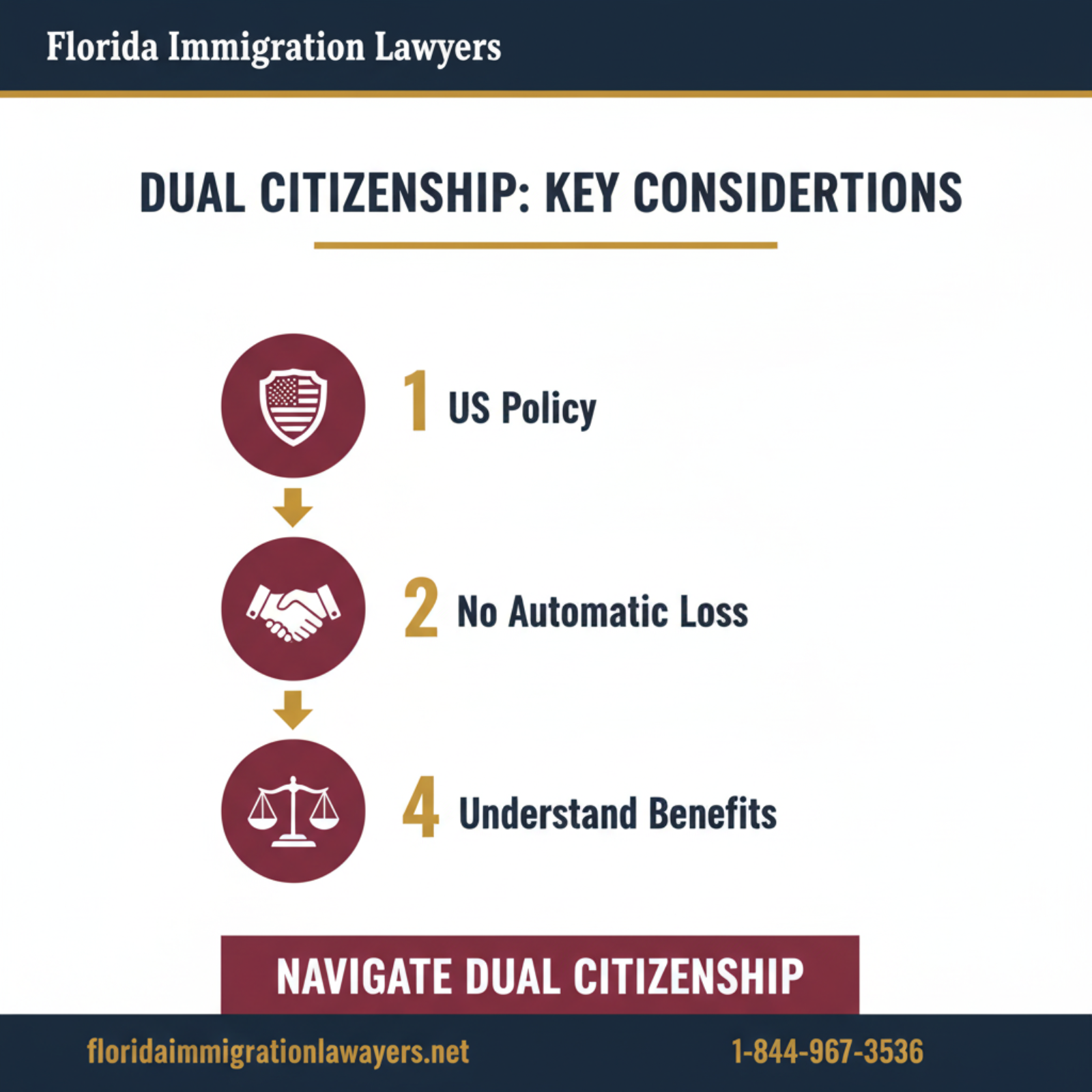
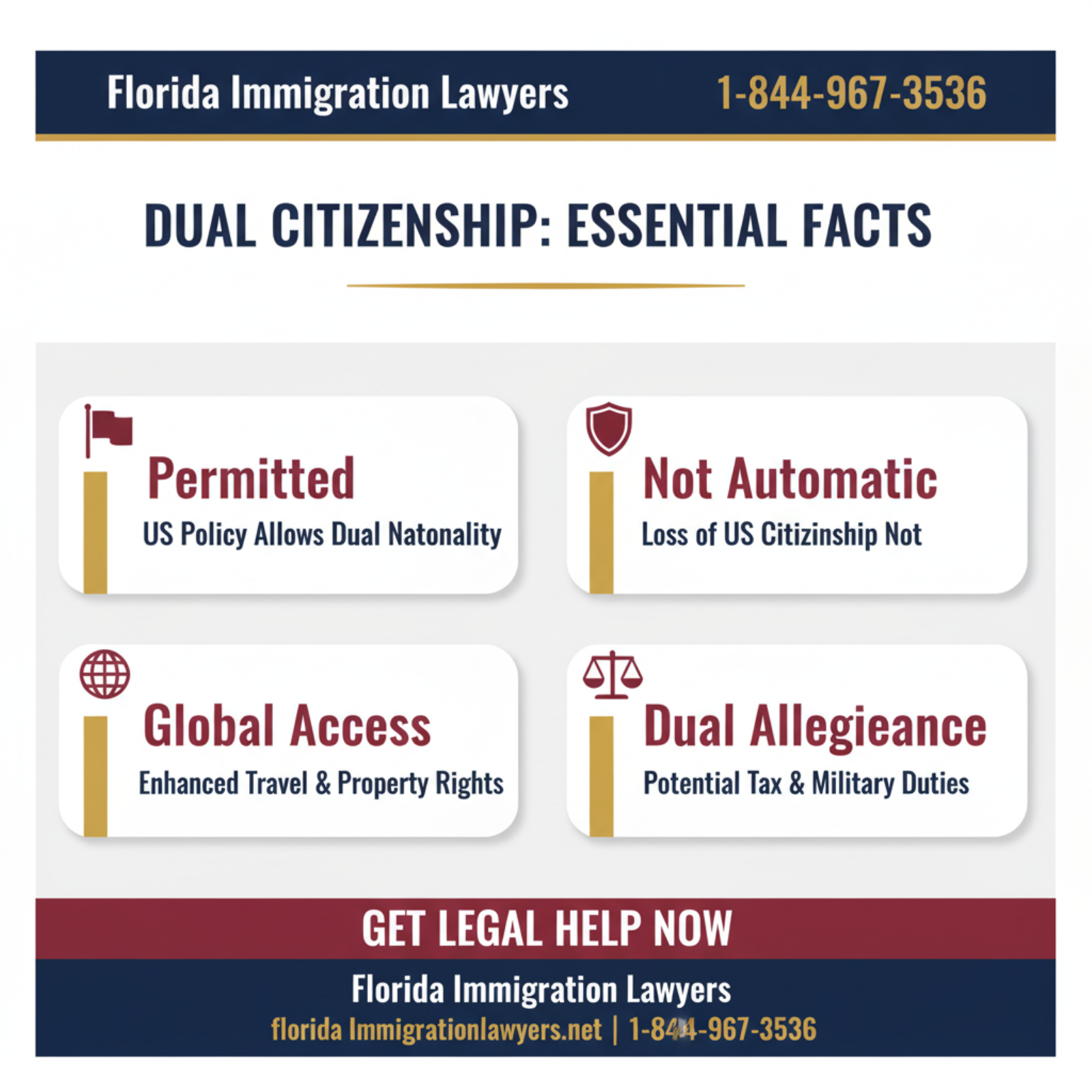
Dual citizenship in Florida refers to holding citizenship in both the United States and another country simultaneously. The U.S. generally permits its citizens to retain foreign citizenship, and foreign nationals may pursue U.S. naturalization without renouncing their original nationality, provided their home country allows it. This status offers various benefits, including increased travel freedom and expanded rights.
- The U.S. generally allows dual nationality.
- Naturalization is the primary path for foreign nationals.
- Each country's laws determine dual citizenship eligibility.
- Benefits include expanded rights and travel flexibility.
- Consult an attorney for personalized guidance on your dual citizenship Florida journey.
Are you living in Hollywood, Florida, and dreaming of the benefits of holding two passports? Many individuals in our diverse state wonder about the possibility of dual citizenship. It is a common misconception that becoming a U.S. citizen requires you to give up your original nationality. This is often not the case.
This comprehensive guide will demystify dual citizenship, exploring how it works in Florida and the United States. We will cover the naturalization process, discuss eligibility, and highlight the advantages and potential complexities. Understanding your options is the first step toward achieving your immigration goals.
Do not navigate this complex process alone. Call Florida Immigration Lawyers at 1-844-967-3536 for a free consultation. Our experienced team is ready to assist you.
Understanding Dual Citizenship in Florida and the U.S.
Dual citizenship, or dual nationality, means being a citizen of two countries at the same time. The United States generally permits its citizens to hold dual nationality. This means that a U.S. citizen can also be a citizen of another country.
For foreign nationals residing in Florida, this often involves becoming a naturalized U.S. citizen while retaining their original citizenship. The ability to hold dual citizenship depends on the laws of both the United States and your home country. It is crucial to understand both sets of regulations.
The U.S. Immigration and Nationality Act (INA) does not explicitly prohibit dual nationality. However, when naturalizing, applicants take an Oath of Allegiance to the U.S. While this oath includes renouncing allegiance to foreign states, the U.S. Supreme Court has interpreted this as not requiring an active step to formally renounce foreign citizenship. Instead, it means pledging primary loyalty to the United States. (Refer to 8 U.S.C. Chapter 12).
Eligibility Requirements for Dual Citizenship in Florida
Eligibility for dual citizenship typically involves meeting the requirements for U.S. naturalization. This pathway is available to lawful permanent residents (green card holders) who have met specific residency and moral character criteria. You must generally be at least 18 years old.
The primary requirements include continuous residency in the U.S. for a certain period, usually five years, or three years if married to a U.S. citizen. You must also demonstrate good moral character and pass English and civics tests. Your home country must also allow dual nationality for you to retain your original citizenship.
Many countries, particularly in Latin America and Europe, explicitly permit dual nationality. However, some nations have restrictions or require formal renunciation upon acquiring another citizenship. It is essential to research your home country's specific laws regarding dual nationality.
Benefits and Challenges of Holding Two Passports
Holding two passports offers numerous advantages for individuals and families in Florida. One significant benefit is increased travel freedom, allowing easier entry and exit from both countries without visa requirements. You may also be able to own property or conduct business more freely in your country of origin.
Dual citizens often enjoy expanded rights, including the ability to vote, hold public office, and access social services in both nations. This status can provide a sense of belonging and connection to both cultures. For many, it represents a bridge between their heritage and their new life in the United States.
However, there can be challenges. Dual citizens may owe taxes to both countries, depending on specific tax treaties and income sources. They might also face military service obligations in their country of origin. Complexities can arise regarding legal obligations and diplomatic protection.
Understanding these aspects is vital for anyone considering dual citizenship in Florida. Our team at Florida Immigration Lawyers can help you weigh the pros and cons based on your unique circumstances. Learn more about your options for U.S. citizenship.
The Path to Dual Citizenship: A Step-by-Step Guide
For most foreign nationals in Florida, the path to dual citizenship involves successfully completing the U.S. naturalization process. This journey requires careful preparation and adherence to specific legal procedures. It typically begins after you have established lawful permanent residency.
Here is a general step-by-step guide to becoming a naturalized U.S. citizen, which can lead to dual citizenship if your home country allows it:
- Determine Eligibility: Ensure you meet all U.S. Citizenship and Immigration Services (USCIS) requirements for naturalization. This includes age, continuous residency, physical presence, good moral character, and English/civics proficiency.
- Prepare Form N-400, Application for Naturalization: This is the primary application form. It requires detailed personal information, residency history, and answers about your background. Gather all necessary supporting documents as you complete this form.
- File Form N-400 and Pay Fees: Submit your completed Form N-400 along with all required supporting documents and the filing fee to USCIS. You can check current fees on the USCIS website.
- Attend Biometrics Appointment: After filing, you will receive an appointment notice for a biometrics services appointment. At this appointment, USCIS will collect your fingerprints, photograph, and signature for background checks.
- Complete the Naturalization Interview: You will attend an interview with a USCIS officer. During this interview, the officer will review your N-400 application, test your English reading, writing, and speaking abilities, and administer a civics test. They will also ask questions to confirm your eligibility and good moral character. (Refer to 8 CFR Part 316).
- Receive a Decision: After your interview, USCIS will provide a decision. This could be an approval, a denial, or a request for additional information. If approved, you will receive a notice for your Oath of Allegiance ceremony.
- Attend the Oath of Allegiance Ceremony: This is the final step where you officially become a U.S. citizen. You will take the Oath of Allegiance to the United States. At this point, if your home country permits it, you will officially hold dual citizenship.
- Apply for a U.S. Passport: Once you become a U.S. citizen, you are eligible to apply for a U.S. passport. This document is your official proof of U.S. citizenship for international travel. You can find information on applying for a U.S. passport on the U.S. Department of State website.
Each step requires careful attention to detail and adherence to deadlines. Missing information or errors can cause significant delays. For assistance with any immigration matter, including immigration applications, our firm is here to help.
Essential Documents for Dual Citizenship Applications
Preparing a thorough and accurate document checklist is critical for a successful naturalization application, which is the gateway to dual citizenship. USCIS requires specific documents to verify your identity, eligibility, and good moral character. Incomplete submissions are a leading cause of delays.
Here is a general list of documents you will typically need for your Form N-400 application:
- Copy of your Permanent Resident Card (Green Card).
- Copies of all passports, both current and expired.
- Copies of marriage certificates, divorce decrees, or death certificates (if applicable).
- Copies of birth certificates for yourself and your children.
- Tax returns for the past five years (or three years if married to a U.S. citizen).
- Proof of selective service registration (if applicable).
- Court disposition records for any arrests or detentions, even if charges were dismissed.
- Travel records, including dates of all trips outside the U.S. for the past five years.
- Proof of payment of child support or alimony (if applicable).
- Proof of your relationship to a U.S. citizen spouse (if applying under the three-year rule).
- Two passport-style photographs (if applying by mail, check current requirements).
This list is not exhaustive, and additional documents may be requested based on your individual circumstances. Organizing these documents meticulously before filing can streamline the entire process. Our experienced attorneys can help you compile a comprehensive application.
Dual Citizenship Timeline and Processing Expectations
The timeline for achieving dual citizenship through U.S. naturalization can vary significantly. Several factors influence processing times, including the USCIS field office jurisdiction, the complexity of your case, and current agency backlogs. For residents in Hollywood and other Florida areas, processing times may differ from national averages.
Typically, the entire naturalization process, from filing Form N-400 to attending the Oath of Allegiance ceremony, can take anywhere from 6 to 18 months, or even longer. USCIS provides a tool on its website to check current processing times by form type and field office location. For example, processing times at the Miami or Orlando field offices might have specific variations.
After filing Form N-400, you can expect to receive a receipt notice within a few weeks. The biometrics appointment usually follows within 1-2 months. The naturalization interview can be scheduled several months after biometrics. Finally, the Oath Ceremony typically occurs within a few weeks to a couple of months after a successful interview.
Delays can occur due to requests for evidence (RFEs), background check issues, or scheduling conflicts. Being prepared and responding promptly to all USCIS requests can help keep your application on track. Staying informed about the process is key.
Cost Factors and Fees for Pursuing Dual Citizenship
Understanding the costs associated with pursuing dual citizenship through naturalization is essential for financial planning. The primary costs involve USCIS filing fees, which are subject to change. It is crucial to check the most current fee schedule on the official USCIS website before filing your application.
The main fee is for Form N-400, Application for Naturalization. This fee typically includes the biometrics services fee. There are also potential costs for obtaining necessary supporting documents, such as birth certificates, marriage certificates, or foreign police clearances, which may require translation and certification.
Additional costs might include legal fees if you choose to retain an immigration attorney. While not legally required, professional legal assistance can significantly enhance your chances of success and reduce stress. An attorney can help prepare your application, represent you at interviews, and address any complex issues.
Consider the value of a smooth, error-free application process. Investing in legal guidance can save time and prevent costly mistakes or denials. Our firm offers transparent pricing and free consultations to discuss your options.
Do not navigate this complex process alone. The journey to dual citizenship, especially for those in Florida, involves intricate legal steps. Contact Florida Immigration Lawyers today to ensure your application is handled with precision and care.
Common Mistakes to Avoid in Your Dual Citizenship Journey
Navigating the U.S. naturalization process, and by extension, your path to dual citizenship, can be fraught with potential pitfalls. Avoiding common mistakes is crucial for a smooth and successful application. Many applicants encounter delays or denials due to preventable errors.
- Failing to Meet Residency Requirements: Not accurately calculating your continuous residency or physical presence in the U.S. can lead to denial. Even short trips abroad can impact these calculations.
- Incomplete or Inaccurate Form N-400: Providing incorrect information or leaving sections blank on your application form is a common mistake. Every question must be answered truthfully and completely.
- Insufficient Supporting Documentation: Failing to include all required documents, or submitting uncertified copies when originals or certified copies are needed, will cause delays. Always review the checklist thoroughly.
- Lack of Good Moral Character: Issues like criminal records, failure to pay taxes, or misrepresentation can disqualify you. Be honest about your past and seek legal advice on how to address any concerns. (Refer to INA Section 316, 8 U.S.C. § 1427).
- Poor English Language Proficiency: Failing the English reading, writing, or speaking tests during the interview is a common hurdle. Practice and preparation are essential for success.
- Inadequate Civics Knowledge: The civics test covers U.S. history and government. Not studying sufficiently for this test can result in failure. Utilize USCIS study materials.
- Not Updating USCIS with Address Changes: Moving without informing USCIS can lead to missed notices and delays. Always update your address promptly using their online tool.
- Misunderstanding Your Home Country's Laws: Assuming your home country allows dual nationality without verifying can lead to unexpected renunciation requirements. Research thoroughly.
- Traveling Abroad During Processing: Extensive travel after filing your N-400 can sometimes raise questions about your intent to reside permanently in the U.S. Consult an attorney before significant travel.
- Failing to Disclose All Trips Abroad: Omitting details about all trips outside the U.S., even short ones, can be seen as misrepresentation. Maintain detailed travel records.
- Ignoring Small Legal Infractions: Even minor arrests or citations, like traffic tickets, must be disclosed. Transparency is key, and legal advice can help you present these appropriately.
- Attempting to Navigate Complex Issues Alone: If you have a complicated case history, such as prior deportations or criminal convictions, attempting to file without legal counsel is highly risky.
Avoiding these mistakes can significantly improve your chances of a successful naturalization application and achieving your goal of dual citizenship.
When to Call Florida Immigration Lawyers for Dual Citizenship Guidance
While the naturalization process leading to dual citizenship can seem straightforward, many situations warrant professional legal assistance. Florida Immigration Lawyers are dedicated to helping individuals in Hollywood and throughout Florida navigate these complex immigration matters. We understand the nuances of U.S. immigration law.
You should consider contacting our firm if:
- You have a complex immigration history: This includes previous visa denials, deportation proceedings, or long periods of unauthorized stay. Our deportation defense team can offer valuable insight.
- You have a criminal record: Even minor offenses can impact your good moral character requirement. An attorney can assess your eligibility and advise on potential waivers or rehabilitation evidence.
- You have extensive travel outside the U.S.: Frequent or prolonged absences can complicate continuous residency and physical presence calculations.
- You are unsure about your home country's dual nationality laws: We can help you understand the implications and requirements of retaining your original citizenship.
- You need help preparing your application and documents: Ensuring accuracy and completeness is paramount. Our team can meticulously prepare your Form N-400 and gather all supporting evidence.
- You require representation at your USCIS interview: Having legal counsel present can provide peace of mind and immediate assistance if unexpected questions or issues arise.
- You face a denial or request for evidence: We can help you understand the reasons for denial and advise on appeals or strategies for reapplication.
- You are seeking family immigration or business immigration services: Our expertise extends to all areas of immigration law.
Do not leave your future to chance. Our attorneys provide personalized, compassionate, and effective legal representation. We are committed to protecting your rights and helping you achieve your dual citizenship goals.
About Florida Immigration Lawyers
Florida Immigration Lawyers is a premier law firm serving individuals and families across the entire state of Florida, including Hollywood. We are deeply committed to providing exceptional legal representation in all areas of immigration law. Our experienced attorneys understand the profound impact immigration decisions have on your life.
We offer a comprehensive range of immigration services, from asylum applications and naturalization to deportation defense and visa petitions. Our firm prides itself on its client-centered approach, ensuring that your unique needs and goals are at the forefront of our strategy. We strive to make the complex immigration process as clear and stress-free as possible for you.
Choose Florida Immigration Lawyers because we offer dedicated advocacy, in-depth legal knowledge, and a commitment to achieving the best possible outcomes for our clients. We are available 24/7 to answer your questions and provide support. Your success is our priority.
Contact us today for a free consultation.
Phone: 1-844-967-3536
Website: https://www.floridaimmigrationlawyers.net
Serving all of Florida.
Sources and References
- U.S. Citizenship and Immigration Services (USCIS)
- U.S. Department of State - Bureau of Consular Affairs
- 8 U.S.C. Chapter 12 - Immigration and Nationality Act (INA)
- INA Section 316 (8 U.S.C. § 1427) - General requirements for naturalization
- 8 CFR Part 316 - General Requirements for Naturalization
- Executive Office for Immigration Review (EOIR)
This article provides general legal information and is not intended as legal advice. Every case is unique, and outcomes depend on specific facts and circumstances. Contact an attorney for advice about your particular situation.
Are you ready to explore your options for dual citizenship in Florida? Do not delay in seeking expert legal guidance. Our dedicated team at Florida Immigration Lawyers is here to provide the support and representation you need. Call us now at 1-844-967-3536 for a free, confidential consultation. Se Habla Español - Estamos aquí para ayudarle.
Do Not Navigate This Process Alone
Our experienced immigration attorneys are ready to fight for you. Get a free, confidential consultation today.
Se Habla Español
Frequently Asked Questions
Florida Immigration Lawyers
Immigration Attorney | Founder, Vasquez Law Firm
U.S. Air Force veteran and immigration attorney with thousands of cases resolved. J.D., NCCU School of Law. AILA member. Admitted to the 4th, 5th, and 11th Circuit Courts.
Available 24/7 - Free Evaluations
Related Legal Services
Our Florida immigration attorneys can help you with asylum protection, deportation defense and citizenship and naturalization. Call today at 1-844-967-3536 for a free consultation.
Related Links
Related Topics
Free Legal Consultation
Discuss your case with our experienced attorneys. We're available 24/7.
Se Habla Español - Estamos aquí para ayudarle.
Related Articles
U Visa for Crime Victims in Florida: What You Need to Know
Discover how the U visa can offer immigration relief to crime victims in Florida. Learn about eligibility, the application process, and how to avoid common mistakes. Contact Florida Immigration Lawyers for guidance.
L-1 Visa Intracompany Transfers in Florida | VLF Florida
Discover how an L-1 visa can facilitate your intracompany transfer to Gainesville, Florida. Learn about the process, required documentation, and common pitfalls. Schedule a free consultation with Florida Immigration Lawyers today.
Cancellation of Removal Guide for Florida | VLF Florida
Explore cancellation of removal in Florida with our comprehensive guide. Learn eligibility criteria, step-by-step application process, and common mistakes to avoid. Contact Florida Immigration Lawyers for expert assistance.
ICE Check-In Attorney Representation in Florida | VLF Florida
Facing an ICE check-in in Jacksonville? Learn how legal representation can make a difference. Discover key steps and common mistakes to avoid. Call Florida Immigration Lawyers for a free consultation.