DACA Work Permit Florida Process 2026: Your Essential...
For DACA recipients in Florida, understanding the DACA work permit process for 2026 is crucial. This guide from Florida Immigration Lawyers provides comprehensive details on renewing your DACA status and Employment Authorization Document (EAD). We cover step-by-step instructions, essential documentation, typical processing times, and potential costs. Learn how to avoid common mistakes and when to seek legal assistance to ensure a smooth and successful application. Whether you're in Hialeah or elsewhere in Florida, our expert team is here to help you secure your future and maintain your legal ability to work.

The DACA work permit Florida process in 2026 primarily involves renewing your Deferred Action for Childhood Arrivals (DACA) status and applying for an Employment Authorization Document (EAD) using Form I-765. While initial DACA applications are generally not being processed, renewals remain critical for maintaining work authorization and protection from deportation for eligible individuals in Florida. This guide covers the steps, required documents, and important considerations.
- DACA provides deferred action from deportation and eligibility for a work permit (EAD).
- The process primarily focuses on renewals for existing DACA recipients in Florida.
- You must submit Form I-821D and Form I-765 to USCIS with supporting documents.
- Processing times vary, but typically range from a few months, so apply for renewal early.
- Consulting an experienced immigration attorney is highly recommended for accuracy and guidance.
DACA Work Permit Florida Process 2026: Your Essential Guide to Employment
Are you a DACA recipient in Florida, perhaps in the vibrant community of Hialeah, wondering about the future of your work authorization in 2026? The landscape for Deferred Action for Childhood Arrivals (DACA) can seem uncertain, yet securing and renewing your immigration status and work permit remains vital for your ability to live and work in the Sunshine State.
At Florida Immigration Lawyers, we understand the anxieties and questions you may have. We are dedicated to providing clear, up-to-date information and steadfast legal support for DACA recipients across Florida. This comprehensive guide will walk you through the DACA work permit process for 2026, focusing on renewals, key requirements, and what you need to know to protect your future.
Do not navigate this complex journey alone. For personalized assistance and to ensure your application is handled with precision, call Florida Immigration Lawyers at 1-844-967-3536 for a free consultation. Our experienced team is here to help you every step of the way.
Understanding DACA and Your Employment Authorization Document (EAD)
Deferred Action for Childhood Arrivals, or DACA, offers eligible young people who came to the U.S. as children a temporary reprieve from deportation. Crucially, it also grants them eligibility for an Employment Authorization Document (EAD), commonly known as a work permit. This document is your legal permission to work in the United States.
While the program has faced legal challenges, USCIS continues to accept and process DACA renewal requests. This means that if you currently have DACA, you can typically apply to extend both your deferred action and your work permit. For those living in Florida, especially in areas with large immigrant populations like Hialeah, understanding this process is essential for maintaining employment and stability.
What is DACA? A Brief Overview
DACA was established in 2012 by the Obama administration. It provides a discretionary benefit, not a pathway to permanent residency or citizenship. Recipients are often referred to as "Dreamers." The program allows certain individuals who meet specific criteria to avoid deportation and obtain renewable work authorization for two-year periods.
Eligibility generally requires that you were under 31 as of June 15, 2012; came to the U.S. before your 16th birthday; continuously resided in the U.S. since June 15, 2007; were physically present on June 15, 2012, and at the time of applying; had no lawful status on June 15, 2012; are currently in school, have graduated, or obtained a GED; and have not been convicted of certain crimes.
The Importance of Your DACA Work Permit in Florida
For DACA recipients in Florida, an EAD is not just a piece of plastic; it is your key to economic independence and self-sufficiency. It allows you to legally work, obtain a Social Security number, and in some cases, apply for a driver's license. Without a valid work permit, your ability to secure and maintain employment is severely restricted.
Many DACA recipients contribute significantly to Florida's economy, working in various sectors from healthcare to hospitality. Ensuring your work permit is current is paramount to continuing these contributions and supporting yourself and your family. Renewing your DACA and EAD in a timely manner is therefore a critical priority.
Step-by-Step DACA Work Permit Florida Application Process (Renewals)
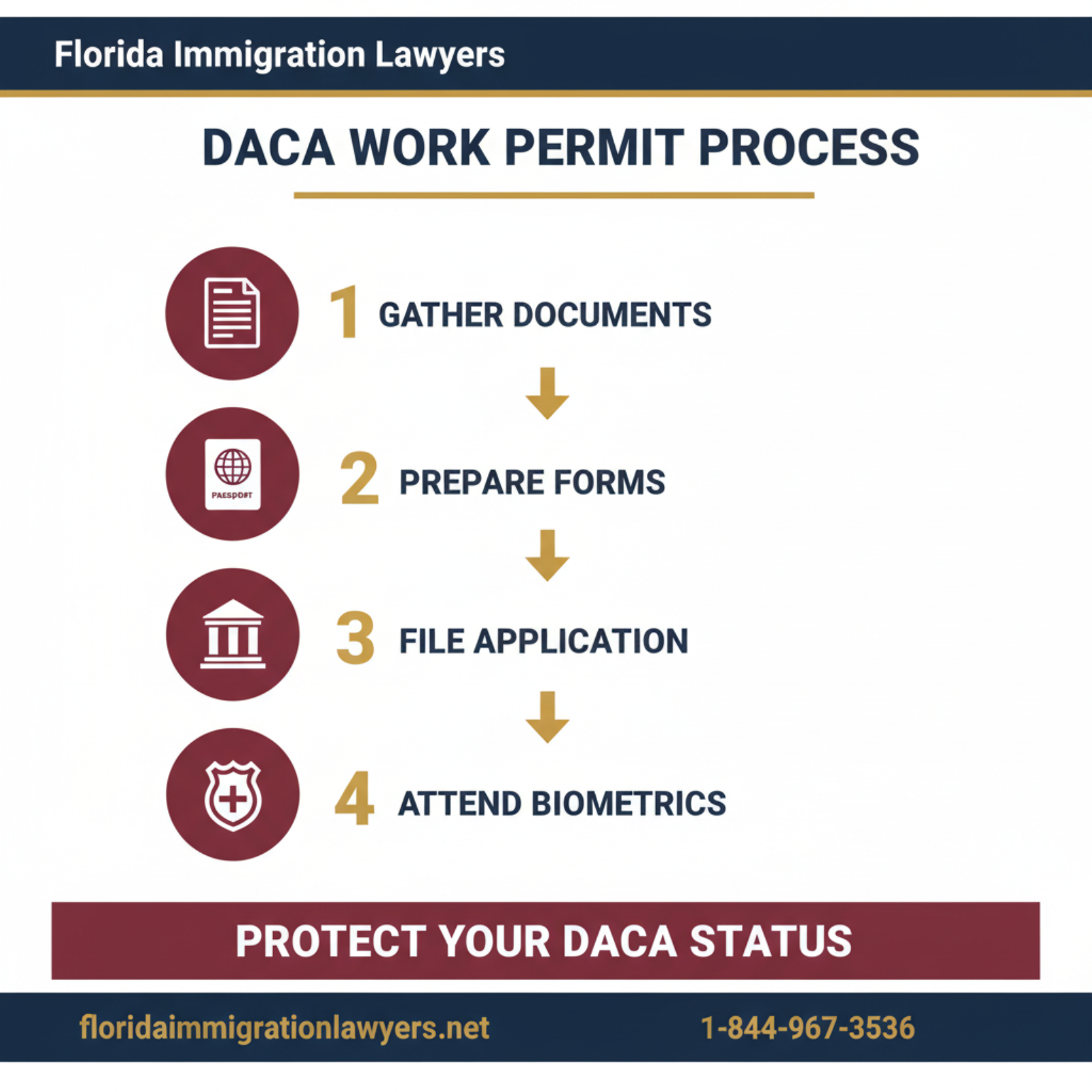
The DACA work permit Florida renewal process involves several key steps. It is crucial to be organized and meticulous with your application to avoid delays or rejections. Our firm can guide you through each stage, ensuring accuracy and completeness.
-
Determine Your Eligibility for Renewal:
Before beginning, confirm you meet the DACA renewal requirements. You must have previously been granted DACA and not have left the United States without advance parole on or after August 15, 2012. Additionally, you must continue to meet the original DACA requirements regarding continuous residence and criminal history.
Even minor infractions can impact your eligibility, so a thorough review of your record is essential. If you have any concerns about your eligibility, it is best to consult with an attorney at Florida Immigration Lawyers.
-
Gather All Necessary Documents:
Collecting the correct documents is a critical part of the DACA renewal process. This includes identity documents, proof of prior DACA approval, and any updated criminal history information. We provide a detailed checklist below to help you organize everything.
Ensure all documents are current and accurately reflect your information. Incomplete submissions are a common reason for processing delays.
-
Complete and File Forms I-821D and I-765:
You will need to complete Form I-821D, Consideration of Deferred Action for Childhood Arrivals, and Form I-765, Application for Employment Authorization. Both forms must be filled out accurately and completely. You will also need to complete Form I-765WS, Worksheet, to demonstrate economic necessity for the EAD.
Pay close attention to all questions and provide truthful answers. Any discrepancies can lead to serious issues. USCIS officials review these documents carefully, and errors can be costly.
-
Pay the Required Filing Fees:
The DACA renewal application requires a filing fee for Form I-765 and the biometric services fee. These fees are subject to change, so always check the USCIS website for the most current amounts. Personal checks, money orders, or cashier's checks are generally accepted.
Fee waivers for DACA renewals are rarely granted and only under very specific circumstances. Do not send cash through the mail.
-
Attend Your Biometrics Appointment (If Required):
After filing, USCIS may send you an appointment notice for biometrics collection at an Application Support Center (ASC). This involves submitting fingerprints, photographs, and a signature. This appointment is mandatory if requested.
Failure to attend your biometrics appointment can result in the denial of your application. Make sure to bring your appointment notice and a valid photo ID.
-
Receive a Decision from USCIS:
Once USCIS has processed your application and biometrics, you will receive a decision. If approved, you will receive a new I-797 approval notice for your DACA and your new EAD card in the mail. Keep these documents safe, as they are proof of your authorization.
If your application is denied, it is crucial to understand the reasons for denial and consult with an attorney immediately to explore your options, which may include filing a motion to reopen or reconsider.
Essential Documents for Your DACA Work Permit Application
Having a complete and organized set of documents is vital for a successful DACA work permit application. Here’s a checklist of what you will typically need for a renewal:
- Most recent DACA approval notice (Form I-797)
- Most recent Employment Authorization Document (EAD card, Form I-766)
- Two passport-style photos (meeting USCIS specifications)
- A copy of your birth certificate (with certified translation if not in English)
- A copy of your passport or national identity document from your country of origin
- A copy of your I-94 arrival/departure record (if available)
- Proof of continuous residence since your last DACA approval (e.g., utility bills, bank statements, school records, employment records, medical records). This is especially important if you have changed addresses within Florida, for example, moving from Miami to Hialeah.
- Any updated criminal history records, if applicable (e.g., certified court dispositions for any arrests or convictions since your last DACA application).
- Completed Form I-821D, Consideration of Deferred Action for Childhood Arrivals.
- Completed Form I-765, Application for Employment Authorization.
- Completed Form I-765WS, Worksheet.
- Check or money order for the exact filing fees.
DACA Processing Times and Fee Considerations for 2026
Understanding the timeline and costs involved is crucial for planning your DACA work permit renewal. USCIS processing times can fluctuate, but it is always best to apply well in advance of your current EAD's expiration date.
Typical Processing Expectations
USCIS generally recommends filing your DACA renewal application between 120 and 150 days before your current DACA and EAD expire. This timeframe allows for potential delays and ensures you maintain continuous work authorization. The processing time for DACA renewals can vary significantly, often ranging from 3 to 6 months.
Factors that can influence processing times include the volume of applications, the complexity of your case, and the specific USCIS service center handling your application. You can check current processing times on the USCIS website. Delays can be particularly stressful for individuals relying on their EAD for employment in Florida, including in communities like Hialeah.
Cost Factors and Fee Breakdown
The primary costs associated with your DACA work permit renewal are the USCIS filing fees. As of our last update, these fees typically include the fee for Form I-765 and the biometric services fee. It is important to note that these fees are subject to change by USCIS.
We strongly advise checking the official USCIS website for the most current fee schedule before preparing your payment. Legal fees for professional assistance from Florida Immigration Lawyers would be an additional cost, but an investment that can save you time, stress, and potential errors in the long run.
Do not navigate this process alone. The complexities of DACA renewals, especially with evolving legal interpretations, require expert guidance. Contact Florida Immigration Lawyers today for dedicated support and peace of mind.
Common Mistakes to Avoid in Your DACA Work Permit Application
- Filing Late: Submitting your renewal application too close to your EAD expiration date can lead to a lapse in work authorization. This means you could temporarily lose your job or face legal issues. Always aim to file within the 120-150 day window recommended by USCIS.
- Incomplete Forms: Missing signatures, unanswered questions, or failure to include all required forms will result in a returned or rejected application. This causes significant delays and additional stress. Double-check every section before submission.
- Incorrect Fees: Submitting the wrong fee amount, an expired money order, or an improperly filled-out check is a common error. USCIS will reject your application for incorrect payment, requiring you to resubmit and restart the process.
- Lack of Evidence for Continuous Residence: Failing to provide sufficient documentation to prove your continuous residence in the U.S. since your last DACA approval can jeopardize your renewal. Maintain records like utility bills, pay stubs, and school transcripts.
- Undisclosed Criminal History: Attempting to hide or omit any arrests or convictions, even minor ones, is a serious mistake. USCIS conducts thorough background checks, and misrepresentation can lead to denial and potential deportation proceedings. Transparency is key.
- Not Attending Biometrics: Skipping your scheduled biometrics appointment without rescheduling or a valid excuse will lead to the denial of your application. Treat this appointment as mandatory.
- Mailing to the Wrong Address: USCIS has specific Lockbox facilities for different types of applications and states. Sending your application to the wrong address can cause significant delays or even loss of your documents. Verify the correct filing address on the USCIS website for DACA renewals from Florida.
- Ignoring Changes in Personal Information: If your name, address, or other vital information has changed, ensure your application reflects these updates and provide supporting documentation. Inconsistencies can raise red flags.
- Traveling Without Advance Parole: Leaving the U.S. without an approved Form I-131, Application for Travel Document (Advance Parole), can lead to the termination of your DACA status and inadmissibility upon return. DACA does not automatically grant travel authorization.
- Not Seeking Legal Advice: Trying to navigate the DACA renewal process entirely on your own, especially with a complex case history, increases the risk of errors. An experienced immigration attorney can identify potential issues and ensure a strong application.
When to Call Florida Immigration Lawyers for Help
While this guide provides general information, your specific situation may present unique challenges. Knowing when to seek professional legal assistance can make all the difference in the success of your DACA work permit application.
You should contact Florida Immigration Lawyers immediately if:
- You have been arrested or convicted of any crime, no matter how minor, since your last DACA approval. This is a critical area where legal guidance is indispensable to avoid deportation risks.
- You have concerns about meeting the continuous residence requirement or have gaps in your documentation.
- You have received a Request for Evidence (RFE) from USCIS or a Notice of Intent to Deny (NOID). These require a prompt and precise legal response.
- Your DACA or EAD is expiring soon, and you are worried about meeting the renewal deadline.
- You are unsure which forms to fill out or how to accurately answer complex questions.
- You have previously been denied DACA or have had other immigration applications denied.
- You are considering applying for Advance Parole to travel outside the U.S. while on DACA.
- You simply want peace of mind knowing your application is prepared correctly by experts.
Our attorneys regularly assist individuals in Hialeah, Miami, Orlando, Tampa, and throughout Florida with their DACA and EAD applications. We understand the nuances of immigration law, including relevant sections of the Immigration and Nationality Act (INA) and 8 U.S.C. statutes, and can provide tailored advice.
About Florida Immigration Lawyers
Florida Immigration Lawyers is a leading immigration law firm dedicated to serving individuals and families across the entire state of Florida. With a deep understanding of the complexities of U.S. immigration law, our experienced attorneys provide compassionate and effective legal representation.
We offer a wide range of immigration services, including DACA renewals, family-based visas, employment visas, asylum, deportation defense, and citizenship applications. Our firm is committed to protecting your rights and helping you achieve your immigration goals.
When you choose Florida Immigration Lawyers, you gain a dedicated legal partner who understands your unique situation. We pride ourselves on clear communication, meticulous preparation, and unwavering advocacy. Your future is our priority.
Contact Florida Immigration Lawyers today:
- Phone: 1-844-967-3536
- Website: https://www.floridaimmigrationlawyers.net
- Availability: 24/7
- Consultations: Free consultations available
- Service Area: Serving all of Florida
Sources and References
- U.S. Citizenship and Immigration Services (USCIS) - Deferred Action for Childhood Arrivals (DACA)
- U.S. Citizenship and Immigration Services (USCIS) - Form I-765, Application for Employment Authorization
- Executive Office for Immigration Review (EOIR) - Immigration Law Resources
- 8 U.S.C. Chapter 12 - Immigration and Nationality Act (INA)
- 8 U.S.C. § 1324a - Unlawful employment of aliens
- 8 CFR § 274a.12(c)(14) - Classes of aliens authorized to accept employment
- USCIS Policy Manual, Volume 1, Part D, Chapter 3 - Deferred Action for Childhood Arrivals
This article provides general legal information and is not intended as legal advice. Every case is unique, and outcomes depend on specific facts and circumstances. Contact an attorney for advice about your particular situation.
The DACA work permit Florida process in 2026 demands careful attention and adherence to USCIS guidelines. Protecting your ability to work and live without fear of deportation is a priority. Let Florida Immigration Lawyers be your trusted partner in this journey. Our team is ready to provide the expert legal support you deserve.
Do not wait until it's too late. Call us today at 1-844-967-3536 for a free, confidential consultation. Se Habla Español - Estamos aquí para ayudarle.
Do Not Navigate This Process Alone
Our experienced immigration attorneys are ready to fight for you. Get a free, confidential consultation today.
Se Habla Español
Frequently Asked Questions
Florida Immigration Lawyers
Immigration Attorney | Founder, Vasquez Law Firm
U.S. Air Force veteran and immigration attorney with thousands of cases resolved. J.D., NCCU School of Law. AILA member. Admitted to the 4th, 5th, and 11th Circuit Courts.
Available 24/7 - Free Evaluations
Related Legal Services
Our Florida immigration attorneys can help you with asylum protection, deportation defense and citizenship and naturalization. Call today at 1-844-967-3536 for a free consultation.
Related Links
Related Topics
Free Legal Consultation
Discuss your case with our experienced attorneys. We're available 24/7.
Se Habla Español - Estamos aquí para ayudarle.
Related Articles
Conditional Green Card Removal in Florida | VLF Florida
Learn how to remove conditions from your green card in Florida, ensuring you maintain your residency without issues. Call us today for a free consultation!
EB-5 Investor Green Card Opportunities in Florida | VLF Florida
Explore opportunities with the EB-5 investor green card in Florida. Learn about investment requirements, application steps, and how to avoid common pitfalls. Call now for a free consultation.
F-1 Reinstatement Process for Florida Students | VLF Florida
Explore the F-1 reinstatement process for students in Florida. Learn about eligibility, required documents, and common mistakes. Contact Florida Immigration Lawyers for expert help.
I-601 Waiver Guide for Florida Residents | VLF Florida
Facing inadmissibility issues in Florida? Our comprehensive guide on the I-601 waiver process offers insights into eligibility, documentation, and more. Call us for expert assistance.
