Change of Status to F-1 Student Visa in Florida Guide
Considering a change of status to an F-1 student visa in Florida? This detailed guide from Florida Immigration Lawyers outlines the complete process, from eligibility requirements and obtaining your Form I-20 to filing your application with USCIS. Learn about crucial steps, essential documents, expected timelines, and important cost factors. We also highlight common mistakes to avoid, such as violating the 90-day rule or filing with insufficient financial evidence. Whether you're in St. Petersburg, Miami, or anywhere in Florida, understanding these complexities is vital. Discover when to seek legal assistance to protect your immigration future and ensure a smooth transition to F-1 student status. Contact us for a free consultation.

Changing your immigration status to an F-1 student visa in Florida allows you to pursue academic studies within the U.S. This process typically involves submitting Form I-539 to USCIS and demonstrating eligibility, including acceptance into an SEVP-approved school and sufficient financial resources. Careful adherence to regulations is crucial to avoid complications.
- Submit Form I-539 to USCIS.
- Obtain an I-20 from an SEVP-approved school.
- Prove financial capability for studies and living expenses.
- Maintain current nonimmigrant status until approval.
- Consult an attorney for complex cases or potential issues.
Are you currently in Florida on a nonimmigrant visa and dreaming of pursuing higher education in the Sunshine State? The path to becoming an F-1 international student, allowing you to study at a U.S. college or university, often involves a process known as a change of status. This transition can seem daunting, but with the right guidance, it is achievable. Florida, known for its vibrant culture and numerous academic institutions, attracts students from all over the world.
This comprehensive guide from Florida Immigration Lawyers will walk you through the intricacies of changing your immigration status to an F-1 student visa right here in Florida. We will cover eligibility, the application process, required documents, and what to expect along the way. Our goal is to empower you with the knowledge needed to navigate this important journey successfully. If you have questions or need personalized assistance, do not hesitate to Call Florida Immigration Lawyers at 1-844-967-3536 for a free consultation today.
Understanding Change of Status to F-1 Student Visa in Florida
A change of status allows certain nonimmigrants already lawfully present in the United States to apply to USCIS to change their nonimmigrant classification to another. For many aspiring international students in Florida, this means transitioning from a tourist visa (B-2), business visa (B-1), or another nonimmigrant category to an F-1 student visa. Florida, with its vibrant cities like St. Petersburg, Orlando, and Miami, and numerous world-class educational institutions, is a highly attractive destination for international students seeking quality education. An F-1 visa is specifically designed for academic students who wish to enroll in full-time programs at SEVP-approved colleges, universities, or language schools across the U.S. This visa permits you to immerse yourself in academic pursuits and gain valuable educational experiences.
This process of changing status internally differs significantly from applying for an F-1 visa at a U.S. Embassy or Consulate in your home country. When you pursue a change of status from within the U.S., you have the advantage of remaining in Florida while U.S. Citizenship and Immigration Services (USCIS) reviews your application. It is paramount that you meticulously maintain your current lawful nonimmigrant status throughout this entire waiting period. Any lapse in your status, such as overstaying your authorized period or violating the terms of your existing visa, can severely jeopardize your application and lead to serious, long-lasting immigration consequences, including potential deportation defense issues. Our firm, Florida Immigration Lawyers, specializes in guiding clients through these intricate processes, ensuring compliance every step of the way.
Who Qualifies for an F-1 Change of Status?
To be eligible for a change of status to an F-1 student visa, you must meet several key criteria. First, you must currently be in the United States in a lawful nonimmigrant status. This means you entered legally and have not violated the terms or conditions of your current visa. For example, overstaying a previous visa, working without authorization, or engaging in activities inconsistent with your current status would generally make you ineligible for a change of status to F-1.
Secondly, you must have a genuine intent to study full-time at an educational institution approved by the Student and Exchange Visitor Program (SEVP). You will need to obtain a Form I-20, "Certificate of Eligibility for Nonimmigrant Student Status," from your chosen school. This document confirms your acceptance and enrollment in a specific program. Lastly, you must demonstrate that you have sufficient funds to cover your tuition, fees, and living expenses for your entire period of study. This financial stability is a critical component of your application, ensuring you will not become a public charge or seek unauthorized employment.
The 90-Day Rule for Change of Status
USCIS often looks closely at applications where an individual attempts to change status shortly after entering the U.S. This is often referred to as the "90-Day Rule," although it is not a formal regulation. USCIS may presume misrepresentation if you apply for a change of status within 90 days of your last entry into the U.S., especially if your initial intent upon entry seems inconsistent with your rapid change of plans. For instance, entering Florida on a tourist visa (B-2) with the stated purpose of vacation and then immediately applying for an F-1 student visa could raise red flags about your true intentions upon arrival.
While not a strict rule, it is generally safer to wait at least 90 days after your last entry into the U.S. before filing an I-539 application for a change of status. This waiting period helps to demonstrate that your intent to study developed after your entry, rather than being your primary purpose for entering the U.S. initially. This can help to alleviate concerns about "preconceived intent." Consulting with an immigration attorney from Florida Immigration Lawyers can help you assess the risks and determine the best timing for your specific situation, particularly if your entry was recent.
Step-by-Step Guide to F-1 Change of Status in Florida
Navigating the change of status process to an F-1 student visa can be complex, but following a structured approach can help ensure a smoother journey. Here is a detailed step-by-step guide to assist you through this critical process in Florida. Each step requires careful attention to detail and strict adherence to USCIS regulations.
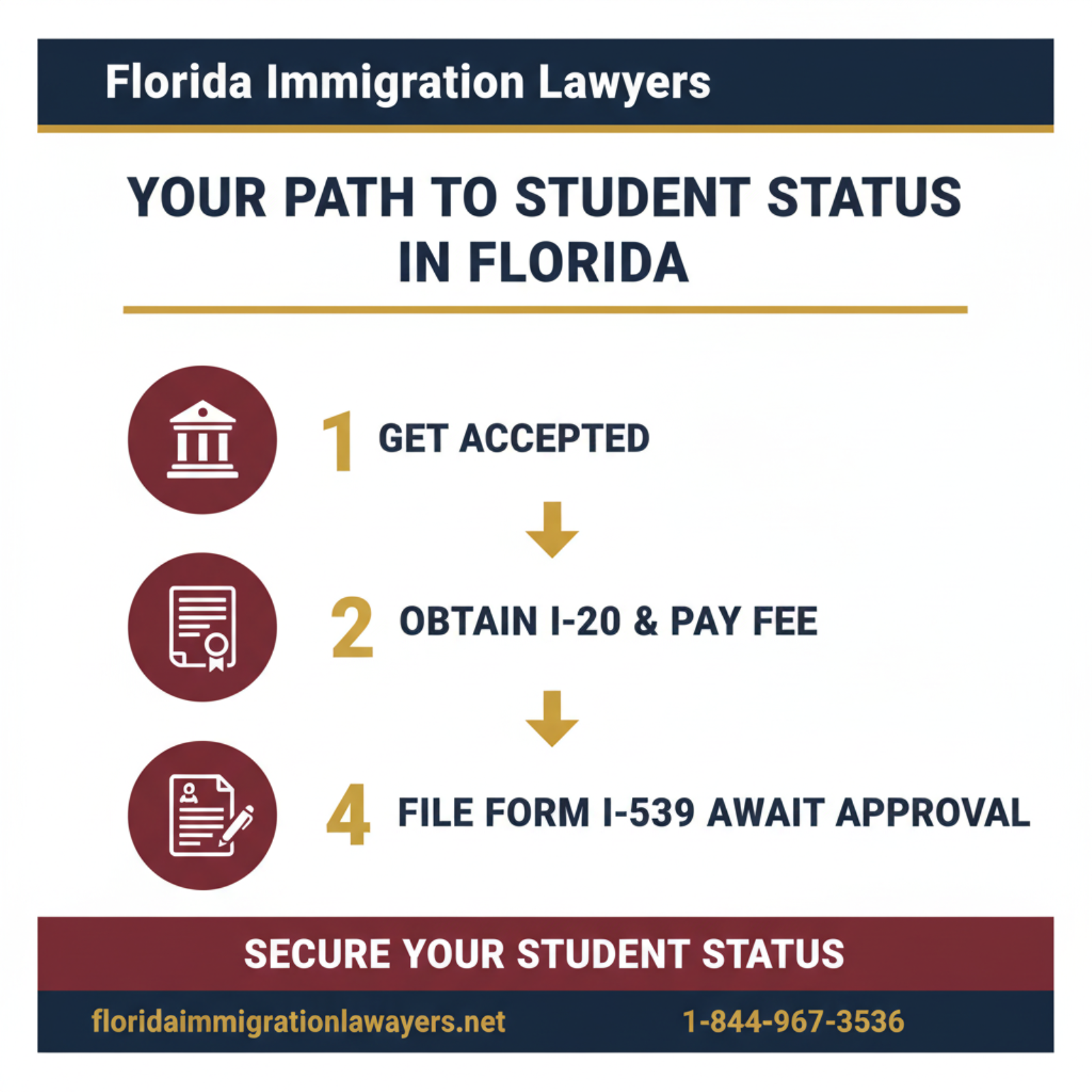
- Gain Acceptance to an SEVP-Approved School and Obtain Form I-20: Your initial and most crucial step is to apply to and be accepted by a U.S. college, university, or language program that is approved by the Student and Exchange Visitor Program (SEVP). Florida boasts many such institutions, from large universities to specialized language academies. Once accepted, the school's Designated School Official (DSO) will issue you a Form I-20, "Certificate of Eligibility for Nonimmigrant Student Status." This document is absolutely essential as it confirms your enrollment, outlines your program details, and specifies the financial requirements for your studies.
- Pay the SEVIS I-901 Fee: After receiving your Form I-20, you must pay the SEVIS I-901 fee. This fee is mandatory and supports the Student and Exchange Visitor Information System (SEVIS), which tracks nonimmigrant students and exchange visitors. You can pay this fee conveniently online at Study in the States and will need the SEVIS ID from your I-20. It is vital to keep the payment receipt, as you will need to submit it with your application to USCIS.
- Complete Form I-539, Application to Extend/Change Nonimmigrant Status: This is the primary form for your change of status application. Fill out Form I-539 completely and accurately, providing all requested personal and immigration information. Ensure you clearly select "Change of Status" and specify "F-1 (Academic Student)" as your desired new status. Pay close attention to all sections, as any blank fields or inconsistent answers can lead to delays.
- Gather All Required Supporting Documents: Systematically collect all necessary documentation to support your application. This includes your I-20, proof of SEVIS fee payment, comprehensive financial evidence, copies of your passport and current visa, and other relevant records. A comprehensive list of documents is provided in the next section to guide you through this critical stage. Organization is key here.
- Prepare a Detailed Cover Letter (Optional but Recommended): While not strictly required, a well-crafted cover letter can significantly help USCIS understand your application more clearly and efficiently. It should summarize your intent, current status, the specific change you are requesting, and provide an organized list of all included documents. This is also an opportunity to explain any specific circumstances of your case, such as why you are seeking a change of status from within the U.S. rather than applying abroad.
- File Your Application with USCIS: Mail your completed Form I-539, all meticulously organized supporting documents, and the applicable filing fee to the correct USCIS lockbox facility. The filing address depends on your current status and where you reside in Florida. Always check the official USCIS website for the most current filing addresses and fee information. Crucially, ensure your application is physically received by USCIS while you are still in valid nonimmigrant status.
- Attend Biometrics Appointment (If Required): After filing your application, you may receive an appointment notice for biometrics collection at a local Application Support Center (ASC). This appointment typically involves fingerprinting and photographing to verify your identity. Be sure to attend this appointment as scheduled, as it is a mandatory part of the process. Florida has several ASC locations conveniently located in major cities like St. Petersburg, Tampa, Orlando, and Miami.
- Respond to Requests for Evidence (RFE) (If Applicable): USCIS may send a Request for Evidence (RFE) if they determine they need additional information or clarification to make a decision on your application. Respond promptly and thoroughly to any RFE by the specified deadline. Failure to provide the requested evidence in a timely manner can lead to a denial of your change of status request, so take these notices very seriously.
- Receive Decision from USCIS: Once USCIS has thoroughly reviewed your application and all supporting evidence, they will issue a final decision. If approved, you will receive an I-797 Approval Notice indicating your new F-1 status and a new I-94 record. If denied, the notice will explain the specific reasons for the denial, which may require further legal action or departure from the U.S.
Essential Document Checklist for F-1 Change of Status
A thorough and accurate submission of documents is absolutely critical for a successful change of status application to an F-1 student visa. Missing or incorrect documents can lead to significant delays, Requests for Evidence (RFEs), or even outright denial. Use this comprehensive checklist to ensure you have everything prepared for your F-1 student visa application in Florida, leaving no room for error.
- Form I-539, Application to Extend/Change Nonimmigrant Status: You must submit the original, signed form. Ensure all sections are completed accurately and legibly.
- Form I-20, Certificate of Eligibility for Nonimmigrant Student Status: Include the original or a clear copy, depending on USCIS instructions. This document is issued by your SEVP-approved school and verifies your acceptance and program details.
- SEVIS I-901 Fee Payment Confirmation: Provide clear proof that you have paid the Student and Exchange Visitor Information System (SEVIS) fee. A copy of the payment receipt is usually sufficient.
- Passport and Visa Copies: Submit clear copies of your passport's biographic page, any current U.S. visa stamp, and your most recent entry stamp into the U.S.
- Form I-94, Arrival/Departure Record: Include a printout of your electronic I-94 record, which can be accessed from the U.S. Customs and Border Protection (CBP) website. This document shows your lawful entry and authorized period of stay.
- Financial Evidence: This is a crucial component. Provide recent bank statements, affidavits of support from sponsors, scholarship letters, or other official documents proving you have sufficient funds to cover your tuition, fees, and living expenses for at least one academic year.
- Transcripts and Diplomas: If applicable, include academic records from previous educational institutions. These can help demonstrate your academic intent and history.
- Letter of Intent: A compelling personal statement explaining your reasons for seeking a change of status, your specific educational goals, why you chose your particular school and program in Florida, and how you plan to maintain your F-1 status.
- Proof of Current Nonimmigrant Status: Include copies of previous I-797 approval notices if you have previously extended or changed your nonimmigrant status within the U.S.
- Marriage Certificate (if applicable): If you are applying with dependents, provide a copy of your marriage certificate to prove your relationship.
- Dependents' Documents (if applicable): If your spouse or children are applying for F-2 status with you, include their individual Forms I-539 (if filing separately) or ensure they are listed on your I-539, along with copies of their passports, visas, and I-94 records. This is vital for family immigration planning.
- Filing Fee: Include a check or money order for the correct USCIS filing fee for Form I-539. Always check the USCIS website for the most current fee to avoid rejection. Do not send cash.
F-1 Change of Status Timeline and Processing Expectations in Florida
The processing time for an F-1 change of status application can vary significantly, and it is a common source of anxiety for applicants in Florida. USCIS processing times are subject to frequent change based on caseload, policy updates, and the specific service center handling your case. While it is difficult to provide an exact timeframe, understanding the general expectations can help you plan your academic and personal life.
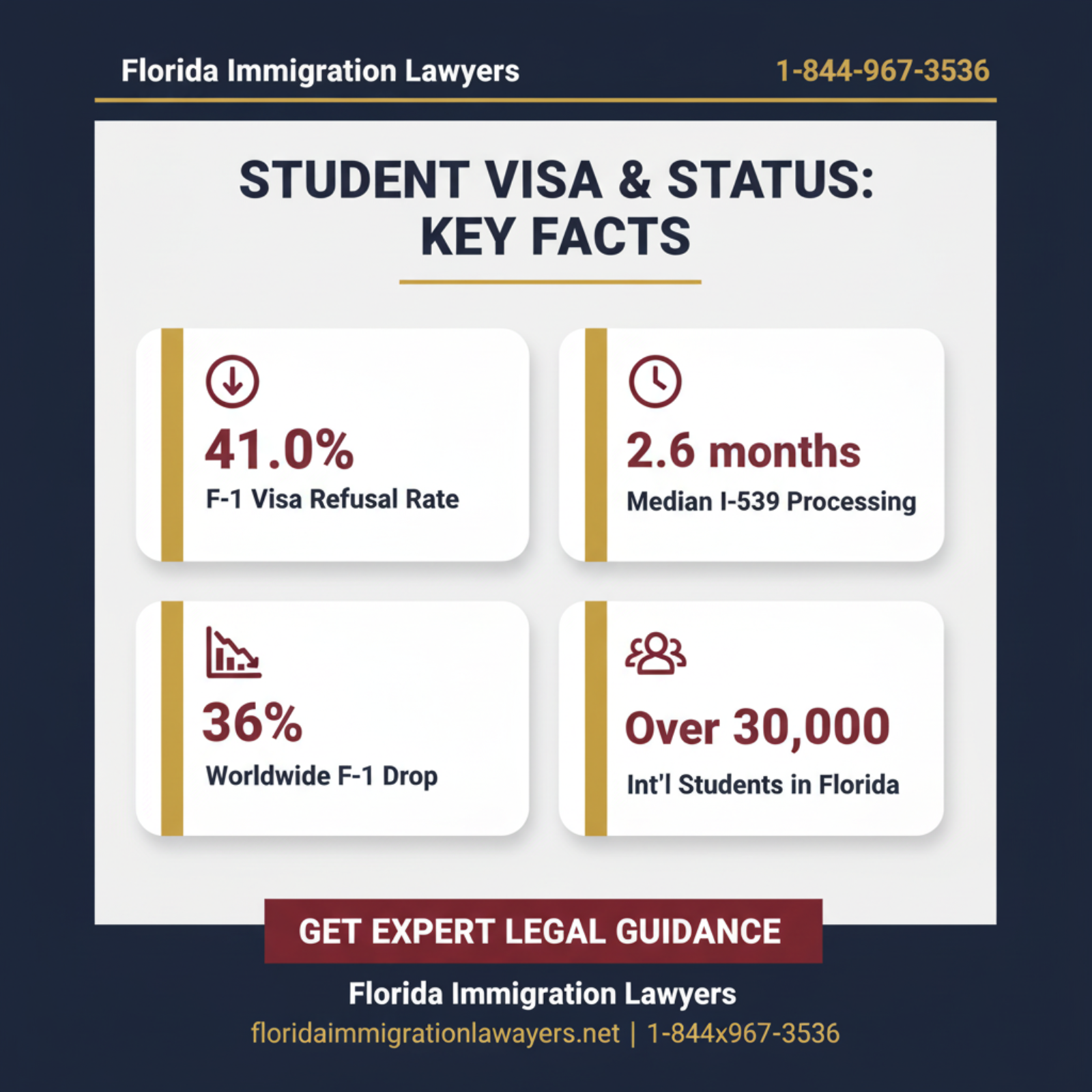
Typically, change of status applications can take anywhere from 6 to 18 months, or even longer, from the date USCIS receives your application. You can check the current estimated processing times for Form I-539 on the USCIS website by selecting the form type and the service center that processes such applications. It is critically important to note that you must maintain your lawful nonimmigrant status throughout the entire processing period. This means you cannot overstay your current visa while waiting for a decision, even if your application is pending.
If your current nonimmigrant status is nearing expiration and the processing time for your change of status is projected to extend beyond your current I-94 date, you may need to consider filing an extension of your current status concurrently with your change of status application, or explore other options. This is a complex area where strategic legal advice from Florida Immigration Lawyers is highly recommended. For those in St. Petersburg, Tampa, Orlando, or anywhere in Florida, proper planning and timely filing are key to avoiding an "out of status" situation, which can have severe negative consequences for your immigration future.
Cost Factors and Fee Breakdown for Change of Status
Understanding the potential costs associated with an F-1 change of status application is an important part of your overall financial planning. While specific fee amounts are subject to change and should always be verified, we can outline the general categories of expenses you should anticipate. It is important to remember that USCIS filing fees are non-refundable, regardless of the outcome of your application.
The primary government costs include the USCIS filing fee for Form I-539. This fee is subject to periodic adjustments by USCIS, so always check the official USCIS website for the most current amount before preparing your application. Additionally, you will need to pay the SEVIS I-901 fee, which is a separate and mandatory fee from the USCIS filing fee. This fee also changes periodically and must be paid and a receipt obtained before submitting your I-539 application package.
Beyond these government fees, you should budget for potential additional costs. These may include translation services for any non-English documents that require certified translation, mailing costs for your comprehensive application package, and professional legal fees if you choose to hire an experienced immigration attorney. While legal representation is not mandatory, it can significantly enhance the accuracy, completeness, and strategic strength of your application, especially for complex cases or if you are unsure about any aspect of the process. Florida Immigration Lawyers offers transparent consultation services to help you understand all potential costs involved in your unique situation.
Do not navigate this complex change of status process alone. The stakes are high, and even minor errors can lead to significant delays or denials. Contact Florida Immigration Lawyers today to ensure your application is prepared correctly and thoroughly. Our dedicated team is here to support you every step of the way.
Common Mistakes to Avoid During Your F-1 Change of Status in Florida
The change of status process to an F-1 student visa requires meticulous attention to detail and a thorough understanding of immigration regulations. Many applicants encounter issues due to preventable errors. Understanding these common pitfalls can help you avoid them and significantly improve your chances of a successful outcome for your F-1 student visa application in Florida.
- Filing After Your Current Status Expires: This is one of the most critical and irreversible mistakes. You must file your Form I-539 while you are still in a valid nonimmigrant status. Filing after your I-94 expiration date will almost certainly lead to a denial, as you would be considered "out of status" and ineligible for a change of status.
- Violating Your Current Visa Terms: Engaging in activities inconsistent with your current nonimmigrant status, such as unauthorized employment while on a tourist visa (B-2) or failing to attend classes if you are on another student visa, will disqualify you from a change of status. Always adhere strictly to your current visa's regulations.
- Insufficient Financial Evidence: USCIS requires clear and compelling proof that you can financially support your education and living expenses without resorting to unauthorized employment. Vague or incomplete bank statements, or insufficient funds to cover your I-20 expenses, are common reasons for an RFE or outright denial.
- Applying Too Soon After Entry (The 90-Day Rule): As discussed, applying for a change of status within 90 days of entering the U.S. can raise questions about your original intent. While not a strict rule, it is a significant red flag for USCIS and can lead to a presumption of misrepresentation.
- Incorrectly Completing Forms: Any errors, omissions, or inconsistencies on Form I-539 or any supporting documents can cause significant delays or lead to an RFE. Double-check all information meticulously before submission, ensuring it matches your passport and previous immigration records.
- Not Paying SEVIS I-901 Fee: Forgetting to pay the mandatory SEVIS fee, or failing to include clear proof of payment with your application, will result in your application being rejected or significantly delayed. This fee is separate from the USCIS filing fee.
- Missing Deadlines for RFEs: If USCIS sends a Request for Evidence, you must respond by the specified deadline. Failure to do so, or submitting an incomplete response, will almost certainly lead to a denial of your application. These deadlines are strict.
- Traveling Outside the U.S. While Application is Pending: If you leave the U.S. while your change of status application is pending, USCIS will consider your application abandoned. You would then need to apply for an F-1 visa at a U.S. consulate abroad to re-enter for studies.
- Not Keeping Copies of All Submitted Documents: Always keep a complete, organized copy of your entire application package, including all forms, supporting documents, and receipts. This is crucial for your records, for responding to RFEs, or if USCIS requests additional information.
- Failing to Notify USCIS of Address Change: If you move residences while your application is pending, you must notify USCIS of your new address promptly using Form AR-11. Failure to do so can result in missed notices, important communications, or even denial if USCIS cannot reach you. This is especially important for those moving within Florida, for example from St. Petersburg to Miami.
- Assuming F-1 Status Grants Residency: It's important to understand that an F-1 visa grants nonimmigrant status for temporary study. It does not automatically lead to permanent residency or a green card, regardless of how long you hold the status. Separate applications are required for permanent residency pathways.
When to Call a Florida Immigration Lawyer for Your Change of Status
While the change of status process to an F-1 student visa has a clear framework, individual circumstances can introduce significant complexities. Knowing when to seek professional legal counsel from Florida Immigration Lawyers can save you time, stress, and potential heartbreak. Our firm specializes in helping individuals throughout Florida, including St. Petersburg, Tampa, Orlando, and Miami, navigate these intricate immigration pathways.
You should strongly consider contacting an attorney from our experienced team if:
- You have previously violated immigration laws: Any past overstays, unauthorized employment, or other immigration violations can make your case highly complex and potentially lead to inadmissibility.
- Your current nonimmigrant status is expiring soon: If you are nearing the end of your authorized stay, strategic advice is crucial to avoid falling out of status, which could impact your future immigration prospects.
- You have received a Request for Evidence (RFE): RFEs indicate USCIS needs more information, and an experienced lawyer can help you craft a thorough, compliant, and persuasive response.
- You have a criminal record: Even seemingly minor offenses can impact your eligibility for immigration benefits. A lawyer can assess the impact and advise on possible waivers.
- You have dependents applying with you: Including family members, such as a spouse or children seeking F-2 status, adds layers of complexity, requiring careful documentation and coordination for each individual.
- You are concerned about the "90-Day Rule": If you plan to apply for a change of status shortly after entering the U.S., legal guidance can help you mitigate potential issues related to preconceived intent.
- Your application has been denied: An attorney can help you understand the specific reasons for denial and explore possible next steps, such as filing a motion to reopen or reconsider, or appealing the decision.
- You simply want peace of mind: Ensuring your application is meticulously prepared, strategically presented, and fully compliant with current immigration laws by experienced professionals provides invaluable confidence and increases your chances of success.
Florida Immigration Lawyers offers comprehensive legal services for immigration applications, including detailed document review, strategic advice, and representation throughout the entire change of status process. We understand the nuances of Florida immigration law and are committed to helping you achieve your educational goals. Our expertise extends to areas such as citizenship and asylum, ensuring a broad understanding of immigration pathways.
About Florida Immigration Lawyers
Florida Immigration Lawyers is a leading immigration law firm dedicated to serving individuals and families across the entire state of Florida. With years of experience and a deep understanding of U.S. immigration law, our firm provides compassionate, effective, and results-driven legal representation. We are committed to helping our clients achieve their American dreams, whether through family visas, employment visas, or navigating complex processes like a change of status to an F-1 student visa.
Our services encompass a wide range of immigration matters, including green cards, citizenship applications, asylum claims, deportation defense, family-based petitions, and business immigration solutions. We pride ourselves on clear communication, personalized attention, and a steadfast commitment to our clients' best interests. Our team understands the unique challenges faced by immigrants in Florida, from St. Petersburg to Miami, and we are equipped to provide tailored legal strategies.
We believe that everyone deserves expert legal counsel, which is why we offer free consultations to discuss your case. Our offices are available 24/7 to address your urgent immigration needs. When you choose Florida Immigration Lawyers, you are choosing a partner who will stand by you every step of the way. Call us at 1-844-967-3536 or visit our website at https://www.floridaimmigrationlawyers.net to learn more about how we can assist you. You can also contact us directly through our site.
Sources and References
- U.S. Citizenship and Immigration Services (USCIS) - Change My Nonimmigrant Status
- Study in the States - SEVIS I-901 Fee
- 8 U.S.C. § 1101(a)(15)(F) - Definition of "immigrant" and "nonimmigrant" for F visa
- 8 U.S.C. § 1258 - Adjustment of status of nonimmigrant to that of person admitted for permanent residence
- 8 CFR § 214.2(f) - Rules relating to F-1 students
- USCIS Policy Manual, Volume 7, Part B, Chapter 5 - Change of Nonimmigrant Status
This article provides general legal information and is not intended as legal advice. Every case is unique, and outcomes depend on specific facts and circumstances. Contact an attorney for advice about your particular situation.
Embarking on a change of status journey to an F-1 student visa in Florida is a significant step towards your educational and personal goals. Do not leave your future to chance. Let the experienced attorneys at Florida Immigration Lawyers guide you through every regulation and requirement. Our team is dedicated to providing clear, empathetic, and effective legal support. Call us today at 1-844-967-3536 for a free, confidential consultation. We are here to help you navigate this complex process successfully. Se Habla Español - Estamos aquí para ayudarle.
Do Not Navigate This Process Alone
Our experienced immigration attorneys are ready to fight for you. Get a free, confidential consultation today.
Se Habla Español
Frequently Asked Questions
Florida Immigration Lawyers
Immigration Attorney | Founder, Vasquez Law Firm
U.S. Air Force veteran and immigration attorney with thousands of cases resolved. J.D., NCCU School of Law. AILA member. Admitted to the 4th, 5th, and 11th Circuit Courts.
Available 24/7 - Free Evaluations
Related Legal Services
Our Florida immigration attorneys can help you with deportation defense, citizenship and naturalization and family immigration services. Call today at 1-844-967-3536 for a free consultation.
Related Links
Related Topics
Free Legal Consultation
Discuss your case with our experienced attorneys. We're available 24/7.
Se Habla Español - Estamos aquí para ayudarle.
Related Articles
Protecting Against Immigration Scams in Florida | VLF Florida
Learn how to protect yourself from immigration scams in Florida, including notario fraud. Discover actionable steps and legal resources. Call Florida Immigration Lawyers at 1-844-967-3536.
L-1 Visa Transfer for Florida Companies | VLF Florida
Learn about L-1 visa intracompany transfers for Florida companies. Ensure a smooth transition for your employees to Tampa. Call 1-844-967-3536 for expert advice.
H-2A Visa Opportunities for Florida Agricultural Workers
Explore opportunities for Florida agricultural workers under the H-2A visa program. Learn about application steps, costs, and common mistakes.
Derived Citizenship Through Parents in Florida | VLF Florida
Discover how children born abroad can gain U.S. citizenship through their parents in Florida. Learn about eligibility, the application process, and common pitfalls. Contact Florida Immigration Lawyers at 1-844-967-3536 for expert assistance.