Change of Status B-2 to F-1 Florida: Tourist to Student Visa
Transitioning from a B-2 tourist visa to an F-1 student visa in Florida opens doors to academic pursuits but requires careful navigation of U.S. immigration law. This comprehensive guide from Florida Immigration Lawyers details the step-by-step process for a change of status B-2 to F-1, including essential documents, eligibility criteria, and crucial timelines. Learn about the I-539 application, the "90-day rule," and how to demonstrate non-immigrant intent effectively. We also cover common mistakes to avoid, cost factors, and when professional legal assistance is indispensable. Whether you're in Fort Lauderdale or elsewhere in Florida, our expert team is here to provide the support needed to achieve your educational dreams. Contact us for a free consultation.

Changing your status from a B-2 tourist visa to an F-1 student visa in Florida allows you to pursue academic studies legally within the United States. This process, primarily involving the submission of Form I-539, Application to Extend/Change Nonimmigrant Status, to USCIS, requires careful attention to eligibility criteria, documentation, and timing. You must demonstrate a clear intent to study, sufficient financial resources, and maintain your B-2 status until the change is approved. Navigating the complexities of this change of status B-2 to F-1 in Florida can be challenging, making legal guidance invaluable for a successful outcome.
- You must maintain valid B-2 status while applying for a change to F-1.
- Obtaining an I-20 from a SEVP-approved school is a mandatory first step.
- The "90-day rule" is crucial for demonstrating non-immigrant intent.
- Financial solvency and academic eligibility are key requirements.
- Consulting an attorney can help avoid common pitfalls and delays.
Are you currently in Florida on a B-2 tourist visa, but your true aspiration is to pursue higher education or specialized training in the Sunshine State? The dream of transitioning from a temporary visit to a fulfilling academic journey is a common one for many international visitors. However, the path to achieving a change of status B-2 to F-1 in Florida can be complex, filled with specific legal requirements and potential pitfalls that demand meticulous attention.
At Florida Immigration Lawyers, we understand the unique challenges and opportunities that arise when individuals seek to convert their B-2 tourist visa into an F-1 student visa. Our dedicated team helps clients in Fort Lauderdale and across Florida navigate the intricate process of filing Form I-539, ensuring all necessary documentation and eligibility criteria are met. This comprehensive guide will walk you through every aspect of changing your status from tourist to student, providing you with the knowledge needed to pursue your educational goals.
Don't let the complexities of immigration law deter you from your academic dreams. For personalized guidance and a clear understanding of your options, call Florida Immigration Lawyers at 1-844-967-3536 for a free consultation. Our experienced attorneys are ready to assist you every step of the way.
Understanding the B-2 to F-1 Change of Status in Florida
The process of changing your nonimmigrant status from a B-2 visitor visa to an F-1 student visa allows individuals lawfully present in the United States to enroll in academic programs. This specific change of status B-2 to F-1 is governed by federal immigration law, primarily Section 248 of the Immigration and Nationality Act (INA), found at 8 U.S.C. § 1258, and its implementing regulations at 8 CFR 214.2(f). To be eligible, you must demonstrate several key factors, including maintaining your current nonimmigrant status, having a genuine intent to study, and possessing adequate financial resources to cover your educational and living expenses.
A critical consideration for applicants in Florida is the "90-day rule." While not a formal law, this USCIS guideline suggests that if you apply for a change of status within 90 days of entering the U.S. on a B-2 visa, it may raise questions about your original intent. USCIS might presume you misrepresented your purpose of entry, which could lead to a denial. It is generally advisable to wait beyond this 90-day period before filing your I-539 application, though there are exceptions and nuances best discussed with an attorney. Additionally, you must be accepted by a Student and Exchange Visitor Program (SEVP)-approved school in Florida or elsewhere in the U.S. and receive a Form I-20, "Certificate of Eligibility for Nonimmigrant Student Status," before you can apply for the change of status.
Step-by-Step Guide to Applying for F-1 Change of Status
The journey from a B-2 tourist to an F-1 student in Florida involves a series of precise steps. Following these steps diligently is crucial for a successful outcome. Each stage requires attention to detail and adherence to specific USCIS requirements. This guide outlines the typical process:
- Gain Admission to an SEVP-Approved School: Your first and most critical step is to apply for and be accepted by an educational institution that is authorized by the Student and Exchange Visitor Program (SEVP) to enroll international students. Many excellent universities and colleges in Florida, including those in Fort Lauderdale, Miami, and Orlando, are SEVP-approved. Once accepted, the school's Designated School Official (DSO) will issue you a Form I-20, Certificate of Eligibility for Nonimmigrant Student Status. This document is essential for your application.
- Pay the SEVIS I-901 Fee: Before filing your I-539, you must pay the SEVIS I-901 fee. This fee supports the Student and Exchange Visitor Information System (SEVIS), which tracks F and M nonimmigrants. You will need your SEVIS ID from your Form I-20 to complete this payment. Keep the receipt, as it is required for your application.
- Prepare Form I-539, Application to Extend/Change Nonimmigrant Status: This is the primary form for your change of status B-2 to F-1. Fill out the form accurately and completely, providing all requested information about yourself, your current status, and your desired F-1 status. Pay close attention to Part 2, Question 1, where you indicate your request to change to F-1 status.
- Gather Supporting Documentation: Collect all required documents, including your I-20, SEVIS I-901 fee receipt, proof of financial support (bank statements, affidavits of support), a copy of your passport and visa, I-94 arrival/departure record, academic transcripts, and a personal statement explaining your intent to study. Ensure all documents are clear and legible.
- Write a Personal Statement (Letter of Explanation): This letter is your opportunity to clearly articulate your reasons for seeking a change of status B-2 to F-1. Explain why you initially entered as a B-2 visitor and how your educational plans developed after arrival. Emphasize your non-immigrant intent and your commitment to returning to your home country after completing your studies.
- Submit Your Application to USCIS: Mail your completed Form I-539, all supporting documents, and the required filing fee to the appropriate USCIS lockbox facility. The filing fee is subject to change, so always check the USCIS website for the most current amount. Keep a copy of your entire application package for your records.
- Attend Biometrics Appointment: After USCIS receives your application, they will send you a receipt notice and, subsequently, an appointment notice for biometrics (fingerprints and photos) at an Application Support Center (ASC) in Florida. Attending this appointment is mandatory.
- Await a Decision: Processing times for Form I-539 can vary significantly. During this period, you are generally allowed to remain in the U.S. while your application is pending, even if your B-2 status expires. This is known as "period of authorized stay." However, you cannot begin your F-1 studies until your change of status is approved.
Essential Documents Checklist for B-2 to F-1 Petitioners
A successful change of status B-2 to F-1 application hinges on a comprehensive and accurate submission of documents. Any missing or incorrect documentation can lead to delays, Requests for Evidence (RFEs), or even denial. Here is a detailed checklist of the documents you will typically need to prepare:
- Form I-539, Application to Extend/Change Nonimmigrant Status: Completed and signed by the applicant.
- Form I-539 Filing Fee: Check the USCIS website for the current fee amount. This must be paid by check or money order made out to "U.S. Department of Homeland Security."
- Form I-20, Certificate of Eligibility for Nonimmigrant Student Status: Original or copy issued by your SEVP-approved school.
- SEVIS I-901 Fee Payment Receipt: Proof that you have paid the SEVIS fee.
- Copy of Passport: Including the biographical page and any pages with visas or entry stamps.
- Copy of Current U.S. Visa (B-2): If applicable.
- Copy of Form I-94 Arrival/Departure Record: Printed from the CBP website.
- Proof of Financial Support: Bank statements from your or your sponsor's account, showing sufficient funds to cover tuition, fees, and living expenses for at least one year. This should match the amount stated on your I-20. If you have a sponsor, include an Affidavit of Support (Form I-134) and their financial documents.
- Academic Transcripts and Diplomas: From previous educational institutions, both U.S. and foreign.
- Letters of Acceptance: From the SEVP-approved school.
- Personal Statement/Letter of Explanation: Detailing your intent to study, how your plans evolved, and your non-immigrant intent.
- Proof of Ties to Home Country: While not always mandatory for I-539, evidence like property ownership, family ties, or job offers in your home country can strengthen your case by demonstrating intent to return.
- Any Previous Immigration Documents: Such as prior I-797 approval notices for other statuses, if applicable.
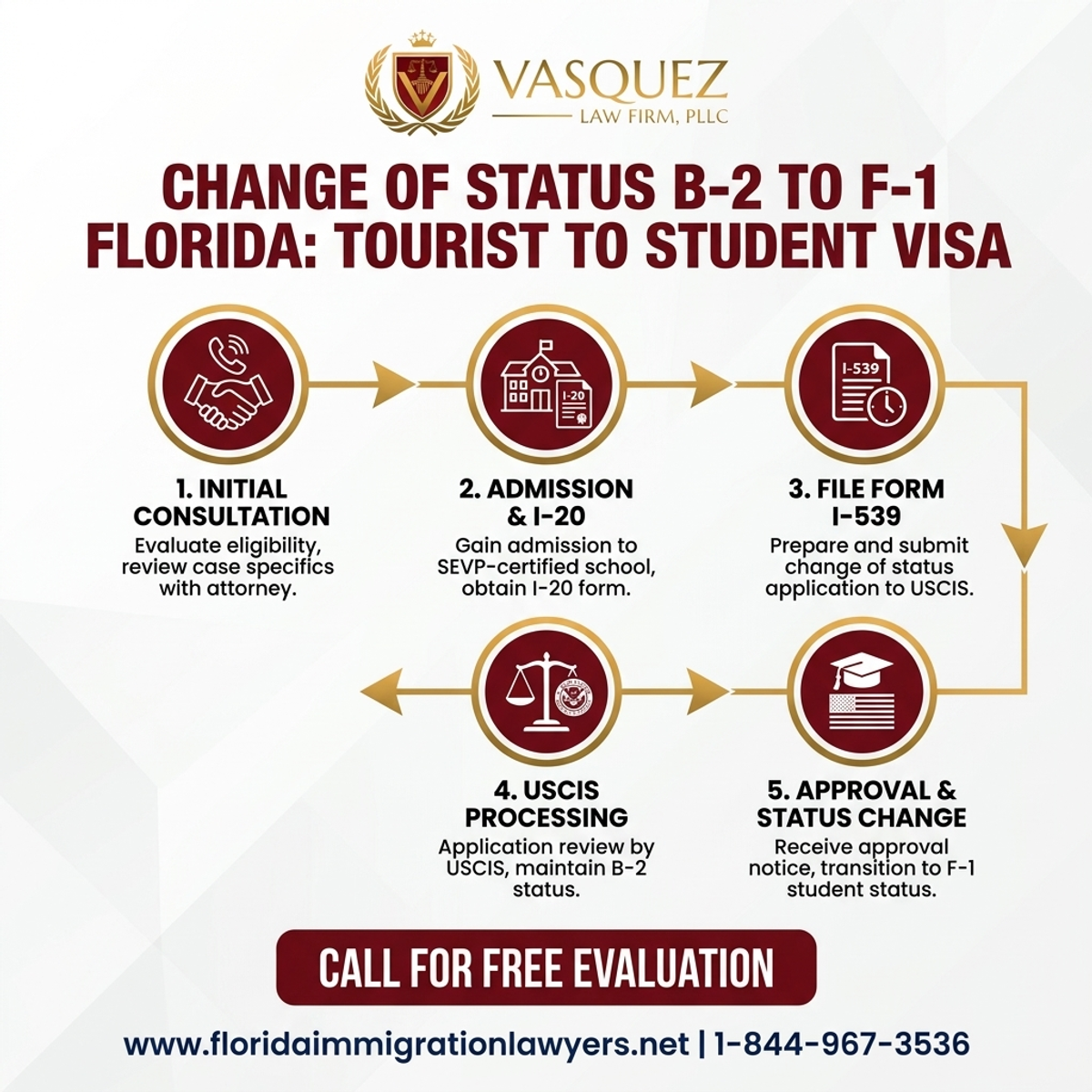
Step-by-Step Process — Change of Status B-2 to F-1 Florida: Tourist to Student Visa
Navigating Timelines and Processing Expectations for I-539 in Florida
Understanding the processing times for a change of status B-2 to F-1 application is vital for planning your academic future in Florida. The United States Citizenship and Immigration Services (USCIS) processes Form I-539, and the timelines can vary significantly based on the service center handling your application and the volume of cases. While USCIS aims for efficiency, applicants should prepare for potential waiting periods that can range from several months to over a year. You can check current processing times on the USCIS website by selecting Form I-539 and the specific service center.
It is important to note that during the pendency of your I-539 application, you are generally authorized to remain in the U.S. even if your B-2 status expires, provided you filed the application before your I-94 expiration date. This "period of authorized stay" means you are not considered unlawfully present. However, you cannot begin your F-1 studies until your change of status is officially approved by USCIS. Starting classes before approval can jeopardize your application and future immigration prospects. If your B-2 status expires while your I-539 is pending, and your application is ultimately denied, you would immediately become unlawfully present and may accrue unlawful presence, potentially impacting future U.S. visa applications. Consulting with an attorney from Florida Immigration Lawyers can help you understand these nuances and plan accordingly, especially if your I-94 expiration date is approaching.
Cost Factors and Fee Breakdown for Your Change of Status Application
Pursuing a change of status B-2 to F-1 involves several financial considerations beyond just tuition fees. Understanding the various costs associated with the application process is crucial for proper planning. These fees are subject to change, and it is always advisable to check the official USCIS website for the most current amounts before submitting your application. The primary costs include government filing fees and potential legal fees if you choose to hire an attorney.
Firstly, there is the USCIS filing fee for Form I-539, Application to Extend/Change Nonimmigrant Status. This fee is mandatory for all applicants. Secondly, you will need to pay the SEVIS I-901 fee, which is a separate charge to maintain the Student and Exchange Visitor Information System. This fee is paid directly to SEVP. Beyond these government fees, consider potential costs for obtaining official transcripts, translating documents if they are not in English, and mailing your application package. While not mandatory, investing in legal representation from Florida Immigration Lawyers can be a cost-effective decision in the long run. An experienced attorney can help ensure your application is complete and accurate, minimizing the risk of costly delays or denials that could require refiling or appeals. Our firm offers transparent fee structures, and a free initial consultation can help you understand the full scope of costs involved in your specific case.
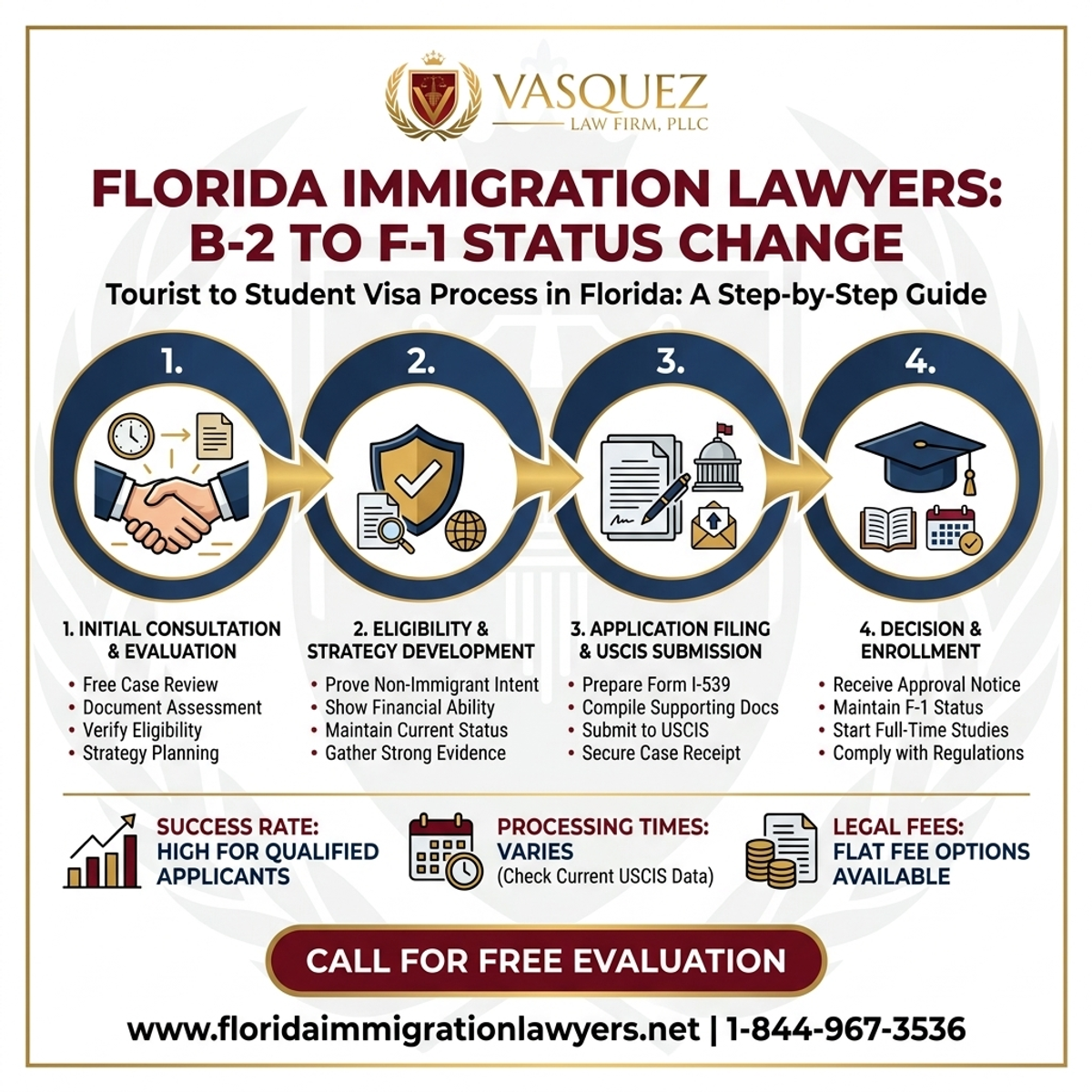
Key Statistics — Change of Status B-2 to F-1 Florida: Tourist to Student Visa
Common Mistakes to Avoid During Your Change of Status B-2 to F-1 Application
Navigating the change of status B-2 to F-1 process can be tricky, and even minor errors can have significant consequences. Avoiding these common mistakes can save you time, money, and stress:
- Failing to Maintain B-2 Status: You must maintain valid B-2 status until your I-539 application is filed. Overstaying your authorized period of stay before filing can make you ineligible for a change of status.
- Violating the "90-Day Rule": Applying for a change of status within 90 days of entering the U.S. on a B-2 visa can trigger a presumption of misrepresentation of intent, leading to denial. It's generally safer to wait.
- Insufficient Proof of Non-Immigrant Intent: USCIS needs to be convinced that your primary intent on entering the U.S. was for tourism and that your educational plans developed genuinely afterward. A weak explanation or lack of ties to your home country can be detrimental.
- Lack of Adequate Financial Support: You must demonstrate sufficient funds to cover tuition, fees, and living expenses for the duration of your studies without needing to work unlawfully. Insufficient proof is a common reason for denial.
- Starting Studies Before Approval: You cannot begin your F-1 program until your change of status is officially approved by USCIS. Doing so can result in denial and potentially render you out of status.
- Submitting an Incomplete or Inaccurate Application: Missing documents, incorrect information on Form I-539, or failure to include the correct fees will lead to Requests for Evidence (RFEs) or outright denial.
- Unauthorized Employment: Working without authorization while on a B-2 visa or during the pendency of your I-539 application is a serious violation that will lead to denial and future immigration difficulties.
- Ignoring RFEs or Notices: If USCIS sends a Request for Evidence, you must respond comprehensively and by the deadline. Failing to do so will result in denial.
- Not Consulting a Designated School Official (DSO): Your school's DSO is a crucial resource. Failing to communicate with them, especially regarding your I-20 or any changes in your academic program, can cause issues.
- Underestimating Processing Times: Not allowing enough time for USCIS to process your I-539 can lead to stress, especially if your B-2 status is expiring. Always file well in advance.
When to Call a Lawyer for Your Change of Status B-2 to F-1
While some individuals attempt the change of status B-2 to F-1 process on their own, there are specific scenarios where legal counsel becomes not just beneficial, but often essential. An experienced immigration attorney from Florida Immigration Lawyers can provide invaluable assistance, particularly when your case presents complexities or red flags. For instance, if you have a prior immigration violation, such as an overstay, a previous visa denial, or any criminal history, navigating the change of status without legal expertise is highly risky. These factors can significantly complicate your eligibility and require specialized legal arguments and documentation.
Furthermore, if you are unsure about meeting the "90-day rule" or have concerns about demonstrating your non-immigrant intent, an attorney can help you craft a compelling personal statement and gather appropriate evidence. Receiving a Request for Evidence (RFE) from USCIS is another clear sign to seek legal help; attorneys are skilled at preparing comprehensive and timely responses that address USCIS concerns effectively. If your I-94 expiration date is fast approaching and you need to ensure your application is filed correctly and promptly, or if you simply want peace of mind knowing your application is meticulously prepared, contacting Florida Immigration Lawyers is a wise decision. Our team can help you avoid common pitfalls and enhance your chances of a successful outcome, allowing you to focus on your academic pursuits in Florida.
About Florida Immigration Lawyers
Florida Immigration Lawyers is a leading law firm dedicated to providing exceptional legal representation to individuals and families across the state of Florida. With a deep understanding of U.S. immigration law, our experienced attorneys are committed to guiding clients through every stage of their immigration journey, including complex cases like the change of status B-2 to F-1. We pride ourselves on offering personalized, compassionate, and effective legal solutions tailored to meet the unique needs of each client.
Our comprehensive services cover a wide range of immigration matters, from family-based visas and asylum applications to deportation defense and citizenship petitions. We serve clients throughout Florida, including Fort Lauderdale, Miami, Orlando, and Tampa, ensuring that expert legal advice is accessible no matter where you are in the state. At Florida Immigration Lawyers, we believe everyone deserves fair and just legal representation. We are available 24/7 for support and offer free consultations to help you understand your options without financial commitment. Visit our website at floridaimmigrationlawyers.net or call us at 1-844-967-3536 to speak with a knowledgeable attorney today.
Sources and References
- U.S. Citizenship and Immigration Services (USCIS)
- Executive Office for Immigration Review (EOIR)
- U.S. Department of State (travel.state.gov)
- 8 U.S.C. § 1258 - Immigration and Nationality Act (INA) Section 248 (Change of Status)
- 8 CFR 214.2(f) - Regulations Pertaining to F-1 Students
- 8 CFR 248 - Regulations Pertaining to Change of Nonimmigrant Status
Related services: immigration practice areas, family immigration services, business immigration, experienced immigration attorneys.
This article provides general legal information and is not intended as legal advice. Every case is unique, and outcomes depend on specific facts and circumstances. Contact an attorney for advice about your particular situation.
Embarking on a change of status B-2 to F-1 journey can be life-changing, opening doors to educational opportunities in Florida. Don't leave your future to chance. Let the experienced attorneys at Florida Immigration Lawyers guide you through every step, ensuring your application is strong and accurate. We are committed to helping you achieve your academic and immigration goals. Call us for a free consultation today at 1-844-967-3536. Se Habla Español - Estamos aquí para ayudarle.
If you need legal assistance, learn more about how our immigration attorneys can help, or call us at 1-844-967-3536 for a free consultation.
Do Not Navigate This Process Alone
Our experienced immigration attorneys are ready to fight for you. Get a free, confidential consultation today.
Se Habla Español
Frequently Asked Questions

William J. Vásquez
Founding Attorney · Vasquez Law Firm
U.S. Air Force veteran and immigration attorney with thousands of cases resolved. J.D., NCCU School of Law. AILA member. Admitted to the 4th, 5th, and 11th Circuit Courts.
Available 24/7 - Free Evaluations
Related Legal Services
Our Florida immigration attorneys can help you with business immigration, asylum protection and deportation defense. Call today at 1-844-967-3536 for a free consultation.
Related Links
Related Topics
Free Legal Consultation
Discuss your case with our experienced attorneys. We're available 24/7.
Se Habla Español - Estamos aquí para ayudarle.
Related Articles
Biometrics Appointment in Florida: What to Expect in 2026
Navigating a biometrics appointment in Florida is crucial for your USCIS process. Learn what to expect, how to prepare, and common pitfalls to avoid. Florida Immigration Lawyers are here to help with personalized guidance and support.
Withholding of Removal Explained: Florida Defense in 2026
For those in Florida facing deportation and fearing persecution or torture in their home country, understanding withholding of removal is critical. This form of protection prevents removal to a dangerous country, though it differs significantly from asylum in its eligibility criteria and benefits. It requires proving a "more likely than not" chance of persecution based on protected grounds or torture, a higher standard than asylum's "well-founded fear." While withholding of removal does not lead to a Green Card, it offers mandatory protection if the stringent criteria are met, even for some individuals barred from asylum. The process involves complex legal proceedings before an immigration judge, often in Miami or Orlando immigration courts. A comprehensive application, detailed testimony, and robust supporting evidence, including country conditions reports and affidavits, are essential. Given the high stakes and intricate legal requirements, securing the expertise of a Florida immigration lawyer is paramount to building a strong defense and navigating the path to safety.
US Visa Policy Changes July 2026: What Students in Florida
As of July 2026, international students in Florida seeking a change of status to an F-1 student visa must prepare for potential adjustments to U.S. visa policies. This comprehensive guide from Florida Immigration Lawyers explores the anticipated policy changes, detailing their potential impact on application requirements, processing times, and eligibility criteria. We provide a step-by-step overview of the change of status process, including a document checklist, expected timelines, and cost considerations. Understanding these complexities and avoiding common mistakes is crucial for a successful application. With potential changes approaching, proactive planning and expert legal guidance are more important than ever. Our firm is dedicated to helping students in Tampa and across Florida navigate these challenges, offering tailored advice and robust representation. Learn how to protect your academic future and ensure a smooth transition to F-1 student status.
Dual Citizenship Lawyer: Your 2026 Guide to Naturalization
Achieving U.S. citizenship is a profound milestone, but the path to naturalization, especially with dual citizenship in mind, is fraught with legal intricacies and a critical interview process. This comprehensive guide from Florida Immigration Lawyers demystifies the journey, offering essential citizenship interview tips and highlighting the invaluable role of a dual citizenship lawyer. We cover eligibility, document preparation, timelines, and common pitfalls, all tailored for Florida residents in areas like Pembroke Pines. Discover how expert legal counsel can prepare you for your naturalization interview, address dual nationality concerns, and ensure a smooth, successful application. From initial assessment to interview representation, we provide the support needed to navigate USCIS requirements confidently. Call Florida Immigration Lawyers for a free consultation to start your journey.