Asylum Annual Fee Florida 2026: Essential Guide for
The asylum annual fee in Florida for 2026 is a crucial component for many asylum seekers. This comprehensive guide from Florida Immigration Lawyers explains who needs to pay this fee, how to ensure correct payment, and what mistakes to avoid. We cover the step-by-step process, essential documentation, and expected timelines, clarifying common misconceptions about various immigration fees. Understanding these requirements is vital to protect your asylum claim and maintain your legal status. Learn why this fee exists, if it can be waived, and when professional legal assistance is indispensable. Our firm is dedicated to guiding you through every complexity.

The **asylum annual fee** (AAF) is a charge for certain asylum applications pending for a specified period, typically around $100-$150. It helps fund immigration processes and applies to eligible individuals, including those with cases before USCIS or EOIR. Non-payment can lead to serious consequences, including case dismissal. Understanding this fee is crucial for asylum seekers in Florida.
- The AAF applies to specific pending asylum cases.
- Fees are subject to change and vary by year.
- Non-payment can result in case dismissal.
- Legal guidance is essential for compliance.
- The fee supports the immigration system.
Navigating the U.S. immigration system can be complex, especially when seeking asylum. If you are an asylum seeker in Florida, you may have heard about the new or updated **asylum annual fee Florida** for 2026. This fee is a critical component of the asylum process that can significantly impact your case. Understanding its requirements, who must pay it, and the potential consequences of non-payment is vital for your future.
This comprehensive guide by Florida Immigration Lawyers will demystify the asylum annual fee, providing you with essential information to help you comply with USCIS regulations. We will cover eligibility, the payment process, common pitfalls, and when to seek professional legal assistance. Our goal is to empower you with the knowledge to protect your asylum claim. Do not face this complex journey alone. Call Florida Immigration Lawyers at 1-844-967-3536 for a free consultation and let our experienced team guide you through the immigration process.
Understanding the Asylum Annual Fee in Florida for 2026
The landscape of immigration fees is constantly evolving, and 2026 brings important considerations for asylum seekers. The **asylum annual fee Florida** is a relatively new requirement designed to support the operational costs of the U.S. asylum system. It applies to certain individuals whose asylum applications have been pending for a specific duration.
This fee is separate from the initial application fee for Form I-589, Application for Asylum and for Withholding of Removal. Its implementation reflects ongoing efforts by the government to manage the volume and processing of asylum claims. For many in Hollywood and across Florida, understanding this fee is a new and sometimes confusing challenge.
Who is Required to Pay the Asylum Annual Fee?
Generally, the asylum annual fee applies to individuals who have had an asylum application pending for a specified period, often exceeding one year. This includes cases pending with U.S. Citizenship and Immigration Services (USCIS) or the Executive Office for Immigration Review (EOIR). The exact criteria for eligibility are detailed in official USCIS guidance and are subject to change.
It is crucial to verify the specific eligibility requirements for the 2026 fiscal year, as these can be updated regularly. Factors such as the filing date of your I-589 and the duration your case has been active are key determinants. Our firm monitors these changes closely to provide the most current advice.
Why Was the Asylum Annual Fee Implemented?
The implementation of the asylum annual fee is part of a broader strategy to ensure the sustainability of the U.S. immigration system. Funds generated from this fee are typically allocated to cover the costs associated with processing asylum applications, conducting interviews, and managing caseloads. This helps to maintain the integrity and efficiency of the asylum process.
While fees can be burdensome, the government argues they are necessary to manage the significant resources required for asylum adjudications. For individuals seeking protection in Florida, these fees represent an additional hurdle that must be carefully navigated.
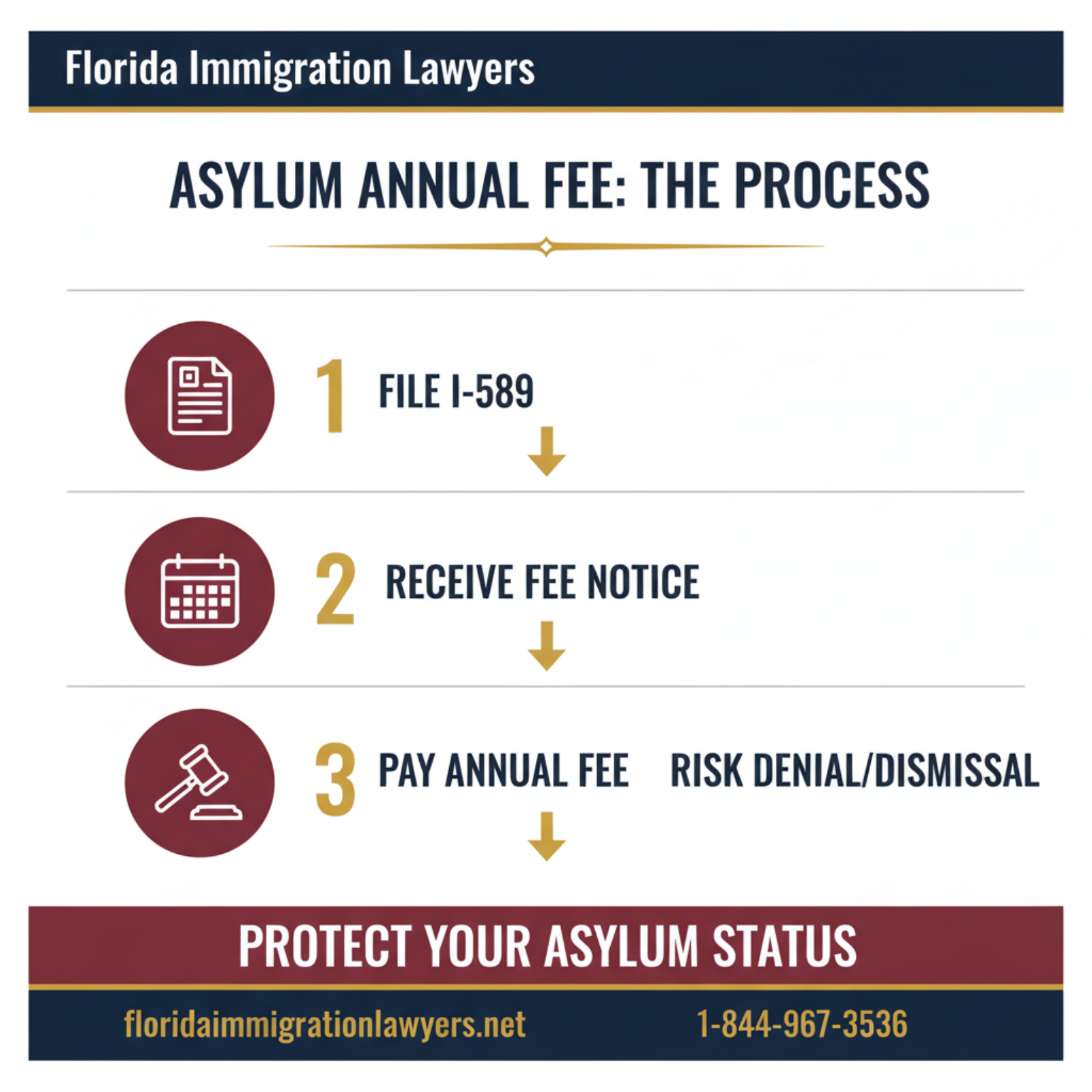
Step-by-Step Guide to Paying Your Asylum Annual Fee
Paying the asylum annual fee correctly is essential to avoid delays or adverse actions on your case. This process requires attention to detail and adherence to specific instructions provided by USCIS. Missing a deadline or incorrect payment can have severe consequences for your asylum claim.
We understand that this can feel overwhelming, especially when dealing with other pressing concerns. Following a clear step-by-step guide can help ensure you meet all requirements.
- Identify Your Eligibility: First, determine if you are required to pay the **asylum annual fee Florida** for 2026. Review any notices from USCIS or EOIR carefully. These notices typically specify the fee amount, the payment due date, and instructions for submission. If you are unsure, consult with an immigration attorney.
- Locate Your Case Information: You will need your Alien Registration Number (A-Number) and potentially your case receipt number. This information is critical for correctly identifying your application during the payment process. Ensure all details match your official immigration documents.
- Determine the Correct Fee Amount: The fee amount is subject to change. Do not rely on outdated information. Always check the official USCIS website or your specific fee notice for the most current amount. As of early 2026, fees for certain asylum-related processes are often in the range of $100-$150, but this can fluctuate.
- Choose Your Payment Method: USCIS generally accepts various payment methods, including money order, personal check, cashier's check, or credit card using Form G-1450, Authorization for Credit Card Transactions. Ensure your chosen method is accepted and that funds are available.
- Complete Payment Form (if applicable): If paying by credit card, you must complete Form G-1450. For checks or money orders, ensure they are made payable to "U.S. Department of Homeland Security" and include your A-Number in the memo line. Do not send cash.
- Submit Payment: Follow the specific mailing instructions provided by USCIS or EOIR. Typically, payments are sent to a designated lockbox facility. Keep a copy of your payment, the form, and proof of mailing for your records. This documentation is vital in case of any discrepancies.
- Monitor Your Case Status: After submitting payment, regularly check your case status online using your receipt number. This will help confirm that your payment has been received and processed. If you do not see an update within a reasonable timeframe, follow up with USCIS.
Essential Document Checklist for Asylum Annual Fee Compliance
While the asylum annual fee itself doesn't require an extensive package of supporting documents, proper record-keeping and attention to detail are paramount. The documents listed below are primarily for your own records and for ensuring accurate payment submission. Having these readily available can prevent misunderstandings and provide proof of compliance.
This checklist focuses on what you should keep on hand related to the fee payment.
- Official Fee Notice: Any notice received from USCIS or EOIR detailing the **asylum annual fee Florida**, the amount due, and the payment deadline. This is your primary source of truth.
- Alien Registration Number (A-Number): Your unique identifier with USCIS. This must be correctly referenced on any payment or correspondence.
- USCIS Receipt Number: If applicable, the receipt number from your Form I-589 application. This helps track your specific asylum case.
-
Proof of Payment:
- Copy of the money order or cashier's check (front and back).
- Copy of the personal check (front and back).
- Completed and signed Form G-1450 if paying by credit card.
- Confirmation of online payment (if an online option becomes available).
Step-by-Step Process Guide - Proof of Mailing: Certified mail receipt or tracking number for your payment submission. This demonstrates that you sent the payment on time.
- Correspondence Log: A record of all communication with USCIS or EOIR regarding your fee, including dates, names of representatives, and summaries of discussions.
Maintaining organized records is a critical step in managing your immigration case. It provides a safeguard against administrative errors and supports your claim of compliance.
Timeline and Processing Expectations for the Asylum Annual Fee
Understanding the timeline for the asylum annual fee is crucial for effective case management. The deadlines for payment are strict, and failure to meet them can have severe repercussions for your asylum application. While processing times for the fee itself are typically fast, the impact on your overall asylum case can be significant.
Once you submit your payment, USCIS or EOIR will process it and update your case record. You will generally receive a confirmation that the payment has been applied. However, this is distinct from the processing time for your actual asylum application.
What Happens After Payment?
After successfully paying the **asylum annual fee Florida**, your case status should reflect that the requirement has been met. This prevents your case from being administratively closed or dismissed due to non-payment. The fee payment itself does not expedite the adjudication of your asylum application. It merely ensures that your case remains active and in good standing.
The overall timeline for asylum case processing varies widely based on factors such as the volume of applications, the complexity of individual cases, and the specific USCIS field office or immigration court handling your matter. For applicants in Florida, including those attending interviews at the USCIS asylum office in Orlando or appearing before immigration courts in Miami or Orlando, patience is often required.
Potential Delays and How to Address Them
While fee processing is usually straightforward, delays can occur. Common issues include incorrect payment amounts, unreadable checks, or missing case information. If you notice an unusual delay in your payment being processed or if your case status does not update, it is important to act promptly.
First, review your proof of mailing and payment records. If you believe there's an error on USCIS's part, you may need to contact their customer service center. However, for complex issues or if your case is in immigration court, it is highly advisable to consult with an experienced immigration attorney. They can help investigate the issue and communicate with the appropriate authorities on your behalf.
Cost Factors and Fee Breakdown: Demystifying the Asylum Annual Fee
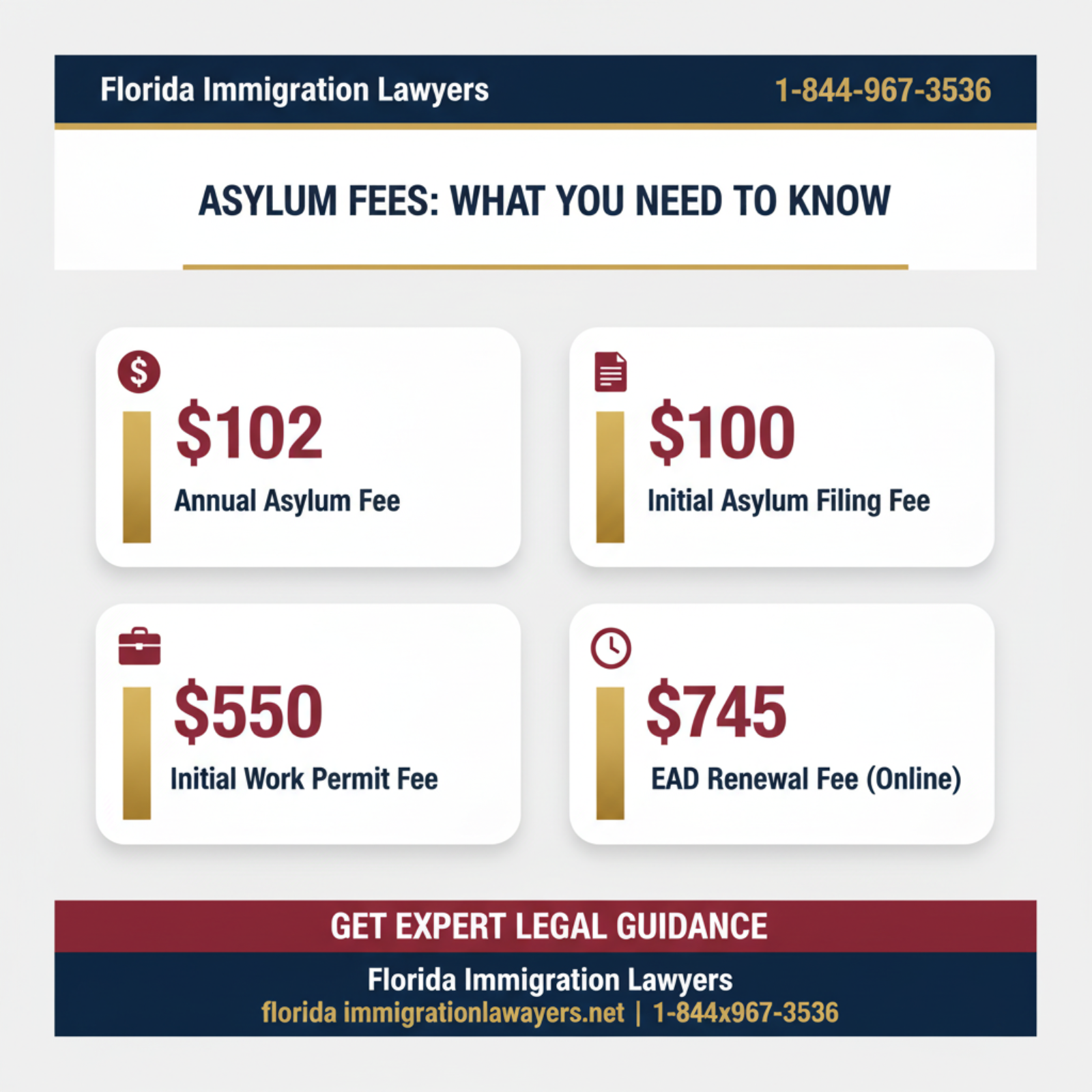
The **asylum annual fee Florida** is one component of the broader financial considerations for asylum seekers. It is important to distinguish this specific annual fee from other potential costs associated with the asylum process. While we cannot provide exact fee amounts as they are subject to change, we can explain the nature of these costs.
The annual asylum fee is typically a fixed amount, often in the range of $100 to $150, as determined by USCIS for a given fiscal year. This fee is generally non-refundable and cannot be waived. This makes careful planning and accurate payment even more critical for asylum applicants.
Distinguishing Asylum Fees: Answering "People Also Ask"
Many individuals have questions about various fees related to asylum. Let's clarify some common inquiries:
- Do I need to pay the $100 asylum fee? If your asylum application has been pending for the specified duration (e.g., one year or more) as defined by USCIS for the current fiscal year, you are generally required to pay the annual asylum fee. This fee is often around $100-$150, though the precise amount can vary. Always check official USCIS guidance.
- What is the annual fee for asylum payment? This refers to the specific charge discussed throughout this article, applicable to certain long-pending asylum cases. It is an annual requirement for eligible individuals to maintain the active status of their asylum application.
- What is the $600 asylum fee? There is no widely recognized "annual $600 asylum fee" for asylum applicants. However, USCIS fees can change, and different fees apply to various immigration forms. For example, some employment-based petitions or adjustment of status applications can have higher fees. It is crucial to identify the specific form or process to determine the correct fee.
- What is the $5000 fee for immigration? Similarly, a $5000 fee is not typically associated with an asylum application itself. Immigration processes involve a wide range of fees, from petitions for relatives (Form I-130) to investment visas (EB-5), which can indeed reach thousands of dollars. Always verify the specific form or service to understand the associated costs.
Can the Asylum Annual Fee Be Waived?
Unlike some other USCIS fees, the **asylum annual fee Florida** is generally not eligible for a fee waiver. This is a critical point that applicants must understand. While fee waivers are available for certain forms based on financial hardship, the annual asylum fee typically requires full payment from all eligible individuals.
This policy underscores the importance of budgeting and financial preparation for asylum seekers. If you are facing extreme financial hardship, discussing your situation with an attorney might reveal other potential avenues or strategies, though direct fee waivers for the annual asylum fee are rare.
Do not navigate this complex process alone. The nuances of immigration law, especially concerning fees and deadlines, can be overwhelming. Contact Florida Immigration Lawyers today to ensure your asylum case is handled with the precision and expertise it deserves.
Common Mistakes to Avoid with the Asylum Annual Fee
Navigating the requirements for the **asylum annual fee Florida** can be tricky, and even small errors can have significant consequences. Avoiding these common mistakes is crucial for protecting your asylum claim.
- Missing the Payment Deadline: This is perhaps the most critical mistake. Failing to pay the fee by the specified due date can lead to your asylum application being dismissed or administratively closed. Consequences can include loss of work authorization and initiation of removal proceedings.
- Paying the Incorrect Amount: USCIS fees change periodically. Paying less than the required amount will result in your payment being rejected and returned, causing delays. Paying too much can also complicate processing and may not be refunded easily. Always verify the current fee.
- Using an Unaccepted Payment Method: Not all payment methods are accepted for all fees. For instance, sending cash is never advisable. Ensure your check or money order is correctly made out to "U.S. Department of Homeland Security" and includes your A-Number.
- Failing to Include Case Information: Forgetting to write your A-Number on your check or money order, or failing to properly complete Form G-1450, can lead to your payment not being correctly associated with your case. This can cause significant processing delays and potential dismissal.
- Ignoring Official Notices: Notices from USCIS or EOIR regarding the annual fee often contain critical instructions and deadlines. Disregarding these notices or not understanding their content can lead to missed payments and severe repercussions.
- Assuming a Fee Waiver is Available: As discussed, the asylum annual fee is generally not eligible for fee waivers. Assuming you can waive it without verifying this can lead to non-payment and case dismissal.
- Sending Payment to the Wrong Address: USCIS has specific lockbox facilities for different forms and fees. Sending your payment to the wrong address will delay processing and may result in it being returned or lost. Always use the address specified in the fee notice.
- Not Keeping Records of Payment: Failing to keep copies of your payment, mailing receipts, and official notices can leave you without proof of compliance if there's an administrative error. This can be devastating if USCIS claims non-payment.
- Confusing the Annual Fee with Other Immigration Fees: The annual asylum fee is distinct from the initial I-589 filing fee (if applicable) or fees for work permits (Form I-765). Misunderstanding which fee applies can lead to incorrect payments.
- Delaying Consultation with an Attorney: If you are confused or unsure about any aspect of the fee, waiting until the last minute to seek legal advice can be detrimental. Early consultation can prevent costly mistakes.
When to Call a Lawyer for Your Asylum Annual Fee
The complexities of immigration law, especially when it involves fees like the **asylum annual fee Florida**, demand expert guidance. While this guide provides general information, your specific situation may present unique challenges. Knowing when to seek legal counsel can be the difference between a successful outcome and significant setbacks.
You should consider contacting Florida Immigration Lawyers if:
- You have received a notice about the asylum annual fee but are unsure if it applies to you.
- You are confused about the correct fee amount or payment method for 2026.
- Your payment was rejected, returned, or you believe it was incorrectly applied.
- You are facing a deadline that you fear you cannot meet.
- Your asylum application is in removal proceedings before an immigration judge.
- You have received a notice of intent to dismiss your asylum case due to non-payment.
- You are experiencing financial hardship and need to explore all possible options, even if fee waivers are not directly applicable.
- You need help understanding any aspect of the asylum process, from initial application (Form I-589) to work authorization (Form I-765) and beyond.
Our dedicated team at Florida Immigration Lawyers is here to provide personalized advice and representation. We serve clients throughout Florida, including Hollywood, Miami, Orlando, and Tampa, ensuring your rights are protected every step of the way. Do not risk your future by navigating these critical requirements alone.
About Florida Immigration Lawyers
At Florida Immigration Lawyers, we are a leading law firm dedicated to providing exceptional legal services to immigrants across the entire state of Florida. With years of specialized experience, our attorneys are passionate about helping individuals and families achieve their American dream. We understand the profound impact immigration matters have on your life.
Our comprehensive practice areas include asylum, deportation defense, family immigration, business immigration, citizenship, and general immigration matters. We pride ourselves on offering compassionate, client-focused representation, always prioritizing your best interests. Our team is committed to delivering clear communication and strategic legal solutions tailored to your unique needs.
Why choose us? We offer free consultations, are available 24/7, and provide bilingual services (English and Spanish) to ensure effective communication. Our deep understanding of federal immigration law, combined with our local knowledge of Florida's immigration courts and USCIS offices, makes us your trusted partner. Visit our website at https://www.floridaimmigrationlawyers.net or call us at 1-844-967-3536 to learn how our attorneys can assist you.
Sources and References
- U.S. Citizenship and Immigration Services (USCIS)
- Executive Office for Immigration Review (EOIR)
- 8 U.S.C. Chapter 12 - Immigration and Nationality Act (INA)
- 8 CFR Part 208 - Asylum and Withholding of Removal
- USCIS Policy Manual
This article provides general legal information and is not intended as legal advice. Every case is unique, and outcomes depend on specific facts and circumstances. Contact an attorney for advice about your particular situation.
Your asylum journey is too important to leave to chance. Ensure every detail, including the **asylum annual fee Florida**, is handled correctly. Contact Florida Immigration Lawyers today for a free, confidential consultation. Our experienced team is ready to provide the dedicated legal support you deserve. Call us now at 1-844-967-3536. Se Habla Español - Estamos aquí para ayudarle.
Do Not Navigate This Process Alone
Our experienced immigration attorneys are ready to fight for you. Get a free, confidential consultation today.
Se Habla Español
Frequently Asked Questions
Florida Immigration Lawyers
Immigration Attorney | Founder, Vasquez Law Firm
U.S. Air Force veteran and immigration attorney with thousands of cases resolved. J.D., NCCU School of Law. AILA member. Admitted to the 4th, 5th, and 11th Circuit Courts.
Available 24/7 - Free Evaluations
Related Legal Services
Our Florida immigration attorneys can help you with deportation defense, citizenship and naturalization and family immigration services. Call today at 1-844-967-3536 for a free consultation.
Related Links
Related Topics
Free Legal Consultation
Discuss your case with our experienced attorneys. We're available 24/7.
Se Habla Español - Estamos aquí para ayudarle.
Related Articles
TPS Re-Registration Deadlines in Florida 2026 | VLF Florida
Stay informed on TPS re-registration deadlines in Florida for 2026. Discover key steps and mistakes to avoid. Call Florida Immigration Lawyers at 1-844-967-3536 for a free consultation.
U Visa for Crime Victims in Florida: A Guide | VLF Florida
Discover how crime victims in Florida can benefit from the U visa, providing a pathway to safety and legal status. Learn about eligibility, the application process, and common pitfalls to avoid.
Immediate Relative Petition Florida: A Comprehensive Guide
Learn about the Immediate Relative Petition in Florida, a crucial step for U.S. citizens to sponsor family members. This guide covers eligibility, documentation, and timelines to help you navigate the process successfully.
Change of Status: Navigating Student Visas in Florida
Navigating a change of status for a student visa in Florida can be complex. This guide covers essential steps, common pitfalls, and when to seek legal help. Call Florida Immigration Lawyers for a free consultation.
