Your Immigration Case: What You Can Control at Every Step
October 10, 2026
A 2024 survey from the National Conference on Citizenship, a nonpartisan nonprofit that tracks US civic participation, found that only one in four Americans believe they can influence what happens in their own community (nationalconference.org). If you are waiting on a hearing date at Miami Immigration Court or an interview notice from the USCIS Tampa Field Office, that sense of powerlessness probably sounds familiar.
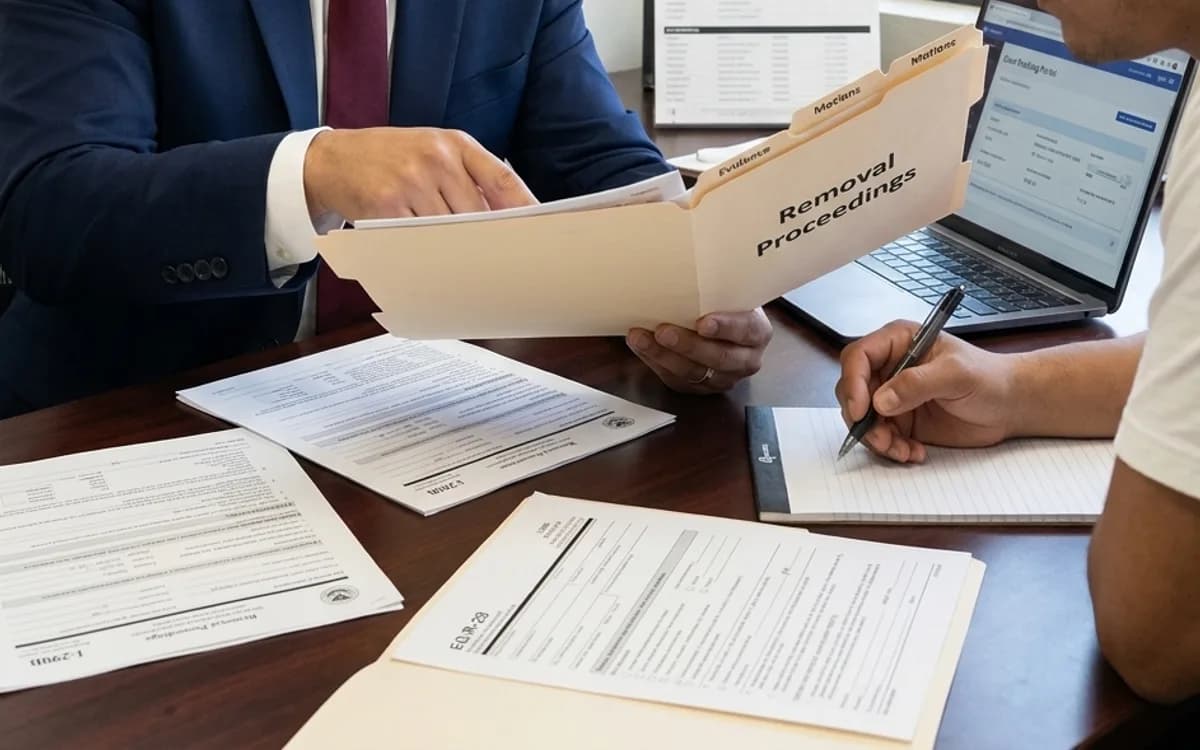
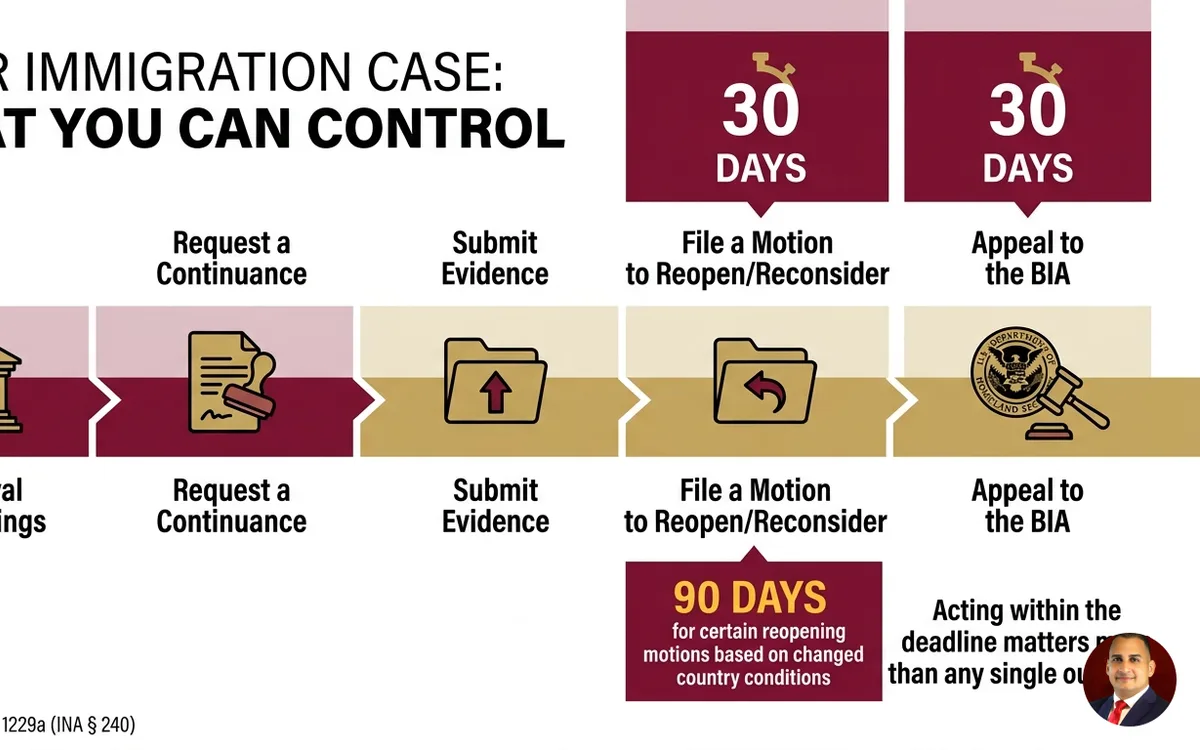
A courtroom file works on a different logic. Removal proceedings under 8 U.S.C. § 1229a (INA § 240) (law.cornell.edu/uscode/text/8/1229a) and USCIS applications move through fixed procedural steps. Nearly every step includes a point where you or your attorney can act: requesting a continuance, submitting evidence, filing a motion, meeting a filing deadline. The backlog is real and the process is slow, but those action points are real too.
Removal proceedings and USCIS cases involve a series of procedural stages, not a single long wait. You can request continuances, submit evidence, file motions to reopen or reconsider, and appeal to the BIA under 8 U.S.C. § 1229a (INA § 240). Deadlines are strict, often 30 or 90 days, so acting inside the window matters more than the outcome of any single hearing.
The Hard Truth
Here is the hard part. Nationally, immigration judges granted asylum in roughly 46% of decided cases in fiscal year 2024, per TRAC Immigration at Syracuse University (trac.syr.edu). More than half of claims were denied. Cancellation of removal under 8 U.S.C. § 1229b (law.cornell.edu/uscode/text/8/1229b) requires ten years of continuous physical presence, good moral character, and 'exceptional and extremely unusual hardship' to a qualifying US citizen or lawful permanent resident spouse, parent, or child, a standard the Board of Immigration Appeals applies narrowly, as set out in Matter of Monreal-Aguinaga, 23 I&N Dec. 56 (BIA 2001).
A motion, a filing, or an attorney cannot rewrite those legal standards. A properly filed continuance request, a complete hardship record, or a timely motion to reopen does something narrower: it keeps a judge deciding the case on its facts, rather than closing it over a missed deadline or an incomplete filing. That is the real, limited thing legal representation changes. No attorney can honestly promise a specific result.
What Happens If You Wait
Missing a hearing has a specific, immediate consequence. Under 8 U.S.C. § 1229a(b)(5), an immigration judge can order removal in absentia, meaning the case proceeds and a removal order issues even though you were not in the room. Reopening that order generally requires a motion showing lack of proper notice or exceptional circumstances, filed within the deadlines set out in that same statute, and the exceptions are narrow.
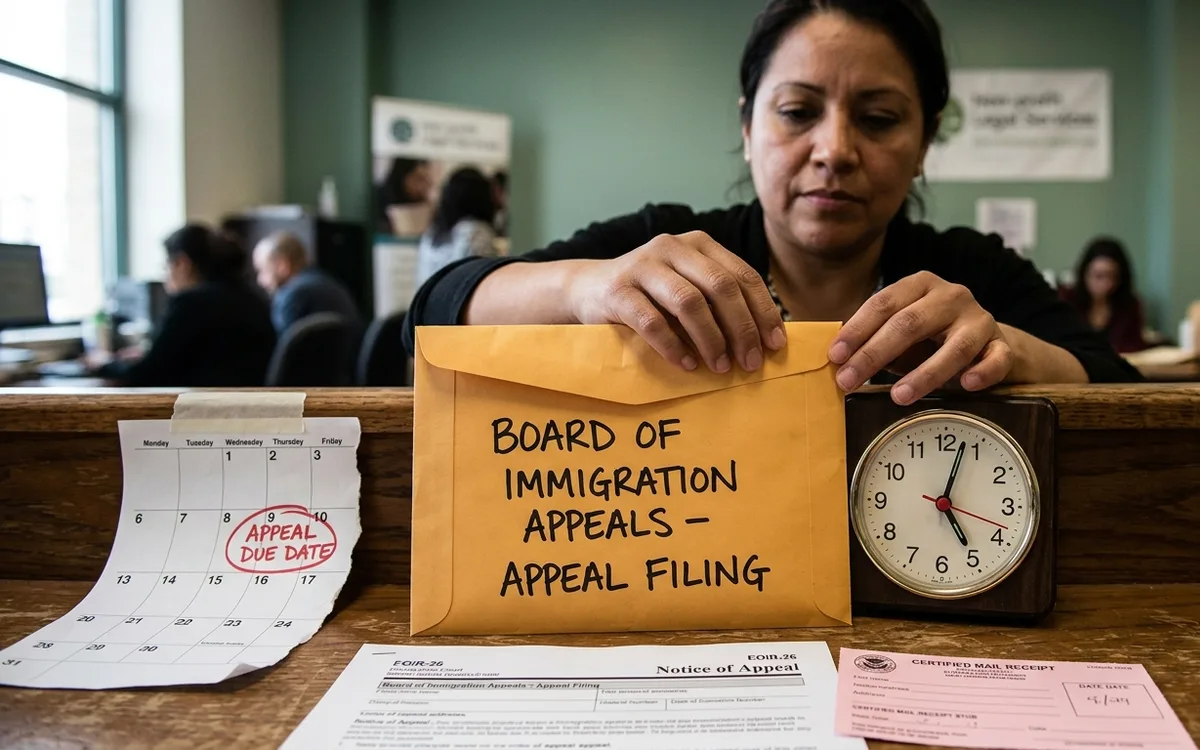
Deadlines outside the courtroom matter just as much. The one-year filing deadline for most asylum applications under 8 U.S.C. § 1158(a)(2)(B) (law.cornell.edu/uscode/text/8/1158) runs from your date of arrival, not from when you first spoke to an attorney. A Notice of Appeal to the BIA is due within 30 days of a judge's decision under 8 C.F.R. § 1003.38, with no routine extensions. Waiting to see what happens, or waiting until a consultation fits your budget, does not pause any of these clocks.
Step-by-Step Process
For most readers in the Miami and Orlando immigration court catchment areas, a removal case moves through a predictable sequence, even though the calendar dates depend on the court's backlog.
Notice to Appear (NTA). DHS files the NTA with the Miami Immigration Court (333 S. Miami Ave., Suite 700, Miami, FL) or Orlando Immigration Court (3535 Lawton Rd., Orlando, FL), which starts the case.
Entry of appearance. Your attorney files Form EOIR-28 and, where applicable, submits documents through the EOIR Courts & Appeals System (ECAS) under the Miami court's electronic filing standing order and the EOIR Immigration Court Practice Manual, Chapter 4.
Master calendar hearing. This is a short procedural hearing, usually 5 to 15 minutes, where the judge confirms identity, takes pleadings on the NTA's factual allegations, and sets deadlines for any application for relief.
Individual (merits) hearing. TRAC Immigration reported more than 3.7 million pending cases nationwide as of 2025 (trac.syr.edu), and Florida individual hearings are commonly scheduled one to three years out. This is the hearing where evidence and testimony are presented on relief such as asylum or cancellation of removal.
Decision and appeal window. If the judge denies relief, you have 30 days to file a Notice of Appeal with the BIA under 8 C.F.R. § 1003.38. If you are detained or need a separate custody determination, our bond hearing representation page covers how that motion works while a removal case is pending (/immigration/bond-hearings).
BIA appeal. The Board reviews the written record. Under 8 C.F.R. § 1292.1, any attorney licensed in good standing in a single US state bar may represent clients before the BIA nationwide, with no circuit-specific admission required.
Petition for review. If the BIA denies the appeal, the next step is a petition for review filed within 30 days under 8 U.S.C. § 1252(b)(1). For Florida cases, that petition goes to the Eleventh Circuit.
You can check where your case stands at any point through the EOIR Automated Case Information System (ACIS) at 1-800-898-7180, using your nine-digit A-number.
A Real-World Example
Consider a composite example based on common patterns, not a real client. Deuna applied for asylum after missing the one-year filing deadline and received an NTA directing her to Orlando Immigration Court. At the first master calendar hearing, her attorney requested a continuance to gather country-conditions evidence and briefed the 'changed circumstances' exception to the filing deadline under 8 U.S.C. § 1158(a)(2)(D).
The judge granted the continuance and set the case for an individual hearing roughly two years later, consistent with the Orlando court's current scheduling load. In the interim, her attorney compiled medical records, country-conditions reports, and declarations, and filed them with the court before the deadline set at the master calendar hearing. This is the stage where most case preparation actually happens, not at the final hearing itself.
At the individual hearing, both sides presented evidence and the judge took the matter under advisement, a common step when a full record needs review before a written decision issues. This example shows the sequence and the work involved at each stage, not a result. Results depend on facts and evidence specific to each case.
William J. Vasquez is admitted to the North Carolina State Bar and to practice before the U.S. Court of Appeals for the Eleventh Circuit, which covers federal appellate review for cases arising from Florida's immigration courts, including Miami and Orlando. His practice is scoped to federal immigration matters handled through EOIR and USCIS, not Florida state-court proceedings.
Appearing before the Board of Immigration Appeals does not require state-specific bar admission. Under 8 C.F.R. § 1292.1, any attorney licensed in good standing in one US state bar may represent clients before the BIA nationwide. More background on his practice areas and admissions is available on his attorney profile (/attorneys/william-vasquez).
Key Terms Explained
Notice to Appear (NTA): The charging document DHS files with the immigration court that starts removal proceedings and lists the factual and legal basis for removal.
Master Calendar Hearing: A short procedural hearing, often 5 to 15 minutes, where the judge takes pleadings, confirms identity, and sets deadlines. Evidence is presented later, at the individual hearing.
Individual (Merits) Hearing: The hearing where testimony and documentary evidence are presented on an application for relief, such as asylum or cancellation of removal.
Motion to Reopen: A request asking the court to reconsider a case based on new facts or evidence not available earlier, generally due within 90 days of a final order under 8 U.S.C. § 1229a(c)(7)(C)(i).
Motion to Reconsider: A request asking the court to review its own decision for legal or factual error, generally due within 30 days under 8 U.S.C. § 1229a(c)(6)(B).
Board of Immigration Appeals (BIA): The administrative body within the Department of Justice that reviews immigration judge decisions on the written record.
Petition for Review: The step after a BIA denial, filed with the federal circuit court of appeals covering the case, within 30 days under 8 U.S.C. § 1252(b)(1).
Cancellation of Removal: Discretionary relief under 8 U.S.C. § 1229b requiring, among other elements, ten years of continuous physical presence and 'exceptional and extremely unusual hardship' to a qualifying relative.
Well-Founded Fear: The legal standard for asylum eligibility, requiring a showing lower than 'more likely than not,' established in INS v. Cardoza-Fonseca, 480 U.S. 421 (1987).
EOIR Automated Case Information System (ACIS): A free phone and online system (1-800-898-7180) for checking a case's next hearing date and status using an A-number.
Frequently Asked Questions
Q: How much does it cost to hire an immigration attorney for a removal case? A: Fees vary by case type and stage, and this firm does not use contingency pricing for immigration matters because there is no monetary recovery to share, unlike a personal injury case. Ask for a written fee agreement describing what is and is not included before signing anything.
Q: How long does a removal case take from Notice to Appear to a final decision? A: Master calendar hearings are typically scheduled within months of the NTA, but individual hearings on relief are commonly set one to three years out given the national backlog (TRAC Immigration, trac.syr.edu, 2025). Appeals to the BIA add more time, often a year or more, depending on the Board's current caseload.
Q: What happens if I miss my hearing at Orlando or Miami Immigration Court? A: The judge can order removal in absentia under 8 U.S.C. § 1229a(b)(5) even if you are not present. Reopening that order requires a motion showing you did not receive proper notice or that exceptional circumstances caused the absence, filed within the deadlines set in that statute.
Q: Can I represent myself in immigration court instead of hiring an attorney? A: You are allowed to appear pro se, but the government is represented by an ICE attorney at every hearing, and the burden of proving eligibility for most relief falls on you under 8 U.S.C. § 1229a(c)(4). Self-represented respondents file the same forms, meet the same deadlines, and face the same evidentiary standards as represented ones.
Q: What evidence actually helps a cancellation of removal case? A: Courts weigh documented hardship to a qualifying US citizen or lawful permanent resident spouse, parent, or child, so medical records, school records, and country-conditions evidence for that relative typically carry more weight than general hardship statements. The 'exceptional and extremely unusual hardship' standard, discussed in Matter of Monreal-Aguinaga, 23 I&N Dec. 56 (BIA 2001), looks for hardship beyond what removal ordinarily causes a family.
Q: How do I find a BIA-accredited representative near Miami or Tampa? A: EOIR maintains a public roster of recognized organizations and accredited representatives through its Recognition and Accreditation Program, searchable at justice.gov/eoir. Accredited representatives are not attorneys, but they can represent clients in limited settings once their organization is recognized.
Q: How do I check my immigration court case status online? A: Call the EOIR Automated Case Information System (ACIS) at 1-800-898-7180 or use the online case status lookup on the EOIR website, with your nine-digit A-number ready. The system shows your next hearing date and court location but not case strategy or filed evidence.
Q: How long does a USCIS interview at the Miami or Tampa Field Office take? A: Most individual interviews, such as adjustment of status interviews, last 20 to 45 minutes, though wait times before being called back can run longer depending on the office's daily schedule. Bring your appointment notice, government-issued ID, and the original documents listed on that notice.
Q: How do I request a continuance in Miami or Orlando Immigration Court? A: Continuances are requested orally at a hearing or in writing through a motion filed with the court, under the EOIR Immigration Court Practice Manual, Chapter 4, showing good cause such as needing more time to gather evidence or retain counsel. Judges have discretion to grant or deny the request, and repeated requests without a clear reason are more likely to be denied.
Q: How can I verify that an immigration attorney is legitimate? A: Check state bar status through that bar's public attorney lookup, and confirm federal immigration standing since EOIR practice does not require a state-specific license. Groups such as the American Immigration Lawyers Association's South Florida Chapter maintain member directories that can serve as a secondary reference point.
This firm's reviews are visible on Google and Avvo, where former clients describe communication during each procedural stage, from the first consultation through hearing preparation. Aggregate ratings on third-party platforms are not a measure of case outcomes, and this firm does not publish win rates or success statistics because immigration case results are not objectively comparable across different facts, judges, and relief types. Reading recent reviews directly on those platforms will tell you more than any summary here.
The national backlog and the legal standards a judge applies stay fixed no matter what you file. The variable is whether your case gets decided on a complete record, inside the deadlines that actually govern it.
If you have a Notice to Appear, a USCIS interview notice, or a missed hearing in the Miami or Orlando immigration court system, schedule a consultation to review your paperwork and current deadlines with our immigration team (/contact). We also handle related bond hearing requests (/immigration/bond-hearings), asylum applications (/immigration/asylum), and BIA appeals (/immigration/bia-appeals) for clients already in proceedings.
- Bond Hearing Representation: /immigration/bond-hearings
- Asylum Applications: /immigration/asylum
- BIA Appeals: /immigration/bia-appeals
- Removal Defense Overview: /immigration/removal-defense
- Attorney Profile, William J. Vasquez: /attorneys/william-vasquez
- Schedule a Consultation: /contact