Withholding of Removal Attorney: Protection When Asylum Is Barred
October 10, 2026
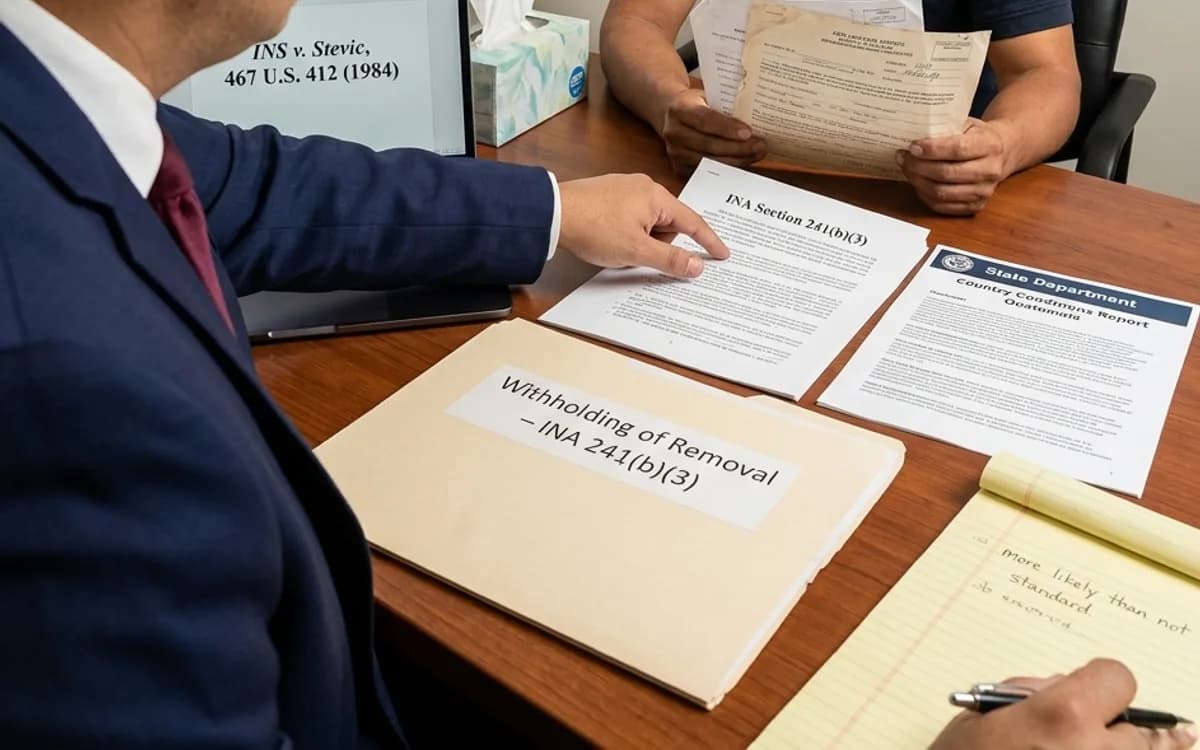
You already know asylum is closed to you, whether because you filed a year and three months after you arrived or because a conviction from years ago put you in a box the law calls a "particularly serious crime." What matters now is whether the law still has a door open for you, and whether anyone can prove you belong on the other side of it.
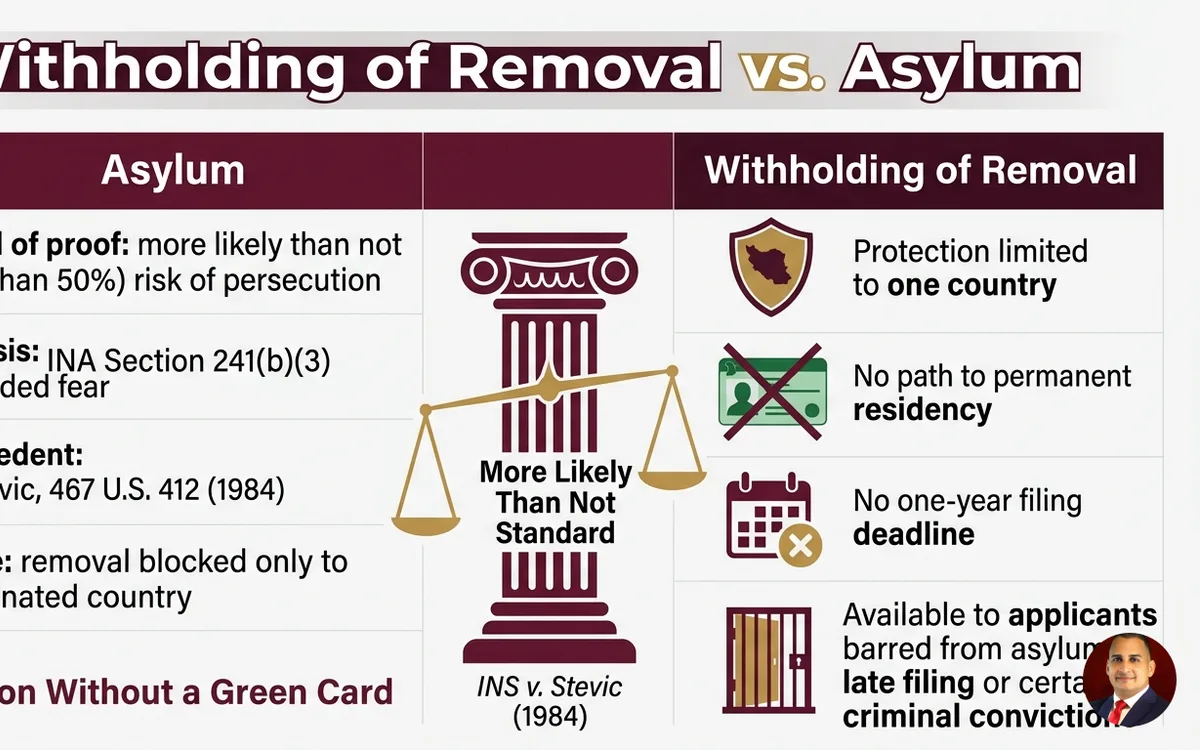
Withholding of removal under INA § 241(b)(3) protects people already barred from asylum by a late filing or a conviction. It requires proving it is more likely than not you will be persecuted if returned, the standard set in INS v. Stevic (1984). A grant blocks removal to that country only, with no green card.
The Hard Truth
Withholding of removal is harder to win than asylum, not easier. Asylum asks for a "reasonable possibility" of harm, roughly a 10 percent chance, per INS v. Stevic, 467 U.S. 407 (1984). Withholding asks for "more likely than not," over 50 percent, and the Immigration Judge decides that question from the bench, not from sympathy. Win it and you still have no green card, no path to citizenship, and no way to petition for your spouse or children. You get to stay and you get to work. That is the entire benefit, and for someone facing persecution, it is also the only benefit that matters.
What Happens If You Wait
The Miami Immigration Court's Local Operating Procedures require all documentary evidence, including country-conditions reports and expert declarations, filed no later than 15 days before your Individual Calendar Hearing. Miss that window and the judge can exclude your evidence outright, before your case is ever heard on the merits. The EOIR Immigration Court Practice Manual, Chapter 3.1(b), sets the same hard line for witness lists. If you are already under a reinstated removal order, you move straight into withholding-only proceedings with no new Notice to Appear and no second chance to raise asylum. Every week spent deciding whether to call a lawyer is a week your evidence-gathering clock is already running.
Step-by-Step Process
Step one: identify the bar. An Immigration Judge or USCIS first has to find you ineligible for asylum, whether for a late I-589 filing past the one-year deadline or a conviction classified as an aggravated felony or particularly serious crime. Step two: file or amend your application to withholding of removal and, where torture is a risk, Convention Against Torture protection, both decided by the same Immigration Judge in the same proceeding. Step three: build the record, country-conditions evidence, expert testimony, medical and psychological documentation, anything that shows the probability of harm tied to you specifically, not generally to your country. Step four: the Individual Calendar Hearing, where you testify, the government cross-examines, and the judge applies the clear-probability standard from INS v. Stevic. Step five: the written decision. If denied, you have 30 days to appeal to the Board of Immigration Appeals, and from there, a petition for review to the federal Court of Appeals covering the jurisdiction where your case was heard. If granted, you file for employment authorization with USCIS under the category tied to a withholding order, not a green card application, because none exists for this relief.
A Real-World Example
Consider a composite respondent held at Krome North Service Processing Center after a reinstated removal order. He had a ten-year-old drug conviction that made him ineligible for asylum and put him on a withholding-only docket from day one, no new Notice to Appear, no second asylum bite. His attorney requested a country-conditions expert report and gathered affidavits from family still in the home country describing specific threats made against him by name. At the Individual Calendar Hearing, the government's trial attorney cross-examined him for close to an hour on inconsistencies between his credible fear interview and his written declaration. The judge took the matter under advisement rather than ruling from the bench, a common outcome on detained dockets where the record is dense. The decision, whichever way it goes, becomes the basis for either a release on a withholding grant or a Board of Immigration Appeals filing within 30 days.
William J. Vasquez holds admission to the North Carolina State Bar and to the Fourth, Fifth, and Eleventh Circuit Courts of Appeals. Immigration proceedings before the Executive Office for Immigration Review and the Board of Immigration Appeals are federal, open nationwide to any attorney admitted to practice before them regardless of state bar membership, under 8 C.F.R. § 1292.1. His withholding of removal and CAT practice is built on that federal authority, representing respondents in Immigration Court on withholding-only dockets, including cases originating from detained proceedings, and briefing appeals to the Board. His Eleventh Circuit admission lets him carry a denied case forward into a petition for review in the circuit that includes Florida, when an Immigration Judge or the Board rules against a client.
Key Terms Explained
Withholding of removal: relief under INA § 241(b)(3) that blocks removal to a specific country where the person would more likely than not face persecution; it carries no path to a green card. Convention Against Torture (CAT) protection: separate relief barring removal to a country where torture by or with the acquiescence of government officials is more likely than not. Clear probability standard: the over-50-percent likelihood of persecution a withholding applicant must prove, established in INS v. Stevic, 467 U.S. 407 (1984). Particularly serious crime: a conviction, including many aggravated felonies, that bars asylum and some withholding claims but not CAT protection. Master calendar hearing: a short initial court appearance, usually 5 to 15 minutes, where the judge confirms identity, takes pleadings, and sets deadlines. Individual Calendar Hearing: the full merits hearing where testimony and evidence are presented and the judge decides the case. Reinstated removal order: a prior removal order reactivated under INA § 241(a)(5) without a new hearing on removability, limiting the person to withholding-only proceedings.
Frequently Asked Questions
Q: Can I still get protection if I missed the one-year asylum deadline? A: Yes, potentially, through withholding of removal, which has no filing deadline, though you must still prove the higher more-likely-than-not standard under INA § 241(b)(3).
Q: Does a past conviction automatically disqualify me from withholding of removal? A: Not automatically. Some convictions bar asylum but not withholding, while a true particularly serious crime can bar both, leaving Convention Against Torture protection as the remaining option since CAT has no criminal bar.
Q: Can I get a work permit if I'm granted withholding of removal? A: Yes. A withholding grant lets you apply to USCIS for employment authorization, but it does not create a path to a green card or let you petition for family members.
Q: What's the real difference between withholding of removal and asylum? A: Asylum requires a reasonable possibility of persecution, roughly 10 percent, and leads to a green card; withholding requires proving persecution is more likely than not, over 50 percent, and only blocks removal to one country with no further immigration benefit.
Clients come to our Florida office after being told by another lawyer, or by a notice from Immigration Court, that asylum is no longer an option. What they look for next is not reassurance but a straight answer about what withholding actually requires and what it does not deliver. Our clients describe a team that explains the clear-probability standard in plain terms before taking a case, not after filing fees are paid.
If you are facing a withholding-only docket, a reinstated removal order, or a criminal bar that closed off asylum, the next question is whether your evidence can meet the more-likely-than-not standard, and that is a case-specific analysis, not a form you fill out alone.
Call our office to schedule a consultation on your withholding of removal or Convention Against Torture claim. We will review your prior filings, your conviction record if one exists, and the country conditions tied to your case before your next Individual Calendar Hearing date arrives.

- Asylum Attorney
- Convention Against Torture (CAT) Claims
- Detained Immigration Defense
- Board of Immigration Appeals (BIA) Appeals
- Removal Defense Attorney
- Federal Circuit Court Immigration Appeals