When the Government Defies a Court Order: Your Rights and Next Steps
October 10, 2026
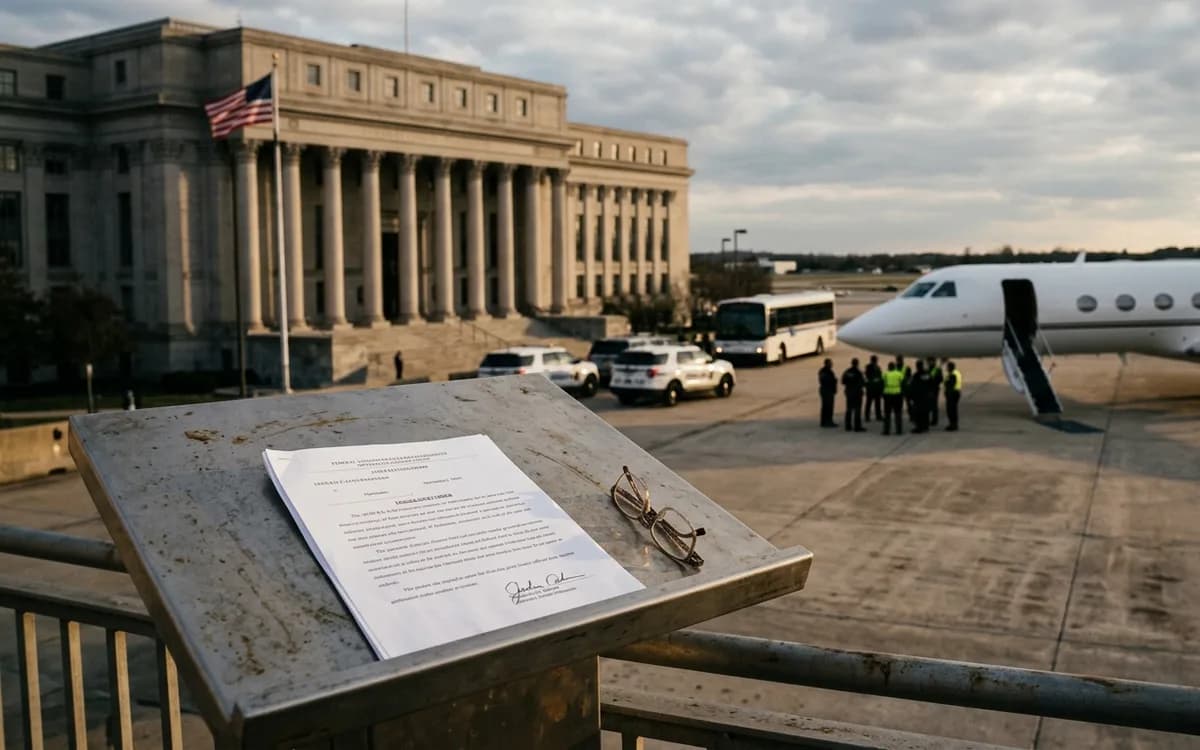
You were told a judge had blocked the flight. Then your phone rang and your husband was already gone, flown out before the order could take effect. The ACLU has made exactly this argument in federal court: that Trump administration officials defied a judge's order in a case just like this one (per ACLU, aclu.org).
The courts are still deciding whether anyone will be held accountable for that. In the meantime, the deadlines in your own case keep running no matter what happens in the broader litigation. The next move has to be precise and timed to the dates that apply to you.
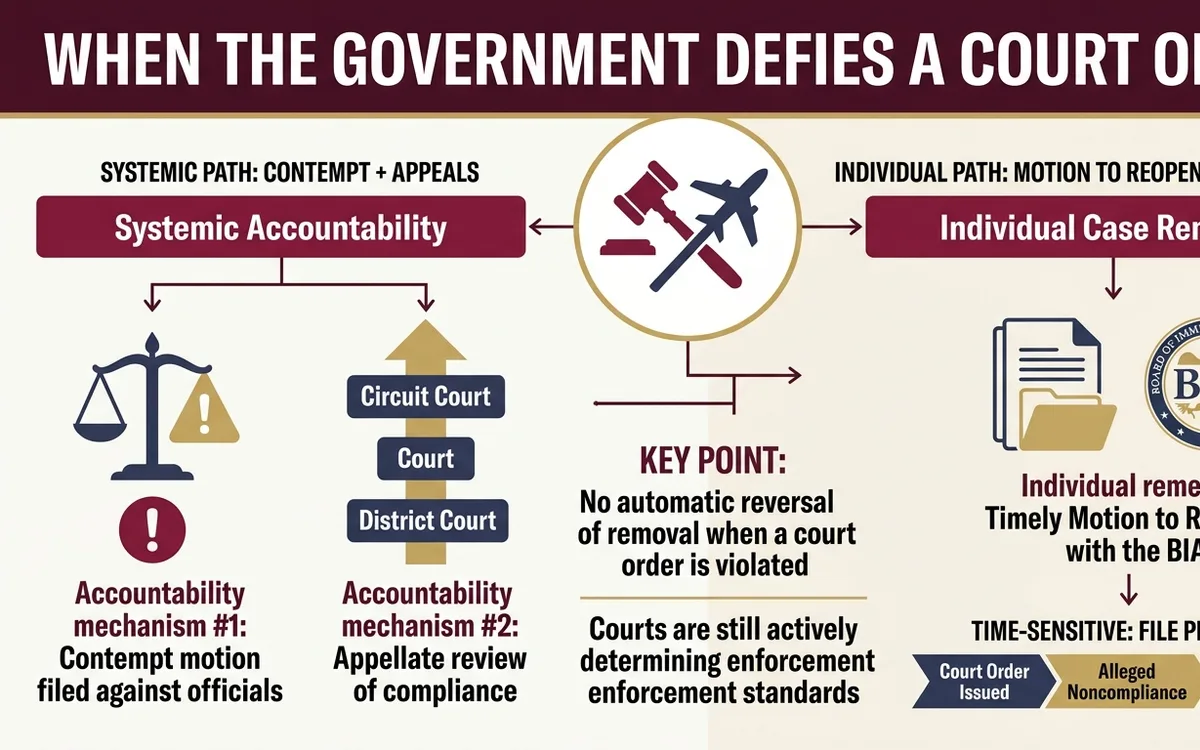
When federal officials ignore a judge's order in an immigration case, as the ACLU argued occurred in the Alien Enemies Act removal-flights litigation, accountability depends on contempt motions and appellate review, not automatic reversal. Courts are still deciding how to enforce compliance. For an individual case, the path forward is a timely motion to reopen or BIA appeal.
The Hard Truth
A judge finding that the government broke the law does not automatically bring anyone home. Contempt proceedings against federal officials move slowly, and courts have real limits on how they can compel compliance once a removal has already happened. The case the ACLU is litigating, over flights carried out under the Alien Enemies Act, is still working through the federal courts, and no one can tell you today how or when it will resolve.
What that means practically: you cannot wait for that larger fight to finish before protecting your own case. The deadlines in your immigration file do not pause because a different lawsuit is pending.
What Happens If You Wait
A motion to reopen generally must be filed within 90 days of a final removal order, per 8 C.F.R. § 1003.23(b)(1). An appeal to the Board of Immigration Appeals (BIA) generally must be filed within 30 days of the immigration judge's decision, per 8 C.F.R. § 1003.38(b). Miss either window, and the immigration court or the BIA can refuse to hear the case at all, no matter how strong the underlying facts are.
While you wait, detention does not pause either. Someone held at Krome Service Processing Center in Miami or Broward Transitional Center in Pompano Beach stays in custody while these clocks run. Every week spent unsure which deadline applies is a week closer to losing the option to use it.
Step-by-Step Process
Start by confirming exactly what order exists and what it covers. Request the A-number and the most recent order from the file at the Miami Immigration Court (EOIR); you are entitled to know the current posture of your own case.
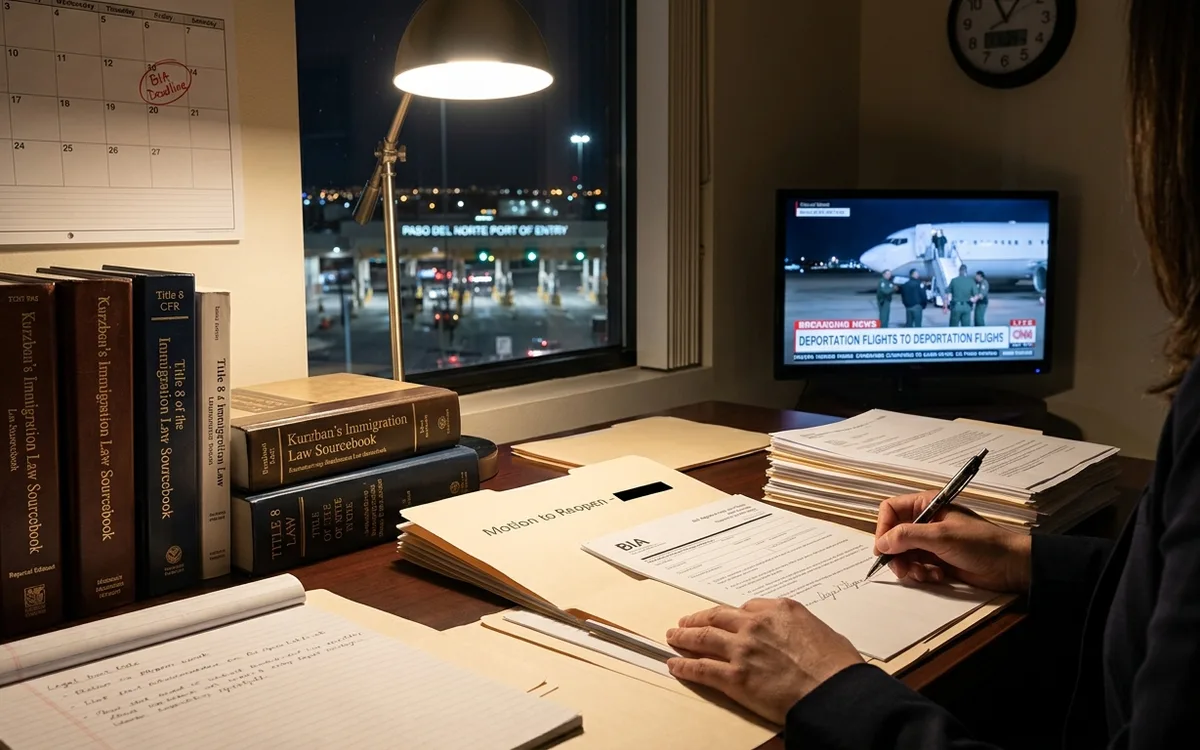
Identify which deadline applies. If a final removal order has already been issued, you generally have 90 days to file a motion to reopen under 8 C.F.R. § 1003.23(b)(1), or 30 days to appeal to the BIA under 8 C.F.R. § 1003.38(b). These run from the date of the order, not from the date you found out about it.
If the person is detained at Krome or Broward Transitional Center, use ICE's online detainee locator to confirm custody status, and submit a FOIA request for the full A-file to see what the government's records actually show.
Separately, understand that enforcing a federal court order against government officials, through contempt or an injunction under the All Writs Act, 28 U.S.C. § 1651, is litigated in federal district court. That is a distinct legal track from the immigration court process, with its own filing rules under Federal Rule of Civil Procedure 65(d) and its own attorney admission requirements tied to that specific district court.
If the BIA denies a motion or appeal, a petition for review can be filed with the U.S. Court of Appeals for the Eleventh Circuit, which covers Miami-based cases, generally within 30 days of the BIA's final order under 8 U.S.C. § 1252(b)(1).
A Real-World Example
Consider a composite example based on the kind of call our office receives. A woman in Hialeah learns her brother, detained at Krome, was placed on a removal flight the same week news broke about officials allegedly defying a judge's order in an unrelated case. She does not know whether her brother's case is connected to that litigation or entirely separate.
The first step is not guessing. It is pulling the actual order from his Miami Immigration Court file and confirming the date it became final. That date determines whether a motion to reopen is still available under the 90-day window in 8 C.F.R. § 1003.23(b)(1), or whether the 30-day BIA appeal deadline under 8 C.F.R. § 1003.38(b) has already passed.
From there, the file gets reviewed for whether any prior motion, appeal, or stay request is already pending, since that changes what filing makes sense next. The family is told, plainly, which deadlines have already closed and which are still open. No outcome is promised at any point in this process, because the immigration court and the BIA decide those questions, not the attorney reviewing the file.
William J. Vasquez is admitted to the North Carolina State Bar and to the Fourth, Fifth, and Eleventh Circuit Courts of Appeals. His practice before the Eleventh Circuit covers petitions for review of BIA decisions arising from immigration courts within that circuit, including the Miami Immigration Court.
Immigration proceedings before the Executive Office for Immigration Review (EOIR), the BIA, and USCIS are federal matters, and federal immigration practice does not require a Florida state bar license. Mr. Vasquez's work on these cases is grounded in his federal immigration-bar standing and his Eleventh Circuit appellate admission, not in any Florida state-court credential, which he does not hold and does not claim.
Key Terms Explained
Contempt of court: a finding that a party disobeyed a court's order, which can lead to sanctions but does not by itself reverse an action already taken.
Motion to reopen: a filing asking the original immigration court to reconsider a case based on new facts or evidence not available earlier, governed by 8 C.F.R. § 1003.23(b)(1).
Board of Immigration Appeals (BIA): the administrative body within EOIR that reviews immigration judges' decisions; appeals to it are governed by 8 C.F.R. § 1003.38(b).
Petition for review: a request to a U.S. Court of Appeals, such as the Eleventh Circuit, to review a final BIA order, governed by 8 U.S.C. § 1252(b)(1).
All Writs Act (28 U.S.C. § 1651): the statute federal courts can use to issue orders necessary to enforce their own prior rulings.
8 U.S.C. § 1252(f)(1): a statute that limits when federal courts can issue injunctions against certain immigration enforcement actions.
Frequently Asked Questions
Q: Can federal officials really be held in contempt for ignoring a judge's order in an immigration case? A: Courts can find officials in contempt, and the ACLU has argued in litigation over Alien Enemies Act removal flights that this is exactly what happened (per ACLU, aclu.org). As of now, the courts are still deciding how, or whether, to enforce that finding.
Q: If my relative was deported despite a court order, does that mean they automatically come back? A: No. A finding that an order was violated does not by itself undo a removal. Separate legal steps, such as a motion to reopen or an appeal, have to be filed within their own deadlines regardless of what happens in the broader court fight over accountability.
Q: What deadline applies if my family member already has a final removal order? A: Generally, a motion to reopen must be filed within 90 days of the final order under 8 C.F.R. § 1003.23(b)(1), and a BIA appeal within 30 days under 8 C.F.R. § 1003.38(b). The exact date on the order controls, so getting a copy of it is the first step.
Q: Is enforcing a federal court order against the government the same process as an immigration appeal? A: No. Enforcing compliance with a federal court order, through contempt or the All Writs Act, 28 U.S.C. § 1651, happens in federal district court. A motion to reopen or a BIA appeal happens inside the immigration court system, and they run on different rules and different deadlines.
Clients come to our office after a removal order, a denied application, or a detention they did not see coming. What they describe afterward is less about any single result and more about finally understanding what was actually happening in their case, the deadlines that applied, and what options remained. We do not publish outcome statistics, because immigration case results are not something a law firm can responsibly quantify or guarantee.
If your family is caught in the gap between a news story about government misconduct and the specific deadline sitting in your own file, the gap is where the risk lives. The broader accountability litigation will take its own time. Your case's deadlines will not wait for it.
If someone in your family has a pending case before the Miami Immigration Court, has already received a removal order, or is detained at Krome or Broward Transitional Center, call our office to review the file, confirm which deadlines still apply, and go over whether a motion to reopen, a BIA appeal, or an appeal to the Eleventh Circuit fits the facts.
- Removal Defense
- BIA Appeals
- Motions to Reopen
- Eleventh Circuit Immigration Appeals
- Detention and Bond Case Review
- Contact Our Office