TPS Haiti in Orlando: Protect Your Status, Know Your Rights
October 10, 2026
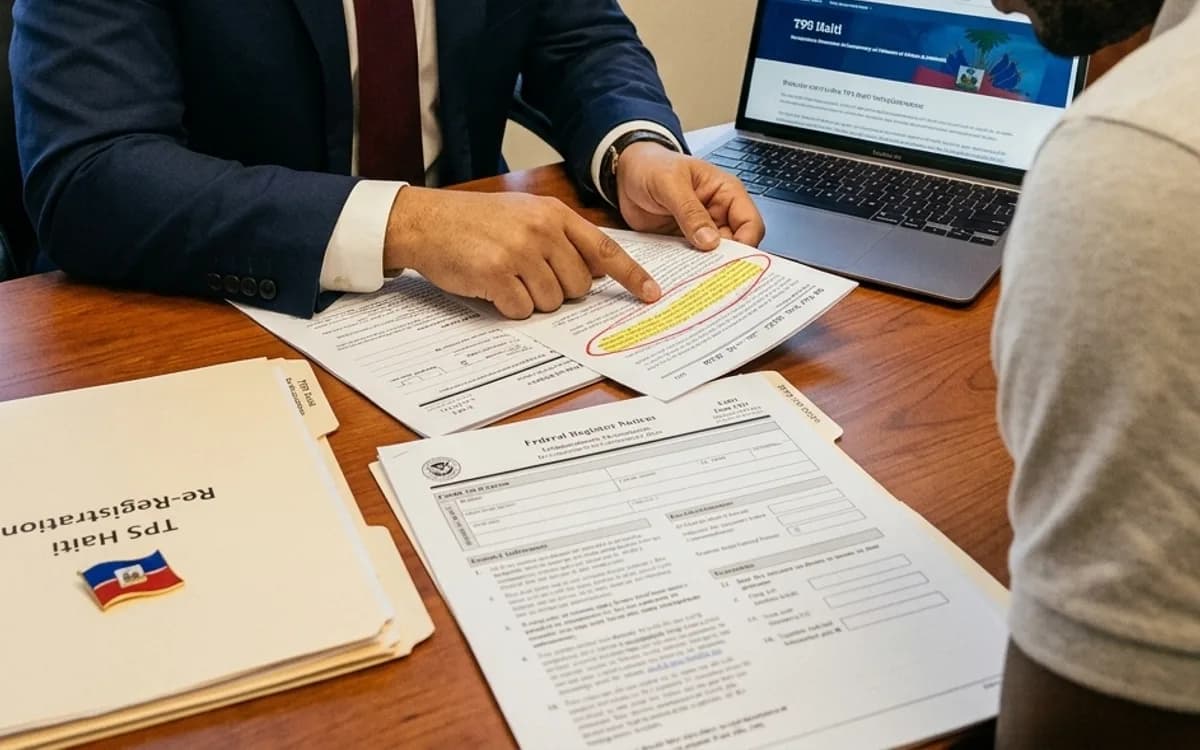
Your TPS work permit has an expiration date printed on it, and that date is closer than it looks. If you are Haitian and holding Temporary Protected Status, you have likely already lived through one deadline scare: the 2024 termination attempt, the lawsuit that paused it, the extension that followed. Each round takes something out of you. You need to know where things stand right now, not where they stood a year ago.
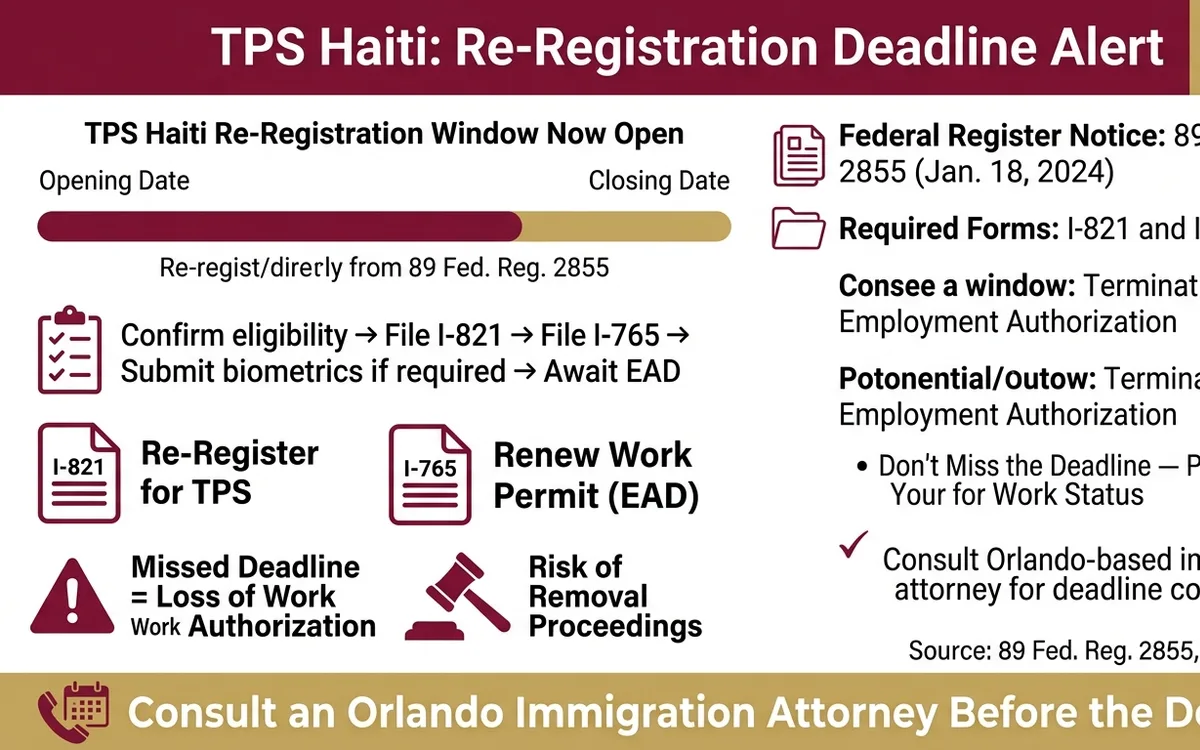
Haitian nationals with Temporary Protected Status must re-register during the window set by the current Federal Register notice (89 Fed. Reg. 2855, Jan. 18, 2024) to keep work authorization active. Missing that window can end employment authorization and expose a person to removal proceedings. An Orlando-based immigration attorney can confirm deadlines and file Forms I-821 and I-765 correctly.
The Hard Truth
Temporary Protected Status is exactly what the name says: temporary. Congress built INA Section 244, 8 U.S.C. § 1254a, as a stopgap for people who cannot safely return to a country affected by conflict or disaster, not as a route to permanent residence. Re-registration does not get easier each cycle. USCIS processing of Form I-765 renewals has run months behind the official notice period in recent cycles, and a late or incomplete filing is not automatically forgiven. If you are counting on TPS alone to keep you in the country long-term, you need a different plan, and that plan takes time to build.
What Happens If You Wait
Every TPS re-registration window closes on a fixed date published in the Federal Register notice for Haiti. Miss it, and your current status and Employment Authorization Document can lapse before USCIS finishes processing anything. An employer who sees an expired EAD has no legal basis to keep you on payroll under 8 C.F.R. § 274a.12, even while your renewal sits in a government mailroom. Once status lapses, you also lose the automatic protection against removal that TPS provides, and a pending but late filing does not undo a Notice to Appear already issued by DHS. People who wait until deadline week to gather documents routinely lose the extra months USCIS sometimes grants under 8 C.F.R. § 244.17 for timely-filed applications still pending.
Step-by-Step Process
Start by confirming the exact re-registration window for Haiti in the current Federal Register notice; dates change with each extension or redesignation and the window printed on an old flyer may no longer apply. Gather proof of continuous residence and physical presence since your last approval, including lease records, pay stubs, and school records for any children. File Form I-821 (TPS re-registration) and Form I-765 (EAD renewal) together, not separately, so USCIS processes them as one package. If you cannot afford the filing fees, file Form I-912 requesting a fee waiver based on income or a qualifying hardship. Attend your scheduled biometrics appointment at the USCIS Orlando Field Office, 9403 Tradeport Drive, and bring your current EAD and any prior TPS approval notices. Track your receipt notice number and check whether the Federal Register notice includes an automatic EAD extension while your renewal is pending. If USCIS denies the filing or DHS issues a Notice to Appear, your case moves to the Orlando Immigration Court (EOIR) at 3535 Lawton Road, where different deadlines and a different set of options apply.
A Real-World Example
The following is a composite, not an actual client, used to illustrate the process. 'Marie' is a Haitian national who has held TPS since 2011. In 2024, her re-registration fell three weeks outside the published window because she was caring for a sick relative and missed the Federal Register notice entirely. Her attorney first checked whether the delay fell within any exception recognized under 8 C.F.R. § 244.17 for that re-registration period, then filed Form I-821 with a cover letter documenting the circumstances. Biometrics were scheduled at the USCIS Orlando Field Office about five weeks after filing. The I-765 EAD renewal went in at the same time, along with an I-912 fee waiver request tied to her reduced work hours during the caregiving period. As of the most recent update, USCIS had not yet issued a decision; the filing remained pending adjudication, which is ordinary, since published I-821 processing times regularly run eight months or longer.
William J. Vasquez is licensed by the North Carolina State Bar and admitted to practice before the U.S. Courts of Appeals for the Fourth, Fifth, and Eleventh Circuits. Immigration matters, including TPS applications before USCIS, hearings before the Executive Office for Immigration Review, and appeals to the Board of Immigration Appeals, are federal matters. Under 8 C.F.R. § 1292.1, an attorney licensed in good standing in any U.S. state may represent clients nationwide before USCIS and EOIR, regardless of where that license was issued. His work on Haiti TPS filings is scoped to these federal proceedings.
Key Terms Explained
Temporary Protected Status (TPS): a designation under INA Section 244, 8 U.S.C. § 1254a, letting nationals of a specified country remain and work in the United States while conditions there make return unsafe.
Re-registration: the periodic renewal filing a current TPS holder must submit during a window published in a Federal Register notice to maintain status and work authorization.
Form I-821: the application used to register or re-register for TPS.
Form I-765: the application for an Employment Authorization Document (EAD), filed alongside Form I-821 for TPS purposes.
Form I-912: the request for a fee waiver on USCIS filing fees, based on income, hardship, or receipt of a means-tested benefit.
Federal Register notice: the official government publication where USCIS announces TPS extensions, redesignations, and the specific re-registration dates for a country.
Redesignation: an expansion of TPS eligibility to include people who arrived in the U.S. after the original designation date, published in a new Federal Register notice.
EOIR: the Executive Office for Immigration Review, the federal agency that runs immigration courts and hears removal cases.
BIA: the Board of Immigration Appeals, which reviews appeals of immigration judge decisions.
Notice to Appear (NTA): the document DHS files to start removal proceedings against a person in immigration court.
Frequently Asked Questions
Q: What happens if my Haiti TPS expires while my renewal is still pending with USCIS? A: If you filed Forms I-821 and I-765 within the re-registration window published in the Federal Register notice, USCIS often grants an automatic extension of your current EAD's validity through that same notice or a follow-up publication. Automatic extensions are not guaranteed for every cycle, so check the specific Haiti notice rather than assuming the last cycle's rule still applies.
Q: Can I apply for TPS Haiti if I missed the original registration period years ago? A: Possibly, through late initial registration under 8 C.F.R. § 244.2(f), if you can show you qualify for a recognized exception, such as recently obtaining Haitian nationality or a documented change in circumstances. These exceptions are narrow and require supporting evidence, not just a written explanation.
Q: Does TPS lead to a green card? A: Not by itself. A TPS holder who separately qualifies for another benefit, such as a family-based petition or asylum, may later pursue adjustment of status, but TPS on its own grants only temporary protection from removal and temporary work authorization under INA Section 244.
Q: Is there a fee waiver available for TPS re-registration? A: Form I-912 lets applicants request a waiver of the I-821 and I-765 filing fees based on household income, financial hardship, or receipt of a means-tested public benefit. USCIS decides each request individually based on the documentation submitted.
Clients describe our intake process in Haitian Creole and English as clear and unhurried, and many return for other family members once they understand how the filing process actually works. We do not publish star counts or outcome percentages here; TPS adjudications are USCIS decisions, not results a law firm controls or can ethically promise. What we can account for is how the paperwork gets built, tracked, and followed through to a decision.
Reading a Federal Register notice is not the same as applying it correctly to your own file. If you are unsure which window applies to you, or whether a past denial can be revisited under a later redesignation, that is worth a conversation before the next deadline, not after it.
Schedule a consultation with our Orlando team to review your Haiti TPS filing, whether you are re-registering, pursuing late initial registration, or responding to a denial. Call our Orlando office or request a consultation online, and bring your current TPS documents, EAD, and any USCIS notices you have received.

- TPS Haiti Re-Registration
- Employment Authorization (EAD) Renewal
- Late Initial TPS Registration
- Immigration Court Representation
- BIA Appeals
- Contact Our Orlando Office