USCIS Processing Times: What Delays Mean for Your Case
October 10, 2026
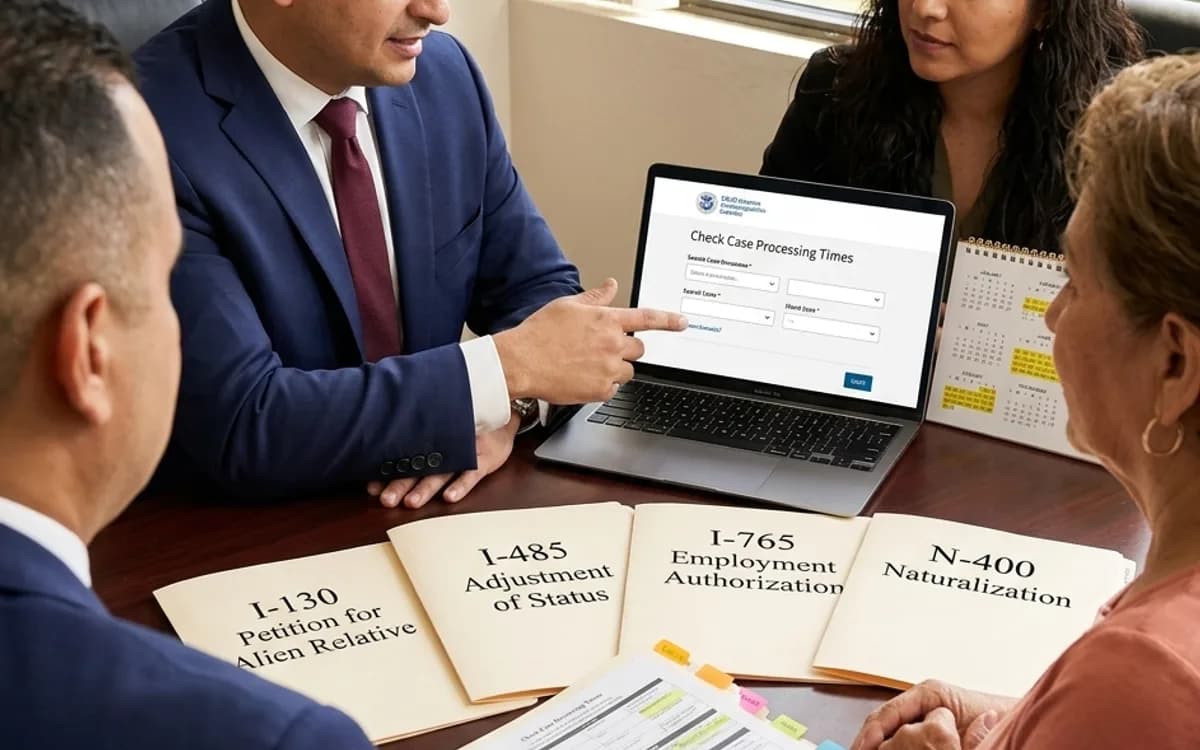
En español: Si usted busca “tiempo de procesamiento USCIS,” aquí está la respuesta directa: revise el estado de su trámite en la herramienta oficial, egov.uscis.gov/processing-times, escribiendo el tipo de formulario y la oficina que lo procesa. Si su caso ya pasó el tiempo normal, puede presentar un e-Request, y en casos extremos, una demanda federal por demora injustificada.
You refreshed the USCIS case status page again this morning. The processing time bar still says your Form I-485 or I-130 should have moved by now, and it has not. Maybe your work permit is about to expire, or the wedding you planned around your green card interview is six weeks away.
Checking a government tool and getting no real answer is its own kind of stress. The number on that screen is not a promise from USCIS. It is a snapshot of how long the last batch of similar cases took to finish, updated once a month, and your case can sit past it for reasons the tool never explains.
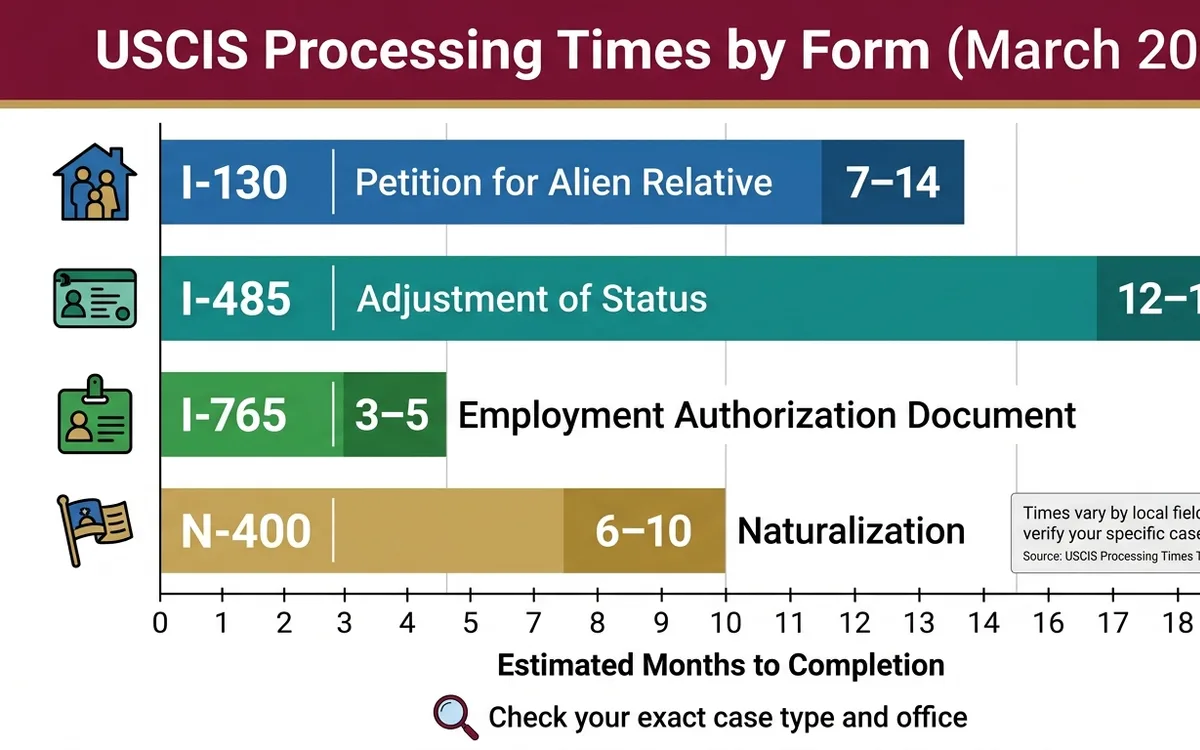
USCIS processing times vary by form and office: I-130 petitions take roughly 7 to 14 months, I-485 adjustment of status 12 to 19 months, I-765 work permits 3 to 5 months, and N-400 naturalization 6 to 10 months (USCIS Processing Times Tool, March 2025). Check your exact case type and office before assuming a delay.
The Hard Truth
The Processing Time Tool Shows History, Not a Promise
The number you see on the USCIS Processing Times Tool is not a deadline USCIS owes you. It reflects how long it took the agency to complete 93% of similar cases at that office over the prior six months, recalculated and republished monthly (USCIS Processing Times Tool, egov.uscis.gov/processing-times, data retrieved March 2025). Half the point of the tool is that some cases always take longer than the posted range.
Background checks, biometrics backlogs, and random quality-assurance review can hold a case well past the normal window with no notice to you. Asylum cases at the Miami Asylum Office, for instance, can sit for three to six years or more under the agency's last-in-first-out docketing approach. None of this means your case is denied, and none of it means an attorney can make USCIS move faster by asking nicely.
What Happens If You Wait
What Happens If You Wait Without Taking Any Action
A pending case does not freeze your other deadlines. If your work permit (Form I-765) expires while a timely-filed renewal is pending, you get an automatic extension of up to 540 days under the Department of Homeland Security's temporary final rule (8 C.F.R. § 274a.13(d), 89 Fed. Reg. 83947, Sept. 27, 2024), but only for the categories the rule covers, and only if you filed before the card expired. Miss that filing window and the extension does not apply; you lose work authorization the day the old card expires.
Family-based cases have their own trap. Once an approved I-130 petition reaches the National Visa Center, the case is administratively closed after one year of inactivity, for example if requested civil documents or the DS-260 immigrant visa application are never submitted (22 C.F.R. § 42.83(b)). Reopening it later usually means resubmitting the $325 immigrant visa application fee (U.S. Department of State Visa Services Fee Schedule) and waiting for a new interview slot through our family-based petitions page.
If you are also in removal proceedings before the Miami or Orlando immigration court, a stalled USCIS petition does not pause your court deadlines. Missing a filing deadline set by the immigration judge because you were waiting on USCIS can mean losing the ability to present that evidence at all, regardless of where your underlying petition stands.
Step-by-Step Process
Step 1: Read the USCIS Processing Times Tool Correctly
Go to the USCIS Processing Times Tool and select your exact form and the field office or service center handling it, not just the form in general. The tool gives a range, for example 10.5 to 14 months for an I-130 filed at the Miami Field Office, and only cases outside that upper number count as delayed.
Step 2: Confirm Your Case Is Actually Outside Normal Time
Compare the filing date on your receipt notice (Form I-797C) to the posted upper range. If your case has not crossed that line yet, there is nothing to escalate; USCIS is within its own stated window even if it feels slow.
Step 3: File an e-Request
If you are past the range, submit a USCIS e-Request online. USCIS generally responds within 30 days. This step is free, takes about ten minutes, and is a prerequisite before any further escalation, including a federal lawsuit.
Step 4: Escalate Through the CIS Ombudsman or a Congressional Inquiry
If the e-Request response is unhelpful or the deadline passes with no answer, you can file a case assistance request with the USCIS Ombudsman or ask your member of Congress's office to submit a congressional inquiry. Neither office can order USCIS to approve your case, but both can prompt a status review.
Step 5: Consider a Federal Mandamus or APA Delay Lawsuit
If the delay remains unreasonable after exhausting the steps above, an attorney can evaluate a lawsuit under the Mandamus Act (28 U.S.C. § 1361) and the Administrative Procedure Act (5 U.S.C. § 706(1)), filed in the U.S. District Court for the Southern District of Florida in Miami or the Middle District of Florida in Orlando, depending on where the case is pending. Courts evaluate these claims using the six-factor test from Telecommunications Research & Action Center v. FCC, 750 F.2d 70 (D.C. Cir. 1984), known as the TRAC factors. A mandamus order compels USCIS to issue a decision; it does not compel approval of the underlying petition, and a swift denial is as legally possible as a swift approval. Before filing, Southern District of Florida Local Rule 7.1(a)(3) requires the parties to confer, and in practice USCIS's local counsel is notified at that point and often responds before the judge rules on anything.
A Real-World Example
Example: How a Stalled I-130 Case Typically Moves Through the Process
Consider a composite example based on patterns we see, not a real client. Mateo filed an I-130 petition for his spouse in January 2023 through the Miami Field Office. By March 2025 the case had been pending 26 months, well past the 14-month upper range posted on the USCIS Processing Times Tool for that office.
Mateo filed a free e-Request in February 2025 and received a form response ten days later stating the case remained within normal processing. He waited the full 30 days required before any further escalation and kept a dated record of each contact. When the delay persisted, he consulted an attorney about whether the TRAC factors supported a mandamus complaint in the Southern District of Florida.
The attorney reviewed the receipt notice, the e-Request response, and any prior Requests for Evidence before drafting a complaint under 28 U.S.C. § 1361 and 5 U.S.C. § 706(1). Filing triggered the Local Rule 7.1(a)(3) conferral requirement, and USCIS's counsel was formally notified of the suit. At that point the case moved into the court's standard scheduling process, with USCIS required to respond to the complaint within the deadlines set by the Federal Rules of Civil Procedure.
William J. Vasquez is admitted to the North Carolina State Bar and holds federal immigration-bar standing that allows him to represent clients before USCIS, the Executive Office for Immigration Review, and the Board of Immigration Appeals nationwide, under 8 C.F.R. § 1292.1. He is also admitted to the Fourth, Fifth, and Eleventh Circuit Courts of Appeals, which covers federal appellate matters arising from Florida, including petitions for review of BIA decisions originating in this state.
His practice includes evaluating USCIS delay complaints, from reading a client's posted processing-time range correctly through drafting mandamus and Administrative Procedure Act complaints in federal district court. That federal scope is what matters here: USCIS, EOIR, and BIA practice is governed by federal, not state, bar rules, so his authority to handle these matters does not depend on Florida state-court admission, which he does not hold and does not claim.
Our team reviews each processing-time dispute individually before recommending an e-Request, an Ombudsman inquiry, or litigation, because the right escalation step depends on the form, the office, and how far past the posted range the case already is. See his full background on our attorney profile page.
Key Terms Explained
Key Terms Used on This Page
USCIS Processing Times Tool: The agency's online tool (egov.uscis.gov/processing-times) showing the time it took to complete 93% of recently decided cases for each form and office, updated monthly.
e-Request: A free online case inquiry submitted through the USCIS website when a case is outside its posted processing time; USCIS typically responds within 30 days.
Writ of Mandamus: A federal court order compelling a government agency to perform a duty it is legally required to perform, such as issuing a decision on a pending petition (28 U.S.C. § 1361). It does not compel a particular outcome.
TRAC Factors: A six-part test from Telecommunications Research & Action Center v. FCC, 750 F.2d 70 (D.C. Cir. 1984), that federal courts use to decide whether an agency's delay is unreasonable enough to justify court intervention.
Administrative Procedure Act (APA) Unreasonable Delay Claim: A claim under 5 U.S.C. § 706(1) asking a court to compel agency action unlawfully withheld or unreasonably delayed.
NVC Administrative Closure: The National Visa Center's practice of closing an approved immigrant visa case after one year of inactivity on the applicant's part (22 C.F.R. § 42.83(b)).
Frequently Asked Questions
Q: Why does USCIS say my case is outside the normal processing time? A: The posted range only reflects the time it took to complete 93% of recently decided cases at your specific office, not a guarantee for every case (USCIS Processing Times Tool). Cases involving background check holds, missing biometrics, or random quality review can take longer without any notice to you.
Q: How do I submit an e-Request to USCIS? A: Go to egov.uscis.gov/e-request, select the inquiry type that matches your situation, and enter your receipt number. USCIS generally responds within 30 days, and this step is required before any further escalation, including a federal lawsuit.
Q: How much does a mandamus lawsuit against USCIS cost? A: The federal district court filing fee is currently $405 under the court's standard civil case fee schedule (28 U.S.C. § 1914 and the Judicial Conference miscellaneous fee schedule). Attorney fees are typically billed as a flat fee or hourly rate, since contingency billing does not apply to immigration matters.
Q: If NVC closes my I-130 case for inactivity, do I have to pay the filing fee again? A: Usually not. The approved I-130 petition itself does not need to be refiled, but reopening the case at NVC typically requires resubmitting the $325 immigrant visa application fee (U.S. Department of State Visa Services Fee Schedule) and any lapsed civil documents.
Q: Will my work permit automatically extend if my renewal is still pending when it expires? A: It can, for up to 540 days, but only for eligible categories and only if you filed the renewal (Form I-765) before the current card expired (8 C.F.R. § 274a.13(d), 89 Fed. Reg. 83947). Filing after expiration forfeits the automatic extension.
Q: How long is the wait for an asylum interview in Miami? A: Affirmative asylum cases at the Miami Asylum Office can take three to six years or longer, because USCIS processes most asylum applications on a last-in-first-out basis that prioritizes newer filings (USCIS Processing Times Tool, March 2025).
Q: Can an attorney make USCIS decide my case faster without going to court? A: Sometimes. An e-Request, a USCIS Ombudsman case assistance request, or a congressional inquiry can prompt a status review, though none of them can order USCIS to approve a case or guarantee a faster decision.
Clients who come to us about a stalled USCIS case usually want two things: a straight answer about whether the delay is normal, and a clear next step if it is not. Reviews on Google and Avvo from immigration clients describe direct communication about where a case stands and what the realistic timeline looks like from that point forward, rather than vague reassurance. We do not publish outcome statistics for these cases, because USCIS processing delays resolve case by case, and a quoted success rate would not describe any individual reader's situation honestly.
Before you decide whether your case needs an e-Request, an Ombudsman inquiry, or a federal lawsuit, it helps to have someone look at your actual receipt notice and processing-time data side by side. The right next step depends on which office has your case, how far past the posted range it is, and whether you have already tried the free options above.
If your case is pending well past the posted USCIS range and the free options above have not moved it, schedule a consultation with our team to review your receipt notice, e-Request response, and whether a federal mandamus or APA delay claim fits your situation. Request a case-delay consultation through our immigration practice, or start with our USCIS delay litigation page to see how the process works before you call.

- /immigration/adjustment-of-status
- /immigration/family-based-petitions
- /immigration/citizenship-naturalization
- /immigration/employment-authorization
- /immigration/uscis-delay-lawsuit
- /attorneys/william-vasquez