Pennsylvania Citizenship and Naturalization Lawyer
October 10, 2026
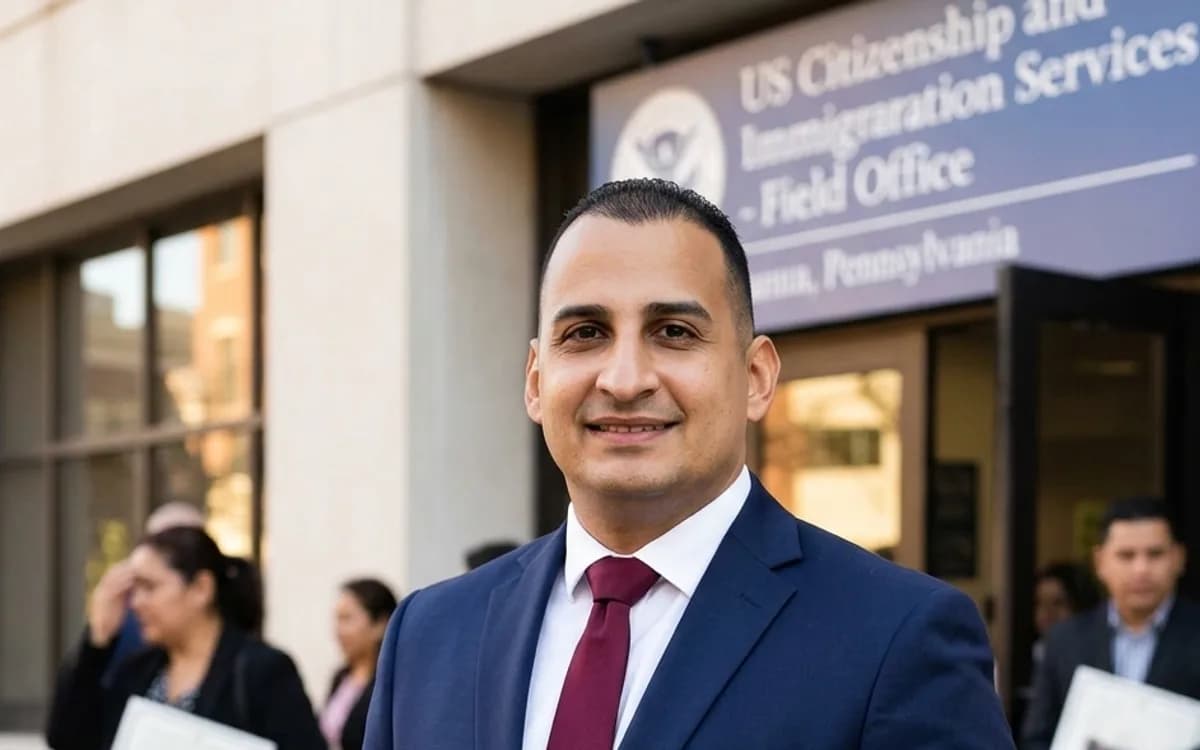
You got a notice, or you're staring at Form N-400 wondering if a DUI from 2019 or six months you spent working in Germany is going to sink your case. Naturalization isn't complicated because the form is hard. It's complicated because one missed detail, a trip abroad you didn't track, an old conviction you assumed didn't matter, can turn a routine interview at the Philadelphia Field Office into a denial or a referral to immigration court.
Here's what matters first: naturalization is federal law. USCIS decides your N-400 under 8 U.S.C. § 1427, not a Pennsylvania state court, and there is no state-bar requirement standing between you and effective representation. An attorney admitted to practice before the federal courts and USCIS can represent a Pittsburgh or Philadelphia-area applicant the same way a locally licensed attorney could, because naturalization jurisdiction runs through federal agencies and federal courts, not state ones.
That doesn't mean every case is simple. It means whether you need someone licensed in Pennsylvania isn't actually the right question to ask.
Naturalization (Form N-400) is decided entirely under federal law, 8 U.S.C. § 1427, by USCIS, not Pennsylvania courts. Pennsylvania applicants interview at the Philadelphia or Pittsburgh Field Office. Any attorney with federal immigration-bar standing, regardless of state bar location, can represent you. Good moral character issues, prior convictions, and overseas trips are the real risk factors.
The Hard Truth
Good moral character is where most preventable denials happen, and it's evaluated over a statutory period, 5 years for standard applicants, 3 years for marriage-based cases under INA § 319(a), plus USCIS can look further back. A single DUI doesn't automatically disqualify you, but multiple DUIs, a DUI within the statutory period combined with other conduct, or an unresolved warrant will draw scrutiny under 8 U.S.C. § 1427(a) (https://www.law.cornell.edu/uscode/text/8/1427). Unpaid child support can also count against you if a court order was ignored, since willful failure to support dependents is listed as conduct that reflects on moral character in the USCIS Policy Manual (https://www.uscis.gov/policy-manual).
If you were ever in removal proceedings, even if they were terminated years ago, USCIS will pull that record at the interview. Bring the immigration court's final order, not just your memory of what happened. Processing itself isn't fast: as of the USCIS Case Processing Times tool (https://egov.uscis.gov/processing-times/), checked June 2025, the Philadelphia Field Office listed a median N-400 processing time of roughly 8 to 13 months and the Pittsburgh Field Office roughly 6 to 10 months. Check the live tool before you plan around any number here, because these figures move quarterly and yours is the only one that matters.
What Happens If You Wait
Waiting to address a known problem doesn't make it disappear at the interview. If you have a conviction on your record, a status question, or a gap in your continuous residence from an extended trip abroad, USCIS finds it in the same background check that clears most applicants. The difference is whether you walked in prepared to explain it with documentation or walked in hoping it wouldn't come up.
A denied N-400 isn't the end of the process, but it starts a clock. You have 30 days to file Form N-336 requesting a hearing before a different USCIS officer, under 8 C.F.R. § 336.2, and missing that window can mean refiling from scratch and waiting out another processing cycle. If your case sat past 120 days after the interview with no decision, you gain the right to ask a federal district court to decide it yourself under 8 U.S.C. § 1447(b) (https://www.law.cornell.edu/uscode/text/8/1447), but that petition has its own filing requirements and deadlines that don't wait for you to get around to it.
For applicants with a prior removal history, delay carries a sharper risk: an N-400 that surfaces an old, unresolved order can put you back in front of an immigration judge instead of closer to a certificate.
Step-by-Step Process
How the N-400 Process Works for Pennsylvania Applicants
Step 1: Eligibility screening
Confirm you meet the residence and physical presence thresholds under 8 U.S.C. § 1427(a) (https://www.law.cornell.edu/uscode/text/8/1427): 5 years as a lawful permanent resident (3 years if married to and living with a U.S. citizen spouse under INA § 319(a)), plus physical presence for at least half of that period. Trips of a year or more generally break continuous residence outright, absent an approved Form N-470 exception for qualifying overseas employment.
Step 2: File Form N-400
As of the USCIS fee schedule effective April 1, 2024 (https://www.uscis.gov/g-1055), the filing fee is $760 on paper or $710 if filed online, with no separate biometrics fee for most applicants. Filing electronically through your USCIS online account, where eligible, is the faster intake path.
Step 3: Biometrics
USCIS schedules a biometrics appointment at an Application Support Center under 8 C.F.R. § 335.2 (https://www.law.cornell.edu/cfr/text/8/335.2), which requires a personal examination, not just paperwork submission. Pennsylvania applicants are typically routed to an ASC near their county of residence.
Step 4: Interview
Eastern Pennsylvania applicants interview at the USCIS Philadelphia Field Office; Western Pennsylvania applicants interview at the USCIS Pittsburgh Field Office. Bring your green card, passport, any court dispositions for prior arrests, and, if applicable, the final order from any past removal proceeding.
Step 5: Decision
USCIS approves, denies, or issues a Request for Evidence and continues the case. A continuance is common when a document is missing; it is not a denial.
Step 6: Oath ceremony
Most approved applicants take an administrative oath scheduled directly by USCIS. A smaller number take a judicial oath before the U.S. District Court for the Eastern District of Pennsylvania or the Western District of Pennsylvania, governed procedurally by Federal Rule of Civil Procedure 81(a)(3) (https://www.law.cornell.edu/rules/frcp/rule_81). If your Certificate of Naturalization has an error after the ceremony, correct it with Form N-565, not by refiling the whole case.
If USCIS denies your case
File Form N-336 within 30 days to request a hearing before a different officer (8 C.F.R. § 336.2). If USCIS simply never decides within 120 days of your interview, you can file a petition for judicial review directly with the federal district court under 8 U.S.C. § 1447(b) (https://www.law.cornell.edu/uscode/text/8/1447).
A Real-World Example
Consider a composite: a green card holder in Allegheny County, married to a U.S. citizen, filing under the 3-year marriage-based track. He had a single DUI conviction four years before filing, outside the 3-year statutory period but close enough that he expected USCIS to ask about it. He also spent 7 months working for a client in Ontario during year two of the statutory period, a trip long enough to raise a continuous residence question but short of the 1-year automatic break.
Before filing, he gathered the certified court disposition for the DUI, proof of an alcohol education course he completed voluntarily, and a letter from his employer documenting the Ontario assignment's start and end dates. At the Pittsburgh Field Office interview, the officer asked about both the conviction and the trip; because the documentation was already organized by date, the interview covered them in about ten minutes instead of triggering a continuance for a Request for Evidence. His case was not decided at the interview itself; USCIS told him a decision would follow by mail, which is standard when an officer wants to confirm a record internally before issuing a result.
This scenario illustrates the mechanics of preparation, not a guaranteed result. Every N-400 turns on facts specific to that applicant, and a prior conviction or an extended trip abroad can lead to a request for more evidence, a continuance, or a supervisory review regardless of how well-documented the file is.
William J. Vasquez handles federal immigration matters, including N-400 naturalization petitions and Section 1447(b) delay litigation, for clients across the country, including Pennsylvania residents assigned to the Philadelphia or Pittsburgh Field Office. He holds North Carolina Bar admission along with admission to the U.S. Courts of Appeals for the Fourth, Fifth, and Eleventh Circuits. Naturalization is decided by USCIS and, when litigated, by U.S. district courts, not by Pennsylvania state courts, so representing a Pennsylvania-based applicant in this specific practice area doesn't require a Pennsylvania state law license.
He is a member of the American Immigration Lawyers Association (AILA). Our team's Florida-based office, which coordinates through the USCIS Miami Field Office for local matters and nationwide for clients elsewhere, handles filings, biometrics scheduling, and interview preparation remotely, so clients never need to set foot in Florida or, for that matter, in the state where their own field office sits.
Key Terms Explained
Key Terms Used on This Page
N-400: The Application for Naturalization, the form that starts the process of becoming a U.S. citizen after meeting the residence, presence, and good moral character requirements of 8 U.S.C. § 1427.
Good moral character (GMC): A statutory requirement, evaluated over the 3- or 5-year period before filing, that looks at criminal history, tax compliance, child support compliance, and honesty with USCIS. Defined in practice through USCIS Policy Manual guidance (https://www.uscis.gov/policy-manual), not a fixed checklist.
Continuous residence: An unbroken period of living in the U.S. as a lawful permanent resident. A single trip of a year or longer generally breaks it outright; shorter, repeated trips can still raise questions at the interview.
Physical presence: The total number of days you were actually inside the U.S. during the statutory period, calculated separately from continuous residence and requiring at least 30 months (or 18 months for the 3-year marriage track) of actual presence.
Application Support Center (ASC): A USCIS facility where biometrics, fingerprints, photo, and signature, are collected under 8 C.F.R. § 335.2 as part of the background check.
8 U.S.C. § 1447(b): The provision letting an applicant petition a federal district court to decide, or order USCIS to decide, an N-400 that has sat undecided for more than 120 days after the interview.
Form N-336: The form used to request a hearing before a different USCIS officer after a denial, filed within 30 days under 8 C.F.R. § 336.2.
Administrative vs. judicial oath ceremony: An administrative ceremony is scheduled and conducted by USCIS itself. A judicial ceremony takes place before a federal district court, in Pennsylvania that means the Eastern or Western District, and follows Federal Rule of Civil Procedure 81(a)(3).
Denaturalization: The process of revoking citizenship already granted, typically for fraud or willful misrepresentation in the original application, a standard shaped by Fedorenko v. United States, 449 U.S. 490 (1981) (https://supreme.justia.com/cases/federal/us/449/490/).
Frequently Asked Questions
Frequently Asked Questions
Can a green card holder living in Pittsburgh naturalize while working overseas for extended periods? It depends on how long each trip lasts and whether you kept your U.S. home and ties intact. A single trip of a year or more generally breaks continuous residence unless you filed Form N-470 in advance for qualifying employment. Multiple shorter trips that add up to more than half the statutory period can also draw questions, even without one trip crossing the one-year line.
What happens if USCIS denies my naturalization application after the interview at the Philadelphia Field Office? You have 30 days to file Form N-336 requesting review by a different officer, under 8 C.F.R. § 336.2. That review can result in approval, a second denial, or a request for more evidence; it is not itself a federal court proceeding.
How do I request judicial review under 8 U.S.C. § 1447(b) if USCIS hasn't decided within 120 days? You file a petition in the federal district court for the district where you live, the Eastern or Western District of Pennsylvania depending on where you're located. The court can decide the application itself or send it back to USCIS with instructions, and this petition has procedural requirements that differ from a standard N-336 request.
Does a DUI on my record disqualify me from establishing good moral character? Not automatically. A single, older DUI outside the statutory period, with no other conduct issues, is different from multiple DUIs or one that falls inside your 3- or 5-year window. USCIS reviews the full record, not just the existence of a conviction.
Can I file Form N-400 based on marriage to a U.S. citizen if my spouse is stationed at a Pennsylvania military base? Yes, an active-duty station location doesn't change the marriage-based 3-year eligibility track under INA § 319(a); it changes which USCIS office and ASC handle your case. If your spouse's status abroad affected your own physical presence calculation, flag that separately, since military family circumstances sometimes qualify for other exceptions under INA §§ 328/329.
Can prior unpaid child support affect a good moral character determination? Yes. Willful failure to pay child support ordered by a court is listed in USCIS guidance as conduct that can weigh against good moral character, separate from any criminal record. Documentation showing the arrears were resolved, or a payment plan you've followed, helps address it at the interview.
How do I correct an error in my Certificate of Naturalization after an oath ceremony? File Form N-565, Application for Replacement Naturalization/Citizenship Document, if the certificate has a USCIS typo or you've had a legal name change since the ceremony. If the error was USCIS's own mistake there's typically no additional fee; a requested name change follows the standard fee schedule (https://www.uscis.gov/g-1055).
Can a Florida-based immigration attorney represent someone living in Pennsylvania? Yes. Naturalization is decided by USCIS field offices and, when litigated, by federal district courts, not by Pennsylvania state courts, so representation doesn't depend on holding a Pennsylvania state law license. What matters is federal immigration-bar standing and familiarity with the Philadelphia and Pittsburgh Field Offices' specific procedures.
Clients who have worked with our team on federal immigration filings, including N-400 petitions, describe responsiveness during the months-long wait between interview and decision as the thing they valued most, since that waiting period is where most anxiety lives. Feedback on Google and Avvo consistently references clear explanations of what a Request for Evidence means and what documents to gather before an interview, rather than vague reassurance. We don't publish a star-rating figure here because aggregate review scores shift by platform and by the day; check current reviews directly on Google or Avvo before relying on any number a website quotes you.
None of this replaces a look at your specific file. A DUI from 2019, a 7-month remote work trip to Toronto, or a removal case closed five years ago all read differently on paper than they do once someone has actually pulled your record and checked it against the statutory period that applies to your filing basis.
If you're a Pennsylvania resident with a green card and a naturalization question that doesn't have a simple answer, schedule a consultation with our federal immigration team to review your N-400 eligibility, your continuous residence history, and any prior criminal or removal record before you file. We handle N-400 petitions and 8 U.S.C. § 1447(b) delay litigation for clients assigned to the Philadelphia and Pittsburgh Field Offices, coordinated remotely from our Florida-based office. Call or request a consultation through our contact page to start with an actual review of your documents, not a generic checklist.
- Green Card Renewal and Replacement (Form I-90)
- N-648 Medical Disability Exception Waiver
- How Criminal Convictions Affect Immigration Status
- Naturalization Interview Preparation Checklist
- Removal Defense and EOIR Proceedings
- Contact Our Federal Immigration Team