New Jersey Immigration Defense: Your Rights, Your Next Steps
October 10, 2026
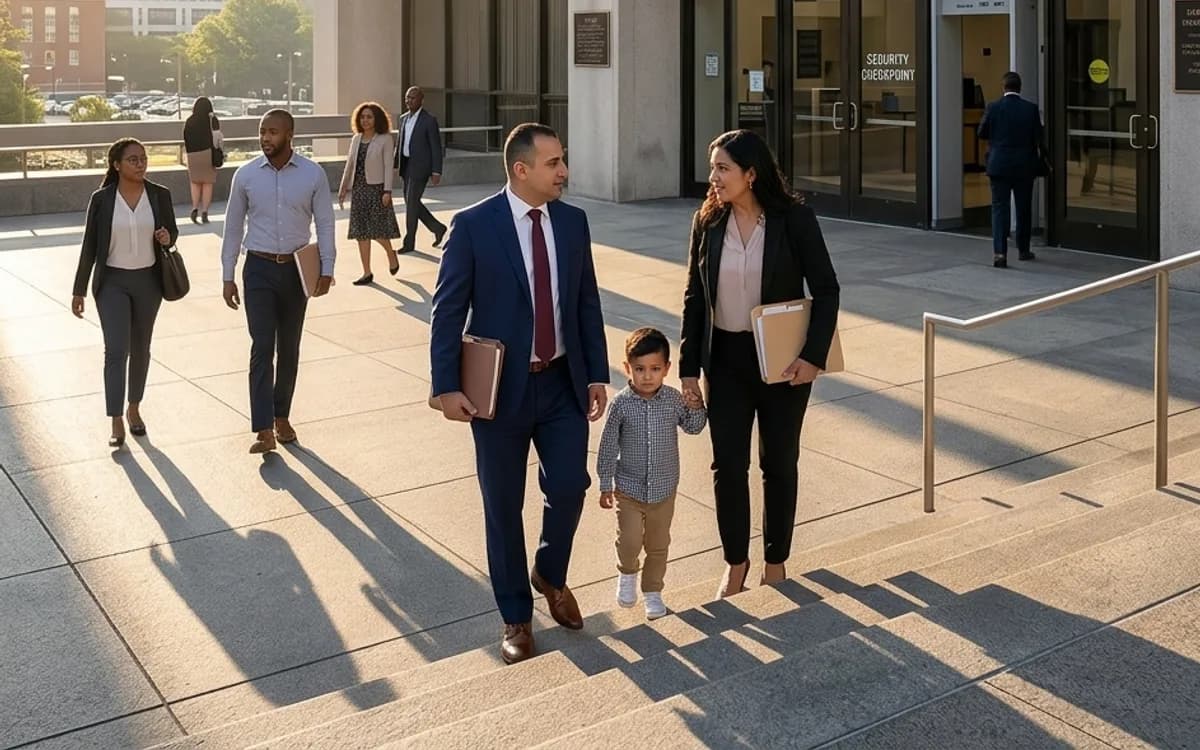
You got a notice with a hearing date at 970 Broad Street in Newark, and you don't know what it means for your family. Maybe someone you love was taken into custody and is now at Elizabeth Detention Center, and nobody will tell you when the bond hearing is. Maybe USCIS denied your spouse's I-130 petition and the letter said nothing beyond 'denied.' Whatever you're holding right now, there is a next step, and it has a deadline attached to it.
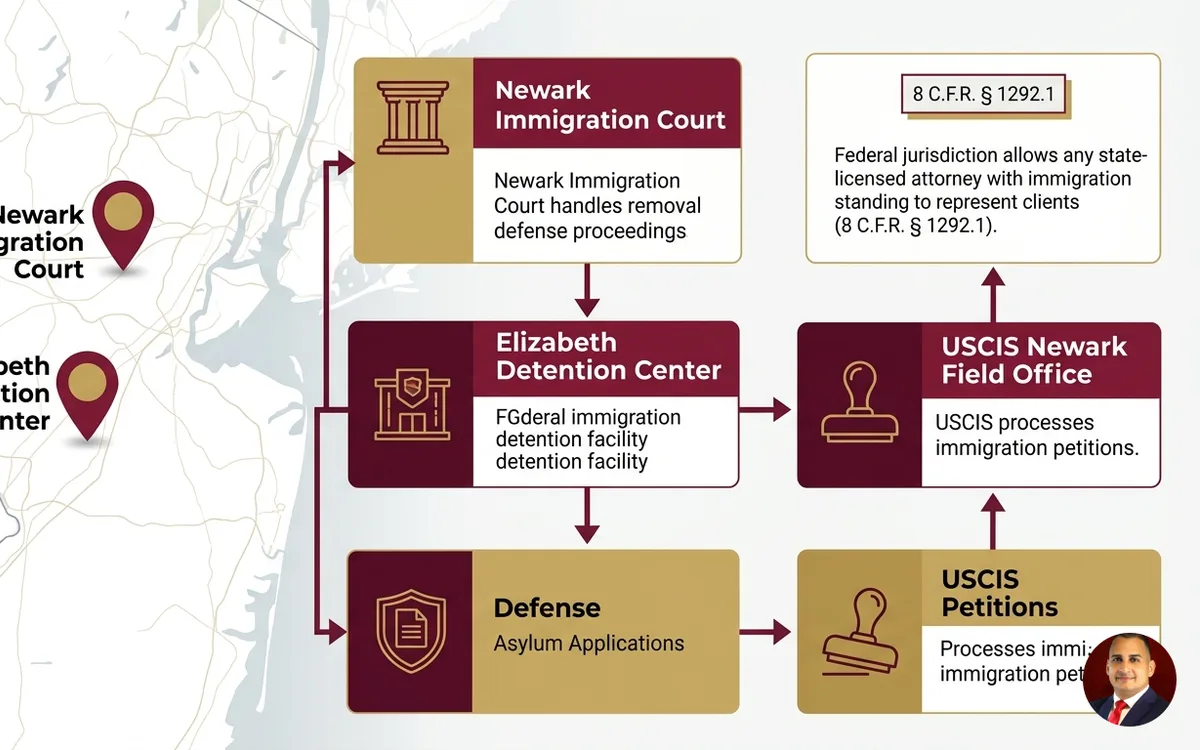
A New Jersey immigration law firm handles federal immigration matters, removal defense, asylum applications, and USCIS petitions, for people with cases before Newark Immigration Court, the Elizabeth Detention Center, or the USCIS Newark Field Office. Because immigration is federal jurisdiction, any state-licensed attorney with immigration standing may represent you, per 8 C.F.R. § 1292.1.
The Hard Truth
What the Newark Immigration Court Backlog Actually Looks Like
Here is the hard part first: EOIR's nationwide pending caseload reached roughly 3.7 million cases by the end of fiscal year 2024, per the Executive Office for Immigration Review's FY2024 Adjudication Statistics report (reviewed October 2026). Newark Immigration Court is one of the busier dockets in that system. A case filed today, with a Notice to Appear issued now, can sit for two to four years before an individual hearing is scheduled, depending on docket assignment and how the judge categorizes the case.
Bond hearings move faster, usually within one to three weeks of a request for people held at Elizabeth Detention Center, but a bond hearing is not a guarantee of release. The judge decides based on flight risk and danger to the community, and a denied bond request can be appealed to the Board of Immigration Appeals, which adds months to the timeline.
One more thing readers deserve to hear plainly. This firm's attorney, William J. Vasquez, is admitted to the North Carolina State Bar and to the Fourth, Fifth, and Eleventh Circuit Courts of Appeals. He is not admitted to the New Jersey State Bar or the Florida Bar, and he is not currently admitted to the U.S. Court of Appeals for the Third Circuit, the court that reviews BIA decisions arising from New Jersey cases. None of that prevents him from representing you in Newark Immigration Court or before the BIA itself. Immigration proceedings are federal, and under 8 C.F.R. § 1292.1, any attorney admitted to a U.S. state bar in good standing may appear before EOIR and the BIA nationwide, with no state-specific or circuit-specific admission required for those two forums. If your case eventually needs a Third Circuit petition for review, that step requires separate Third Circuit admission, something we discuss honestly at intake, not after you've already paid a retainer.
What Happens If You Wait
What Missing a Deadline in Newark Immigration Court Actually Costs You
If you miss your hearing date at 970 Broad Street, the immigration judge can order removal in absentia, meaning the case is decided without you in the room, under INA § 240(b)(5), 8 U.S.C. § 1229a(b)(5). Reopening an in absentia order is possible through a motion to reopen, but it is not automatic. Newark Immigration Court's Local Operating Procedures set specific filing windows for motions to reopen and motions to continue, and missing those windows can close the door entirely.
The same clock runs on other filings. An I-589 asylum application filed outside the one-year deadline from entry, with no exception that applies, can be denied on timeliness alone regardless of the merits of the underlying claim. A denied I-130 petition for a spouse carries its own appeal window, typically 30 to 33 days depending on where the denial issued, and that window does not pause while you search for an attorney.
Every week spent undecided is a week closer to one of these deadlines passing. See our detention and bond hearing page for what happens specifically when a family member is being held at Elizabeth.
Step-by-Step Process
Step-by-Step: What Happens After a Notice to Appear in New Jersey
1. Notice to Appear (NTA) issued. Under Pereira v. Sessions, 138 S. Ct. 2105 (2018), an NTA that omits the date and time of your hearing does not trigger the 'stop-time rule' for certain forms of relief, a detail that matters for cancellation of removal eligibility. Read the document closely; if it lists a hearing date as 'TBD,' that is legally relevant, not a clerical afterthought.
2. Master calendar hearing at Newark Immigration Court, 970 Broad Street. This is not the trial. It is a short procedural hearing, usually 5 to 15 minutes, where the judge confirms your identity, takes your plea on the allegations in the NTA, and sets a schedule for filings.
3. Filing deadlines under Newark's Local Operating Procedures. Applications for relief, including Form I-589 for asylum, along with supporting evidence and witness lists, are due on dates the judge sets at the master calendar hearing. Under the EOIR Courts & Appeals System (ECAS) mandatory e-filing rule, 8 C.F.R. § 1003.33, most filings now go through the ECAS portal rather than paper filing at the courthouse window.
4. Individual (merits) hearing. This is the actual trial, where you testify, present evidence, and government counsel cross-examines you. Given Newark's docket, this hearing is commonly scheduled two to four years after the master calendar hearing, per EOIR's FY2024 Adjudication Statistics (reviewed October 2026).
5. Decision and appeal. If the judge denies relief, you generally have 30 days to file a Notice of Appeal with the Board of Immigration Appeals. A BIA denial can be challenged through a petition for review to the U.S. Court of Appeals for the Third Circuit, a step that requires an attorney admitted to that specific circuit's bar.
If a family member is detained at Elizabeth Detention Center, a bond request can be filed separately and is typically heard faster than the underlying removal case. Learn more about our approach to detention and bond hearings.
If your case is a USCIS matter instead (Form I-130, I-485 adjustment of status, or I-751 removal of conditions), it does not go through Newark Immigration Court at all. It goes through the USCIS Newark Field Office at the Peter Rodino Federal Building, a separate administrative process with its own timeline. See our adjustment of status page for how that process differs from removal defense.
A Real-World Example
A Composite Example: From Notice to Appear to Individual Hearing
Consider a composite, not a real client: a New Jersey resident, call him Marco, receives a Notice to Appear after an encounter with immigration enforcement. He has lived in New Jersey for over a decade and has a U.S. citizen spouse. At his master calendar hearing at Newark Immigration Court, the judge confirms his identity, reviews the allegations, and sets a deadline for his attorney to file any applications for relief, including a possible I-589 or a filing tied to his spouse's I-130 petition.
Over the following months, Marco's attorney gathers evidence: tax filings, lease agreements, letters from his employer, medical records for his children. The attorney files everything through the ECAS portal before the deadline set at the master calendar hearing. Because Newark's docket is backlogged, Marco's individual hearing is not scheduled for another two years.
During that wait, Marco checks in with his attorney about work authorization renewals and keeps his address updated with the court, since a notice sent to an old address does not excuse a missed hearing. When the individual hearing finally arrives, Marco testifies, his attorney presents the documentary record built over the prior two years, and government counsel cross-examines him. The judge takes the matter under advisement and issues a written decision weeks later. That is the process. What the judge ultimately decides depends on the specific facts, the form of relief at issue, and the record built during those two years, not on anything promised in advance.
About William J. Vasquez
William J. Vasquez is admitted to the North Carolina State Bar and to the Fourth, Fifth, and Eleventh Circuit Courts of Appeals. He has practiced federal immigration law for more than two decades, work that includes removal defense before immigration judges, petitions filed with USCIS, and appeals to the Board of Immigration Appeals. Read his full attorney profile.
He is not admitted to the New Jersey State Bar or the Florida Bar, and this page does not represent otherwise. Immigration proceedings, including cases venued at Newark Immigration Court and the BIA, are federal matters governed by 8 C.F.R. § 1292.1, which allows any attorney admitted to a U.S. state bar in good standing to represent clients before EOIR and the BIA nationwide. Our office is physically located in Florida; filings in New Jersey-venued cases go through the EOIR Courts & Appeals System (ECAS) electronic portal rather than in-person appearances at the courthouse window, consistent with 8 C.F.R. § 1003.33.
If your case eventually requires a petition for review to the U.S. Court of Appeals for the Third Circuit, that filing requires Third Circuit-specific bar admission. We discuss that scope honestly during your consultation, not after you've retained the firm.
Key Terms Explained
Key Terms Used on This Page
Notice to Appear (NTA): The charging document that starts removal proceedings under INA § 240 (8 U.S.C. § 1229a). It lists the allegations against you and, when complete, the date and time of your first hearing.
EOIR: The Executive Office for Immigration Review, the Department of Justice agency that runs immigration courts, including Newark Immigration Court, and the Board of Immigration Appeals.
BIA: The Board of Immigration Appeals, the administrative body that reviews immigration judges' decisions. Under 8 C.F.R. § 1292.1, any state-licensed attorney may appear before the BIA nationwide.
ECAS: The EOIR Courts & Appeals System, the electronic filing portal most immigration court filings must go through under 8 C.F.R. § 1003.33.
Master calendar hearing: A short procedural hearing where the judge confirms identity, takes pleadings, and sets deadlines. It is not the trial.
Individual hearing: The merits hearing, sometimes called the trial, where you testify and present evidence and the government cross-examines you.
Form I-589: The Application for Asylum and for Withholding of Removal, generally due within one year of entry absent an exception.
Form I-130: The Petition for Alien Relative, filed with USCIS to establish a qualifying family relationship, often the first step toward adjustment of status for a spouse.
Motion to reopen: A filing asking the court to reconsider a case after a final order, commonly used after a missed hearing resulted in an in absentia removal order.
Pereira v. Sessions: A 2018 Supreme Court decision holding that an NTA missing the date and time of the hearing does not trigger the 'stop-time rule' used in certain cancellation of removal cases.
Frequently Asked Questions
Frequently Asked Questions
Q: Can an out-of-state attorney represent me at Newark Immigration Court? A: Yes. Immigration proceedings are federal, and under 8 C.F.R. § 1292.1 any attorney licensed in a U.S. state bar and in good standing may appear before EOIR and the BIA nationwide, including at Newark Immigration Court. Most filings now go through the ECAS e-filing portal rather than in-person appearances.
Q: Does my case need a New Jersey address, or can I use a Florida-based attorney? A: Your case is tied to the court where your Notice to Appear was filed, not to your attorney's office address. A Florida-based attorney can file and appear in your Newark-venued case through ECAS and by telephonic or video appearance when the court permits it.
Q: What happens if I missed a hearing and now have a removal order? A: You may be able to file a motion to reopen under 8 U.S.C. § 1229a(b)(5), but Newark Immigration Court's Local Operating Procedures set specific deadlines and evidentiary requirements for that motion, and it is not automatic. The sooner you address it after learning about the order, the more options are generally available.
Q: How much does hiring an immigration attorney cost? A: Immigration representation is billed by flat fee or retainer depending on the case type, not on a contingency basis, since there is no monetary recovery in a removal or petition case. We discuss the fee structure for your specific matter, whether it's removal defense, a family petition, or an appeal, during the consultation before you decide to retain the firm.
Q: What should I expect at a first consultation? A: We review your Notice to Appear, prior USCIS filings, or denial letter, ask about your immigration history and any criminal record, and identify what forms of relief or petitions may apply to your situation. You leave with a sense of your deadlines and options, not a guarantee of a specific result.
Q: Am I eligible for asylum or cancellation of removal? A: Eligibility depends on specific facts. Asylum generally requires a well-founded fear of persecution on a protected ground and a filing within one year of entry absent an exception; cancellation of removal generally requires continuous physical presence, 10 years for non-permanent residents under INA § 240A, and hardship to a qualifying U.S. citizen or permanent resident relative. We evaluate which standard applies to you and whether the facts support it.
Q: My employer's PERM labor certification for my H-1B sponsorship is delayed. What can I do? A: PERM processing times vary by U.S. Department of Labor workload and audit status; current processing times are posted on the DOL Office of Foreign Labor Certification website (flag.dol.gov, checked October 2026). We can review the filing for errors that commonly trigger audits and advise on options while the certification is pending.
Clients who have worked with this firm describe clear explanations of what to expect at each stage of a federal immigration case, not promises about outcomes a judge or USCIS officer ultimately controls. Read more about our approach or see verified reviews on our Google Business Profile. We do not publish win rates or outcome statistics; immigration results depend on the judge, the officer, and the specific facts of your case, not on marketing claims.
A Notice to Appear, a denied petition, or a loved one's detention at Elizabeth does not resolve itself while you wait. The deadlines described above are real and specific to your case, not generic advice. The next step is a conversation about what applies to your situation.
Schedule a consultation to review your Notice to Appear, USCIS denial, or detention case with our immigration team. Book a consultation or call our Florida office to start the federal immigration intake process for your New Jersey-venued case.