N-600 Attorney: Proving the U.S. Citizenship You Already Hold
October 10, 2026
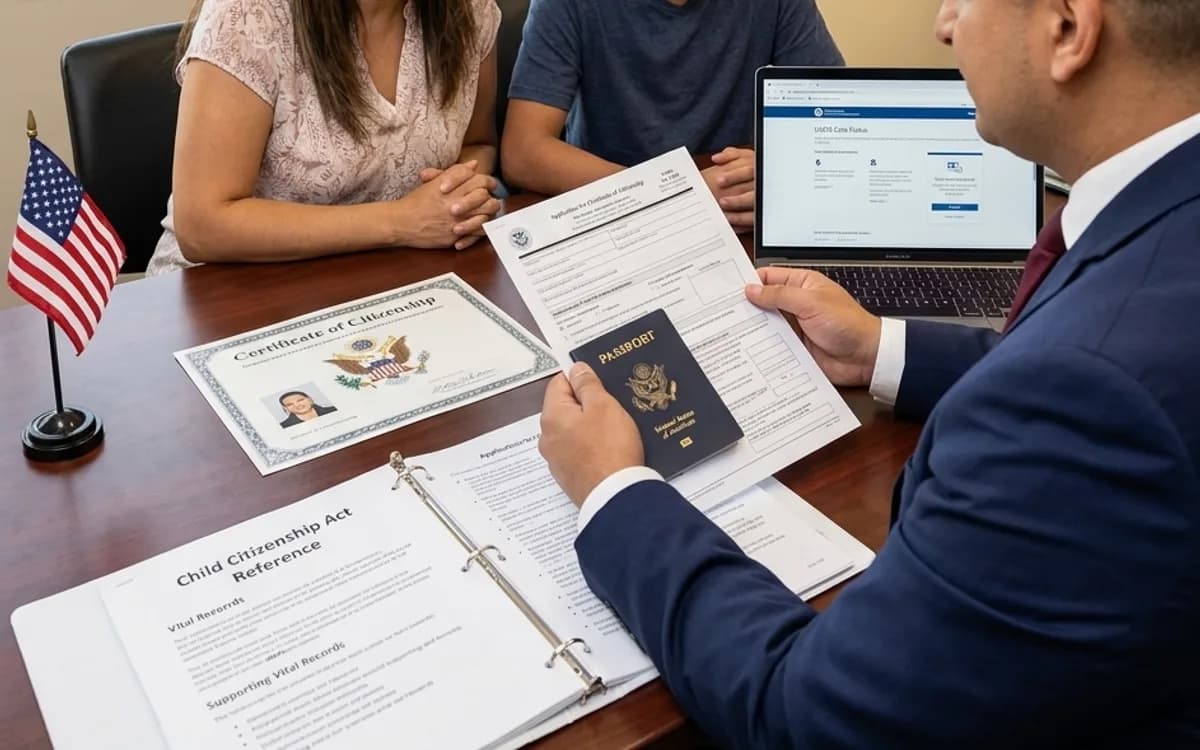
Your passport application came back denied, or your employer's E-Verify check kicked back a mismatch, and now you're dealing with something you didn't expect: proving citizenship you've held since birth or since a parent naturalized years ago. You didn't do anything wrong. The paperwork just never caught up to the law.
A Certificate of Citizenship, issued through Form N-600, is the federal document that closes that gap. USCIS won't take your word for it, though. They want the birth certificate, the marriage or custody record, and the parent's naturalization certificate, lined up against the exact statute that applied the year you turned 18.
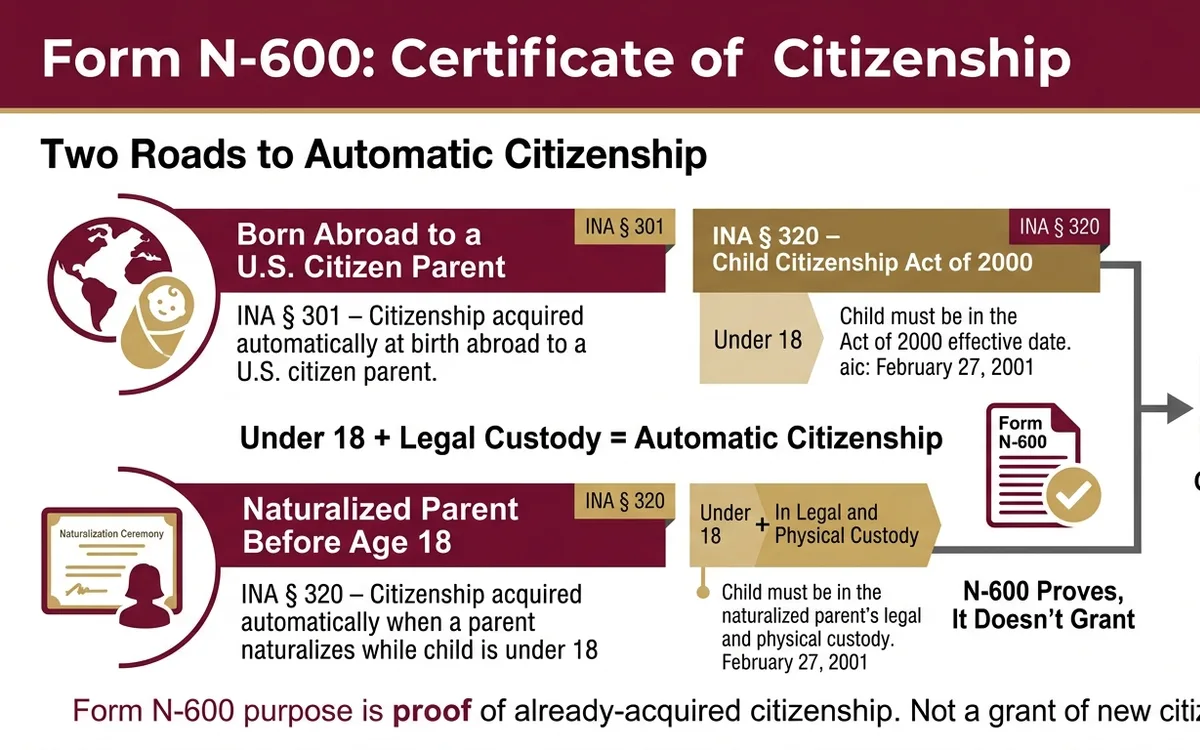
Form N-600 asks USCIS to issue a Certificate of Citizenship proving citizenship you already acquired automatically, either at birth abroad to a U.S. citizen parent under INA § 301, or after birth when a parent naturalized while you were under 18 and in their legal custody under INA § 320 (Child Citizenship Act of 2000).
The Hard Truth
Derivative and acquired citizenship law changes depending on the year you were born, the year your parent naturalized, whether your parents were married, and who had legal custody when the naturalization happened. A child who turned 18 in 1999 falls under a different statute than a child who turned 18 in 2001, because the Child Citizenship Act of 2000 changed the cutoff and doesn't reach back for everyone equally.
If your parents divorced before the naturalizing parent naturalized, USCIS will ask who had legal and physical custody at that moment, and an old custody order from a county courthouse may be the only record that answers it. If your U.S. citizen parent was your father and your parents were never married, USCIS applies a legitimation and residency test under former INA § 309, and Sessions v. Morales-Santana, 582 U.S. 47 (2017), struck down part of the old gender-based residency gap, which changes how some of these cases get analyzed now. None of this gets easier because the citizenship was already yours. USCIS still requires proof, and a missing document can mean a Request for Evidence, a denial, or a second filing.
What Happens If You Wait
A denied or delayed N-600 doesn't just sit there. Without a Certificate of Citizenship, a passport application can be rejected or placed in indefinite administrative review by the State Department, and an E-Verify mismatch can put a job offer on hold or end it. Federal benefits that require proof of citizenship, including some student aid and certain Social Security actions, can stall for the same reason.
Records also get harder to find with time, not easier. A naturalized parent who has since died cannot walk into a USCIS office to request a replacement Certificate of Naturalization, so that record has to come through a FOIA request to USCIS for the parent's A-file, which this office has seen take several months to process. County clerks' historical naturalization archives, including the one at the Miami-Dade County Clerk of the Courts, don't hold records indefinitely, and old travel records used to prove physical residence under INA § 301 disappear from agency systems the same way. The longer this sits unresolved, the fewer options you have left.
Step-by-Step Process
Identify which statute actually governs your case: INA § 301 (citizenship at birth abroad), INA § 320 as amended by the Child Citizenship Act of 2000, former INA § 321 (for those who turned 18 before February 27, 2001), or INA § 309 for children of unwed parents.
Gather the core documents: your foreign birth certificate, your parents' marriage certificate or a legitimation and custody record, and your parent's Certificate of Naturalization with the naturalization date and certificate number.
Order certified replacement records where originals are missing. For Florida-born applicants, that's the Florida Department of Health, Bureau of Vital Statistics in Jacksonville. For a lost or deceased parent's naturalization record, that's a FOIA request to USCIS for the parent's A-file.
File Form N-600 with USCIS, paying the filing fee set out in USCIS's current fee schedule at uscis.gov/forms (fees change periodically, so confirm the amount before filing), along with supporting evidence and a passport-style photo.
Attend a biometrics appointment if USCIS requires one for your case.
Attend the interview, if one is scheduled. For Florida residents this is typically the USCIS Miami, Orlando, or Tampa Field Office. Some N-600 cases qualify for an interview waiver when the documentary record is complete and unambiguous.
If USCIS issues a Request for Evidence, respond by the deadline printed on the notice, commonly 87 days under USCIS's standard RFE response policy.
Receive the decision: a Certificate of Citizenship, or a denial with written reasons.
If denied, you have the option to file a declaratory judgment action under 8 U.S.C. § 1503(a) in U.S. District Court for the Southern District of Florida, Miami Division, within five years of the denial.
A Real-World Example
Consider a composite case: a client born in Colombia in 1994, whose mother naturalized as a U.S. citizen in 2010, when the client was 16 and living with her in Orlando. The client's parents had divorced in 2001, and a Florida custody order gave the mother sole legal custody. The client had never requested proof of citizenship, assuming his mother's naturalization automatically covered him somewhere on file.
The first step was mapping which statute applied. Because the mother naturalized in 2010, while the client was under 18 and in her legal and physical custody, INA § 320 as amended by the Child Citizenship Act of 2000 controlled, not the older former INA § 321 pathway. The document review then focused on three records: the foreign birth certificate, the mother's Certificate of Naturalization, and the 2001 custody order.
The mother's original naturalization certificate had been lost in a move years earlier. Our office filed a FOIA request with USCIS for her A-file to recover the naturalization date and certificate number before the N-600 packet could go in. Once the file arrived, the N-600 was filed with the birth, custody, and naturalization evidence presented side by side, and USCIS scheduled an interview at its Orlando Field Office, where an officer reviewed the original documents and confirmed the facts in the filing. This composite illustrates the document sequence and interview process for an INA § 320 case, not a predicted result for any individual applicant.
William J. Vasquez is admitted to the North Carolina State Bar and to the Fourth, Fifth, and Eleventh Circuit Courts of Appeals, which allows him to handle federal immigration matters, including N-600 derivative and acquired citizenship cases and civil actions under 8 U.S.C. § 1503(a) in federal court. Immigration cases, including N-600 adjudications before USCIS and appeals before the Board of Immigration Appeals, are federal matters under 8 C.F.R. § 1292.1, so this work doesn't depend on Florida state-bar admission. His practice before USCIS field offices, including the Miami, Orlando, and Tampa offices that adjudicate N-600 cases for Florida residents, and before federal courts on citizenship litigation, is limited to federal immigration law. Our team is a member of the American Immigration Lawyers Association (AILA), a professional membership organization for attorneys who focus on immigration practice.
Key Terms Explained
Form N-600: the USCIS application used to request a Certificate of Citizenship for someone who already holds U.S. citizenship by birth abroad or through a parent's naturalization.
Certificate of Citizenship: the federal document USCIS issues under 8 C.F.R. § 341.1 as proof of citizenship already acquired, used for passports, employment verification, and federal benefits.
Derivative citizenship: citizenship a child receives automatically after birth, usually when a parent naturalizes while the child is under 18 and in that parent's legal custody, under INA § 320 or former INA § 321.
Acquired citizenship: citizenship a child receives automatically at the moment of birth abroad to a U.S. citizen parent, governed by INA § 301.
Former INA § 321: the pre-2001 derivative citizenship statute, now repealed for new cases but still controlling for anyone who turned 18 before February 27, 2001.
INA § 309: the statute setting out legitimation and residency requirements for citizenship transmitted through an unmarried parent, historically applied differently to mothers and fathers.
Legitimation: the legal process or event that establishes a child's parentage for purposes of transmitting citizenship from an unmarried father.
A-file: a noncitizen's or naturalized citizen's full USCIS administrative file, which can be requested through a Freedom of Information Act (FOIA) request when original documents are lost.
Request for Evidence (RFE): a USCIS notice asking an applicant to submit additional documents before a decision is made.
Form N-400: the application for naturalization, used by lawful permanent residents seeking to become citizens, distinct from N-600's proof-of-existing-citizenship function.
8 U.S.C. § 1503(a) declaratory judgment action: a federal lawsuit filed in U.S. District Court asking a judge to declare a person a U.S. citizen after USCIS has denied a citizenship claim.
Frequently Asked Questions
Q: What's the difference between Form N-600 and Form N-400? A: Form N-600 proves citizenship you already acquired automatically, either at birth abroad or through a parent's naturalization. Form N-400 is the application a lawful permanent resident files to become a citizen through naturalization, a different legal process entirely.
Q: My parents were never married, and my U.S. citizen father naturalized. Can I still get derivative citizenship? A: It depends on legitimation and residency facts under INA § 309, which historically applied different rules to unmarried fathers than to unmarried mothers. Sessions v. Morales-Santana, 582 U.S. 47 (2017), struck down part of that gender-based gap, so these cases now require a fact-specific review of your father's residence history and the timing of any legitimation.
Q: My parent's Certificate of Naturalization was lost and my parent has since died. How do I prove the naturalization date? A: You can file a FOIA request with USCIS for your parent's A-file, which contains the naturalization date and certificate number. This office has seen that process take several months, so it's worth starting early if you know you'll need an N-600.
Q: USCIS denied my N-600. What can I do? A: You can file a declaratory judgment action under 8 U.S.C. § 1503(a) in federal district court, within five years of the denial, asking a judge to declare you a U.S. citizen based on the same facts and records.
Q: Does the Child Citizenship Act of 2000 apply to me if I already turned 18 before it passed? A: No. The Child Citizenship Act of 2000 applied only to people who were under 18 as of February 27, 2001. If you turned 18 before that date, former INA § 321 governs your derivative citizenship claim instead.
Clients who come to us for N-600 and citizenship cases often describe a long, confusing records search before they called, and relief at having someone map out exactly which documents are needed and why, instead of filing paperwork and hoping it holds up. Our Google Business Profile reflects feedback across our full immigration practice, not only citizenship filings. We don't publish star ratings or outcome statistics here, because a satisfaction score, like a past case result, doesn't predict how any individual N-600 case will be decided.
You already know you're a citizen. The hard part is proving it on paper, to an agency that had no part in the facts when they happened. The next step is figuring out exactly which statute applies to your birth year and your parent's timeline, and what records that means you still need to track down.
Our office handles N-600 Certificate of Citizenship filings as part of our federal immigration practice, including record reconstruction, interviews at the Miami, Orlando, and Tampa USCIS Field Offices, and federal court action under 8 U.S.C. § 1503(a) when a case is denied. Call to schedule a consultation to review your parent's naturalization timeline, your birth and custody records, and which statute controls your case before you file.
- N-400 Naturalization Attorney
- Derivative and Acquired Citizenship
- BIA Appeals
- Adjustment of Status
- Schedule an Immigration Consultation