Massachusetts Immigration Lawyer: Removal Defense & USCIS Help
October 10, 2026
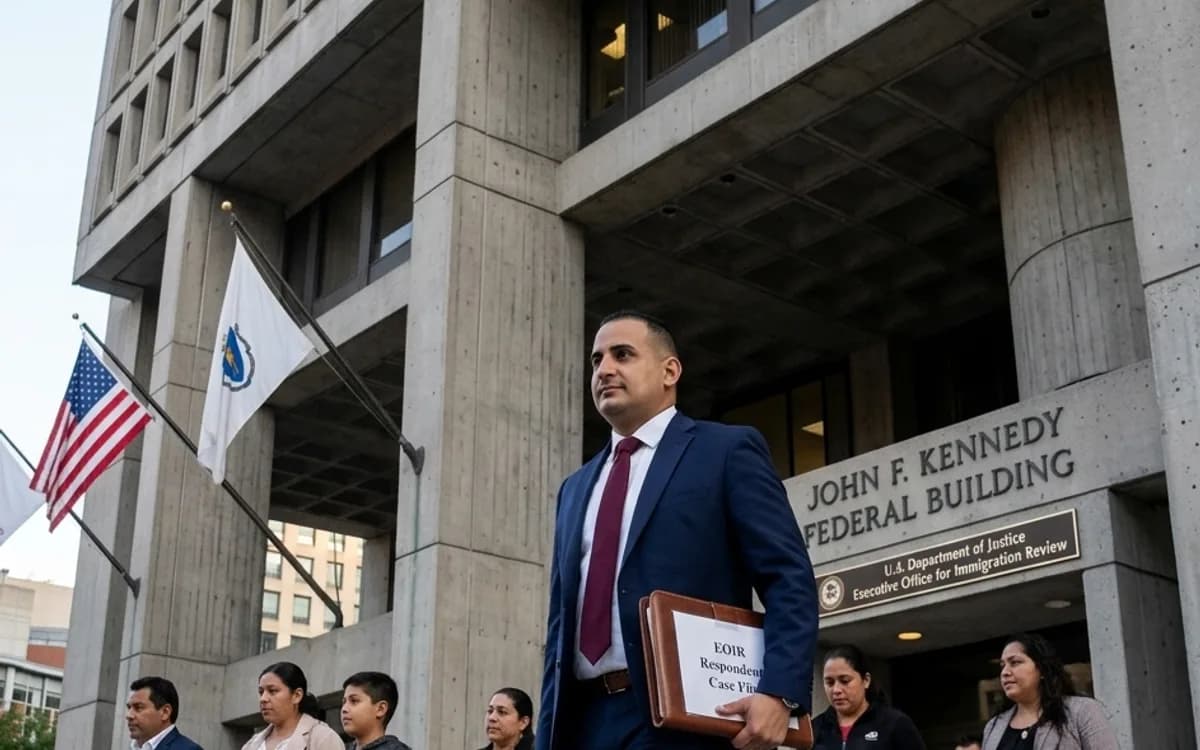
You opened the envelope and found a Notice to Appear ordering you into Boston Immigration Court at the JFK Federal Building. Maybe it came to your home in Worcester or Lowell. Maybe a relative is sitting in Plymouth County Correctional Facility right now, and you do not know how to get them a bond hearing. The clock already started, and nobody handed you an instruction manual.
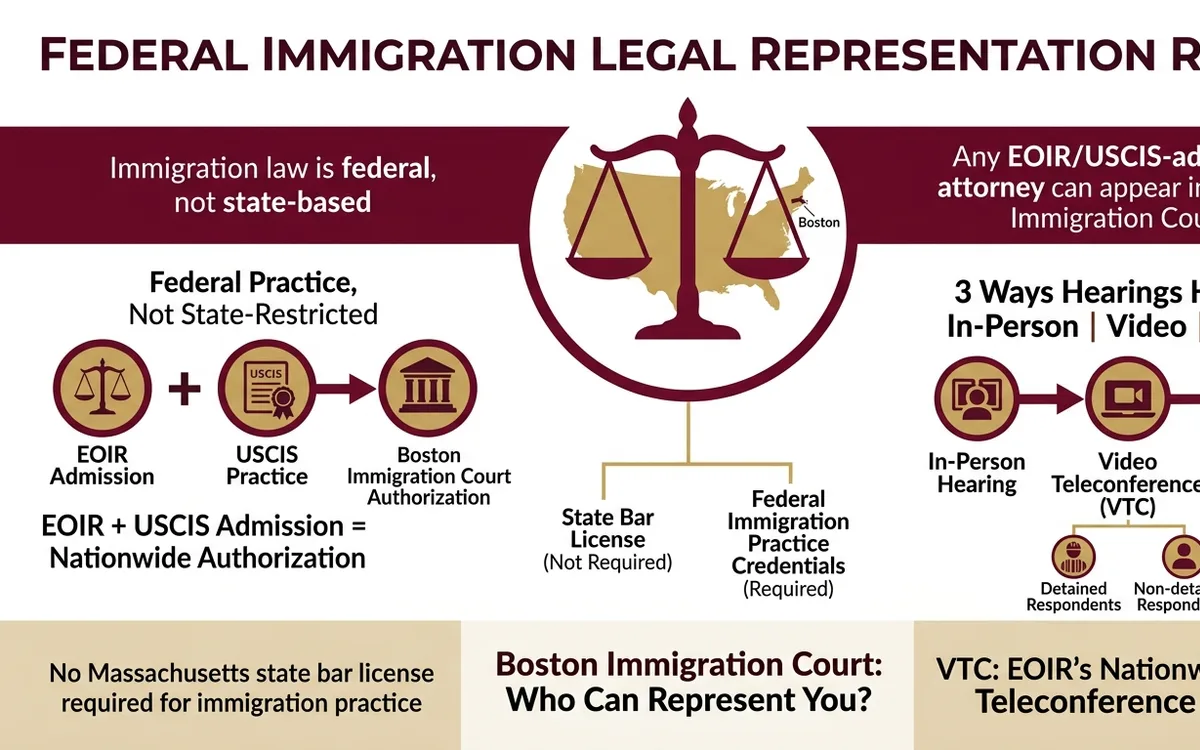
Immigration law is federal, so the lawyer who answers your call does not need an office in Massachusetts. Our Florida office represents respondents in Boston Immigration Court every week through EOIR's video teleconference and telephonic hearing system. What you need right now is someone who can tell you, in plain terms, what happens next and when.
Yes. Immigration law is federal, so any attorney admitted to practice before EOIR and USCIS can represent a Massachusetts respondent in Boston Immigration Court, regardless of state bar license. Hearings proceed in person, by video teleconference, or by phone under EOIR's nationwide VTC system, used routinely for detained and non-detained respondents.
The Hard Truth
Boston Immigration Court carries one of the heaviest dockets in the country, and EOIR's own published data shows removal cases nationwide routinely take years from the first master calendar hearing to a final decision. A lawyer who tells you this moves fast is not being straight with you.
Asylum has a one-year filing deadline from your last arrival in the United States, under INA § 208(a)(2)(B). Missing it is fatal unless you qualify for a changed-circumstances or extraordinary-circumstances exception. The Attorney General's decision in Matter of A-B-, 27 I&N Dec. 316 (A.G. 2018), narrowed what counts as a cognizable particular social group for claims built on domestic or gang violence, so expect close scrutiny if your case rests on that theory.
Filing the right form does not decide your case. The judge decides cancellation of removal, asylum, and most waivers on the specific facts and evidence in your record, built over the months before the hearing, not on the paperwork alone.
What Happens If You Wait
Miss a hearing in Boston Immigration Court and the judge can order you removed without you present, under INA § 240(b)(5). That in absentia order is hard to undo. You generally must show the notice was defective or that exceptional circumstances kept you away, and the motion to reopen has to be filed quickly.
Miss the one-year asylum deadline and the claim is barred unless an exception applies. Miss the 30-day window to appeal an adverse decision to the BIA, under 8 C.F.R. § 1003.38(b), and the order becomes final with no second chance to ask the Board to review it.
Delay carries quieter costs too. An unfiled I-601A provisional unlawful presence waiver stalls a mixed-status family's case every month it waits. A PERM labor certification under 20 C.F.R. § 656 left unfiled because an employer is waiting for a better time pushes an H-1B worker's timeline back by months, sometimes into the next cap season.
Step-by-Step Process
Read the Notice to Appear carefully. Confirm the hearing location, usually the JFK Federal Building at 15 New Sudbury Street in Boston, and the date. If no date is listed, EOIR mails a separate hearing notice; check the automated case status line at 1-800-898-7180 in the meantime.
File a Notice of Entry of Appearance, Form EOIR-28, through the court's ECAS e-filing system, per the EOIR Immigration Court Practice Manual, Chapter 3. Most Boston Immigration Court filings must go through ECAS rather than paper.
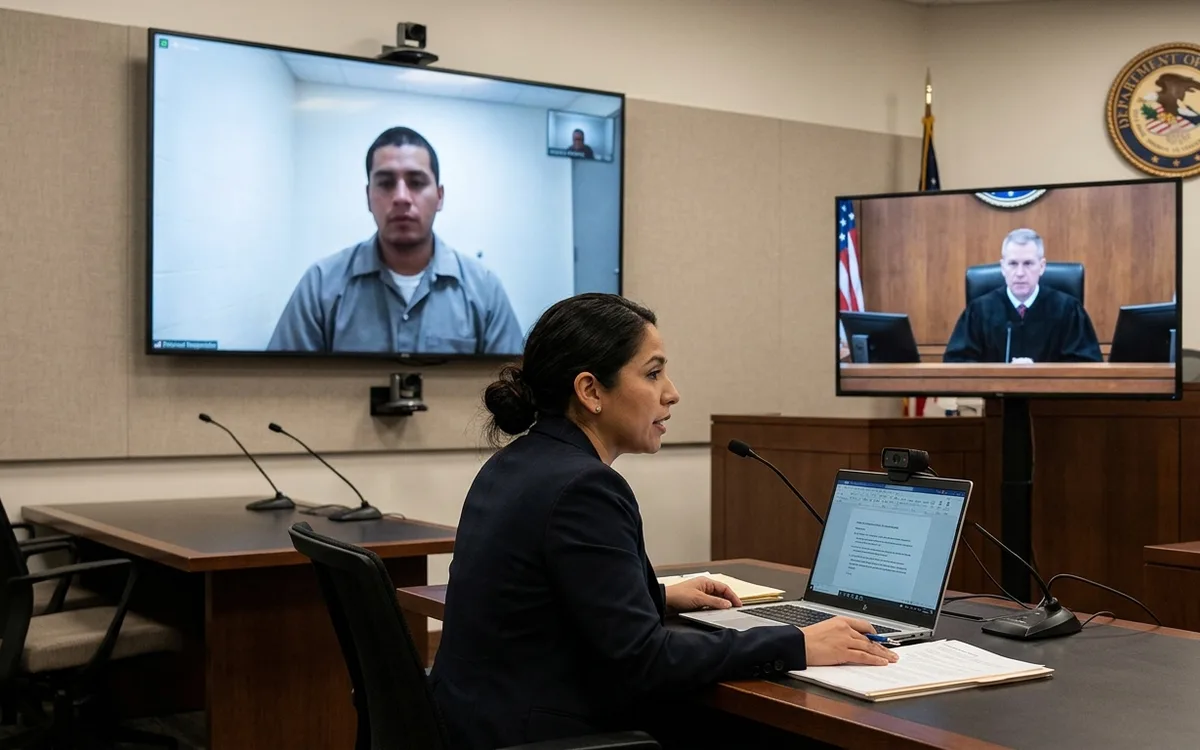
Attend the master calendar hearing. This is a short procedural hearing, typically 10 to 20 minutes, where the judge confirms identity, takes pleadings on the NTA's allegations, and sets a date for the individual merits hearing. Detained respondents at Plymouth County Correctional Facility usually appear by video teleconference.
If detained, request a bond hearing separately from the removal case. The judge decides bond based on flight risk and danger to the community, a decision distinct from whether relief is ultimately granted.
Prepare the individual hearing evidence package, including country-condition evidence, declarations, and witness lists, on the deadlines the judge set at the master calendar hearing, following the filing rules in Chapter 3 of the Practice Manual.
If USCIS has jurisdiction over part of the case, such as an I-485 adjustment application, the USCIS Boston Field Office schedules biometrics and the interview on its own timeline, separate from the court case, unless the judge agrees to a continuance.
If the judge denies relief, there are 30 days to file a Notice of Appeal with the BIA in Falls Church, Virginia, under 8 C.F.R. § 1003.38(b). Missing that date closes the administrative appeal.
A Real-World Example
Consider a composite example. A Massachusetts resident, call her Ana, is placed into removal proceedings after a traffic stop in Lowell leads to an ICE encounter. She is transferred to Plymouth County Correctional Facility within days.
Her family contacts an attorney, who requests a bond hearing separate from the removal case itself. The immigration judge sets the hearing on the docket and hears argument on flight risk and community ties, a decision made before any hearing on Ana's underlying claim for relief.
Meanwhile, the attorney files Form EOIR-28 through ECAS and reviews the Notice to Appear for defects in the allegations. At the master calendar hearing, held by video teleconference from the detention facility, the judge takes pleadings and sets a schedule for the individual hearing. Ana's attorney begins gathering country-condition evidence and declarations against those deadlines.
What happens at the individual hearing, and whether the judge grants any relief, depends on the specific facts, the evidence in the record, and the law that applies to Ana's claim. No two cases move the same way, and no attorney can promise a result before the hearing takes place.
William J. Vasquez is admitted to the North Carolina State Bar and to the Fourth, Fifth, and Eleventh Circuit Courts of Appeals. Immigration proceedings before EOIR and USCIS are federal matters, so an attorney with federal immigration-bar standing may represent respondents nationwide, including in Boston Immigration Court, regardless of state bar license, under 8 C.F.R. § 1292.1.
That authority has a real limit. If a Massachusetts case is ultimately appealed past the BIA to a petition for review in the U.S. Court of Appeals for the First Circuit, filing there requires admission to that circuit's bar specifically. Mr. Vasquez's current federal circuit admissions do not include the First Circuit, and this firm does not currently file petitions for review in that court.
Within Boston Immigration Court, before USCIS, and before the BIA itself, an administrative body open nationwide to any attorney in good standing under 8 C.F.R. § 1292.1, Mr. Vasquez and our team appear for Massachusetts-based clients through EOIR's video teleconference and telephonic hearing system from our Florida office.
Key Terms Explained
Notice to Appear (NTA): the charging document that starts removal proceedings, listing the allegations and the legal basis the government claims makes you removable.
Master Calendar Hearing: a short, preliminary hearing where the judge confirms identity, takes pleadings, and sets deadlines and a date for the individual hearing. It is not where your case is decided.
Individual (Merits) Hearing: the hearing where the judge hears testimony and evidence and decides whether you qualify for relief from removal.
EOIR: the Executive Office for Immigration Review, the Department of Justice agency that runs immigration courts, including Boston Immigration Court, and the BIA.
ECAS: EOIR's Courts & Appeals System, the mandatory electronic filing platform for most documents in immigration court proceedings.
BIA: the Board of Immigration Appeals, based in Falls Church, Virginia, which reviews appeals from immigration judge decisions.
VTC: Video Teleconference, the system EOIR uses to hold hearings remotely, commonly used for detained respondents and for attorneys appearing from outside the hearing's home state.
Bond Hearing: a separate hearing where an immigration judge decides whether a detained person can be released and on what conditions, distinct from the removal case itself.
I-601A: a provisional unlawful presence waiver application filed before leaving the U.S. for a consular interview, to reduce time spent abroad waiting on a waiver decision.
PERM: the labor certification process under 20 C.F.R. § 656 that an employer must complete with the Department of Labor before sponsoring most employment-based green card categories.
In Absentia Order: a removal order issued when a respondent fails to appear for a scheduled hearing, authorized under INA § 240(b)(5).
Frequently Asked Questions
Q: Can a Florida-based immigration attorney represent me in a Massachusetts EOIR hearing? A: Yes. Immigration proceedings are federal, and an attorney with federal immigration-bar standing can appear in Boston Immigration Court for a Massachusetts respondent, including by video teleconference, regardless of state bar license, under 8 C.F.R. § 1292.1.
Q: How does an ICE bond hearing work for someone held at Plymouth County Correctional Facility? A: An attorney requests the bond hearing separately from the removal case, and an immigration judge decides it based on flight risk and danger to the community, usually by video teleconference from the facility.
Q: What if USCIS Boston Field Office delays my biometrics appointment? A: A biometrics delay at USCIS does not automatically pause a pending immigration court case; if the delay affects your court timeline, your attorney can ask the immigration judge for a continuance, but approval is at the judge's discretion.
Q: What happens if I miss my one-year asylum filing deadline? A: Under INA § 208(a)(2)(B), the asylum claim is generally barred after one year from your last arrival, unless you show changed circumstances affecting eligibility or extraordinary circumstances that caused the delay.
Q: How long do I have to appeal a Boston Immigration Court decision to the BIA? A: Thirty days from the date of the immigration judge's decision, under 8 C.F.R. § 1003.38(b). Filing after that deadline generally forfeits the appeal.
Clients most often describe the same thing after their first call: a direct answer about what their Notice to Appear actually means, a callback when a USCIS notice shows up in the mail, and a clear explanation of what the next hearing date will and will not decide. That pattern shows up consistently in client reviews on Google and Avvo, and it reflects how the firm handles communication on federal immigration matters, not a claim about how any individual case will turn out.
None of this changes by waiting another week. The Notice to Appear still has a hearing date on it, the one-year asylum clock is still running if it applies to you, and a loved one at Plymouth County Correctional Facility still needs a bond hearing requested. The next step is a conversation about your specific documents and dates.
Schedule a consultation with our Florida office to go over your Notice to Appear, USCIS case, or a detained family member's bond options. We handle removal defense, USCIS petitions, and BIA appeals for Massachusetts-based clients entirely through EOIR's video teleconference and telephonic hearing system, so your case can move forward without you needing a Massachusetts law office. Call or request a video consultation to start.
- Removal Defense Representation
- USCIS Petitions & Waivers
- BIA Appeals
- Immigration Bond Hearings
- Family-Based Immigration Cases
- Employment-Based Immigration (PERM & H-1B)
- Asylum Applications
- Schedule a Consultation