Lived Here Since Before 1972? Registry May Grant a Green Card
October 10, 2026

You have lived in this country longer than most of your neighbors have lived anywhere. Fifty years, maybe more, paying rent, raising children, showing up to work, never once in front of an immigration judge. You have heard there is a law that could finally turn that long, quiet record into a green card, and you are afraid that the one gap in your paperwork, the summer you moved and didn't keep the lease, will be the thing that stops it.
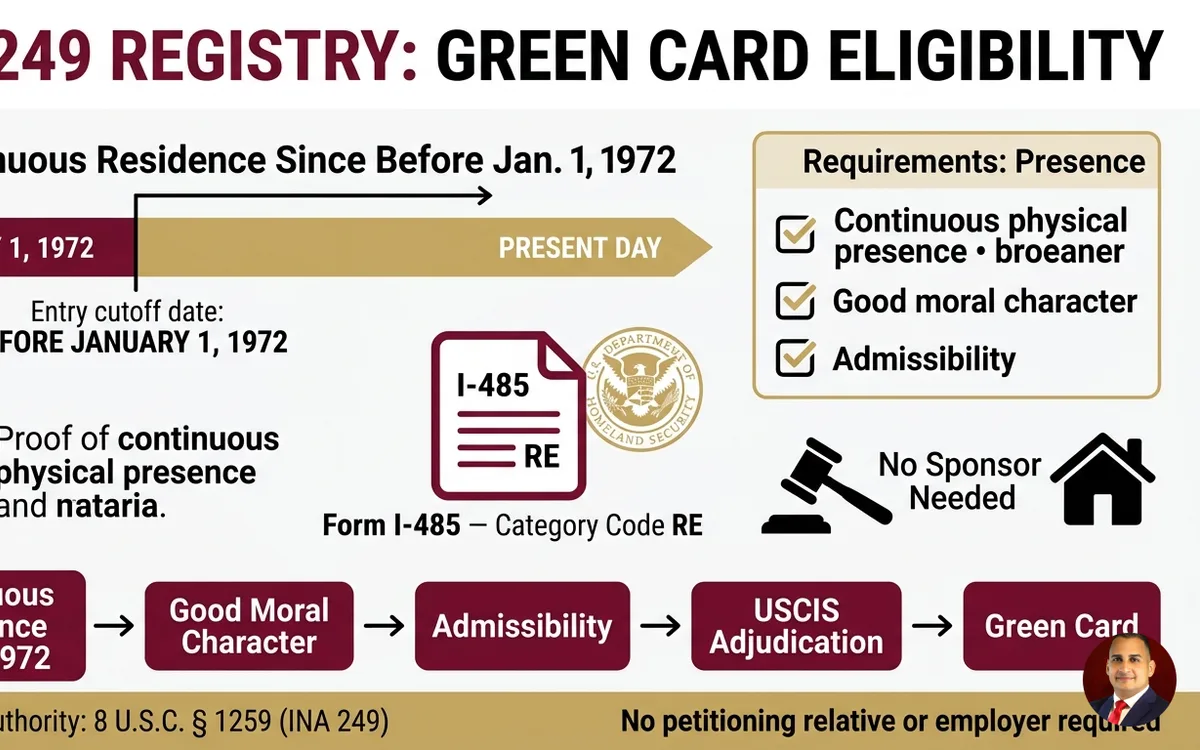
INA 249 registry lets you apply for a green card based on continuous residence since before January 1, 1972 (8 U.S.C. § 1259), without a petitioning relative or employer. You must show continuous physical presence since that date, good moral character, and admissibility. USCIS adjudicates Form I-485 under category code RE.
The Hard Truth
Registry under INA § 249 (8 U.S.C. § 1259) only helps people who can prove continuous residence in the United States since before January 1, 1972. Congress set that date in the Immigration Reform and Control Act of 1986, and it has not moved since, despite several bills introduced in Congress to update it (per Congress.gov legislative records). If you arrived in 1975, 1985, or later, registry is not available to you no matter how long you have lived here since.
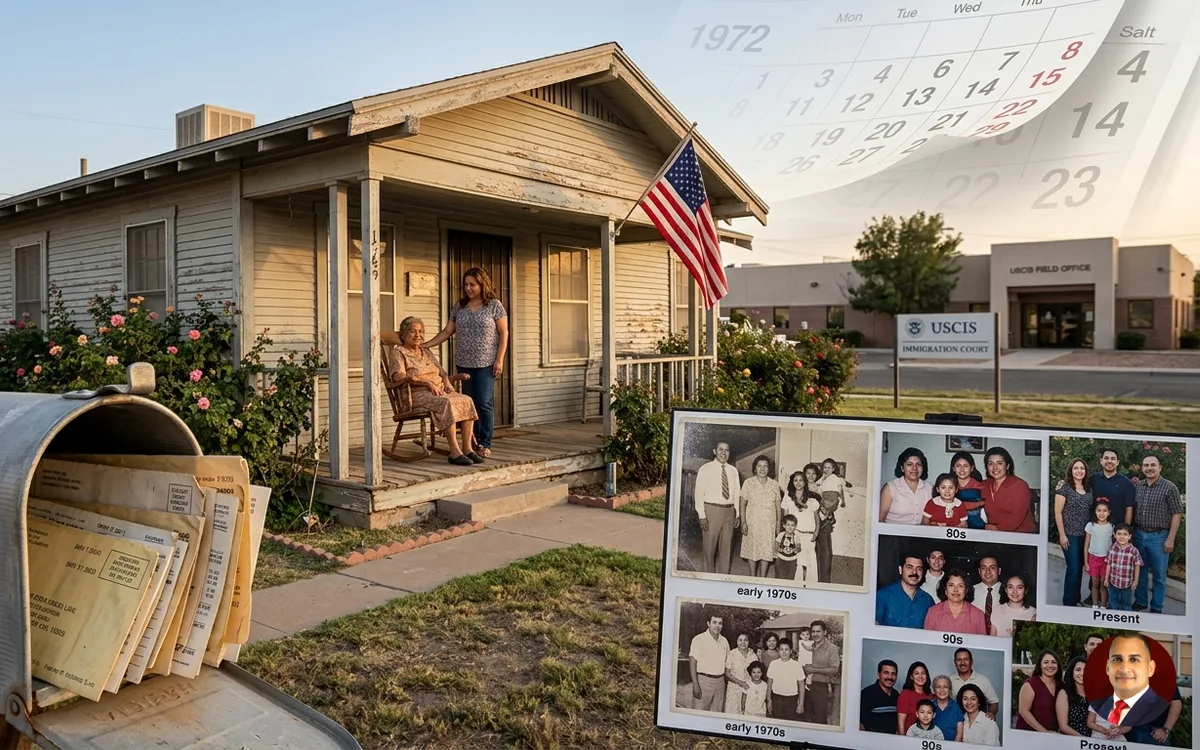
For those who do qualify by date, the harder problem is proof. Fifty-plus years of continuous physical presence is difficult to document when old leases are gone, employers have closed, and paper tax records from the 1970s rarely survive. The Board of Immigration Appeals set the evidentiary bar in Matter of Wong, 12 I&N Dec. 271 (BIA 1967): gaps or weak corroboration can defeat an otherwise strong claim, and USCIS examiners apply that standard narrowly.
What Happens If You Wait
Registry itself has no filing deadline, but waiting still costs you. Every year you delay, the witnesses who could sign an affidavit about your presence in 1971 or 1985 get older, move away, or pass away, and the documentary record you need under 8 C.F.R. § 249.2 gets thinner, not thicker.
If you are already in removal proceedings, the cost is sharper. Registry can be raised as relief before an immigration judge under the procedures in the EOIR Immigration Court Practice Manual, Chapter 3, but it has to be raised through a motion on the court's schedule, not whenever you happen to gather the paperwork. Missing that window while you track down a 1978 school record can mean the judge decides your case without ever considering registry at all.
Step-by-Step Process
Screen eligibility first. Confirm you have lived in the U.S. continuously since before January 1, 1972, and identify any absences, arrests, or prior removal orders that could affect good moral character or admissibility under USCIS Policy Manual, Volume 7, Part O, Chapter 2.
Build the residence record. Under 8 C.F.R. § 249.2, acceptable proof includes church and school records, old leases, medical records, employment letters, money order receipts, and sworn affidavits from people who knew you during specific years. Collect evidence in chronological blocks, such as 1972 to 1980 and 1980 to 1990, rather than trying to document every single year.
File Form I-485 under registry category code RE with USCIS, routed to the Chicago Lockbox under current filing instructions, with the required fee and supporting evidence.
Attend biometrics at a USCIS Application Support Center, such as the one in Miami, Florida, and respond to any Request for Evidence addressing gaps in the residence timeline.
If you are already in removal proceedings before the Miami Immigration Court or another EOIR court, your attorney files a motion to raise registry as relief under the Immigration Court Practice Manual, Chapter 3, rather than waiting on a separate USCIS filing.
Attend the interview or hearing. USCIS or the immigration judge evaluates continuous residence, good moral character, and admissibility, and issues a decision on the record.
A Real-World Example
Consider a composite example. A longtime Miami-area resident, call him Mr. R., believes he arrived in South Florida in 1971 but has no passport stamp or lease from that year. His attorney starts by mapping what records might still exist: baptismal records from a local parish, an old employer's payroll ledger, a cousin who remembers the apartment they shared near Flagler Street.
The attorney organizes those documents year by year and drafts affidavits from three people who can each speak to a different stretch of his presence, since no single witness covers fifty years. The Form I-485 filing under category RE goes to the Chicago Lockbox, and Mr. R. attends biometrics at the Miami Application Support Center. USCIS later issues a Request for Evidence asking for more detail about a four-year gap in the 1980s, and the attorney responds with additional affidavits and a notarized statement from a former coworker.
This is what a registry case actually looks like in practice: slow, document-heavy work spread across months, not a single hearing that resolves everything at once.
William J. Vasquez is admitted to the North Carolina State Bar and to the 4th, 5th, and 11th Circuit Courts of Appeals, and handles federal immigration matters, including registry applications under INA § 249, nationwide. Immigration proceedings before USCIS, the Immigration Court, and the Board of Immigration Appeals are federal matters, so a registry case can be handled by an attorney with federal immigration-bar standing regardless of state bar admission, per 8 C.F.R. § 1292.1. His registry practice focuses on assembling decades-long documentary records and preparing the evidentiary showing required under 8 C.F.R. § 249.2 and Matter of Wong.
Key Terms Explained
Registry (INA § 249): A path to lawful permanent residence for people who have lived in the U.S. continuously since before January 1, 1972, codified at 8 U.S.C. § 1259.
Continuous physical presence: Residence in the U.S. without a departure long enough, or a pattern of departures frequent enough, to break the chain of presence the statute requires.
Good moral character: A USCIS and immigration-court standard, addressed in USCIS Policy Manual, Volume 7, Part O, Chapter 2, that looks at an applicant's conduct, including any criminal history, during the relevant period.
Form I-485, category code RE: The adjustment-of-status application form and the specific category USCIS uses to process registry claims.
Matter of Wong, 12 I&N Dec. 271 (BIA 1967): The Board of Immigration Appeals decision that set the standard for how strong and consistent the evidence of continuous residence must be in a registry case.
8 C.F.R. § 249.2: The regulation listing the types of documents USCIS accepts as proof of continuous residence for registry.
Frequently Asked Questions
Q: Can I apply for registry if I entered the U.S. after 1972? A: No. INA § 249 requires continuous residence since before January 1, 1972 (8 U.S.C. § 1259), and that cutoff has not changed since the Immigration Reform and Control Act of 1986. If you arrived later, registry is not available, though other relief may apply depending on your situation.
Q: What if I don't have tax records or a lease from the 1970s? A: USCIS accepts a range of secondary evidence under 8 C.F.R. § 249.2, including school records, church records, affidavits from people with personal knowledge of your presence, and employment or medical records. A gap in one type of document is not automatically disqualifying if other evidence fills it in.
Q: Can registry be raised if I'm already in removal proceedings? A: Yes. Registry can be requested as relief before an immigration judge, and the procedure for raising it is set out in the EOIR Immigration Court Practice Manual, Chapter 3. It has to be filed as a motion on the court's schedule, so timing matters.
Q: Is there a move to update the 1972 cutoff date? A: Bills to update the registry date have been introduced in Congress over the years, but none has passed as of this writing, per Congress.gov legislative records. Eligibility is based on the current January 1, 1972 date unless and until Congress changes it.
Clients who come to us with registry cases are usually describing the same thing: decades of steady life here, and real uncertainty about whether their proof will hold up. Reviewers describe our team's intake process, the time spent reviewing old documents, and clear explanations of what USCIS or the immigration court will actually look for. We do not publish outcome statistics for immigration matters, because results depend on facts, evidence, and adjudicator discretion that vary from person to person.
Registry cases depend on paper built years before the filing, not on the day of the interview. If you think you may qualify, the next useful step is an honest review of what you can document now, not a guess about what the law might become later.
If you have lived in the U.S. continuously since before January 1, 1972, schedule a consultation with our immigration team to review your residence history and identify what documentation under 8 C.F.R. § 249.2 you already have, and what still needs to be gathered, before you file Form I-485 under registry category RE.