Illinois Immigration Bond Lawyer for Detained Family Members
October 10, 2026
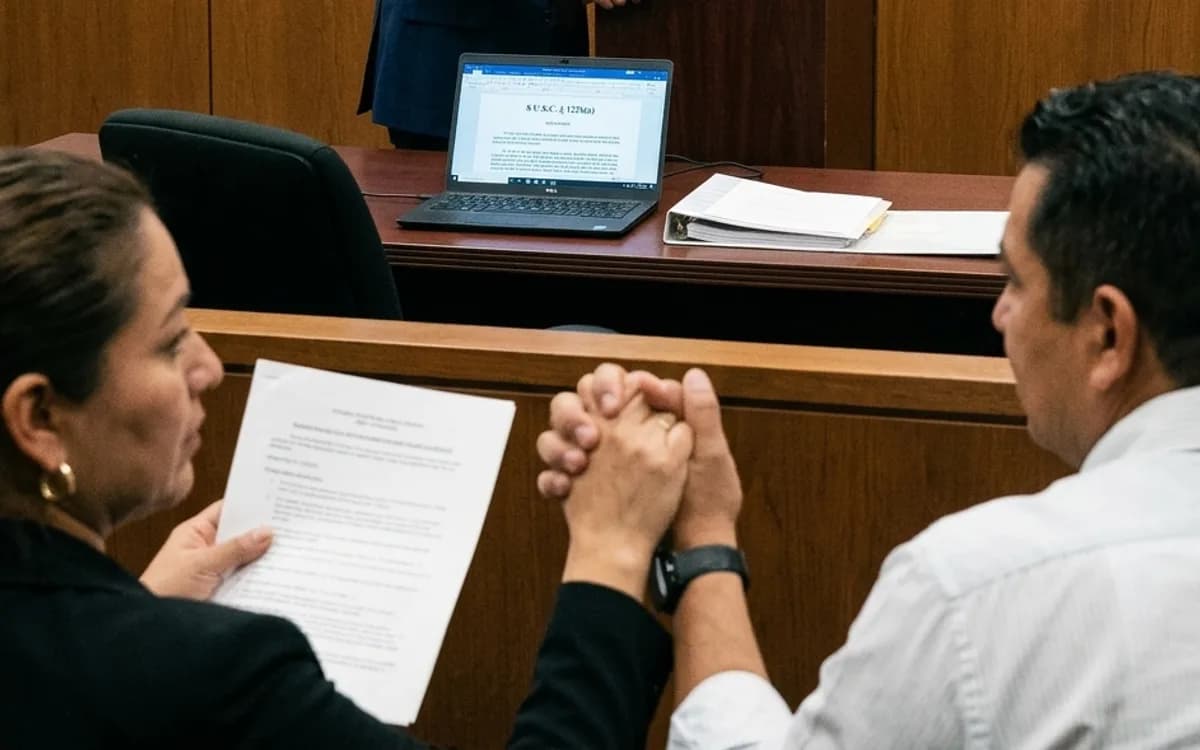
Last updated June 2025. Someone you love was just taken into ICE custody, maybe from a traffic stop, a check-in, or their own front door, and you don't know if Illinois law lets them come home before their case is decided. You are not alone in not knowing the answer. Bond eligibility turns on a federal statute most people have never heard of until this week, and the clock on your next move is already running.
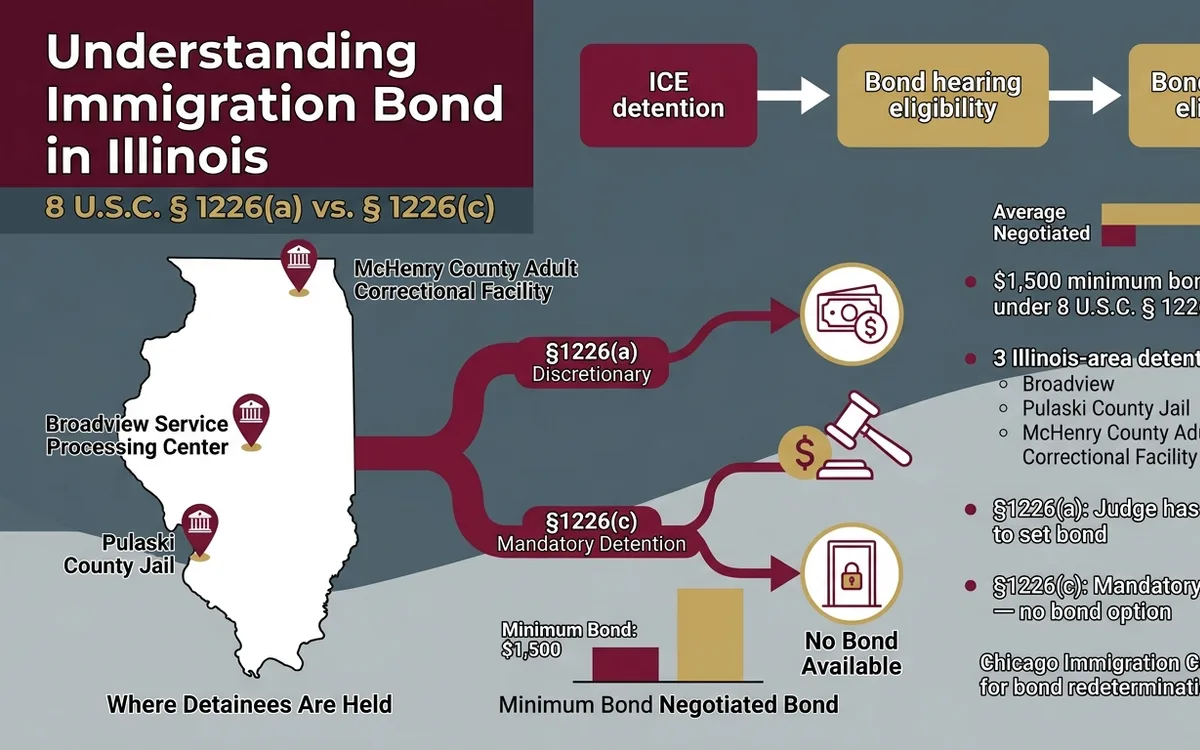
An immigration bond lawyer in Illinois petitions the Chicago Immigration Court for release of a detained noncitizen held at facilities like Broadview Service Processing Center, Pulaski County Jail, or McHenry County Adult Correctional Facility. Under 8 U.S.C. § 1226(a), judges set bond starting at $1,500; mandatory detention under § 1226(c) blocks this option entirely.
The Hard Truth
Will You Actually Get Your Family Member Out on Bond?
Not every detained noncitizen qualifies for bond. If ICE charges your relative under 8 U.S.C. § 1226(c) (mandatory detention) rather than § 1226(a) (discretionary detention), the immigration judge has no legal authority to set bond at all, regardless of family ties or employment history.
Those who do qualify often wait one to three weeks for a hearing date at the Chicago Immigration Court, 55 E. Monroe Street. Nationally, immigration judges have granted bond in roughly half of contested custody hearings in recent years, though grant rates vary by courthouse and by judge (per TRAC Immigration, Syracuse University, custody and bond data, updated 2024). A prior removal order, a pending criminal charge, or ICE's own flight-risk classification can each lower those odds, and under Matter of Guerra, 24 I&N Dec. 37 (BIA 2006), a judge is not required to weigh family ties over a criminal record.
What Happens If You Wait
What Happens If You Wait to File the Bond Motion?
Every day your relative stays in custody without a bond motion on file is a day lost from work, childcare, and preparing the underlying removal case. ICE's initial custody determination is not the last word, but it is also not automatic: nobody schedules a redetermination hearing until Form EOIR-28 is filed and served on the ICE Office of Chief Counsel, per the Chicago Immigration Court's local filing requirements.
If the immigration judge denies bond, the deadline to appeal to the Board of Immigration Appeals is 30 days from the written decision under 8 C.F.R. § 1003.38(b). Miss it, and the denial becomes final, often for the rest of the case. Meanwhile, transfers between facilities, from Broadview Service Processing Center to Pulaski County Jail or McHenry County Adult Correctional Facility, can delay mail, phone access, and your ability to reach your relative at all (per ICE's detention facility locator).
Step-by-Step Process
How Does the Illinois Immigration Bond Process Work, Step by Step?
- ICE sets an initial custody bond amount. After an arrest or Broadview intake, the ICE Chicago Field Office decides whether to release your relative, set an initial bond, or hold them without bond under § 1226(c). Under § 1226(a)(2)(A), any bond ICE or a judge sets must be at least $1,500.
- We file Form EOIR-28 and a bond motion. The notice of appearance and request for a custody redetermination hearing go to the Chicago Immigration Court and are served on the ICE Office of Chief Counsel before any hearing gets calendared.
- The court schedules a bond redetermination hearing. This typically takes one to three weeks, though detention at a facility outside Cook County, such as Pulaski County Jail, can add time for transport and video hearing coordination.
- The hearing itself runs short. Expect 15 to 30 minutes at 55 E. Monroe Street. The judge hears argument on flight risk and danger to the community under 8 C.F.R. § 1003.19 and the discretionary factors from Matter of Guerra.
- The judge issues a bond decision. If bond is set, payment goes through the ICE Chicago Field Office cashier, not the court, and release follows processing, usually the same day or next business day.
- Either side can appeal. You have 30 days to appeal a denial to the Board of Immigration Appeals under 8 C.F.R. § 1003.38(b); ICE has the same window to appeal a bond grant it disputes. For the removal case itself, separate from bond, see our Illinois removal defense overview.
A Real-World Example
What Does a Typical Illinois Bond Case Look Like?
The pattern below reflects what our attorneys commonly see across EOIR bond dockets nationwide, including the Chicago docket. It is a composite built from common fact patterns, not a specific client, and it does not predict any outcome.
A man is stopped for a broken taillight in DuPage County and transferred to ICE custody, then to Broadview Service Processing Center for intake. Within 48 to 72 hours he is moved to a longer-term facility, and his family does not know which one until they call the ICE Online Detainee Locator.
Our office files Form EOIR-28 and a bond motion, requesting a custody redetermination hearing. We gather proof of a fixed address, a job letter, and documentation of community ties to address the flight-risk factors a judge weighs under Matter of Guerra. The hearing is calendared for 55 E. Monroe Street roughly two weeks later, and the judge hears argument from both sides before ruling. Whatever the ruling, the removal case continues on its own track, often for months or years, with the bond hearing addressing custody only, not the merits of relief.
Who Handles Illinois Bond Cases at This Firm?
William J. Vasquez is licensed by the North Carolina State Bar and admitted to practice before the 4th, 5th, and 11th Circuit Courts of Appeals. Because EOIR and BIA proceedings are federal administrative matters, any attorney with federal immigration-bar standing, including Vasquez, can appear before the Chicago Immigration Court and the Board of Immigration Appeals for a detainee held anywhere in Illinois, under 8 C.F.R. § 1292.1.
That federal authority does not extend to Florida or Illinois state courts, and nothing here should be read as a claim to state-bar admission in either state. Our attorneys focus on federal immigration matters, bond redeterminations, removal defense, and BIA appeals, handled from the firm's South Florida office for clients in Illinois and across the country.
If a case later requires a petition for review in a federal circuit court, a step after the BIA, that filing requires admission to the specific circuit where the petition is filed. Illinois cases route to the 7th Circuit, where the firm is working to expand its federal appellate admission; today, our confirmed circuit admissions are the 4th, 5th, and 11th.
Key Terms Explained
Key Terms in an Illinois Bond Case
Bond redetermination hearing: A hearing before an immigration judge, separate from the removal case, where the judge can set, lower, or deny bond under 8 C.F.R. § 1003.19. Discretionary detention (8 U.S.C. § 1226(a)): Custody that a judge can review and change; the judge weighs flight risk and danger to the community. Mandatory detention (8 U.S.C. § 1226(c)): Custody tied to certain criminal convictions where the judge has no authority to set bond at all. Delivery bond: The standard bond type in a 1226(a) case; a third party posts the full amount with ICE, and the detainee is released once processing finishes. Voluntary departure bond: A separate bond, distinct from a custody bond, that guarantees a person will leave the United States by a set date after an immigration judge grants voluntary departure. Form EOIR-28: The Notice of Entry of Appearance an attorney files with the immigration court to represent a detainee and request a hearing. Flight risk: One of two discretionary factors, along with danger to the community, a judge weighs under Matter of Guerra, 24 I&N Dec. 37 (BIA 2006), looking at community ties, immigration history, and prior failures to appear. Joseph hearing: A separate hearing used to contest whether someone is actually subject to mandatory detention under § 1226(c) in the first place, named for Matter of Joseph, 22 I&N Dec. 799 (BIA 1999). ICE Office of Chief Counsel: The government attorneys who represent ICE at a bond hearing and must be served with the bond motion before a hearing is calendared.
Frequently Asked Questions
Q: How do I request a bond redetermination hearing in Chicago? A: Your attorney files Form EOIR-28 with the Chicago Immigration Court and serves a copy on the ICE Office of Chief Counsel, then asks the court to calendar a custody redetermination hearing under 8 C.F.R. § 1003.19.
Q: What is the difference between the ICE bond amount and an EOIR bond hearing? A: ICE's Chicago Field Office sets an initial bond amount at intake, often at or near the $1,500 statutory minimum under 8 U.S.C. § 1226(a)(2)(A); an EOIR bond hearing lets an immigration judge independently review that amount and raise, lower, or deny it.
Q: Can a prior removal order affect bond eligibility in Illinois? A: Yes. A prior removal order can place someone in mandatory detention under 8 U.S.C. § 1226(c) or count against them as a flight-risk factor under Matter of Guerra even in a discretionary 1226(a) case.
Q: How do I pay an immigration bond for someone detained in Illinois? A: Delivery bonds for the ICE Chicago Field Office are paid at the ICE cashier's office by cashier's check or money order payable to the U.S. Department of Homeland Security, after the amount is set; ICE's detention facility locator lists current payment instructions by location.
Q: How long does a bond hearing take at 55 E. Monroe Street? A: Most custody redetermination hearings run 15 to 30 minutes, though the hearing date itself typically takes one to three weeks to get calendared after the bond motion is filed.
Clients come to us mid-crisis, often within days of a detention at Broadview or a facility downstate, and feedback reflects that starting point: relief at getting a clear explanation of the process, not a guaranteed result. Our attorneys do not publish outcome statistics or success rates, because bond and removal decisions are made by immigration judges and the BIA, not by any law firm. What clients consistently describe is responsiveness, direct answers about realistic timelines, and plain explanations of what a judge can and cannot do under the statute.
A bond motion filed today still takes one to three weeks to reach a hearing date at the Chicago Immigration Court. That gap is the time your attorney has to gather proof of address, employment, and community ties, the evidence that actually matters under Matter of Guerra. The sooner that record is built, the stronger the argument at the hearing.
If your relative is detained at Broadview Service Processing Center, Pulaski County Jail, McHenry County Adult Correctional Facility, or another Illinois facility, our immigration team can review the custody classification and file a bond motion with the Chicago Immigration Court. Call our office to schedule a consultation on your relative's bond eligibility and next steps in the removal case.
- Illinois Removal Defense Overview
- BIA Appeals Process
- Broadview Service Processing Center Detention Guide
- Understanding Mandatory vs. Discretionary Detention
- Schedule a Bond Case Consultation