Humanitarian Relief Lawyer for Crime, Abuse & Persecution Survivors
October 10, 2026
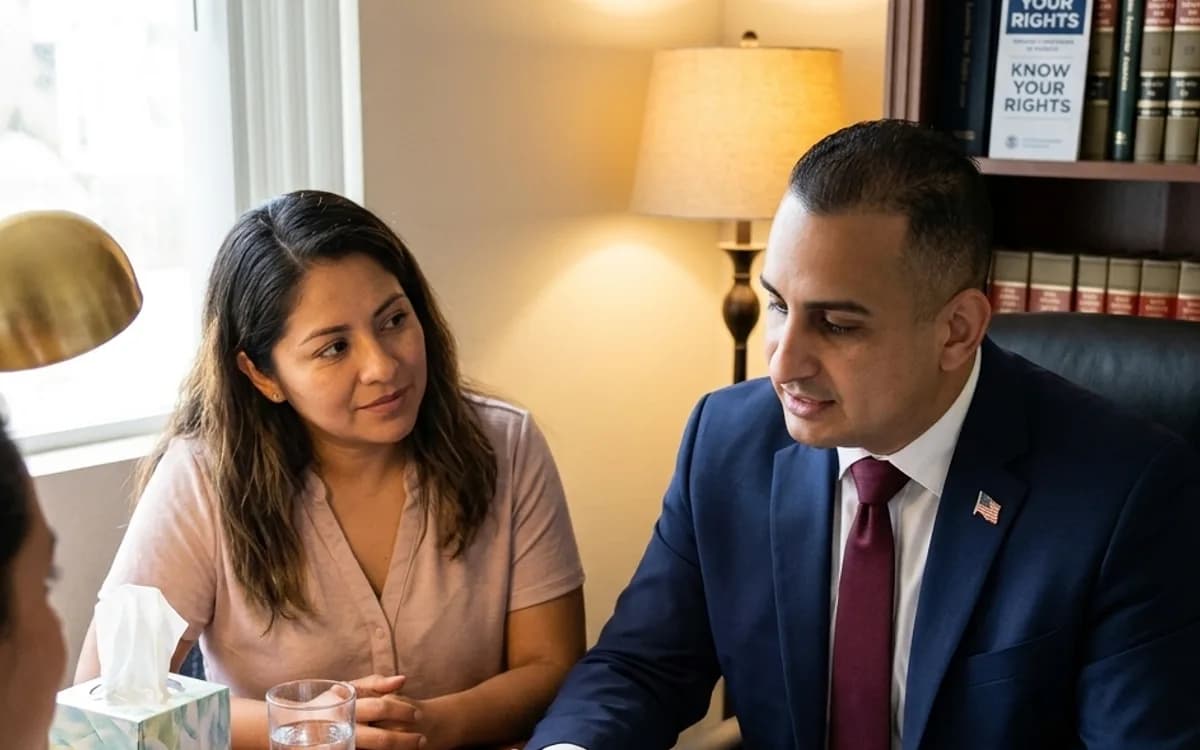
You got a letter, or a call, or you finally found the courage to leave. Maybe someone you love was picked up by immigration enforcement, or the one-year mark on your asylum clock is closing in, or your TPS re-registration window is about to shut. Whatever brought you here, you are not out of options yet. Federal immigration law has built specific paths for people who survived crime, abuse, trafficking, or persecution, and figuring out which one applies to you is the first real step forward.
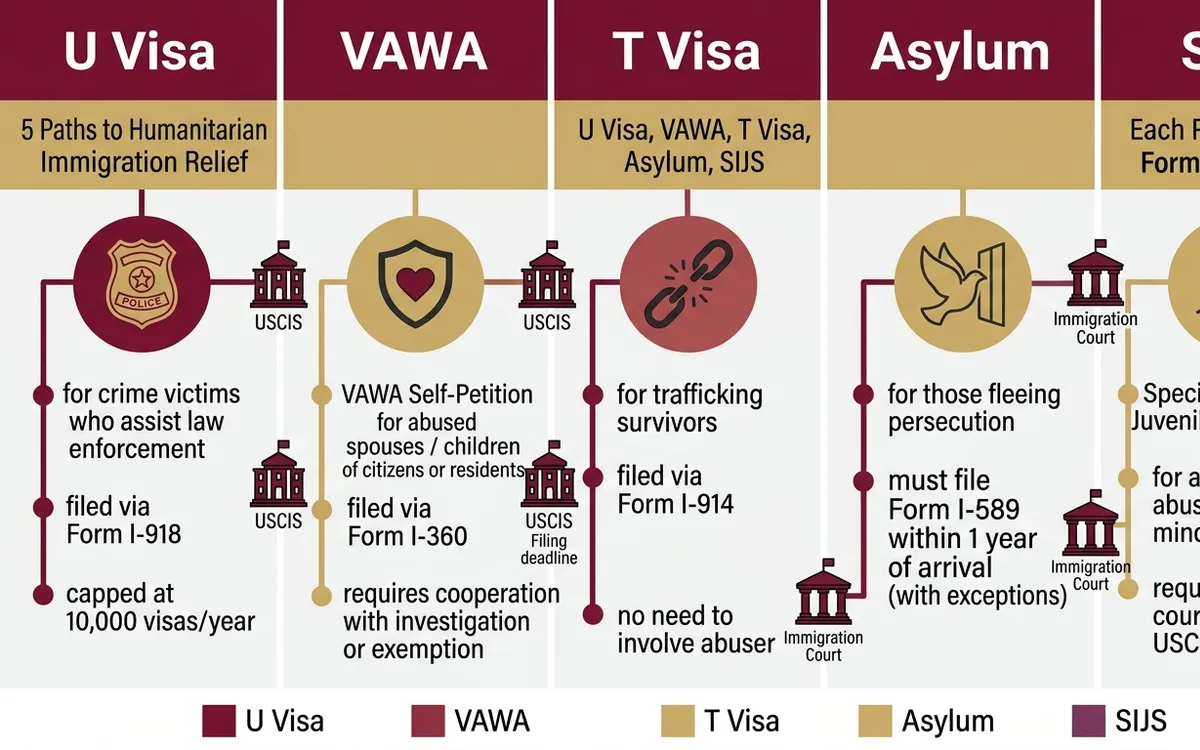
Humanitarian immigration relief covers legal paths built for survivors: U visas for crime victims who help police, VAWA self-petitions for abused spouses or children, T visas for trafficking survivors, asylum for those fleeing persecution, and Special Immigrant Juvenile Status for abandoned or abused minors. Each has its own form, agency, and deadline.
The Hard Truth
Most humanitarian relief categories take years, not months, to resolve. Congress caps U visa approvals at 10,000 principal petitions per fiscal year (8 U.S.C. § 1101(a)(15)(U)), and that cap has produced a waitlist that now routinely runs past five years before a case is even reached for review, per USCIS's published processing data. Asylum applicants must generally file Form I-589 within one year of arrival absent a recognized exception (8 C.F.R. § 1208.4), and missing that window can foreclose asylum even when the underlying fear of persecution is genuine. None of these programs are automatic. USCIS and immigration judges weigh the evidence submitted against a specific statutory standard, and the outcome in any individual case is not something any attorney can promise before the agency or the court decides it.
What Happens If You Wait
Delay has a cost in every one of these cases. A missed one-year asylum deadline under 8 C.F.R. § 1208.4 can push a survivor into the narrower standard of withholding of removal, which blocks removal to one specific country but carries no path to a green card. A lapsed TPS re-registration window, published separately for each designated country in the Federal Register, can mean losing employment authorization and the shield against removal, even for someone who qualified just a month earlier. VAWA self-petitions filed late, after a divorce or after the abuser's death, face added evidentiary burdens to meet the statutory filing window under 8 U.S.C. § 1154(a)(1)(A). Evidence also degrades with time: witnesses relocate, police reports become harder to obtain, and specific dates and details fade from memory, weakening a case regardless of its underlying merit.
Step-by-Step Process
The exact sequence depends on which form of relief fits your facts, but most humanitarian filings in this practice move through a similar set of federal processing points tied to Florida.
- Screening and evidence intake. We review police reports, medical records, country-conditions evidence, or trafficking documentation to identify which category, U visa, VAWA, T visa, asylum, SIJS, or TPS, matches your situation.
- Form preparation and supporting declaration. Each category uses its own petition: Form I-918 for a U visa, Form I-360 for a VAWA self-petition, Form I-914 for a T visa, and Form I-589 for asylum and withholding of removal. SIJS cases require a predicate custody order from a state juvenile court before the federal petition is filed.
- Filing with the correct agency. U visa and VAWA petitions route to USCIS's Vermont Service Center for centralized adjudication. Affirmative asylum applications go to the Miami Asylum Office; asylum raised as a defense in removal proceedings goes through Miami Immigration Court or Orlando Immigration Court (EOIR).
- Biometrics. USCIS schedules fingerprinting and a background check at a local Application Support Center, typically a few months after filing.
- Interview or hearing. Affirmative asylum applicants interview at the Miami Asylum Office. People held at Krome North Service Processing Center who are in removal proceedings go through a credible-fear interview first, followed by individual merits hearings before an immigration judge.
- Decision and next steps. An approved but capped U visa petition goes onto the waitlist for deferred action and, later, a visa number. Approved VAWA and T visa petitions can lead toward adjustment of status. A denied asylum or SIJS decision can be appealed to the Board of Immigration Appeals (BIA).
A Real-World Example
Consider a composite scenario based on a pattern we see often, not a real client. Marisol, a composite name, left an abusive marriage and came to our office with a folder of medical records, a protective order from a Miami-Dade court, and photographs documenting years of harm. She had no lawful status of her own; her husband was a U.S. citizen.
The first meeting focused on evidence, not a quick promise of status. We walked through the VAWA self-petition's statutory elements under 8 U.S.C. § 1154(a)(1)(A): the qualifying marriage, the abuse, residence with the abuser, and good moral character. Over several weeks we helped her assemble additional corroboration, including a declaration describing specific incidents of harm by date.
We filed Form I-360 with supporting evidence at the USCIS Vermont Service Center. A notice of receipt arrived within weeks, followed months later by a biometrics appointment at a local Application Support Center. The case then moved into USCIS's adjudication queue, where it remains pending.
A VAWA self-petition can take well over a year to adjudicate, and USCIS can issue a request for additional evidence at any point before deciding. Marisol's case, like any pending petition, could result in approval, a request for more evidence, or denial, depending on how the record measures against the statutory standard. The waiting period itself does not indicate which way the case is headed.
William J. Vasquez handles humanitarian relief filings as part of a federal immigration practice. He is admitted to the North Carolina State Bar and to the U.S. Courts of Appeals for the Fourth, Fifth, and Eleventh Circuits. Immigration cases, including U visa petitions, VAWA self-petitions, asylum applications, and SIJS matters, are federal matters decided by USCIS and the Executive Office for Immigration Review (EOIR); federal immigration-bar standing, not a particular state bar, is what authorizes an attorney to appear in these proceedings nationwide. His work on these filings covers the full sequence from intake through hearings before an immigration judge and appeals to the Board of Immigration Appeals.
Key Terms Explained
U visa: a nonimmigrant status for victims of certain crimes who assist law enforcement, created under 8 U.S.C. § 1101(a)(15)(U) and filed on Form I-918.
VAWA self-petition: a process under the Violence Against Women Act letting an abused spouse, child, or parent of a U.S. citizen or lawful permanent resident file for status independently, without the abuser's knowledge, on Form I-360.
T visa: a nonimmigrant status for survivors of a severe form of human trafficking, filed on Form I-914.
Asylum: protection for someone who cannot return to their home country because of persecution, or a well-founded fear of persecution, based on race, religion, nationality, political opinion, or membership in a particular social group (Matter of A-R-C-G-, 26 I&N Dec. 388 (BIA 2014), recognized domestic violence survivors as a particular social group in some cases); filed on Form I-589.
Withholding of removal: a more limited form of protection than asylum, available even after the one-year asylum deadline has passed, that blocks removal to one specific country but does not provide a path to a green card.
Special Immigrant Juvenile Status (SIJS): status for a child who has been abused, abandoned, or neglected by one or both parents, requiring a state juvenile court custody order before the federal petition is filed.
TPS (Temporary Protected Status): temporary permission to remain and work in the United States for nationals of countries designated by the Department of Homeland Security due to armed conflict or disaster, requiring re-registration during a specific window for each designation.
Credible-fear interview: a screening interview, often conducted for people held at facilities like Krome North Service Processing Center, used to determine whether a detained individual has a significant possibility of establishing eligibility for asylum.
Board of Immigration Appeals (BIA): the administrative body that reviews appeals of immigration judge decisions nationwide under 8 C.F.R. § 1292.1.
Frequently Asked Questions
Q: Can I apply for a U visa if the crime was never prosecuted? A: Yes. A U visa requires a certification from a law enforcement agency or prosecutor confirming you were helpful, are being helpful, or are likely to be helpful to the investigation, not a conviction or even a completed prosecution.
Q: Does a VAWA self-petition require the abuser to know I filed? A: No. VAWA self-petitions are confidential by design; USCIS does not notify the abuser, and the Department of Homeland Security is barred from certain disclosures under 8 U.S.C. § 1367.
Q: What happens if I missed the one-year asylum filing deadline? A: You may still qualify for withholding of removal or protection under the Convention Against Torture, which carry no one-year deadline, though both have a higher evidentiary standard than asylum and do not lead to a green card.
Q: How long is the current U visa waitlist? A: USCIS's published processing data shows a wait of several years between petition approval and when a visa number becomes available, because the statutory cap is 10,000 principal petitions per fiscal year under 8 U.S.C. § 1101(a)(15)(U).
Q: Do I need to be in removal proceedings to apply for TPS? A: No. TPS is an application made directly to USCIS during the country-specific registration window announced in the Federal Register, separate from any immigration court case.
Former clients describe the intake process, the wait for a decision, and how often our team answered questions along the way, not a guaranteed result, since none of these filings allow for one. Feedback is available on the firm's Google Business Profile and on Avvo for anyone comparing how different offices handle humanitarian filings.
If you are not sure which category fits your situation, that uncertainty is normal. The forms, agencies, and deadlines differ enough between a U visa, a VAWA self-petition, an asylum claim, and TPS that even people with similar stories can end up on different paths.
Schedule a consultation with our immigration team to review your documents and identify which humanitarian relief option, U visa, VAWA self-petition, T visa, asylum, or SIJS, applies to your facts, and what the filing deadline looks like in your specific case.
- U Visa Attorney for Crime Victims
- VAWA Self-Petition Help
- Asylum Attorney, Miami Asylum Office
- TPS Re-Registration Deadlines
- Special Immigrant Juvenile Status
- Contact Our Immigration Team