How a Vacated California Conviction Can Affect Your Immigration Case
October 10, 2026
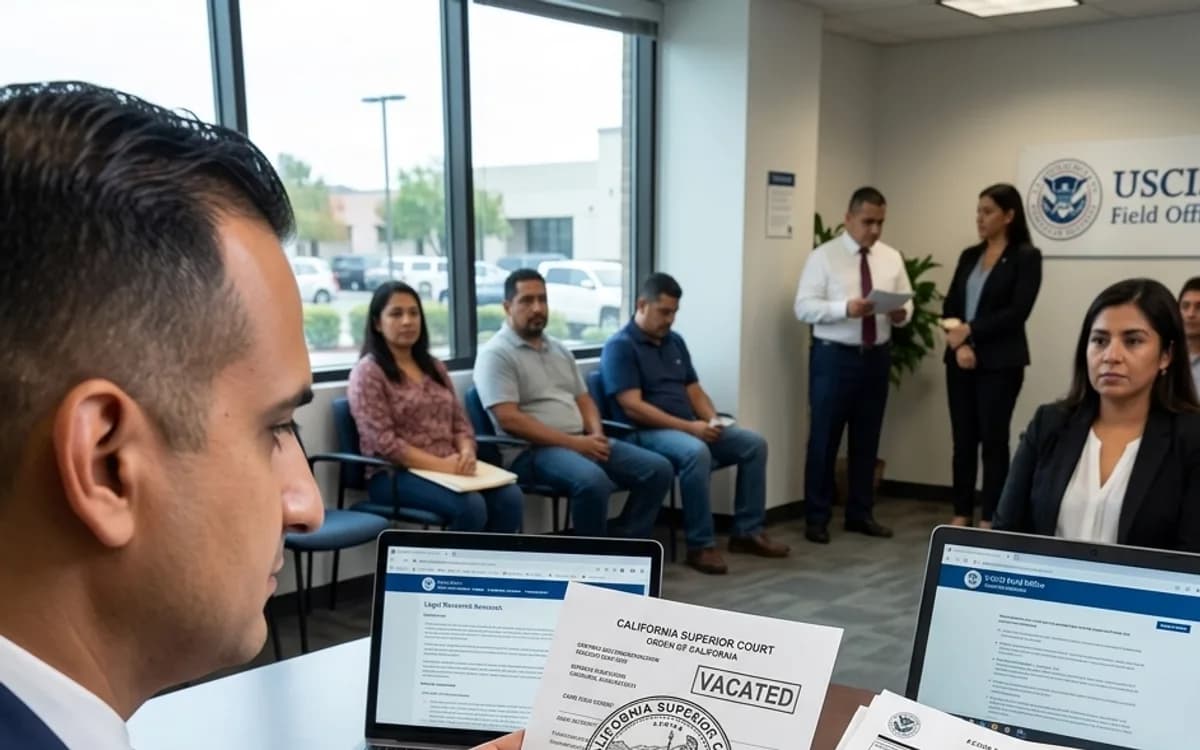
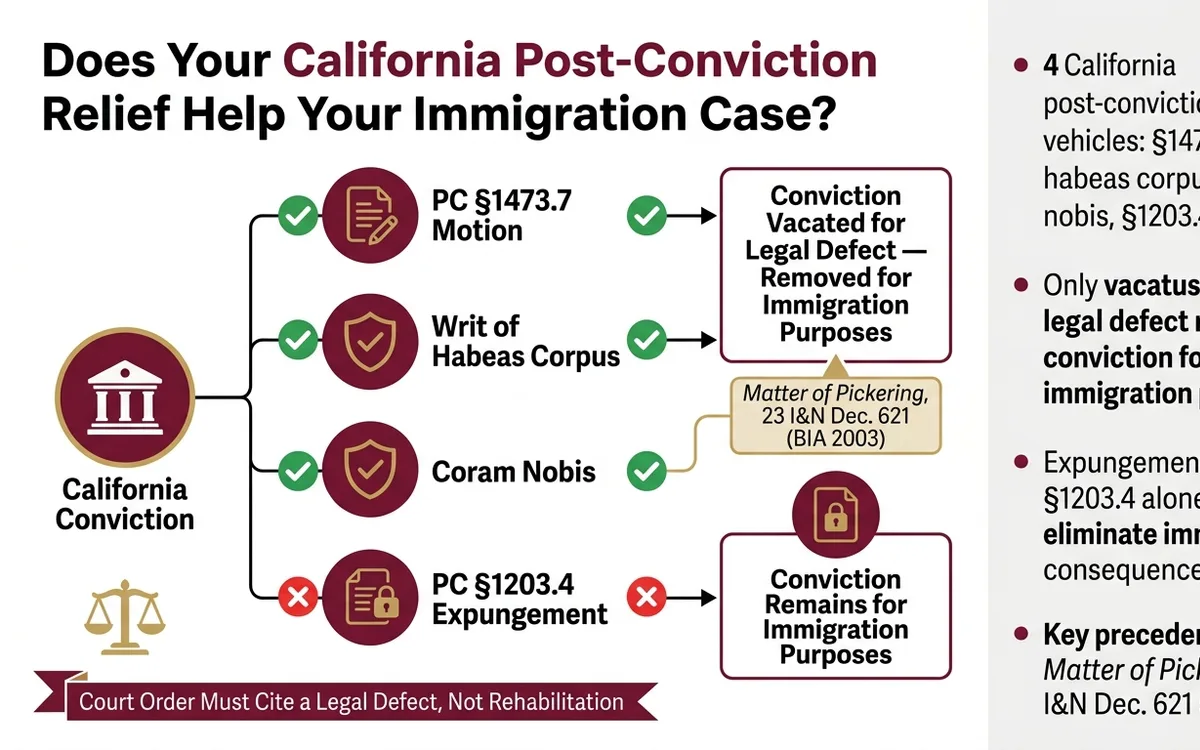
Maybe you pled guilty in a California courtroom years ago, before anyone explained what 'removable' meant. Now that conviction sits in your Notice to Appear, and you found an infographic online listing a dozen ways to challenge it: a 1473.7 motion, a writ of habeas corpus, coram nobis, an expungement. Not every box on that chart actually helps your immigration case, and some of them do nothing for it at all.
This page walks through the real post-conviction vehicles available under California law, what each one does and does not change for a case pending before the Executive Office for Immigration Review (EOIR), and what the next ninety days actually look like if you are already in removal proceedings.
California offers several post-conviction relief vehicles for noncitizens: Penal Code § 1473.7 motions, writ of habeas corpus, coram nobis, and § 1203.4 expungement. Only a court order vacating a conviction for a legal defect can remove it for immigration purposes. Expungement alone does not, per Matter of Pickering, 23 I&N Dec. 621 (BIA 2003).
The Hard Truth
The Hard Truth About Post-Conviction Relief and Immigration Cases
A favorable ruling in California Superior Court does not, on its own, stop a removal case already underway in immigration court — though that's the assumption that trips up most people researching these options online. An expungement under California Penal Code § 1203.4 dismisses a case for most state purposes, but it does nothing for federal immigration law. The Board of Immigration Appeals has held for more than two decades that a conviction expunged under a rehabilitative statute still counts as a conviction under INA § 101(a)(48)(A). The only vehicle that reliably changes the immigration analysis is one that vacates a conviction for a defect in the underlying proceeding, not one that simply forgives it after the fact.
Even a properly granted vacatur under Penal Code § 1473.7 does not automatically close a pending immigration case. You still have to file a motion to reopen under 8 C.F.R. § 1003.23(b), and the immigration judge or the Board of Immigration Appeals (BIA) decides, separately from the California court, whether the vacatur actually eliminates the ground of removability charged against you. Clearing your state court record is no guarantee that the federal case clears with it; the two systems run on separate decision-makers, working from separate records. Matter of Pickering, 23 I&N Dec. 621 (BIA 2003) sets the test the BIA still applies: a conviction vacated for rehabilitative or hardship reasons remains a conviction for removal purposes, while one vacated for a legal defect in the plea does not.
If your conviction happens to be from Florida rather than California, none of the vehicles above apply at all. Florida's equivalent tool is Florida Rule of Criminal Procedure 3.850, filed in the Florida circuit court where you were convicted, generally within two years of the judgment becoming final under Fla. R. Crim. P. 3.850(b). Florida Rule 3.850 is a separate statute with its own court and its own filing deadline, and a Florida court evaluating a 3.850 motion owes nothing to California case law interpreting section 1473.7.
What Happens If You Wait
What Delay Actually Costs You
Waiting to sort out which post-conviction vehicle fits your case has a cost measured in real court dates, not abstract risk. If you are already in removal proceedings and a merits hearing is on the calendar at the Miami Immigration Court or the Orlando Immigration Court, the immigration judge will not pause your case indefinitely while a California public defender's office works through a backlogged 1473.7 calendar. Courts set hearing dates based on their own docket, not yours.
If the immigration judge enters a removal order before your California motion is decided, you then need both the eventual vacatur and a timely motion to reopen under 8 C.F.R. § 1003.23(b). A motion to reopen based on new evidence generally must be filed within 90 days of a final removal order, per 8 C.F.R. § 1003.23(b)(1). Motions tied to a newly vacated conviction can sometimes proceed outside that window with a reasonable-diligence showing, but 'sometimes' is not a filing plan.
The national immigration court backlog exceeded 3.7 million pending cases in 2025, per TRAC Immigration, the Syracuse University clearinghouse that tracks EOIR data. A case that gets continued while you pursue California relief still has to work its way back through that queue once the motion is ready. If you are detained at Krome North Service Processing Center or the Broward Transitional Center while this plays out, every added month is a month in custody without your conviction challenge resolved, and ICE has no obligation to release you while a California motion is pending.
Step-by-Step Process
The Process: California Relief to Federal Immigration Court
This sequence applies whether your conviction is from Los Angeles, Orange, San Diego, or any other California county, and it reflects California and federal immigration law current as of April 2026.
Identify the right vehicle. If you are still in custody, on probation, or on parole, a writ of habeas corpus under Penal Code § 1473 may be available. If you have completed your sentence, Penal Code § 1473.7 is usually the vehicle, built for people no longer in criminal custody who can show the conviction was legally invalid due to prejudicial error, including a failure to advise of immigration consequences under Penal Code § 1016.5. Coram nobis survives only for the narrow factual errors that 1473.7 does not reach. Expungement under Penal Code § 1203.4 and a Governor's pardon are different tools entirely and do not vacate a conviction for immigration purposes on their own.
Retain California criminal defense counsel in the county of conviction. Our immigration practice is federal, appearing before EOIR immigration courts, USCIS field offices, and the BIA rather than California Superior Court. We coordinate with outside California counsel on the state-side filing and review the resulting order for its immigration effect.
File the motion in California Superior Court. The motion needs a declaration establishing the specific prejudicial error, often tied to the plea colloquy and the advisement, or lack of one, addressed in Padilla v. Kentucky, 559 U.S. 356 (2010), and Penal Code § 1016.5.
Obtain a certified copy of the order if the California court grants relief, specifying the legal basis for vacatur. The stated basis matters more than the order itself. An order vacated 'in the interest of justice' reads differently to EOIR than one vacated for a Padilla violation.
File a motion to reopen under 8 C.F.R. § 1003.23(b), attaching the vacatur order and a brief applying Matter of Pickering, 23 I&N Dec. 621 (BIA 2003). Filing at the Miami Immigration Court requires registration and e-filing through ECAS, per the EOIR Immigration Court Practice Manual, Chapter 3.
DHS may oppose the motion, often arguing the vacatur was for rehabilitation or hardship rather than legal error. The immigration judge rules on the motion first; a denial can be appealed to the BIA.
A BIA denial can be appealed further by petition for review to the U.S. Court of Appeals for the Eleventh Circuit, since the Miami and Orlando immigration courts sit within that circuit. William J. Vasquez is admitted to practice before the Eleventh Circuit for this purpose.
A Real-World Example
Example: How a 1473.7 Motion Moves Through Both Systems
Consider a composite example, not a real client. 'Marco' pleaded guilty to a drug offense in a California Superior Court in 2016, when he was 22 and had no immigration counsel in the room. In 2025, ICE issued a Notice to Appear charging him as removable under INA § 237(a)(2)(A)(iii) and placed his case on the docket at the Orlando Immigration Court.
Marco's immigration attorney reviewed the plea transcript and found no record that the California court had advised him of mandatory immigration consequences, a requirement under Penal Code § 1016.5. The attorney referred him to California criminal defense counsel in the county of conviction, who filed a Penal Code § 1473.7 motion to vacate on that basis.
The California court set a contested hearing roughly four months out, consistent with typical county calendaring for 1473.7 motions. While that motion was pending, Marco's immigration case continued on a separate track. His attorney requested a continuance of the individual merits hearing and began preparing a motion to reopen in case the California court ruled before the removal hearing date arrived.
If a California court issues an order vacating a conviction and specifies that the basis was a legal defect rather than rehabilitation, the next step is filing that order with the immigration court under 8 C.F.R. § 1003.23(b), along with a brief addressing Matter of Pickering. The immigration judge then holds a hearing on whether the vacated conviction still supports the charge in the Notice to Appear. That hearing, not the California court's ruling, is where the removability question gets decided.
About the Attorney Handling Your Case Review
William J. Vasquez is licensed by the North Carolina State Bar and admitted to practice before the U.S. Court of Appeals for the Eleventh Circuit, which covers petitions for review from the Miami and Orlando immigration courts. Immigration proceedings before EOIR, USCIS, and the BIA are federal matters, and under 8 C.F.R. § 1292.1, an attorney licensed in good standing in any U.S. state may represent clients before the immigration court and the BIA nationwide, including at the Miami and Orlando immigration courts.
Mr. Vasquez does not hold a California law license and does not appear in California Superior Court. When a case involves a California conviction, our role is to review the vacatur order for its immigration effect, prepare and file the motion to reopen with EOIR, and coordinate with the client's California criminal defense attorney on the state-side filing. For his full practice areas and admissions, see his attorney profile.
Key Terms Explained
Key Terms Used on This Page
Vacatur: A court order that nullifies a conviction, as though the underlying judgment never legally existed, as opposed to a dismissal or expungement that leaves the conviction intact for certain purposes.
Penal Code § 1473.7: California's primary post-conviction statute for people no longer in criminal custody, allowing a motion to vacate a conviction based on prejudicial error that damaged the ability to meaningfully understand immigration consequences.
Writ of habeas corpus (Penal Code § 1473): A petition challenging the legality of custody, available to people still serving a sentence, on probation, or on parole.
Coram nobis: An older common-law petition used to correct a factual error not known at the time of conviction, now largely limited to cases that 1473.7 does not reach.
Penal Code § 1016.5: The California statute requiring courts to advise defendants, before accepting a plea, that a conviction may result in deportation, exclusion from admission, or denial of naturalization.
Expungement (Penal Code § 1203.4): A state-law dismissal available after probation is completed; it changes a defendant's status under California law but does not erase the conviction for federal immigration purposes.
Aggravated felony: A defined category of offenses under INA § 101(a)(43) that triggers especially severe immigration consequences, including the removability ground at INA § 237(a)(2)(A)(iii).
Motion to reopen: A request asking an immigration judge or the BIA to reconsider a case based on new facts or evidence, governed by 8 C.F.R. § 1003.23(b).
EOIR: The Executive Office for Immigration Review, the Department of Justice agency that administers the immigration courts and the BIA.
BIA: The Board of Immigration Appeals, the administrative body that reviews immigration judge decisions nationwide.
Frequently Asked Questions
Q: Does vacating a California conviction automatically end my removal case? A: No. A vacatur only changes the California court record. You still need to file a motion to reopen with the immigration court under 8 C.F.R. § 1003.23(b) and show the vacatur was based on a legal defect, not rehabilitation, per Matter of Pickering, 23 I&N Dec. 621 (BIA 2003).
Q: Will an expungement under Penal Code § 1203.4 help my immigration case? A: Generally no. The BIA has long held that a conviction expunged under a rehabilitative statute still counts as a conviction for immigration purposes under INA § 101(a)(48)(A). It can still matter for state licensing or employment, but it does not by itself resolve a removal charge.
Q: What is the difference between Penal Code § 1473.7 and a writ of habeas corpus? A: Habeas corpus under Penal Code § 1473 requires that you still be in custody, on probation, or on parole. Penal Code § 1473.7 was written for people who have already completed their sentence, which covers most people facing immigration consequences years after a conviction.
Q: Can your firm file my California post-conviction motion? A: No. We handle the federal side of this — EOIR immigration court, USCIS, and the BIA — and California Superior Court falls outside that practice. For the state-side motion, we work alongside California criminal defense counsel, and once an order comes back from that court, we review it for what it actually changes in your immigration case.
Q: How long do I have to file a motion to reopen after a removal order? A: A motion to reopen based on new evidence generally must be filed within 90 days of a final removal order, per 8 C.F.R. § 1003.23(b)(1). Motions based on a newly granted vacatur can sometimes proceed outside that window with a reasonable-diligence showing, but the 90-day rule is the default.
What Clients Say About Working With Us
Clients who come to us after a California conviction resurfaces in a federal immigration case consistently mention the same thing in feedback: a clear explanation of why a state court order did not automatically end their case, and a straightforward answer about what a motion to reopen can and cannot do. We do not publish win rates or case outcome statistics, because immigration relief depends on the specific facts of each case and on the discretion of the immigration judge or USCIS officer deciding it. What we can tell you directly is what step comes next for your specific conviction and your specific Notice to Appear.
Before You Decide Which Vehicle to Pursue
Reading an infographic is a reasonable first step, but matching the right California vehicle to your specific conviction, then connecting it correctly to your pending immigration case, takes a review of your plea transcript, your current custody status, and your Notice to Appear together. Guessing wrong costs months you may not have if a hearing date is already on the calendar.
Talk Through Your Case Before Your Next Hearing Date
If a California conviction is affecting a removal case pending at the Miami Immigration Court, the Orlando Immigration Court, or anywhere else in the country, schedule a consultation with our immigration team to review your Notice to Appear, your conviction record, and whether a motion to reopen under 8 C.F.R. § 1003.23(b) is the right next filing once a California court rules on your post-conviction motion. Contact us to set up that review and get a specific next step for your case, not a general explanation.
- Motions to Reopen Before EOIR (/practice-areas/immigration/motions-to-reopen)
- Cancellation of Removal (/practice-areas/immigration/cancellation-of-removal)
- Miami Immigration Court Representation (/locations/miami-immigration-court)
- Orlando Immigration Court Representation (/locations/orlando-immigration-court)
- Attorney William J. Vasquez (/attorneys/william-j-vasquez)
- BIA Appeals (/practice-areas/immigration/bia-appeals)