High-Skilled Workers Face Longer Green Card Waits: Know Your Options
October 10, 2026
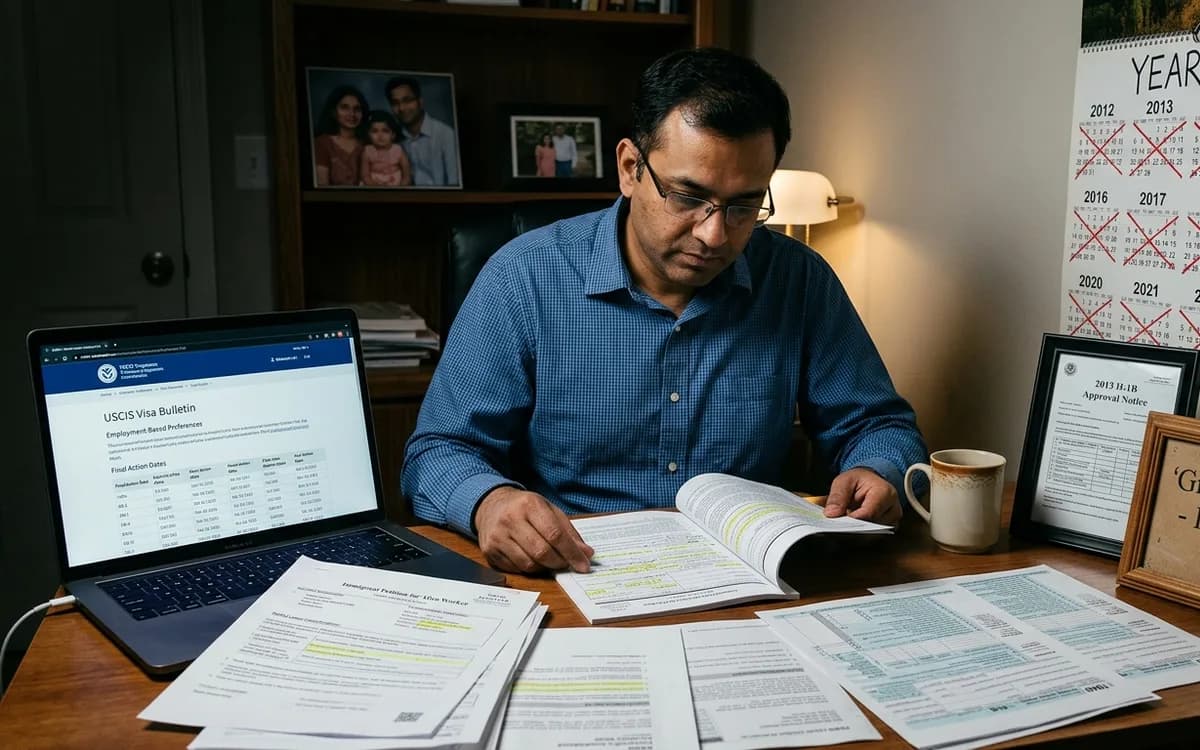
You came to the United States on an H-1B visa, built a career in tech, engineering, or health care, and did everything right. Now the math isn't working. Your employer filed a PERM labor certification, your I-140 is pending, and somewhere in the back of your mind you're counting the years until your visa status runs out before the green card does.
New data on employment-based immigration confirms what you already suspect: the system that welcomes skilled workers into the country is not built to get them permanent status quickly, or sometimes, at all. If you were born in India or China and work in engineering or technology, the gap between arrival and a green card can span a decade or more, driven by statutory per-country caps under INA § 203(b). What matters now is understanding exactly where you stand in that line, what can go wrong, and what still moves while you wait.
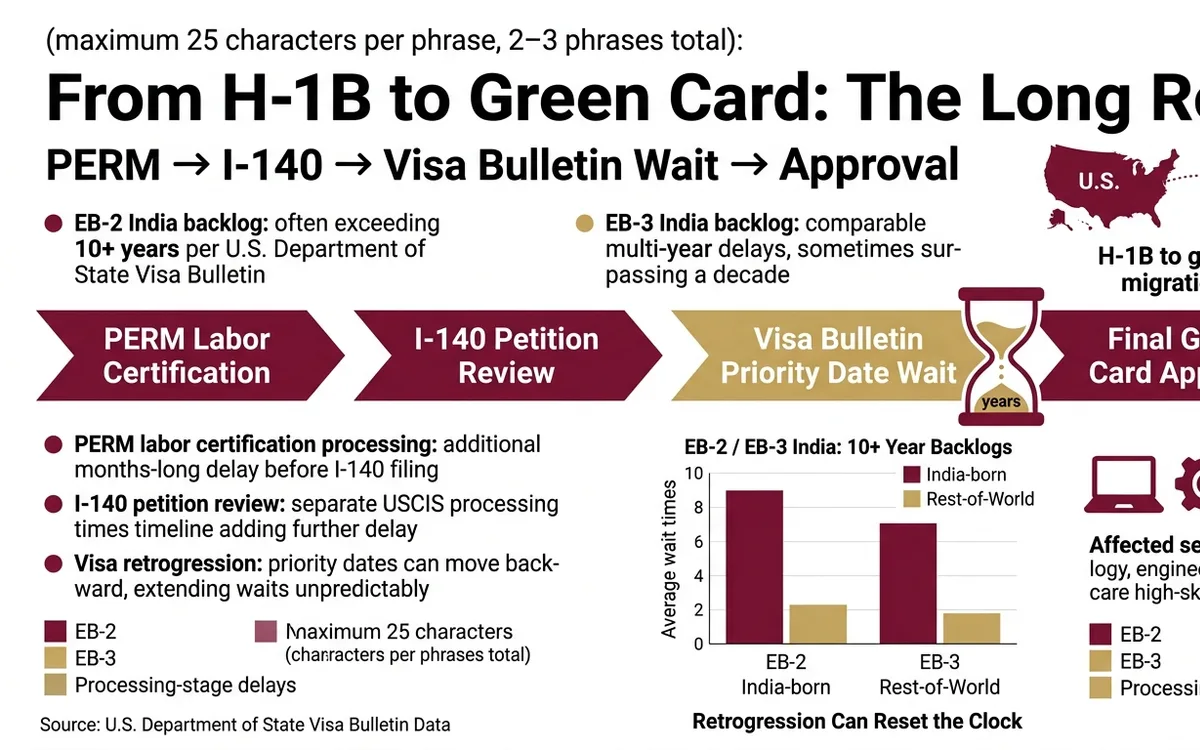
The path from H-1B to a green card is getting longer, not shorter. EB-2 and EB-3 applicants born in India face Visa Bulletin backlogs often exceeding a decade, per U.S. Department of State data. PERM labor certification, I-140 review, and visa retrogression each add separate delays that compound for high-skilled workers in tech, engineering, and health care.
The Hard Truth
Technology, engineering, and health care are the three industries most dependent on high-skilled foreign workers, according to Legal 500's analysis of how skilled-worker visas fill critical roles (source: legal500.com). That dependence does not shorten the line for a green card. Most employers can file the PERM and I-140 petitions without much trouble; the real bottleneck shows up afterward, in the wait for an actual visa number to open up.
Per the Congressional Research Service's 2023 analysis of the employment-based immigration backlog, India-born applicants in the EB-2 and EB-3 categories face projected waits that can exceed two decades at current per-country visa allocation levels under INA § 203(b)(1)-(3). That estimate assumes no change in annual visa allocations, which Congress controls, not USCIS or any attorney.
There is also increasing pressure across the entire employment-based immigration system right now, not just in one visa category (source: https://somireddylaw.com/us-immigration-bottlenecks-and-how-to-prepare/). PERM audits from the Department of Labor's Office of Foreign Labor Certification are taking longer, and USCIS service centers report fluctuating I-140 processing times. Your petition is not doomed because of this. More often than not, the calendar is the real obstacle, not anything wrong with the paperwork.
What Happens If You Wait
Every month you wait to get your PERM or I-140 filed is a month closer to statutory deadlines that do not bend. If your H-1B is approaching its sixth year and your employer has not filed a PERM labor certification at least 365 days before that date, you lose eligibility for the one-year AC21 extension under section 106(a) of the American Competitiveness in the Twenty-First Century Act. Miss that window, and your legal status in the United States can end on a specific date, not a flexible one.
Layoffs compound the risk. Losing your job triggers a 60-day grace period under 8 C.F.R. § 214.1(l)(2) to find a new H-1B sponsor, change status, or leave the country. If your child is approaching 21, delays in I-140 or visa-number availability can cause that child to age out of eligibility to immigrate with you, even where the Child Status Protection Act provides some relief by subtracting I-140 pending time. If you change jobs more than 180 days after filing Form I-485, you need a position in the same or a similar occupation under AC21 § 106(c), or the portability protection does not apply. None of these deadlines pause because the backlog is long.
Step-by-Step Process
Employment-based cases follow a federal sequence regardless of which USCIS field office or Immigration Court a petitioner is connected to. Here is the order for a typical EB-2 or EB-3 case sponsored by an employer, including where a Florida employer or employee fits in.
Prevailing Wage Determination. The employer files Form ETA-9141 with the Department of Labor's Office of Foreign Labor Certification. DOL issues a prevailing wage that the job offer must meet or exceed; current processing times are published on DOL's OFLC website.
Recruitment. The employer runs the required recruitment steps, including a 30-day job order with the state workforce agency and at least two additional recruitment steps, under 20 C.F.R. § 656.17. This step generally takes 60 to 180 days depending on the occupation.
PERM filing (Form ETA-9089). After recruitment closes, the employer files the labor certification. DOL either certifies the application, denies it, or selects it for audit. An audit adds months of additional review; our PERM labor certification audit page covers what DOL typically asks for.
I-140 petition. Once PERM is certified, the employer files Form I-140 with USCIS, generally at the Texas or Nebraska Service Center. Premium processing, where available, guarantees a decision or RFE within 15 business days for an additional fee; standard processing varies by service center and is tracked on USCIS's online Processing Times tool.
Visa Bulletin wait. Even after I-140 approval, the petitioner cannot move forward until their priority date, the date the PERM or I-140 was filed, is current under the U.S. Department of State's monthly Visa Bulletin for their category and country of birth.
Adjustment of status or consular processing. Petitioners already in the United States file Form I-485, often through the USCIS Miami Field Office for South Florida residents. Petitioners abroad go through the National Visa Center and consular processing at a U.S. embassy or consulate instead.
Workers who may qualify to skip steps 1 through 3 should look at the EB-2 National Interest Waiver, which allows a self-petition without employer sponsorship or PERM, if the petition meets the three-part test from Matter of Dhanasar, 26 I&N Dec. 884 (BIA 2016).
A Real-World Example
Consider a composite example drawn from the kind of case this office commonly sees, not any real client. An electrical engineer working for a Miami-based engineering firm on H-1B status has her employer begin the PERM process in her fifth year of status. Her employer's attorney files Form ETA-9141 for a prevailing wage determination, waits for DOL's response, then runs the required recruitment steps over the following 60 to 90 days.
Once recruitment closes, the firm files Form ETA-9089. DOL selects the case for audit — a routine occurrence that happens to a meaningful share of PERM filings and does not by itself signal trouble. It does mean producing additional documentation on the recruitment process and responding within DOL's stated deadline, usually 30 days from the audit notice.
At the two-year mark, her PERM is still moving through DOL's audit review, and her priority date has not yet reached the current cutoff in the Visa Bulletin for her category. Because her PERM was filed more than 365 days before her sixth H-1B year, her employer can file one-year extensions of her H-1B status under AC21 § 106(a) while the case continues. No I-140 decision, PERM certification, or visa number has been issued yet at this stage; the relevant fact is that the extension mechanism keeps her status intact while the underlying case moves through DOL and USCIS review.
William J. Vasquez handles employment-based immigration matters before USCIS, the Executive Office for Immigration Review, and the Board of Immigration Appeals nationwide. He is licensed by the North Carolina State Bar and admitted to practice before the U.S. Courts of Appeals for the Fourth, Fifth, and Eleventh Circuits. Immigration matters, including PERM-based petitions, I-140 filings, and national interest waivers, are federal, so an attorney with federal immigration-bar standing can represent petitioners nationwide regardless of which state bar issued their license, under 8 C.F.R. § 1292.1. His federal admission does not include the Florida Bar, and his practice connected to this firm's Florida office is limited to federal immigration matters, not Florida state-court representation.
Vasquez has spent years working through PERM audits, RFEs on I-140 petitions, and the procedural grind of visa-number waits for clients in technology, engineering, and health care. That experience shapes how this page is written: plainly, with the actual deadlines named, because a client in the middle of a PERM audit does not need reassurance. They need to know what DOL is actually asking for and by when. Content on this page reflecting current federal immigration procedure was last reviewed by his office in October 2026.
Key Terms Explained
PERM Labor Certification: The Department of Labor process (Form ETA-9089) that requires an employer to test the U.S. labor market and certify that no qualified, willing U.S. worker is available for the position before sponsoring a foreign worker for a green card.
Prevailing Wage Determination: DOL's official determination, requested on Form ETA-9141, of the minimum wage an employer must offer for a position before PERM recruitment can begin.
Form I-140, Immigrant Petition for Alien Worker: The USCIS petition establishing a foreign worker's eligibility for an employment-based green card category, filed after PERM certification, or instead of PERM for a National Interest Waiver case.
EB-2 National Interest Waiver (NIW): A category letting certain workers with advanced degrees or exceptional ability self-petition for a green card without a PERM labor certification or employer sponsor, if they meet the three-part test from Matter of Dhanasar, 26 I&N Dec. 884 (BIA 2016).
Visa Bulletin: The U.S. Department of State's monthly publication listing which priority dates are currently eligible to apply for a green card, by category and country of birth.
Priority Date: The date DOL received the PERM application, or USCIS received the I-140 for NIW cases, which determines a petitioner's place in line for a visa number.
Retrogression: When a priority date cutoff in the Visa Bulletin moves backward instead of forward, because demand for visa numbers in a category exceeds the annual supply.
AC21 (American Competitiveness in the Twenty-First Century Act): The 2000 federal law allowing H-1B extensions beyond the normal six-year limit and allowing I-485 applicants to change jobs without restarting their green card case, under specific conditions.
Child Status Protection Act (CSPA): A federal law allowing a portion of the time an I-140 petition was pending to be subtracted from a child's age, to help prevent the child from aging out of eligibility to immigrate with a parent.
Premium Processing: A USCIS service, available for an additional fee on certain petitions including Form I-140, that guarantees a decision or a Request for Evidence within 15 business days.
Adjustment of Status: The process (Form I-485) letting a noncitizen already lawfully present in the United States apply for permanent residence without leaving the country.
Consular Processing: The alternative path to a green card for petitioners outside the United States, handled through the National Visa Center and a U.S. embassy or consulate.
Request for Evidence (RFE): A formal USCIS notice asking for additional documentation before it will decide a pending petition.
Frequently Asked Questions
Q: How long does it actually take to go from H-1B to green card right now? A: It depends on category and country of birth. For EB-2 or EB-3 applicants born in most countries, total time including PERM, I-140, and the visa-number wait often runs 2 to 4 years; for applicants born in India, Visa Bulletin backlogs alone can add a decade or more, per the U.S. Department of State's monthly Visa Bulletin (travel.state.gov).
Q: What happens to my status if I get laid off while my PERM or I-140 is pending? A: You get a 60-day grace period under 8 C.F.R. § 214.1(l)(2) to find a new H-1B sponsor, switch to another valid status, or leave the country. A pending PERM generally does not survive the loss of the sponsoring employer, though an approved I-140 can sometimes carry over to a new employer under AC21.
Q: Can I change jobs while my green card case is pending? A: Once your Form I-485 has been pending for 180 days, you can generally port to a new job in the same or a similar occupation under AC21 § 106(c) without restarting PERM. Changing jobs before that mark, or into an unrelated occupation, usually requires starting the PERM process over.
Q: What does a PERM audit mean for my timeline? A: A PERM audit means DOL's Office of Foreign Labor Certification flagged the case for closer review of recruitment and wage documentation, which typically adds several months. See our PERM labor certification audit page for the documents DOL usually requests.
Q: Is an EB-2 National Interest Waiver faster than PERM sponsorship? A: NIW self-petitions skip PERM recruitment entirely, removing one layer of delay, but the petition still has to meet the three-part standard from Matter of Dhanasar and still waits in the same EB-2 Visa Bulletin line as PERM-sponsored cases. See our EB-2 National Interest Waiver page for who typically qualifies.
Q: What happens to my spouse and children while I wait? A: Spouses and unmarried children under 21 generally hold dependent status tied to yours, and certain H-4 spouses qualify for employment authorization. If a child is approaching 21, the Child Status Protection Act can subtract I-140 pending time from their age, but it does not stop the clock entirely, so this is worth reviewing well before a child's 21st birthday.
Q: How much does an employment-based green card case cost? A: Government filing fees include PERM recruitment costs and USCIS fees for Form I-140 and Form I-485, which change periodically; check USCIS's current fee schedule at uscis.gov/forms/filing-fees. Attorney fees vary by category and whether the case is employer-sponsored or a self-petition, which we go over during a consultation once we know your facts.
Q: What happens if USCIS issues an RFE or denies my I-140? A: An RFE asks for more documentation and adds months but is not a denial. If USCIS denies an I-140 outright, the petitioner can generally appeal to the Administrative Appeals Office or file a motion to reopen or reconsider, depending on the ground for denial.
Q: Does this firm handle cases connected to South Florida? A: Yes. Our office works with employment-based petitioners connected to the USCIS Miami Field Office and employers across South Florida in technology, engineering, and health care, in addition to representing clients nationwide before USCIS and the Board of Immigration Appeals.
Clients working through PERM audits and I-140 delays often describe the same thing: they wanted someone to explain what was actually happening with their case, not just tell them to wait. Review feedback shows a consistent pattern around clear explanations of DOL and USCIS procedure, responsiveness during audits, and plain answers about what a given notice means. We do not publish star-rating aggregates or outcome percentages on this page, because a visa backlog is a function of federal quota and processing capacity, not legal representation, and no attorney can quote a success rate for a process that depends on statutory wait times beyond anyone's control.
If you are trying to figure out where your case actually stands, start by pulling your actual priority date, your I-140 receipt notice, and the current Visa Bulletin cutoff for your category and country of birth, and lining them up side by side. Once you know where those three numbers sit against each other, a consultation becomes a far more useful conversation, because we can tell you what is realistic instead of guessing.
William J. Vasquez and our team handle PERM-based petitions, I-140 filings, EB-2 National Interest Waiver cases, and the AC21 portability questions that come up when a job change or a layoff hits mid-process. Schedule a consultation to go over your priority date, your current status deadlines, and the options actually available to you under federal law right now.

- H-1B Visa Services: /immigration/h-1b-visas
- EB-2 National Interest Waiver Petitions: /immigration/eb-2-national-interest-waiver
- PERM Labor Certification Audits: /immigration/perm-labor-certification-audits
- Schedule a Consultation: /schedule-a-consultation
- Immigration Glossary: /resources/immigration-glossary