H-2A Visa Attorney for Florida Growers and Farmworkers
October 10, 2026
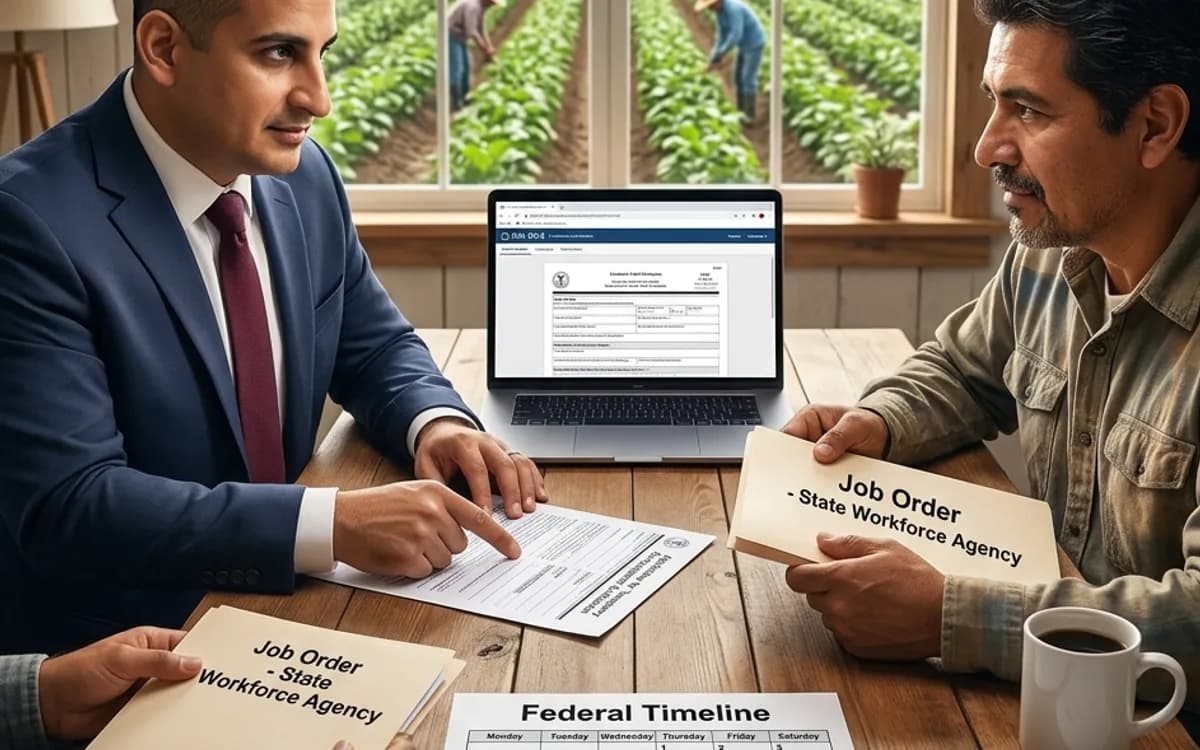
The strawberries in Plant City don't wait for paperwork. Neither does the sugarcane in Clewiston or the citrus coming off the trees in Polk County. If your H-2A workers are stuck behind a DOL certification delay, a stalled job order, or a consulate appointment that keeps slipping, every week costs you labor you can't replace. Workers on the other end of that same delay carry their own stakes, a lost season's wages, a flight rebooked twice, a family counting on income that hasn't arrived yet.
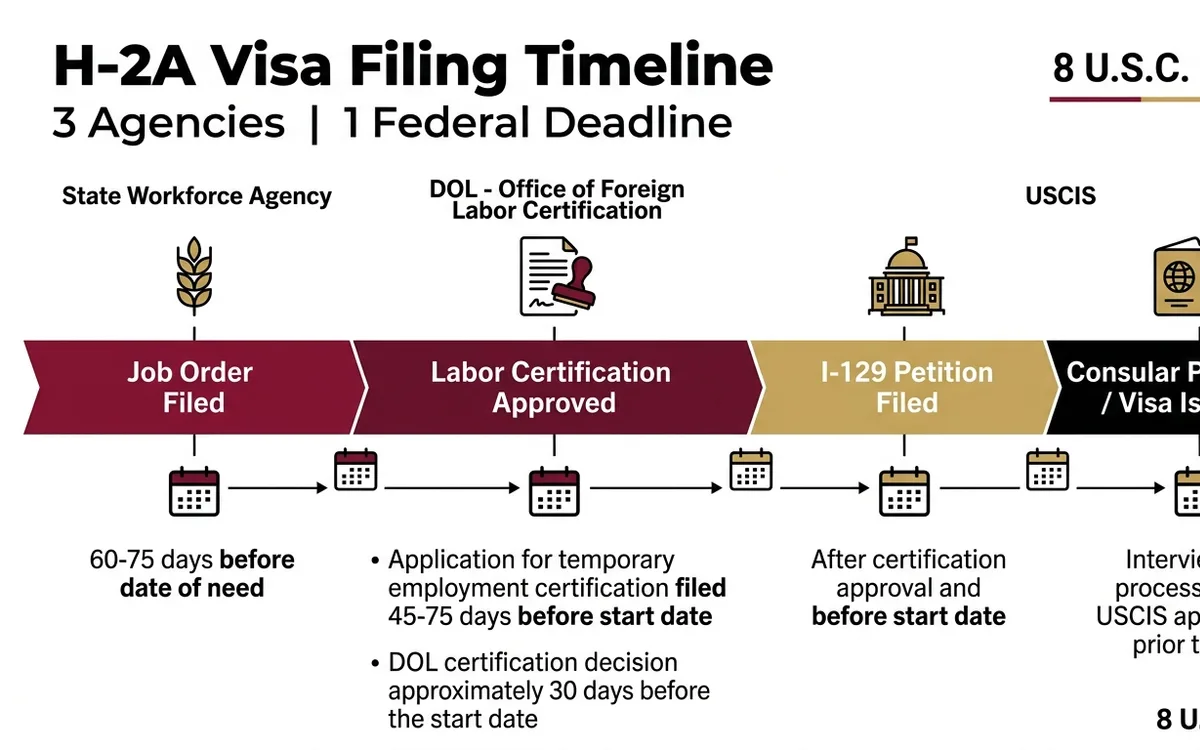
An H-2A visa attorney helps agricultural employers file the job order, labor certification, and I-129 petition on the federal timeline required by 8 U.S.C. § 1188, and helps workers through consular processing. The process runs through three agencies: the state workforce agency, DOL's OFLC, and USCIS, each with its own deadline.
The Hard Truth
The 45-day minimum filing window for the Application for Temporary Employment Certification (20 C.F.R. § 655.130) is the floor, not a guarantee. DOL's Office of Foreign Labor Certification in Chicago can issue a Notice of Deficiency that adds weeks you don't have. A late job order with CareerSource Florida, an adverse effect wage rate miscalculation, or an incomplete housing inspection report can each push certification past your planting date. There is no expedited labor certification process at DOL the way there is premium processing at USCIS, so once a certification stalls, emergency judicial review in federal court becomes the only real lever, and that is a last resort, not a backup plan to build your season around.
What Happens If You Wait
Miss the 60-day job order deadline with CareerSource Florida and your entire timeline slides, because DOL will not certify an application until the state workforce agency has run its required recruitment period (20 C.F.R. § 655.121). A late I-129 filing stacks USCIS adjudication on top of an already-compressed calendar, and the Texas Service Center does not expedite agricultural petitions outside of premium processing. Workers left waiting on a consulate appointment in Monterrey or Ciudad Juárez lose wages for every week they sit. On the compliance side, a documented AEWR underpayment or a 3/4-guarantee violation (20 C.F.R. § 655.122) can trigger DOL Wage and Hour Division back-wage liability, and repeated or willful violations can lead to debarment from the H-2A program for up to five years (20 C.F.R. § 655.182).
Step-by-Step Process
- File the job order with CareerSource Florida, the state workforce agency, at least 60 days before your date of need, listing the adverse effect wage rate, housing, and transportation terms required by 20 C.F.R. § 655.121.
- Submit Form ETA-9142A, the Application for Temporary Employment Certification, to DOL's Office of Foreign Labor Certification in Chicago between 75 and 45 days before the date of need (20 C.F.R. § 655.130).
- Run the required positive recruitment period and document any U.S. worker referrals; DOL reviews this record before certifying the application.
- Once DOL certifies the application, file Form I-129 with USCIS's Texas Service Center. Premium processing is available for an additional fee, per the USCIS Form I-907 fee schedule, and brings adjudication to 15 calendar days instead of the standard queue.
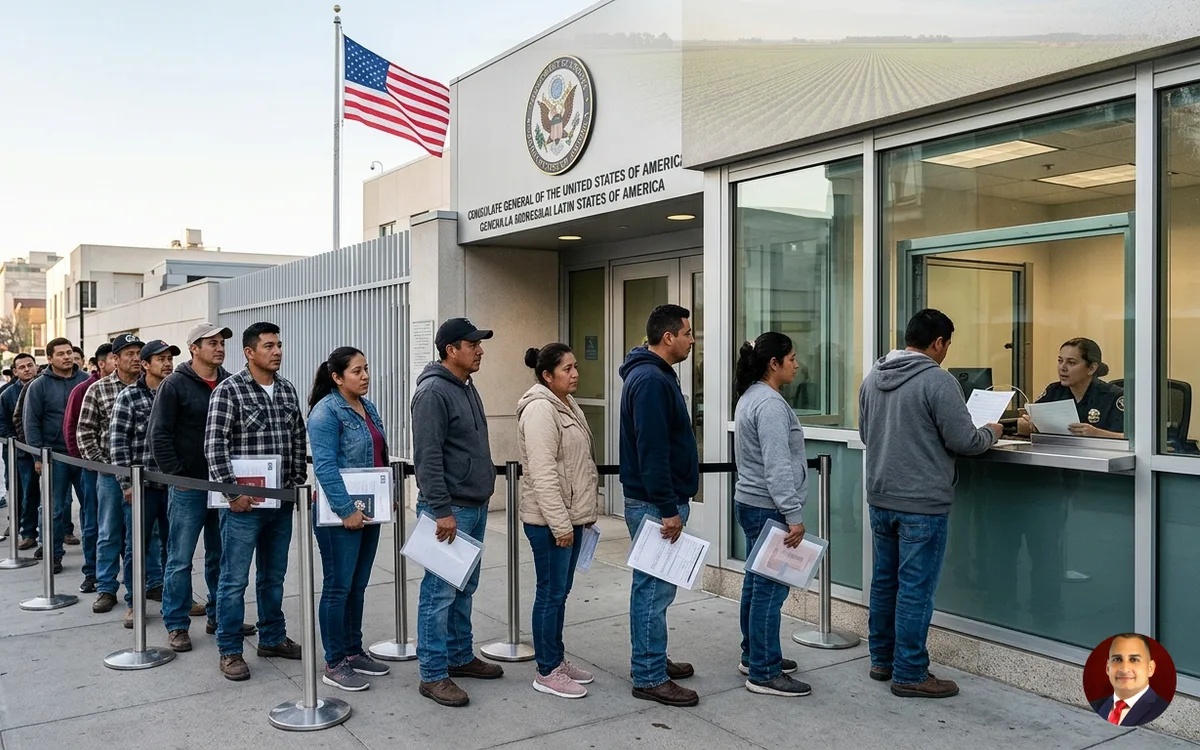
- Workers outside the U.S. schedule a consular interview, commonly at the U.S. Consulate in Monterrey or Ciudad Juárez for Mexican nationals, to obtain the H-2A visa stamp.
- Workers enter the U.S. and begin work under the certified contract terms, including the housing and 3/4-guarantee obligations that attach once employment starts.
A Real-World Example
A composite example: a Southwest Florida strawberry operation needed 40 H-2A workers on-site by the first week of December. The job order reached CareerSource Florida in early October, about 55 days out, five days short of the 60-day minimum. DOL flagged the late filing and requested corrected wage documentation before the application could move forward. The employer's attorney filed the corrected ETA-9142A, tracked the recruitment period, and prepared the I-129 petition for USCIS's Texas Service Center, electing premium processing so the 15-day clock would run as soon as the petition was filed. Consular appointments in Monterrey were requested in parallel, since scheduling there can take weeks on its own. The sequence is the same for every grower regardless of how a given year's calendar falls: job order, certification, petition, visa, arrival, and a delay at any one stage pushes back every stage after it.
William J. Vasquez handles federal immigration matters, including H-2A petitions before USCIS and labor-certification disputes that reach federal court. He is admitted to the North Carolina State Bar and to the U.S. Court of Appeals for the Eleventh Circuit, the circuit with appellate jurisdiction over Florida H-2A litigation. Proceedings before DOL, USCIS, and federal court are federal matters and do not require a Florida state law license; his work on Florida growers' H-2A filings is conducted under that federal authority. He has worked through the job-order, certification, petition, and consular sequence that Florida's citrus, strawberry, and sugarcane seasons depend on.
Key Terms Explained
Adverse Effect Wage Rate (AEWR): the minimum hourly wage DOL sets annually for H-2A workers in each state and occupation (20 C.F.R. § 655.120). 3/4-Guarantee Rule: the employer's obligation to offer work for at least three-fourths of the workdays in the contract period (20 C.F.R. § 655.122(i)). ETA-9142A: the DOL form that starts the Application for Temporary Employment Certification. Job Order / Clearance Order: the recruitment notice an employer files with the state workforce agency before DOL will accept the labor certification application. OFLC: DOL's Office of Foreign Labor Certification, the office in Chicago that adjudicates H-2A applications. Form I-129: the USCIS petition that converts a DOL certification into worker authorization, filed with the Texas Service Center. Premium Processing: an optional USCIS service that commits to acting on a petition within a set number of days for an added fee. Debarment: DOL's exclusion of an employer or farm labor contractor from the H-2A program for a fixed period following documented violations (20 C.F.R. § 655.182). Positive Recruitment: the required period of advertising the job to U.S. workers before DOL will certify that no qualified U.S. workers are available.
Frequently Asked Questions
Q: How far in advance do I need to start the H-2A process before harvest? A: Count back at least 75 days from your date of need. The job order goes to CareerSource Florida around 60 days out, the ETA-9142A goes to DOL between 75 and 45 days before the date of need (20 C.F.R. § 655.130), and USCIS and consular processing still have to happen after that.
Q: Can I speed up a stalled H-2A labor certification at DOL? A: There is no premium processing option at DOL the way there is at USCIS. If a certification is stuck past your planting window, the available option is emergency judicial review in federal district court, which requires showing the delay itself is causing irreparable harm.
Q: What triggers H-2A debarment, and how long does it last? A: DOL can debar an employer for substantial violations, such as repeated AEWR underpayment or 3/4-guarantee failures, for up to five years (20 C.F.R. § 655.182). A documented pattern across more than one season, not a single paperwork error, is what typically drives a debarment case.
Q: Who pays for worker transportation under H-2A? A: Employers must reimburse inbound transportation and subsistence costs once a worker completes 50 percent of the contract period, and outbound costs upon completion, under the standard the Eleventh Circuit set in Arriaga v. Florida Pacific Farms, LLC, 305 F.3d 1228 (11th Cir. 2002).
Florida growers and farm labor contractors tend to call during the same few weeks every year, right as a job order deadline or a stalled certification threatens a planting or harvest date. Clients describe the value in plain terms: someone who already knows the CareerSource Florida clearance order process, the OFLC filing calendar, and what a consulate in Monterrey or Ciudad Juárez needs to schedule a visa interview, so they are not explaining the H-2A program from scratch under deadline pressure.
If your date of need is already on the calendar, the filing windows above are not flexible, they are regulatory deadlines that run backward from a fixed day. The sooner the job order and ETA-9142A go in, the more room there is to fix a deficiency notice before it costs a week of harvest.
Schedule a consultation with our immigration team to map your H-2A filing calendar against this season's planting or harvest date, including the job order, DOL certification, I-129 petition, and consular scheduling. Call our Florida office or use the online intake to start before your 75-day window closes.