Orlando Green Card Attorney: Your Rights in the Adjustment Process
October 10, 2026
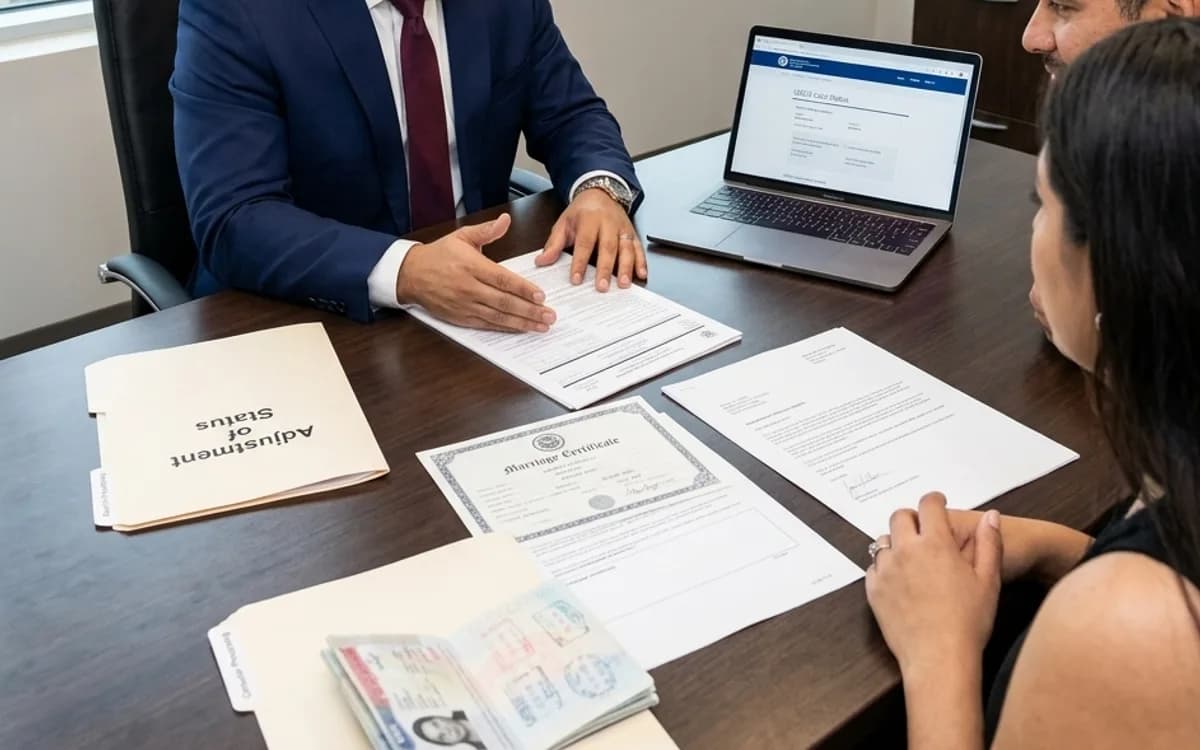
You got married, or your employer sponsored you, or a family member became a citizen and petitioned for you. Then the waiting began, and nobody explained what the next letter from USCIS actually means.
A Request for Evidence might show up with a deadline you don't fully understand. Your work permit might expire before your green card does. You might be undocumented and married to a U.S. citizen, unsure whether applying puts you at risk.
None of that makes your case unusual. It makes it the point where most people in Orlando need an attorney to read the notice, name the form, and tell them what happens next.
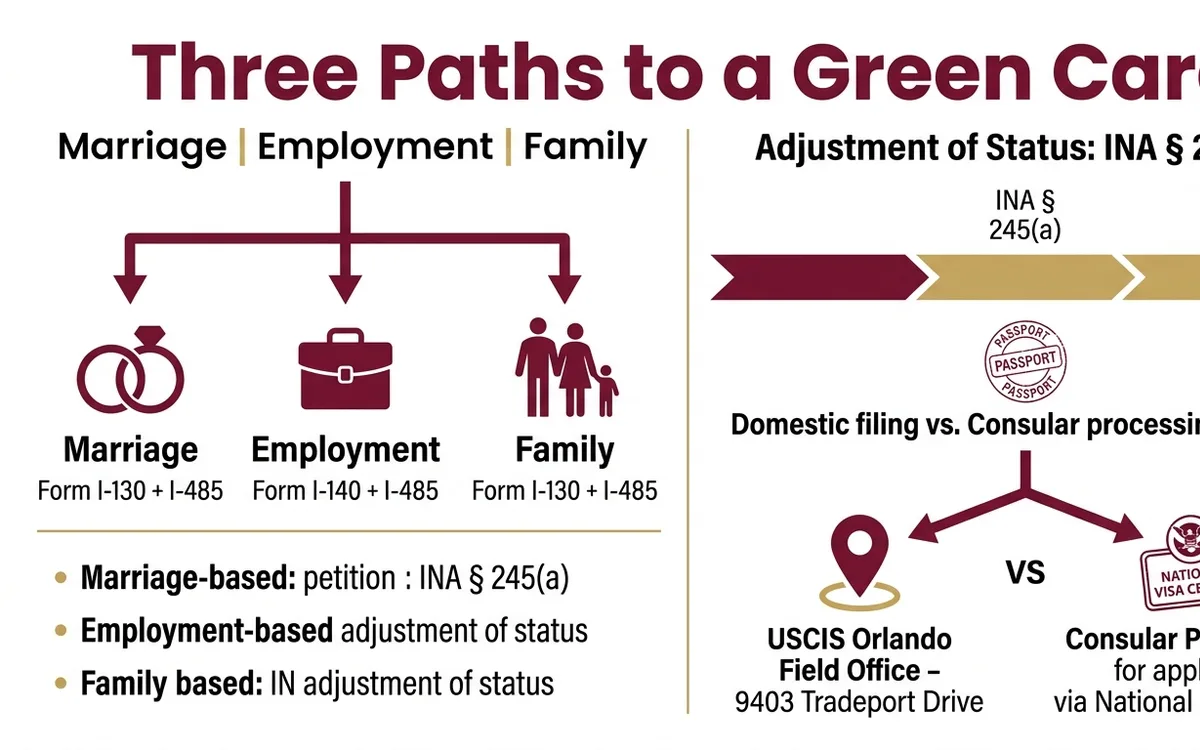
A green card attorney in Orlando helps noncitizens file for lawful permanent residence through marriage, employment, or family petitions, guiding adjustment-of-status cases under INA § 245(a) with the USCIS Orlando Field Office at 9403 Tradeport Drive, or consular processing through the National Visa Center for applicants abroad.
The Hard Truth
USCIS does not have to prove your case false to deny it. The agency applies a preponderance-of-the-evidence standard, meaning it can deny your I-485 if the evidence tips even slightly against you, per Matter of Chawathe, 25 I&N Dec. 369 (AAO 2010). A missing tax return or an inconsistent lease date is sometimes enough.
Processing times shift often, and they tend to run long. USCIS publishes current wait times by form and office at uscis.gov/processing-times, and the Orlando Field Office at 9403 Tradeport Drive moves on its own schedule, separate from Miami or Tampa. Check the published time before you file, and check it again before you assume something is wrong.
Marriage-based cases draw more scrutiny than most. If you married after you were already in removal proceedings, or if there's a prior divorce in the file, expect the interview to run longer and expect follow-up questions beyond the standard list.
What Happens If You Wait
A conditional resident who misses the 90-day window to file Form I-751 before the two-year green card expires loses status the day that window closes. USCIS terminates conditional residence by operation of law under INA § 216(c), and the former cardholder becomes immediately removable.
A Request for Evidence carries a response deadline printed on the notice itself, typically around 87 days per USCIS's RFE response guidance in the USCIS Policy Manual. Miss it, and USCIS can deny the case without asking again. That denial can end work authorization tied to the pending I-485 the same week it issues.
Unlawful presence keeps accruing while you wait to act. Leave the country after 180 days of unlawful presence and you can trigger a 3-year bar; after a year, a 10-year bar, under INA § 212(a)(9)(B). An I-601A provisional waiver can address that bar in some cases, but only if it's filed before you leave, not after.
Step-by-Step Process
Identify your pathway. If you are physically in the United States and eligible, you adjust status under INA § 245(a) (8 U.S.C. § 1255) by filing Form I-485 with USCIS. If you are abroad, or adjustment isn't available to you, your case goes through consular processing instead.
File the underlying petition. Family-based cases start with Form I-130; employment-based cases start with Form I-140. USCIS must approve this petition, or in some categories allow concurrent filing, before the green card application moves forward.
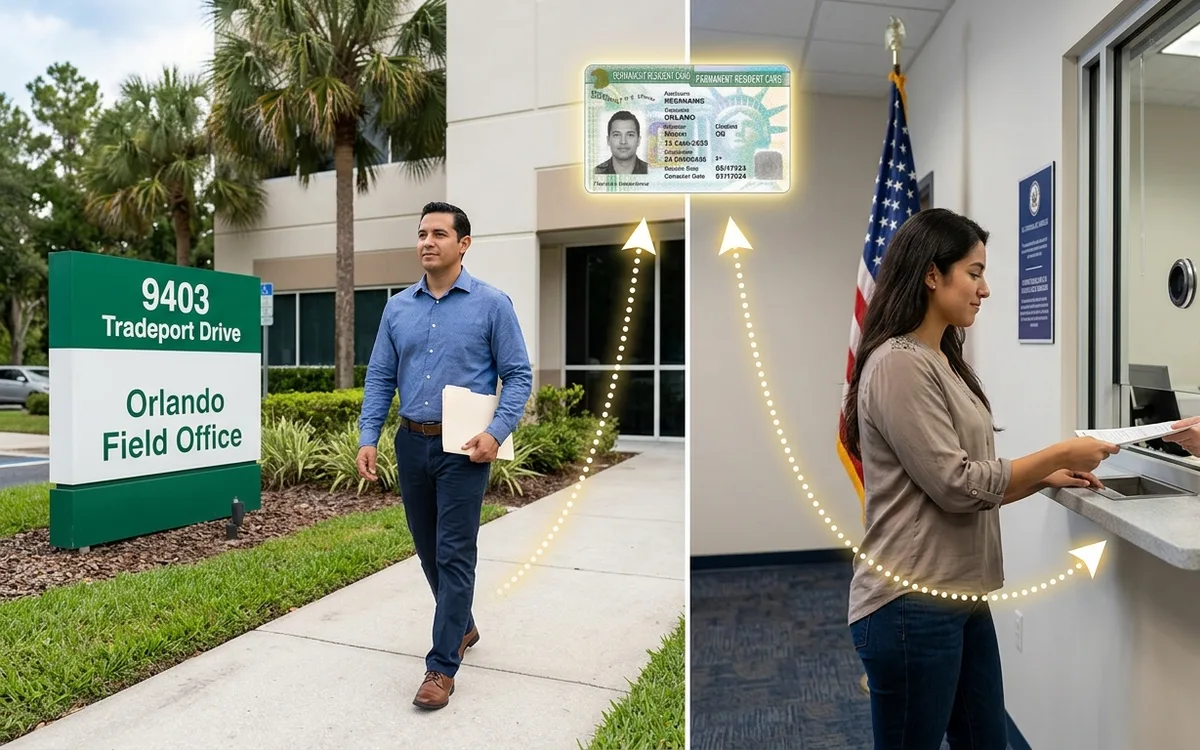
For adjustment of status, file Form I-485, pay the biometrics fee, and attend your biometrics appointment at the USCIS Orlando Field Office's Application Support Center at 9403 Tradeport Drive, Orlando, FL 32827. USCIS uses this appointment to run background and identity checks before scheduling an interview.
Respond to any Request for Evidence by the deadline on the notice. Common RFEs in Orlando marriage cases ask for additional proof of a bona fide marriage, joint finances, or a corrected Affidavit of Support, Form I-864.
Attend your interview at the Orlando Field Office. Bring original civil documents, including certified marriage or divorce records, which Orlando-area applicants typically obtain from the Orange County Clerk of Courts.
For consular processing, once the petition is approved, the case moves to the National Visa Center, which collects civil documents and fees, schedules the DS-260 immigrant visa interview, and forwards the file to the U.S. consulate abroad.
If USCIS denies the case, read the denial notice for your options. Some denials allow a motion to reopen or reconsider with USCIS; denials tied to removal proceedings can be appealed to the Board of Immigration Appeals under 8 C.F.R. § 1003.1(b).
A Real-World Example
Consider a composite example based on the kind of filing we see at our Orlando office. Call her Marisol: a Colombian national married to a U.S. citizen, living in Orange County, working without authorization while her status was pending.
Her husband filed Form I-130 on her behalf, and because she had entered on a valid visa and overstayed rather than entering without inspection, she was eligible to adjust status in place. They filed Form I-485 concurrently with the I-130, along with Form I-864, the Affidavit of Support, and Form I-765 for a work permit.
USCIS scheduled her biometrics appointment at the Orlando Field Office about six weeks after filing. Four months later, USCIS issued a Request for Evidence asking for more proof that the marriage was bona fide, including joint lease documents and updated bank statements, because the couple had only been married eight months at filing.
Our office gathered the additional evidence, submitted the response before the printed deadline, and prepared Marisol and her husband for the interview, reviewing the kinds of questions an officer typically asks about relationship history and the documents in the file. As of this writing, her case is still pending a decision from the Orlando Field Office. A pending case at this stage, months past the interview, is the ordinary outcome for most applicants in her position.
William J. Vasquez is admitted to the North Carolina State Bar and to the U.S. Courts of Appeals for the Fourth, Fifth, and Eleventh Circuits. Immigration cases before USCIS, the Orlando Immigration Court, and the Board of Immigration Appeals are federal matters. Under 8 C.F.R. § 1292.1, an attorney with federal immigration-bar standing can represent clients in those forums nationwide, regardless of which state bar issued the license.
That means William J. Vasquez's work on green card cases in Orlando, filings with the USCIS Orlando Field Office, petitions routed through the National Visa Center, and appeals to the BIA, is federal immigration practice, not Florida state-court practice. He does not hold a Florida state bar license, and his authority here is scoped to federal immigration matters.
He has spent his career focused on immigration law, handling adjustment-of-status cases, consular processing, waivers, and appeals. Our team works these cases from filing through interview, tracking deadlines like the I-751 window and RFE response dates so they don't slip.
Key Terms Explained
Adjustment of Status: the process under INA § 245(a) (8 U.S.C. § 1255) that lets someone already in the United States apply for a green card without leaving the country, filed on Form I-485.
Consular Processing: the alternative path for green card applicants who are abroad, or who are not eligible to adjust status, completed through the National Visa Center and a U.S. consulate using Form DS-260.
Form I-130: the petition a U.S. citizen or lawful permanent resident files to establish a qualifying family relationship with the immigrant relative.
Form I-140: the petition an employer, or in some categories the worker, files to establish eligibility for an employment-based green card.
Request for Evidence (RFE): a USCIS notice asking for more documentation before it decides a case, with a deadline printed on the notice itself.
National Visa Center (NVC): the State Department office that collects civil documents and fees, and schedules the immigrant visa interview, for consular-processing cases.
Biometrics / Application Support Center (ASC): the appointment where USCIS captures fingerprints and a photo for background checks, held at a local ASC such as the one co-located with the USCIS Orlando Field Office.
Board of Immigration Appeals (BIA): the administrative body with appellate jurisdiction, under 8 C.F.R. § 1003.1(b), over certain removal and adjustment-related denials.
Preponderance of the Evidence: the standard USCIS applies when deciding green card cases, meaning the agency can deny a case if the evidence tips even slightly against the applicant, as described in Matter of Chawathe, 25 I&N Dec. 369 (AAO 2010).
I-751, Removal of Conditions: the form a conditional resident married less than two years at approval must file within the 90 days before the second anniversary of that status, to remove the conditions and keep permanent residence.
Frequently Asked Questions
Q: How long does a marriage-based green card take if I live in Orlando? A: It depends on your case type and the USCIS Orlando Field Office's current workload. Check the agency's published processing times at uscis.gov/processing-times for the I-485 form filed at that office, since timelines change throughout the year.
Q: Can I apply for a green card if I entered the United States without inspection? A: Entering without inspection generally blocks adjustment of status under INA § 245(a), so most people in that situation need consular processing instead, sometimes paired with an I-601A provisional waiver for unlawful presence. An attorney can review your entry history to confirm which path applies.
Q: What happens if USCIS denies my green card application? A: The denial notice will state whether you can file a motion to reopen or reconsider with USCIS, or whether the denial is tied to removal proceedings that can be appealed to the Board of Immigration Appeals under 8 C.F.R. § 1003.1(b). Read the notice closely, because the deadline to act is printed on it.
Q: Does your firm charge a flat fee for green card cases? A: Fee structures vary by case type, whether it's a straightforward marriage-based adjustment or a more complex waiver or consular case, and we discuss the fee for your specific filing during the consultation before any work begins.
Q: Is help available in Spanish for green card cases in Orlando? A: Yes, our office handles green card consultations and filings in Spanish for clients throughout Central Florida, including the Orange County community.
Clients come to our Orlando office after searching for help with a specific notice in hand, an RFE, a biometrics appointment, an I-751 deadline, and most say the same thing afterward: they finally understood what the form in front of them actually required. We are members of the American Immigration Lawyers Association's Central Florida Chapter, the professional body that tracks local USCIS Orlando Field Office practice and policy changes.
We don't publish win rates or outcome statistics for green card cases, because USCIS adjudications depend on facts specific to each applicant and no attorney can promise a result. What we can tell you is how we work: direct attorney involvement in your filing, not a call-center intake process, and a team that tracks your deadlines alongside you.
Reading this page is the easy part. The next step, whether that's filing an I-485, responding to an RFE, or figuring out if you're even eligible to adjust status, depends on facts specific to your case that a general article can't cover.
Schedule a consultation with our Orlando office to go over your green card case, whether you're filing a marriage-based I-485, waiting on an employment petition, approaching an I-751 deadline, or responding to a USCIS denial. Bring your notices and petition documents, and we'll tell you what the next filing actually requires.
- Marriage-Based Green Card Attorney Orlando
- Employment-Based Adjustment of Status Orlando
- I-751 Removal of Conditions Attorney
- I-601A Provisional Waiver Attorney Orlando
- BIA Appeals and Green Card Denials
- Spanish-Speaking Immigration Attorney Orlando