Green Card Application Lawyer: Know Your Rights, Next Steps
October 10, 2026
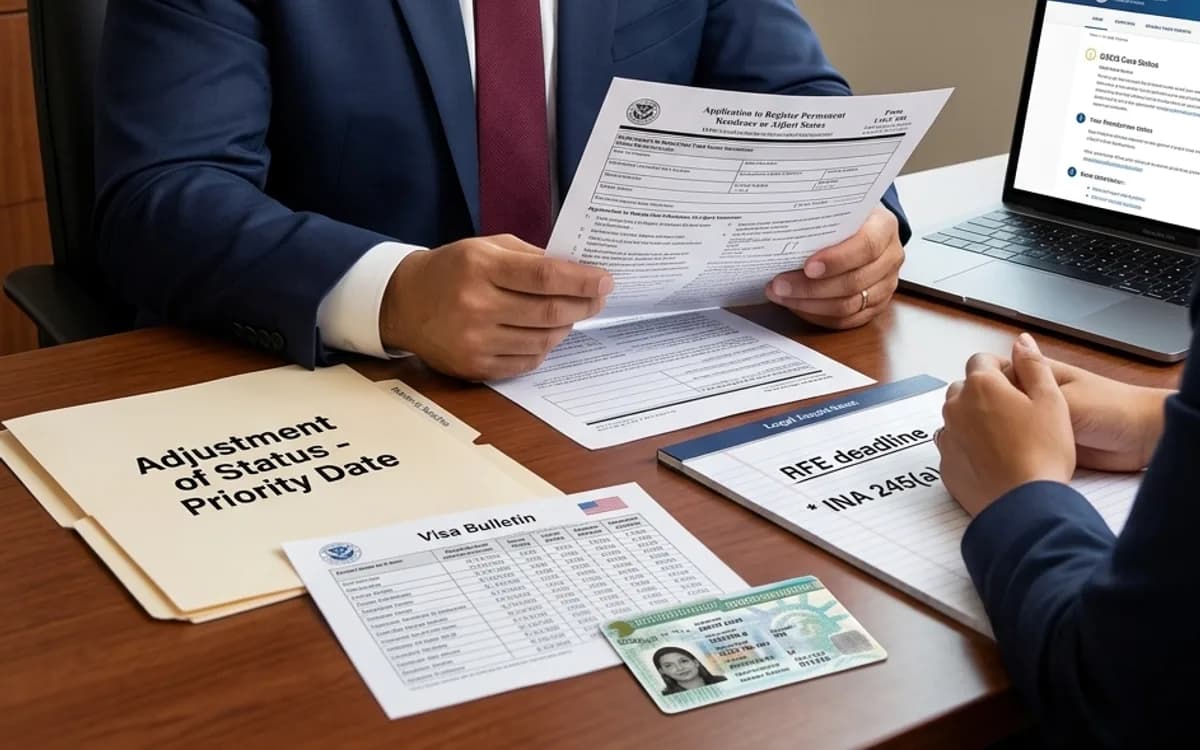
You filed Form I-485 eight months ago, and the only mail you've gotten back is a biometrics notice. No interview date has been scheduled yet, and USCIS hasn't said why. Every day without a decision pushes your plans back, puts work decisions on hold, and leaves your family waiting too.
If a Request for Evidence just landed in your mailbox, you have a government deadline and a narrow window to respond correctly the first time. If your priority date just retrogressed on the Visa Bulletin, the wait you planned for got longer, and there is a real difference between a case that moves forward and one that sits in a drawer for years.
Immigration law doesn't need to make sense tonight. What matters is knowing what happens next, and whether the paperwork in front of you is routine or something that could put your application at risk.
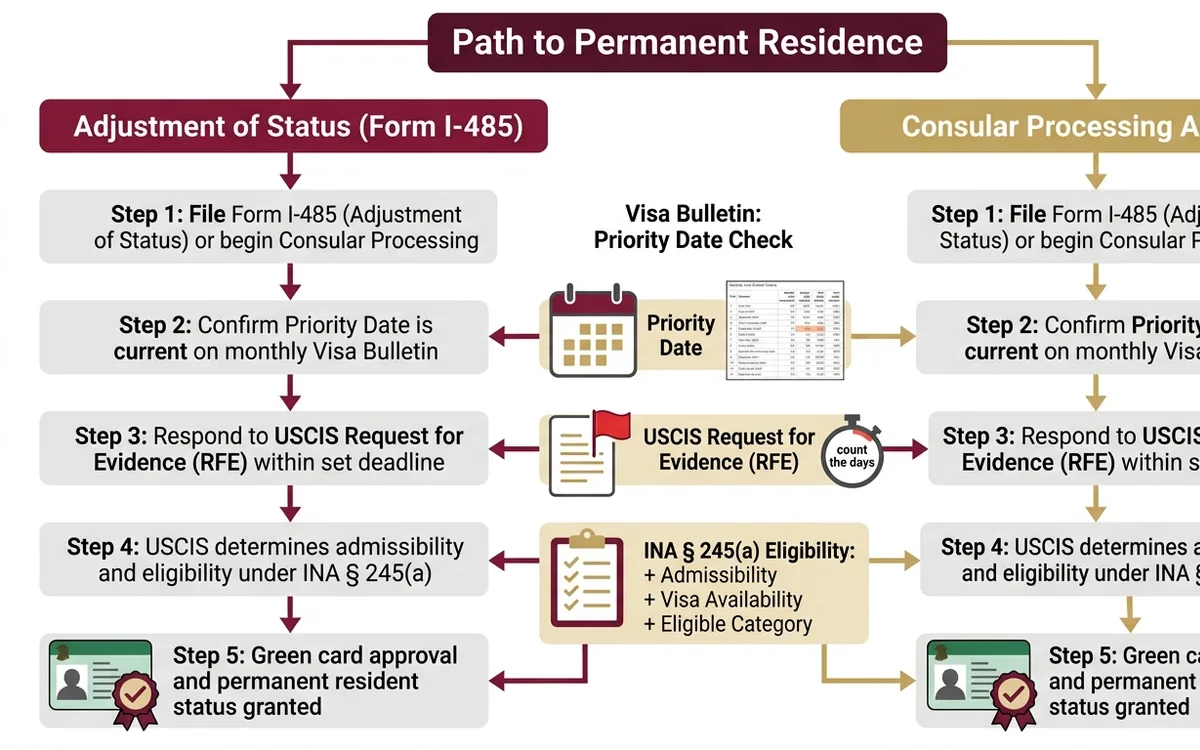
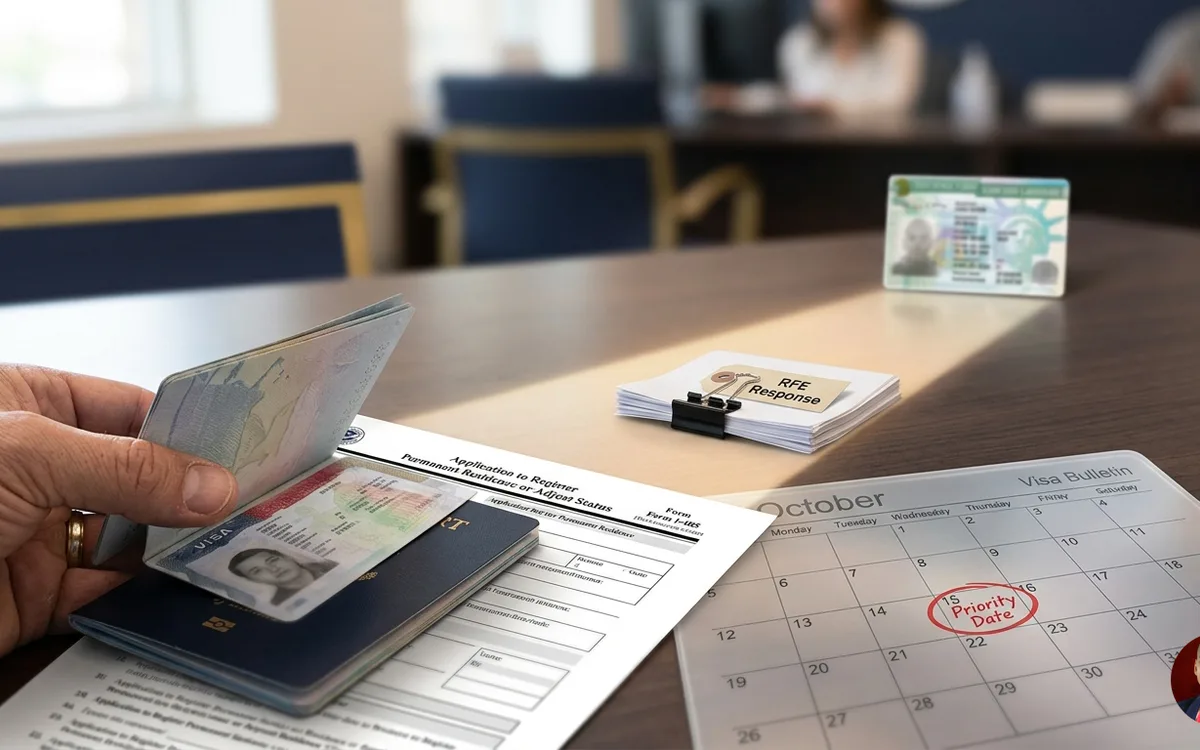
A green card application lawyer helps you file Form I-485 for adjustment of status or guides consular processing abroad, respond to USCIS Requests for Evidence, and track priority dates on the State Department's Visa Bulletin. Under INA § 245(a), USCIS must find you admissible and otherwise eligible before granting permanent residence.
The Hard Truth
Most green card delays are not errors. They are backlog. USCIS Miami Field Office interview wait times run months longer in some categories than the national posted average, and a Request for Evidence does not mean your case failed. It means an adjudicator wants more proof before deciding.
Family-preference categories can sit on the Visa Bulletin for years before a priority date becomes current, sometimes more than a decade for siblings of U.S. citizens from high-demand countries. An attorney cannot make USCIS move faster, and anyone who promises a guaranteed approval or a faster-than-normal timeline is not being straight with you.
What an attorney can do is make sure your file gives USCIS no reason to deny or delay it further: no mismatched dates, no unexplained gaps, no weak evidence on an issue examiners actually check. That is the realistic value, not a shortcut around the line.
What Happens If You Wait
Missing the 90-day window before your two-year conditional green card expires means USCIS can terminate your status and refer your case to Miami Immigration Court at 333 S. Miami Avenue around the time your card lapses, under the I-751 filing rule in 8 C.F.R. § 216.4.
An unanswered Request for Evidence does not sit quietly. The deadline printed on the notice is the deadline. Miss it, and USCIS can deny the underlying I-485 without a second notice, closing the file and forcing a new application, a new fee, and a new place in line.
If your priority date is current and you let your I-485 supporting documents, medical exam, or affidavit of support go stale, you risk a second RFE or a denial on a case that was otherwise ready. Every month a correctable problem goes unaddressed is a month closer to a decision you cannot easily undo, since most I-485 denials are reviewed only through a motion to reopen or a new filing, not a direct appeal.
Step-by-Step Process
File the underlying petition. Most green card cases start with Form I-130 (family-based) or Form I-140 (employment-based), filed with USCIS. For labor-certification cases, the employer first completes PERM under 20 C.F.R. § 656 with the Department of Labor before the I-140 is filed.
Check your priority date against the State Department's Visa Bulletin. If your category is current, move to the next step. If not, the petition is approved but you wait, sometimes years, for your date to become current.
File Form I-485 to adjust status if you are already in the U.S. lawfully, or complete consular processing through the National Visa Center and a U.S. consulate abroad if you are outside the country or your category requires it.
Attend biometrics. USCIS schedules a fingerprint and photo appointment at an Application Support Center within weeks of filing I-485.
Respond to any Request for Evidence within the deadline on the notice, typically 87 or 33 days depending on the form, per the notice itself.
Attend the interview. For applicants in this area, this generally happens at the USCIS Miami Field Office in Kendall, Florida, or the Orlando Field Office, depending on where you filed. Bring original documents: passport, birth certificate, marriage certificate, tax returns, and the evidence listed in your notice.
Receive the decision. USCIS approves, denies, or issues a Notice of Intent to Deny giving you a final chance to respond before a denial, under 8 C.F.R. § 245.2(a)(5).
If you have a conditional two-year green card from a marriage under two years old at approval, file Form I-751 to remove conditions in the 90 days before the card expires.
A Real-World Example
Consider a composite case: a Kendall, Florida resident married a U.S. citizen and filed Form I-485 with a concurrent I-130. Eight months in, USCIS issued a Request for Evidence asking for more proof the marriage was not entered into for immigration purposes, a common RFE in marriage-based filings reviewed under the preponderance-of-the-evidence standard from Matter of Chawathe, 25 I&N Dec. 369 (AAO 2010).
The applicant and attorney gathered additional evidence: joint lease renewals, updated bank statements, photos spanning the full relationship timeline, and signed statements from two people who had known the couple before and after the wedding. The response was filed before the deadline on the notice.
Months later, the Miami Field Office scheduled the interview. Both spouses attended, answered questions separately about daily life and the relationship history, and the officer indicated a written decision would follow by mail. As of this writing, that is where many cases like this one stand: documented, responded to, and waiting on USCIS to issue its decision. There is no way to predict the date or the result from the interview alone.
William J. Vasquez is admitted to the North Carolina State Bar and to practice before the U.S. Court of Appeals for the Fourth, Fifth, and Eleventh Circuits. Immigration cases, including green card applications before USCIS and removal proceedings before the Executive Office for Immigration Review, are governed by federal law and federal agency rules rather than any single state's bar admission. That federal framework allows an attorney admitted in one state to represent clients nationwide in immigration matters, consistent with 8 C.F.R. § 1292.1.
Mr. Vasquez's practice is scoped to federal immigration matters: adjustment of status, consular processing, removal defense, and appeals before the Board of Immigration Appeals. His role does not extend to matters that require a separate, jurisdiction-specific law license.
Our team prepares I-485 and I-130/I-140 filings, responds to Requests for Evidence, and represents applicants at USCIS field office interviews in Florida, working from the actual regulatory standard an adjudicator will apply rather than a general description of the process.
Key Terms Explained
Adjustment of Status: The process under INA § 245(a) (8 U.S.C. § 1255(a)) that lets someone already in the U.S. apply for a green card without leaving the country, filed on Form I-485.
Consular Processing: The alternative path for applicants outside the U.S., or required for some categories, completed through the National Visa Center and an interview at a U.S. consulate abroad.
Request for Evidence (RFE): A USCIS notice asking for additional documents or proof before it decides a case, with a fixed deadline printed on the notice.
Priority Date: The date USCIS or the Department of Labor received your underlying petition, used to track your place in line against the Visa Bulletin.
Visa Bulletin: A monthly U.S. Department of State publication listing which priority dates are currently eligible to move forward in each visa category.
PERM Labor Certification: A Department of Labor process under 20 C.F.R. § 656 that an employer completes to show no qualified U.S. worker is available before sponsoring an employment-based green card.
I-751 (Petition to Remove Conditions): The form a conditional permanent resident files in the 90 days before a two-year card expires to become a ten-year permanent resident.
Affidavit of Support (Form I-864): A sponsor's legally enforceable promise to financially support the immigrant, required to show the applicant will not need public benefits.
Preponderance of the Evidence: The standard USCIS applies in most benefit adjudications, meaning the evidence shows a claim is more likely true than not, as described in Matter of Chawathe, 25 I&N Dec. 369 (AAO 2010).
Frequently Asked Questions
Q: How long does USCIS Miami Field Office take to schedule an adjustment of status interview? A: Processing times vary by category and change throughout the year; check the current estimate for your receipt date on the USCIS Processing Times page, since Miami's posted range has run several months longer than some other field offices in recent cycles.
Q: Can I travel while my green card application is pending? A: Only if you have an approved Advance Parole document (Form I-131) or valid underlying nonimmigrant status; leaving without one while your I-485 is pending can be treated as abandoning the application under 8 C.F.R. § 245.2(a)(4)(ii).
Q: What happens if I miss the deadline on a Request for Evidence? A: USCIS can deny your case based on the record already in the file, without issuing a second notice; the deadline printed on the RFE controls, not a general sense of when you plan to respond.
Q: Does getting a green card through asylum require a waiting period before I can apply? A: Yes. You must wait one year after your asylum grant before filing Form I-485 to adjust status, as required for asylee adjustment cases.
Q: What income does a sponsor need to show on the Affidavit of Support? A: A sponsor generally must show income at or above 125% of the federal poverty guidelines for their household size, per the Form I-864 instructions published by USCIS.
Clients who work with our office describe the same two things: clear explanations of what a notice actually means, and direct answers about what happens at each stage of a case, including when the honest answer is 'we wait.' We do not publish star counts or outcome percentages here, because a green card decision belongs to USCIS or an immigration judge, not to any attorney's advertising.
What we can tell you is how we work. A notice gets read the day it arrives. Deadlines go on the calendar the same day a filing goes out, and when something in a client's file needs fixing, we catch it before USCIS has to ask.
A green card application has a lot of moving pieces: the underlying petition, the priority date, the medical exam, the interview, the conditions period if you're married less than two years. Getting one piece wrong can cost you months, not because the rule is complicated, but because USCIS does not tell you what it needed until after it has already decided against you.
Before you file anything else, or respond to anything USCIS has sent you, it helps to have someone review the file as a whole instead of piece by piece.
Schedule a consultation with our office to review your green card application, whether you're preparing to file Form I-485, waiting on a priority date, or responding to a Request for Evidence. Call us or request a consultation through our website, and bring your receipt notices, any USCIS correspondence, and your filing dates so we can tell you exactly where your case stands and what needs to happen next.