Florida Detention: Your Rights While SCOTUS Reviews the Law
October 10, 2026
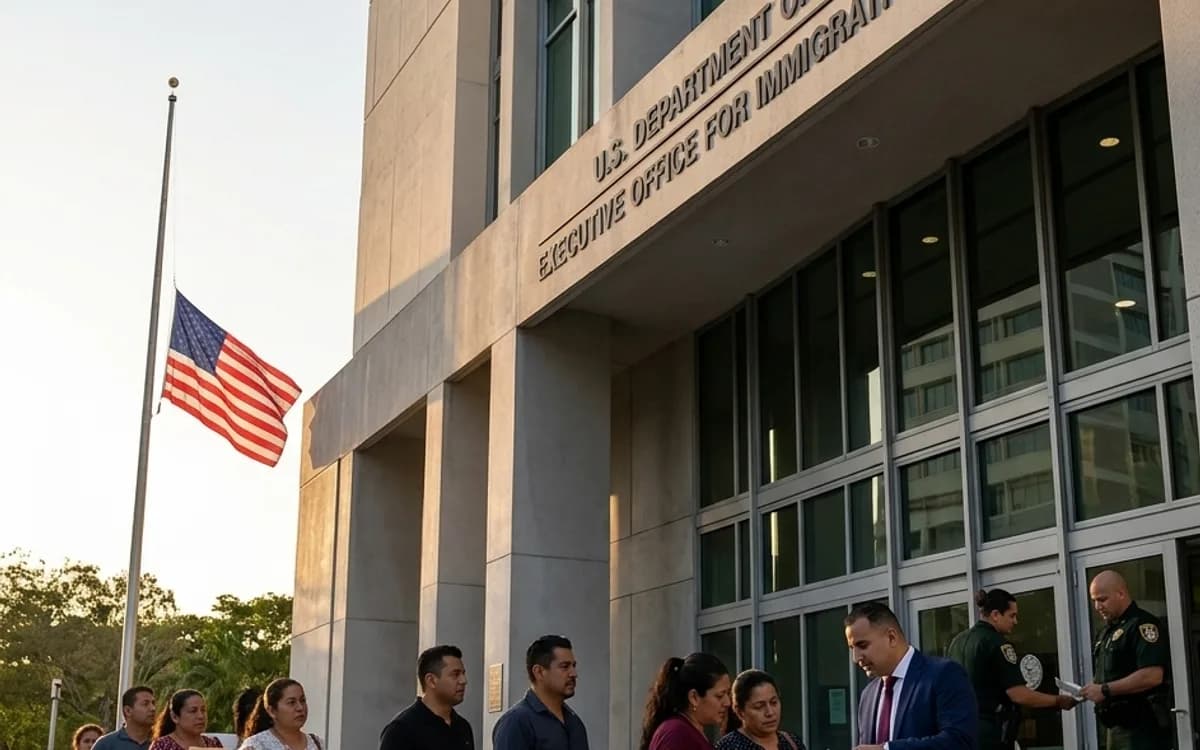
The call from Krome Service Processing Center came collect, and it lasted four minutes before it cut off. Your spouse told you the bond amount wasn't set, that ICE said something about a prior conviction, and that nobody would say when a hearing might happen. Now you've read that the Supreme Court agreed to hear a case about the government's practice of holding people without a bond hearing at all, under 8 U.S.C. § 1226(c) (https://www.law.cornell.edu/uscode/text/8/1226), and you don't know if that helps your family or has nothing to do with your case. It still has to be sorted out this week, at the Miami Immigration Court, whether or not the Supreme Court ever rules.
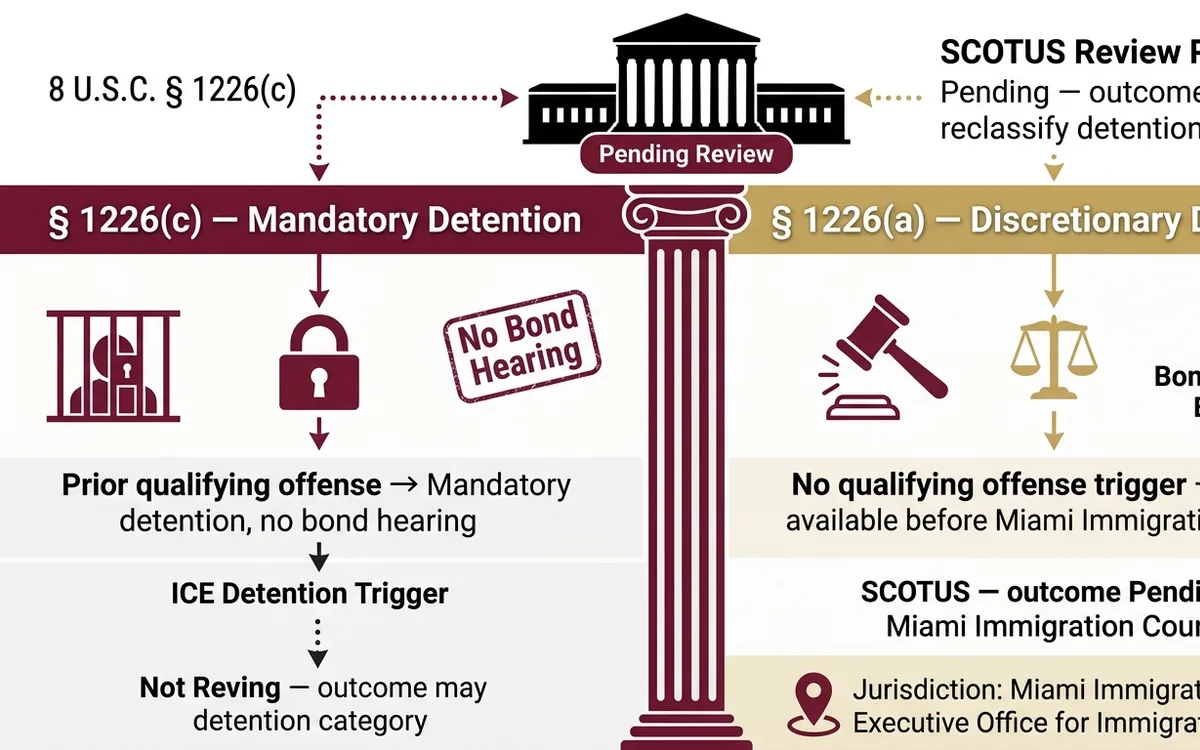
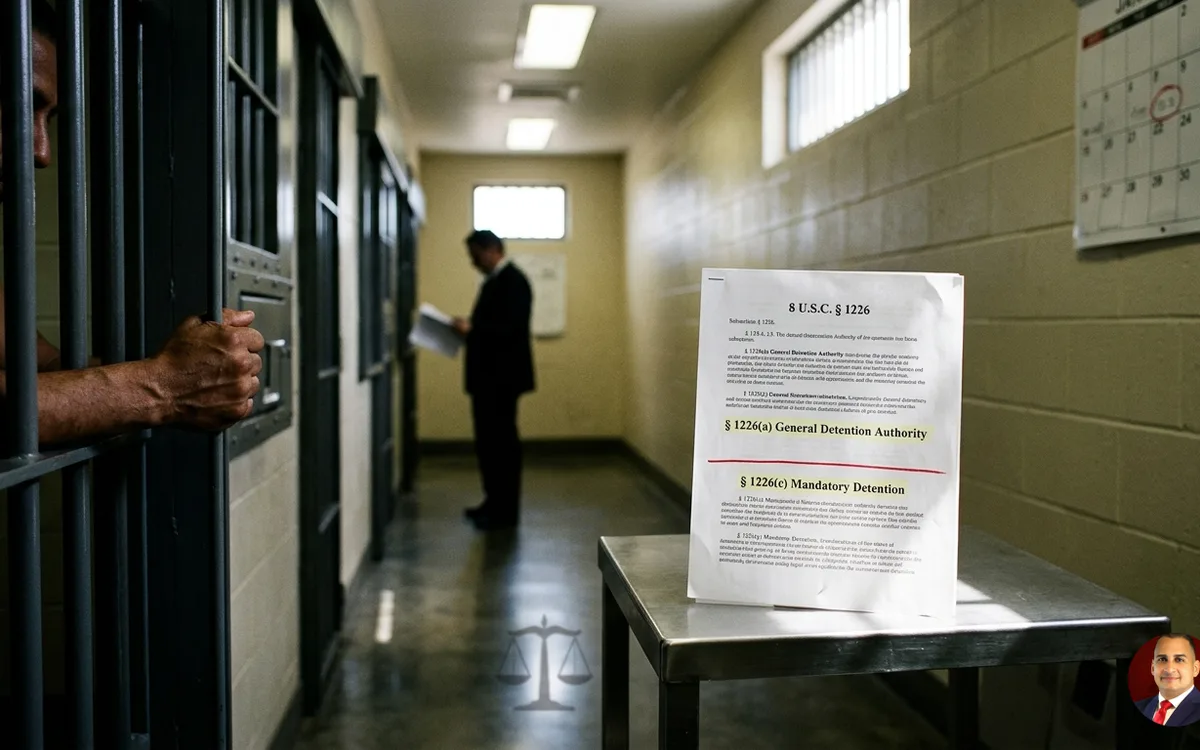
Detention under 8 U.S.C. § 1226(c) means no bond hearing — Congress tied a prior offense to mandatory detention. Under § 1226(a), though, you can request a bond hearing before the Miami Immigration Court. Which category applies to you could change once the Supreme Court rules.
The Hard Truth
Mandatory detention under § 1226(c) means no bond hearing, full stop, for anyone ICE has flagged with a qualifying prior conviction. The Supreme Court agreeing to hear this case does not release anyone today, and it will not for months. Jennings v. Rodriguez, 583 U.S. 281 (2018) (https://www.law.cornell.edu/supct/html/15-1204.ZS.html), already rejected the argument that detainees get an automatic right to periodic bond hearings under this statute, and the current administration's reinterpretation requiring detention of noncitizens who entered the United States without inspection throughout their removal proceedings, per The Guardian (Oct. 1, 2026, https://www.theguardian.com/us-news/2026/oct/01/supreme-court-case-trump-immigration-detention), is pushing more people into the mandatory category, not fewer. A case accepted for argument this term typically is not decided until the following spring or summer. If you are waiting on this ruling to bring someone home, build your case on the law as it stands now, not on a prediction.
What Happens If You Wait
Every day in detention costs money and documentation. Missed rent, a lapsed job, a child moved to a relative's house, and the pay stubs and lease letters a bond motion needs to show ties to the community get harder to gather the longer someone sits at Broward Transitional Center or Baker County Detention Center. If an immigration judge denies bond and you miss the window to appeal to the Board of Immigration Appeals, typically 30 days from the oral decision under 8 C.F.R. § 1003.38, that bond amount stands until circumstances genuinely change. The underlying removal case does not pause while you wait on a strategy. Detained dockets at the Miami Immigration Court move faster than non-detained ones, often resolving in weeks rather than the years typical of the national backlog, which topped 3.7 million pending cases as of mid-2024, per TRAC Immigration at Syracuse University (https://trac.syr.edu/immigration/reports/). A faster docket is good for getting an answer and bad if that answer arrives before anyone has reviewed the Notice to Appear for errors.
Step-by-Step Process
Start by confirming custody status and location through ICE's online detainee locator or the ICE Miami Field Office, Enforcement and Removal Operations, since transfers between Krome, Broward Transitional Center, and Baker County happen without much notice. Next, read the Notice to Appear to see which prior offenses ICE cited, because that determines whether custody is mandatory under § 1226(c) or discretionary under § 1226(a). For discretionary custody, file a motion for custody redetermination with the Miami Immigration Court under the EOIR Immigration Court Practice Manual, Chapter 9 (https://www.justice.gov/eoir/reference-materials/ic/chapter-9), supported by proof of address, employment, and family ties; hearings are typically calendared within one to three weeks, though the Practice Manual sets no fixed deadline and Miami's docket volume affects timing. For mandatory custody, consider whether a Joseph hearing is available to argue the triggering conviction doesn't actually qualify — see our Florida bond hearing guide for how that motion is framed. A bond denial can be appealed to the Board of Immigration Appeals within 30 days under 8 C.F.R. § 1003.38. Once detention stretches toward the six-month mark that Jennings and Zadvydas discuss, a federal habeas corpus petition under 28 U.S.C. § 2241 becomes an option, filed in the U.S. District Court for the Southern District of Florida, Miami Division; read our habeas corpus overview for what that filing requires. Keep preparing the underlying removal defense in parallel, because a bond win and a removal case are two separate fights.
A Real-World Example
Consider a composite we'll call Ana, built from the pattern we see at Broward Transitional Center, not a real client. ICE detains Ana after a traffic stop leads to a records check showing an old, non-qualifying offense, so her detention falls under § 1226(a), discretionary custody. Counsel requests her A-file and criminal disposition records, assembles a bond packet with a lease, two employer letters, and a sponsor's affidavit, and files a motion for custody redetermination with the Miami Immigration Court. At the hearing, the Department of Homeland Security attorney argues flight risk based on a missed court date years earlier; Ana's counsel responds with the sponsor's testimony and proof of a fixed address. The immigration judge takes the bond amount under advisement and sets a decision date, and Ana's removal case, separately, continues on its own merits-hearing track regardless of what happens with custody. That is the actual sequence: records review, packet, hearing, decision, and a removal case that keeps moving no matter the custody outcome.
William J. Vasquez is a member of the North Carolina State Bar and is admitted to practice before the U.S. Courts of Appeals for the Fourth, Fifth, and Eleventh Circuits. Immigration proceedings before the Executive Office for Immigration Review and the Board of Immigration Appeals are federal matters, and under 8 C.F.R. § 1292.1 an attorney licensed in good standing in any U.S. state may represent clients before EOIR and the BIA nationwide, including bond and custody matters arising at Krome, Broward Transitional Center, and Baker County. His practice in Florida is scoped to that federal immigration authority, not to Florida state-court representation, and for matters requiring a Florida state-bar credential, our team coordinates with Florida-licensed counsel directly. For federal habeas petitions filed in the U.S. District Court for the Southern District of Florida, representation requires separate admission to that district's bar, which our team arranges through properly admitted counsel on the matter. See his attorney profile for the full scope of his federal immigration practice.
Key Terms Explained
8 U.S.C. § 1226(c): the statute requiring mandatory detention, without a bond hearing, for noncitizens with specified prior convictions once released from criminal custody.
8 U.S.C. § 1226(a): the statute allowing discretionary custody determinations, meaning an immigration judge can set bond, for noncitizens not covered by § 1226(c).
Bond redetermination hearing: a hearing before an immigration judge, governed by the EOIR Immigration Court Practice Manual, Chapter 9, where the judge decides whether to release a detained noncitizen on bond and in what amount.
Joseph hearing: a hearing, named for Matter of Joseph, 22 I&N Dec. 799 (BIA 1999), where a detainee argues the government is wrong to classify the case as subject to mandatory detention under § 1226(c).
Habeas corpus petition: a civil filing under 28 U.S.C. § 2241 asking a federal district court to review whether continued detention is lawful, filed here in the U.S. District Court for the Southern District of Florida.
Notice to Appear (NTA): the charging document that starts removal proceedings and lists the government's allegations and the immigration laws it claims were violated.
Board of Immigration Appeals (BIA): the administrative body that reviews immigration judges' decisions, including bond denials, on appeal within 30 days under 8 C.F.R. § 1003.38.
Frequently Asked Questions
Q: How do I find out where ICE is holding a family member in Florida? A: Use the ICE Online Detainee Locator System with the person's full name and country of birth, or their nine-digit alien registration number if you have it. The three facilities handling most South Florida detentions are Krome Service Processing Center, Broward Transitional Center, and Baker County Detention Center.
Q: Does the Supreme Court case mean detained immigrants will be released soon? A: No. The Court agreeing to hear the case, per PBS NewsHour (https://www.pbs.org/newshour/politics/supreme-court-grants-review-of-trump-administrations-mandatory-detention-policy-for-immigrants), only means it will decide the legal question, likely with a ruling next term. It does not pause or reverse any current detention.
Q: What does it cost to hire an attorney for a bond or detention matter? A: Immigration representation is billed by flat fee or hourly rate set out in a written fee agreement before work begins; it is not handled on a contingency basis, because there is no monetary recovery in a bond or removal case. Ask for the fee structure in writing during your first consultation.
Q: How long does a federal habeas corpus petition take to resolve? A: Timelines vary by judge and docket at the U.S. District Court for the Southern District of Florida, but these petitions commonly take weeks to several months from filing to a ruling, longer if the government requests an extension to respond. There is no fixed statutory deadline for the court to decide.
Q: Can I appeal if the immigration judge denies bond? A: Yes. You have 30 days from the judge's oral decision to appeal to the Board of Immigration Appeals under 8 C.F.R. § 1003.38, and you can also file a new bond motion later if circumstances genuinely change, such as a new sponsor or address.
Q: What happens to my case if the Supreme Court rules against the current detention policy? A: A ruling against the policy could require new bond hearings for some class of detained noncitizens, but implementation would likely take additional litigation and agency guidance before it changes anyone's individual case automatically. Watch for EOIR and DHS guidance after any decision rather than assuming immediate release.
Q: What's the difference between mandatory and discretionary detention? A: Mandatory detention under § 1226(c) applies when ICE has identified a qualifying prior conviction and means no bond hearing is available absent a successful Joseph hearing. Discretionary detention under § 1226(a) allows an immigration judge to set bond after weighing flight risk and danger to the community.
Q: What if I miss a scheduled immigration court hearing while detained? A: Missing a hearing you were properly notified of can result in an in-absentia removal order, but detained hearings are harder to miss involuntarily since facility staff coordinate transport; if a hearing was missed due to a facility error or lack of notice, a motion to reopen may be available. Contact counsel immediately rather than waiting for the next scheduled date.
Q: Does hiring a private attorney guarantee bond will be granted? A: No attorney can guarantee a bond amount or a grant of release; the decision belongs to the immigration judge, who applies flight-risk and danger-to-community standards to the specific record. What representation changes is whether the judge sees a complete, properly documented bond packet.
Families referred to us after a detention often come from word of mouth, a relative, a community organization, or a prior client who went through a bond hearing at the Miami Immigration Court. What they describe afterward is less about a result and more about whether someone returned their calls during the week their relative was at Krome or Baker County. We ask every new client to judge us on that same responsiveness.
None of this changes by waiting a few more days to make the call, but the bond packet, the Joseph hearing argument, or the habeas timeline does depend on how much runway is left before the next scheduled hearing. If someone you know is currently held at Krome, Broward Transitional Center, or Baker County, the next useful step is a review of the Notice to Appear and the custody classification it creates. Guessing about what the Supreme Court might eventually do won't move that forward.
Schedule a consultation with our team to review the Notice to Appear, determine whether § 1226(c) or § 1226(a) applies, and map the bond, Joseph hearing, or federal habeas options available at the Miami Immigration Court or the U.S. District Court for the Southern District of Florida. Call before the next hearing date arrives.
- Florida Bond Hearing Process
- Federal Habeas Corpus Petitions in the Southern District of Florida
- Krome Service Processing Center Detainee Guide
- Broward Transitional Center Detainee Guide
- Baker County Detention Center Detainee Guide
- Board of Immigration Appeals (BIA) Appeals
- Attorney Profile: William J. Vasquez
- EOIR Immigration Court Practice Manual Overview