Family Separation Lawsuit: What Green Card Applicants Should Know
October 10, 2026
You Heard About the Lawsuit. Here Is What It Actually Changes Today.
If someone in your family is waiting on a green card decision, news that advocates have sued over policies that risk separating families does not feel like background noise. It feels personal. Maybe your spouse has an interview scheduled at the USCIS Miami Field Office next month. Maybe your father is already in proceedings at Miami Immigration Court and you do not know if this lawsuit touches his case at all.
It is reasonable to want this news to mean immediate relief. It does not, not yet. What it does mean is that there is now a public legal record challenging these policies, and real deadlines your family can still act on while that record develops.
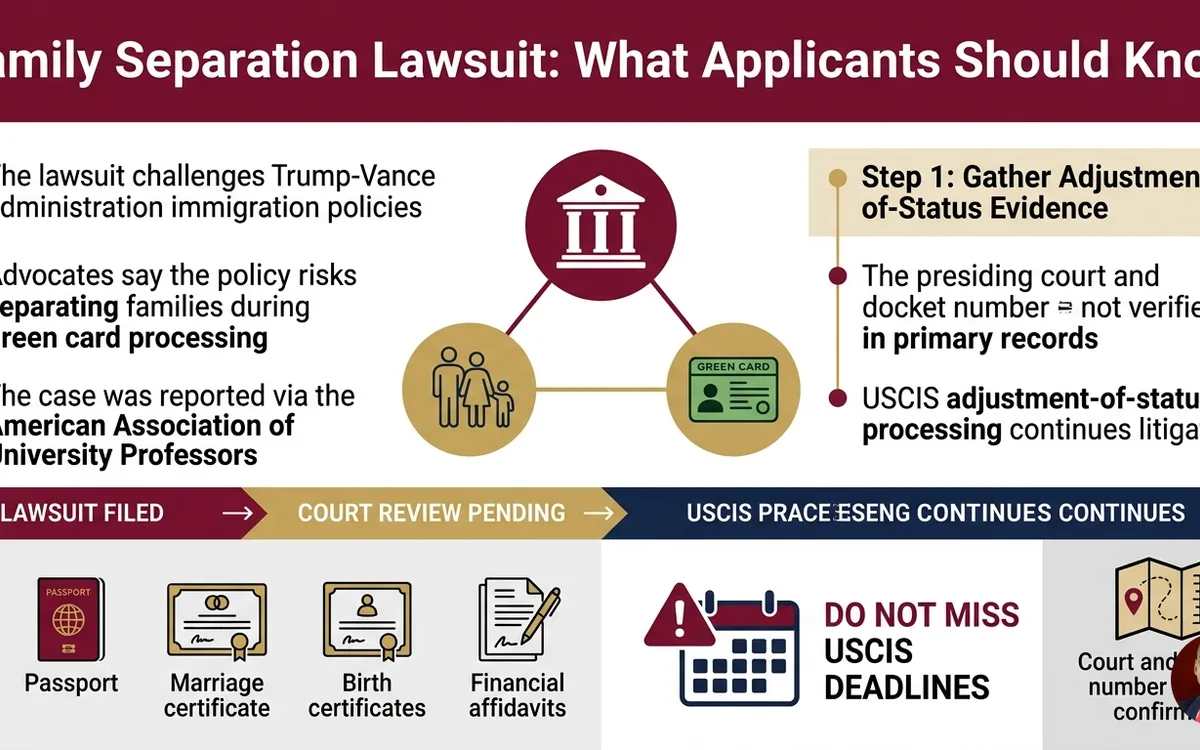
A federal lawsuit, reported by the American Association of University Professors, challenges Trump-Vance administration immigration policies that advocates say threaten to separate families during green card processing. The suit's docket number and presiding court have not yet been confirmed through primary court records. Green card applicants should continue gathering adjustment-of-status evidence and consult an attorney before missing any USCIS deadline.
The Hard Truth
The Lawsuit Does Not Stop Your Case
Unless a federal judge issues an injunction specific to your matter, USCIS will keep scheduling interviews, EOIR will keep setting hearing dates, and DHS will keep operating under the challenged policies while the litigation proceeds. A federal complaint typically takes months to reach even a preliminary injunction ruling, and years to reach final judgment.
The AAUP's report (https://www.aaup.org/news/new-lawsuit-challenges-trump-vance-administration-policies-threatening-green-card-applicants) describes a lawsuit challenging two Trump-Vance administration policies tied to green card family separation. As of this writing, the case name, docket number, and filing court have not been independently confirmed through a primary source such as PACER or the Federal Register, and no motion to dismiss ruling, preliminary injunction, or trial date has been publicly reported. Treat the AAUP account as context, not as a substitute for the court record.
Challenges like this one often argue that executive-branch policy exceeds administrative authority or violates due process. Courts have historically given significant deference to Congress and the executive branch on family-based immigration classifications, as in Fiallo v. Bell, 430 U.S. 787 (1977), which is part of why a win at the district court level is not guaranteed to survive an appeal, and why these cases move slowly. Nationwide, EOIR reported more than 3.7 million pending cases in its FY2024 Adjudication Statistics (Executive Office for Immigration Review, U.S. Department of Justice). One lawsuit, even a successful one, does not clear that backlog.
What Happens If You Wait
What Waiting on the Lawsuit Costs You
A pending lawsuit does not pause your Form I-797C deadlines. If USCIS mails a Request for Evidence, the response window printed on that notice, typically 30 to 87 days depending on the type of request (USCIS Policy Manual, Volume 1, Part E, Chapter 6), keeps running whether or not a court has ruled on the policy you are worried about. Miss it, and USCIS can deny the underlying I-485 for abandonment under 8 C.F.R. § 103.2(b)(13).
The same is true in Miami Immigration Court. If EOIR mails a hearing notice and nobody appears, the immigration judge can enter an in absentia removal order under INA § 240(b)(5), even while a green-card-related lawsuit sits in a different courtroom. A family member who assumes this lawsuit protects them and skips a hearing because of that assumption can end up with a removal order that is far harder to undo than the original case ever was.
Step-by-Step Process
Procedural Roadmap: What Actually Happens Next in Florida
Step 1: Confirm Where Your Case Stands
Log into your USCIS online account or call the USCIS Contact Center at 1-800-375-5283 to confirm your I-130 or I-485 status. If your case lists the USCIS Miami Field Office, note your scheduled interview date; that date does not move because of a lawsuit filed in a different court.
Step 2: Track the Litigation Through Primary Sources
Check PACER (pacer.uscourts.gov) for the relevant district court docket, or the Federal Register for any related agency rule, instead of relying on secondary summaries alone. The AAUP's report is useful for context, not as a substitute for the primary filing.
Step 3: Attend Every Scheduled USCIS Interview
Appear at the USCIS Miami Field Office on the date in your notice and bring the original documents listed there. An unexplained no-show can result in a denial for abandonment under 8 C.F.R. § 103.2(b)(13), regardless of pending litigation.
Step 4: Respond to Every EOIR Notice on Time
Confirm hearing dates through the EOIR automated case information line at 1-800-898-7180. Any motion tied to new developments in this litigation still has to meet the immigration court's own filing rules, and, for related federal civil litigation, Local Rule 7.1 of the U.S. District Court for the Southern District of Florida.
Step 5: If a Family Member Is Detained
If ICE detains a relative who was in the adjustment-of-status process, ask whether they are held at Krome North Service Processing Center in Miami. A bond hearing request goes to the immigration judge at Miami Immigration Court, not to USCIS, and is filed separately from any pending I-130 or I-485 petition. Our removal defense and bond hearing page explains how that request is filed.
Step 6: Get Case-Specific Advice Before a Deadline Passes
A consultation can map your specific filing against both the adjustment-of-status timeline and this litigation. Our adjustment of status page and our consultation scheduling page are the next steps once you have your notices in hand.
A Real-World Example
A Composite Example (Illustrative Only, Not a Real Client)
This is a composite built from patterns we see in Florida adjustment-of-status cases, not an account of any actual person, and it does not predict or guarantee any outcome. A husband, a U.S. citizen, filed an I-130 for his wife, who had entered without inspection years earlier. USCIS approved the I-130 and scheduled her I-485 interview at the Miami Field Office nine months later.
Two weeks before the interview, the wife's brother was detained at a routine check-in and transferred to Krome North Service Processing Center. The family worried the detention would affect her pending adjustment case. It did not automatically; her case and her brother's case are separate matters before separate decision-makers, USCIS for her I-485 and the immigration judge at Miami Immigration Court for his custody determination.
The family's next steps were procedural, not predictive: confirm the wife's interview date had not changed, gather a certified marriage certificate and updated joint financial records, and separately file a bond motion for the brother at Miami Immigration Court. Nothing about how either matter ended is reported here, because nothing about an outcome is the point. The point is the sequence of steps a family in this position actually faces.
About the Attorney Handling Federal Immigration Matters
William J. Vasquez is admitted to the North Carolina State Bar and to practice before the Fourth, Fifth, and Eleventh Circuit Courts of Appeals. Proceedings before USCIS, the Executive Office for Immigration Review, and the Board of Immigration Appeals are federal matters; under 8 C.F.R. § 1292.1, an attorney licensed in good standing in any U.S. state bar may represent clients before EOIR and the BIA nationwide, without separate admission in Florida. His work on green card, adjustment-of-status, and removal defense matters is handled within that federal authority, not through Florida state-court admission.
He has spent his career focused on federal immigration practice, including family-based petitions, adjustment-of-status interviews, and removal defense before immigration courts. You can review his background on his attorney bio page. Our team tracks developments like this lawsuit as part of ongoing case strategy for Florida clients, not as a prediction of how any individual case, including yours, will be decided.
Key Terms Explained
Key Terms Used on This Page
Adjustment of status: The process under INA § 245(a) (8 U.S.C. § 1255) that lets certain noncitizens already in the United States apply for a green card without leaving the country.
Consular processing: The alternative path for a family-based green card, completed at a U.S. embassy or consulate abroad through the National Visa Center, rather than at a USCIS field office.
Request for Evidence (RFE): A USCIS notice asking an applicant to submit additional documents before a decision is made; the response deadline is printed on the notice itself.
Notice to Appear (NTA): The charging document that starts removal proceedings in immigration court.
In absentia order: A removal order entered under INA § 240(b)(5) when a respondent does not appear for a scheduled immigration court hearing.
Motion to dismiss: A request asking a court to throw out a lawsuit, or part of it, before reaching the merits of the claims.
Preliminary injunction / TRO: A court order that pauses a government policy or action temporarily while a lawsuit proceeds; neither is automatic, and both require a separate motion and hearing.
PACER: The federal judiciary's Public Access to Court Electronic Records system, where filed complaints, motions, and docket entries for federal lawsuits can be viewed directly.
EOIR: The Executive Office for Immigration Review, the Department of Justice agency that runs immigration courts, including Miami Immigration Court, and the Board of Immigration Appeals.
Frequently Asked Questions
Q: Does this lawsuit pause my green card interview at the USCIS Miami Field Office? A: No. Unless a court issues an order specific to your case, USCIS keeps your scheduled interview date regardless of the litigation's progress. Confirm your date through your USCIS online account rather than assuming it has changed.
Q: Where can I read the actual lawsuit instead of secondary reporting? A: Search the docket on PACER (pacer.uscourts.gov) for the relevant district court, or check the Federal Register for any related agency policy. The AAUP's report is useful for context, but it is not the primary court filing.
Q: What should I do if ICE detains a family member while my I-130 or I-485 is pending? A: Ask where the person is being held, such as Krome North Service Processing Center in Miami, and whether a Notice to Appear has been issued. A custody or bond request is filed separately with Miami Immigration Court and does not automatically affect a different family member's USCIS petition.
Q: Can I use this lawsuit as a reason to delay responding to a USCIS Request for Evidence? A: No. The response deadline printed on your RFE notice controls, and missing it can lead to a denial for abandonment under 8 C.F.R. § 103.2(b)(13), regardless of pending litigation elsewhere.
Clients come to our team at a stressful point, often after receiving a notice they do not fully understand. Our reviews describe clear explanations of each procedural step and direct communication about realistic timelines, rather than promises about results. We do not publish win rates or outcome statistics, because immigration case results depend on the specific facts, evidence, and the officer or judge assigned, not on any firm's marketing claim.
Reading about a federal lawsuit is not the same as knowing how it applies to your specific I-130, I-485, or removal case. The policies at issue, your filing history, and your family's current status all affect what, if anything, changes for you.
Schedule a consultation with our immigration team to review your current USCIS or EOIR filings against this litigation and your deadlines. Call our office or use our consultation request form to go through your green card or removal defense case with an attorney before a response deadline passes.