Family Immigration Lawyer Florida
October 10, 2026
Your spouse's visa petition has been sitting at USCIS for over a year, and nobody will tell you when it will move. Or you opened an envelope from the National Visa Center, read half of it, and are not sure if you did something wrong. Family immigration cases live in the gap between hope and paperwork, and the wait is real, not imagined. You are not overreacting by checking your case status every morning. The backlog is the system working as designed, slowly, and there is a specific sequence of steps that moves your family from petition to green card to citizenship. Knowing that sequence, and exactly where your case sits in it, is what makes the waiting manageable.
A family immigration lawyer in Florida handles I-130 petitions, adjustment of status, consular processing, I-751 and I-601A waivers, and removal defense before EOIR's Miami and Orlando immigration courts. Processing times vary by category and USCIS field office; current figures are published at uscis.gov/processing-times and the State Department's monthly Visa Bulletin.
The Hard Truth
How Hard Is a Family-Based Immigration Case in Florida?
Marrying a U.S. citizen does not fast-track anyone. Even an immediate relative petition, the fastest category because it carries no annual numerical cap under INA § 201(b), still takes months once filed, and the Miami, Tampa, and Orlando field offices do not move at the same pace. I-130 and I-485 processing times change monthly; the only reliable number is the one posted that week at uscis.gov/processing-times for the specific field office handling your case.
Preference categories are worse. Under the Department of State's monthly Visa Bulletin, the F1 category (unmarried adult children of U.S. citizens) has run multiple years behind for most countries, F2B (unmarried adult children of lawful permanent residents) longer still, and F4 (siblings of U.S. citizens) has historically carried waits exceeding a decade, longer for applicants born in Mexico or the Philippines. These are not worst-case numbers. They are the baseline.
USCIS can also deny. Officers apply a preponderance-of-the-evidence standard, meaning you must show it is more likely than not that the relationship is genuine and the petition is approvable, per Matter of Chawathe, 25 I&N Dec. 369 (AAO 2010). A thin paper trail, a prior immigration violation, or a marriage that looks rushed on paper can trigger a Request for Evidence or a denial. No attorney can promise a specific result in any individual case, and we will not tell you otherwise.
What Happens If You Wait
What Happens If You Wait?
Deadlines in family immigration do not bend. A conditional permanent resident from a marriage must file Form I-751 to remove conditions within the 90 days immediately before the second anniversary of conditional status, per 8 C.F.R. § 216.4(a)(1). Miss that window without a documented reason and conditional status terminates automatically, and USCIS can refer the case to the Miami immigration court for removal proceedings.
The same logic runs in reverse. Someone who entered without inspection and leaves the country before securing a provisional waiver can trigger a three- or ten-year bar to re-entry under INA § 212(a)(9)(B), the exact problem the I-601A process is built to solve before travel, not after a failed consular interview. Waiting to ask questions until after that interview has already gone wrong at a U.S. embassy abroad takes the option off the table.
Delay carries a quieter cost too. A pending I-130 does not shield anyone from an unrelated enforcement action, and a priority date lost to an abandoned or denied petition means starting the line over, sometimes years back. If a family member is already detained at Krome North Service Processing Center or Broward Transitional Center, the clock on a bond hearing or a response to a Notice to Appear starts immediately, not when you feel ready to deal with it.
Step-by-Step Process
What Is the Step-by-Step Process for a Family-Based Case in Florida?
The path depends on where the relative lives and what status they currently hold.
Adjustment of status (relative already in the U.S.)
- File Form I-130, Petition for Alien Relative, with evidence of the qualifying relationship.
- If the relative is an immediate relative eligible to file concurrently, submit Form I-485, Application to Register Permanent Residence, with Form I-864, Affidavit of Support, showing income at or above 125% of the Federal Poverty Guidelines under 8 C.F.R. § 213a.2.
- Attend biometrics, usually at the Application Support Center tied to the Miami, Tampa, or Orlando field office.
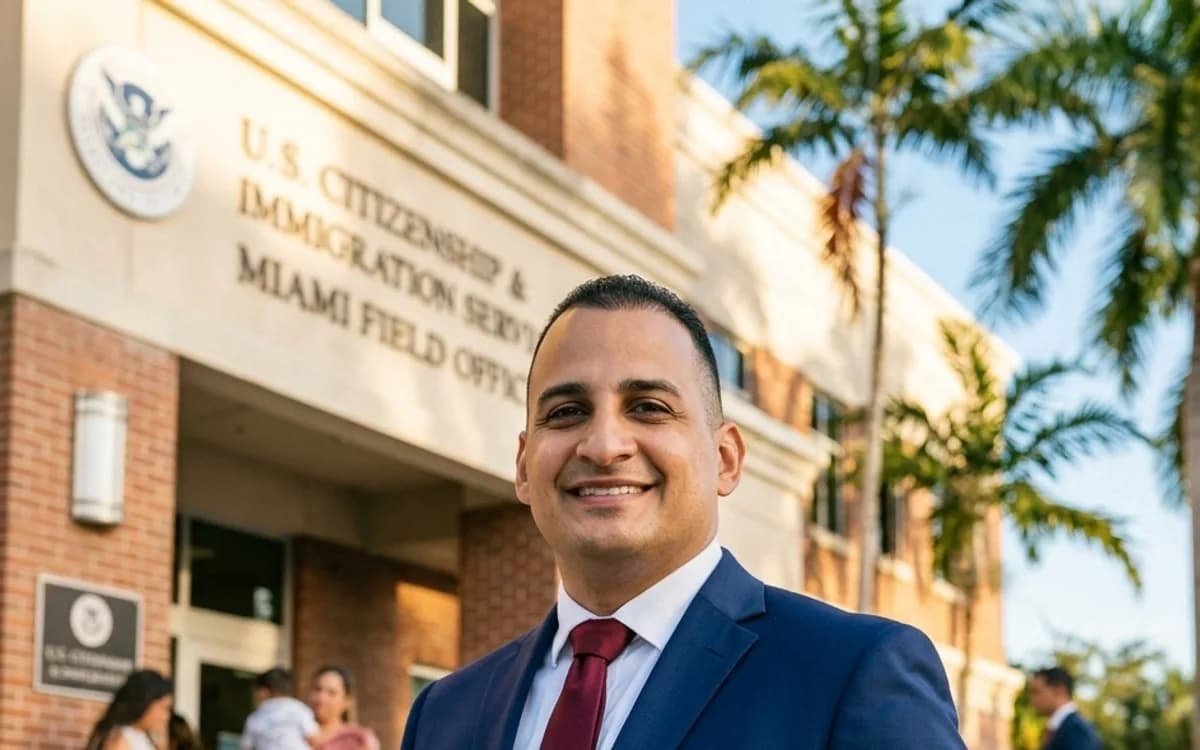
- Attend the in-person interview, commonly at USCIS Miami Field Office, 11440 NW 25th Street, Miami, FL, for South Florida residents.
- Receive a written decision. If denied, review options for a motion to reopen or, where proceedings begin, removal defense before EOIR's Miami Immigration Court.
Consular processing (relative abroad)
- File Form I-130 with USCIS as above.
- After approval, the case moves to the National Visa Center (NVC) for document review and fee payment.
- NVC schedules an interview at the U.S. embassy or consulate with jurisdiction over the relative's residence.
- The relative attends the interview with civil documents and a completed medical exam.
- If approved, the relative is issued an immigrant visa and completes admission as a permanent resident at a U.S. port of entry.
After the green card Conditional residents from a marriage under two years old at approval must file Form I-751, Joint Petition to Remove Conditions, within the 90 days before the second anniversary of conditional status, per 8 C.F.R. § 216.4(a)(1). Most residents become eligible to apply for naturalization, Form N-400, after five years, or three years if married to and living with a U.S. citizen spouse, with interviews at the Miami or Tampa field office.
Each step has its own current processing time, and that number changes monthly. Check uscis.gov/processing-times for the specific form and field office before assuming a timeline.
A Real-World Example
What Does a Florida Family Petition Actually Look Like in Practice?
Consider a composite, not an actual client: a Tampa resident, a U.S. citizen, married a partner who entered on a tourist visa two years earlier and overstayed. They file Form I-130 and, because the spouse qualifies as an immediate relative, file Form I-485 concurrently, with Form I-864 showing the petitioner's income met the 125% poverty guideline threshold.
Eight months later, USCIS issues a Request for Evidence asking for more proof the marriage is genuine: a joint lease, updated bank statements, photos spanning the relationship. The couple gathers the documents and responds by the stated deadline. Months after that, USCIS schedules biometrics and then an in-person interview at the Miami Field Office.
At the interview, an officer questions each spouse separately about daily life, finances, and relationship history, applying the preponderance-of-the-evidence standard described in Matter of Chawathe. The officer may approve the case that day, request more evidence, or issue a Notice of Intent to Deny. Whatever happens, the couple leaves with written notice explaining the next step, not a guaranteed result. That is the actual shape of the process: a sequence of filings, deadlines, and an interview, not a single moment where a lawyer decides the outcome.
Who Handles These Cases?
William J. Vasquez is licensed by the North Carolina State Bar and admitted to practice before the U.S. Courts of Appeals for the Fourth, Fifth, and Eleventh Circuits. Immigration proceedings before USCIS, the Executive Office for Immigration Review, and the Board of Immigration Appeals are federal matters, and under 8 C.F.R. § 1292.1 an attorney licensed in good standing in any U.S. state bar can represent clients before them nationwide, regardless of which state issued the license. That federal authority governs his family immigration practice out of this Florida office; it is not a Florida state-bar credential, and he is not a member of the Florida Bar.
He is a member of the American Immigration Lawyers Association (AILA), the national bar association for practitioners in this field. His work covers I-130 petitions, adjustment of status, I-751 filings, I-601A waivers, VAWA self-petitions, and removal defense in matters arising out of Florida, prepared consistent with USCIS Policy Manual guidance and EOIR practice before the Miami and Orlando immigration courts. If a matter genuinely requires Florida state-court representation, something outside federal immigration practice, our office will say so directly and point you to counsel who holds that specific license.
Key Terms Explained
Key Terms Used on This Page
I-130 (Petition for Alien Relative): The form a U.S. citizen or lawful permanent resident files with USCIS to establish a qualifying family relationship. See I-130 petitions.
I-485 (Application to Register Permanent Residence or Adjust Status): The form filed to obtain a green card from within the United States, under INA § 245(a), 8 U.S.C. § 1255(a).
Adjustment of status: Becoming a permanent resident without leaving the United States, as opposed to consular processing abroad.
Consular processing: Completing the immigrant visa process at a U.S. embassy or consulate overseas through the National Visa Center, after USCIS approves the underlying petition.
Priority date: The date USCIS received the I-130, used to hold a place in line for a visa number in the preference categories, tracked against the monthly Visa Bulletin.
I-751 (Joint Petition to Remove Conditions on Residence): Filed by conditional residents from a marriage under two years old at approval, within 90 days of the second anniversary of conditional status, under 8 C.F.R. § 216.4(a)(1).
I-601A (Provisional Unlawful Presence Waiver): Filed before leaving the U.S. for a consular interview, addressing the 3- or 10-year bars under INA § 212(a)(9)(B), per 8 C.F.R. § 212.7(e).
VAWA self-petition: A path under INA § 204(a)(1)(A)(iii) allowing certain abused spouses, children, or parents of U.S. citizens or lawful permanent residents to petition for themselves. See VAWA self-petitions.
RFE (Request for Evidence): A formal USCIS notice requesting additional documentation before adjudicating a pending case.
NTA (Notice to Appear): The charging document that starts removal proceedings before an immigration judge.
Frequently Asked Questions
Q: How long does an I-130 take at the Miami USCIS Field Office? A: Processing time depends on the relationship category and changes monthly; check the current figure for the Miami Field Office at uscis.gov/processing-times before relying on any estimate.
Q: What is the difference between adjustment of status and consular processing? A: Adjustment of status lets an eligible relative already in the U.S. apply for a green card through USCIS without leaving the country, while consular processing finishes the case at a U.S. embassy or consulate abroad through the National Visa Center after I-130 approval.
Q: How much does it cost to file a family-based immigration case? A: USCIS filing fees come from the agency's fee schedule effective April 1, 2024, listed at uscis.gov/forms/filing-fees; under that schedule, Form I-130 runs $675 online or $625 on paper, Form I-485 is $1,440, and Form I-751 is $750. Attorney fees are separate from government filing fees and are typically quoted as a flat fee for standard petitions, discussed during a consultation once the specific forms involved are known.
Q: What happens if I miss the 90-day window to file Form I-751? A: Conditional residence terminates automatically without a documented reason, and USCIS can refer the case to the Miami immigration court for removal proceedings; a late filing may still be accepted with a written explanation, at USCIS's discretion.
Q: Can a stepchild or adopted child qualify for a family-based visa? A: Yes, if the relationship meets the INA's definitions, generally requiring the stepchild relationship to have formed before age 18 or the adoption to have been finalized before age 16, with evidence of a genuine parent-child relationship.
Clients searching for a family immigration lawyer in Florida usually start with a search and a look at reviews before calling anyone. Ours reflect what this page describes: a process that takes time, requires documentation, and moves through USCIS and EOIR on a federal timeline the firm does not control. We do not publish outcome statistics or success rates because case results are not something any firm can ethically guarantee or verify in aggregate. What you can verify is how the office communicates during the wait, how filings are prepared, and how questions get answered between major steps in the case.
You have read the process. The honest version of your timeline still depends on your specific category, your country of origin if a preference category applies, and which Florida field office or immigration court your case sits in. The next useful step is not another hour of searching; it is putting your actual documents and dates in front of someone who can tell you exactly where your case stands.
Schedule a consultation with our office to go through your I-130, I-485, I-751, waiver, or removal defense matter and get a specific procedural plan for your Florida-based family immigration case, not a generic timeline. Call or use our online scheduling to set up a document review before your next deadline arrives.
- I-130 Petition for Alien Relative — /practice-areas/family-immigration/i-130-petition
- Adjustment of Status — /practice-areas/family-immigration/adjustment-of-status
- I-751 Removal of Conditions — /practice-areas/family-immigration/i-751
- VAWA Self-Petitions — /practice-areas/family-immigration/vawa
- I-601A Provisional Unlawful Presence Waiver — /practice-areas/family-immigration/i-601a-waiver
- Removal Defense — /practice-areas/removal-defense
- Schedule a Consultation — /contact