Deportation Defense Attorney for Texas Immigration Court Cases
October 10, 2026
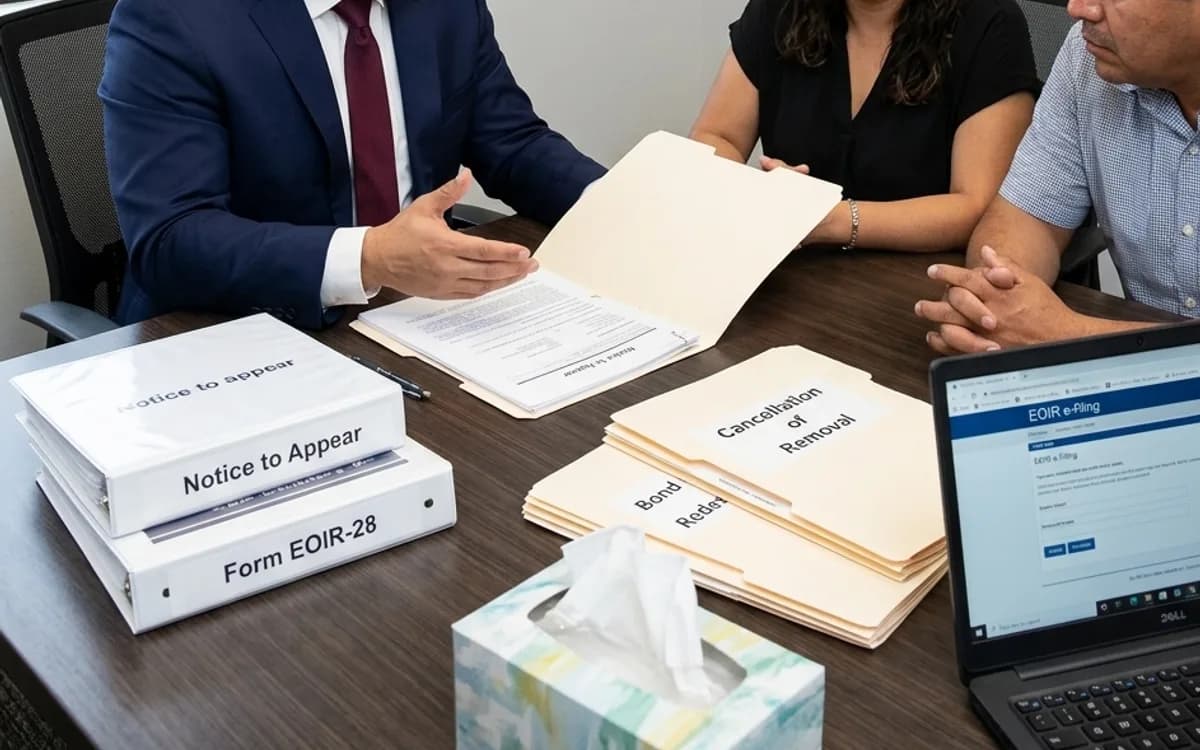
You got a notice in the mail, or a call from Prairieland Detention Facility in Alvarado, and now there's a court date you don't understand. Maybe immigration agents arrested a family member at a routine check-in. Maybe a Notice to Appear names a hearing date in Dallas or Houston immigration court and you don't know what happens if you don't show up.
Removal proceedings move on their own schedule, not yours. A missed deadline or a missed hearing can end with a removal order issued in your absence, no matter how strong your case might have been. You have the right to retain an attorney, at no cost to the government, before your first hearing, and that right exists from the moment DHS files the Notice to Appear.
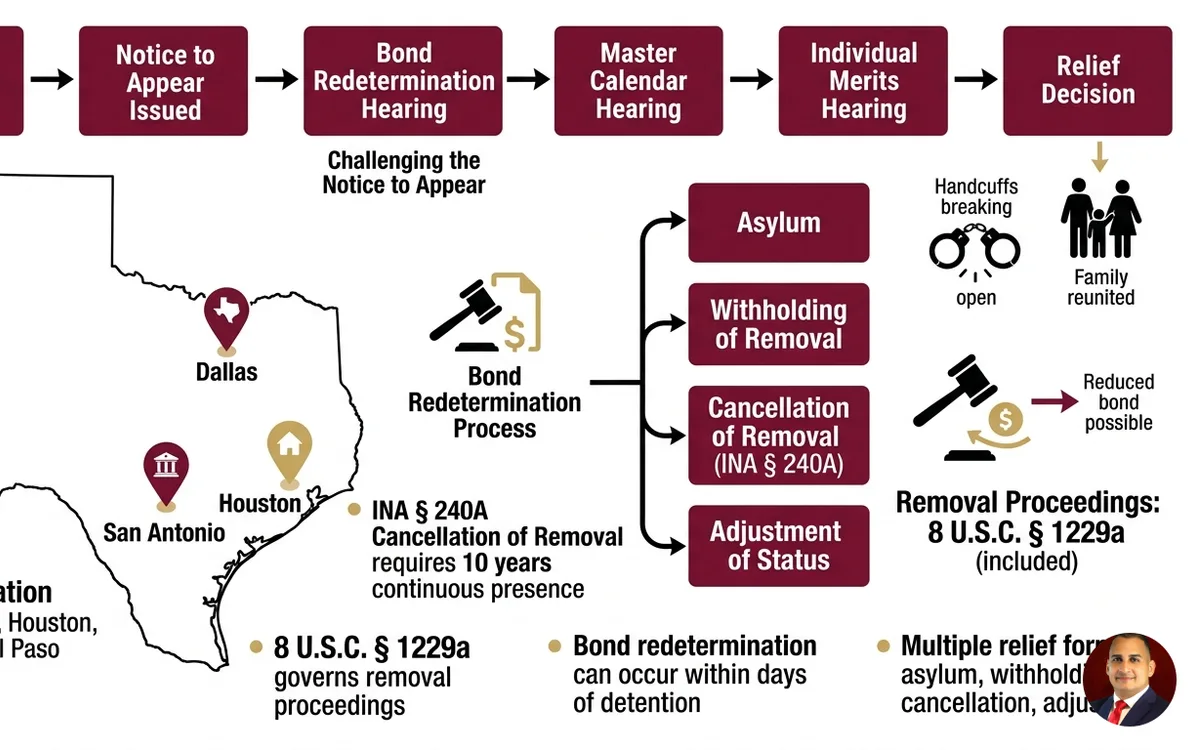
A Texas deportation defense attorney represents immigrants in removal proceedings before the Dallas, Houston, San Antonio, and El Paso immigration courts, challenging the Notice to Appear, requesting bond redetermination for detained clients, and pursuing relief such as asylum or cancellation of removal under INA § 240A, 8 U.S.C. § 1229a.
The Hard Truth
Texas immigration courts are backlogged. As of this writing (January 2026), the national EOIR caseload stood at more than 3.6 million pending matters, per TRAC Immigration's court backlog tool (Syracuse University, trac.syr.edu/phptools/immigration/court_backlog), and Dallas, Houston, San Antonio, and El Paso each carry dockets in the tens of thousands. A non-detained merits hearing scheduled today can take years to reach, and a continuance pushes it further.
Relief from removal is not automatic. Asylum, cancellation of removal under INA § 240A, and most other forms of relief are discretionary or eligibility-limited. A judge can deny relief even when you meet the basic requirements on paper, and certain criminal convictions bar you from applying at all. Filing for relief does not pause removal if the judge denies it, and a denial starts the clock on a BIA appeal, not a second hearing on the same facts.
What Happens If You Wait
Missing a hearing because you moved and didn't update your address with the court results in an in absentia removal order under 8 U.S.C. § 1229a(b)(5). Reopening that order requires a motion to reopen under 8 C.F.R. § 1003.23, generally filed within 180 days, and it must show you never received proper notice or that exceptional circumstances caused the absence.
The one-year deadline to file Form I-589 for asylum, measured from your last entry into the United States, does not bend without proof of changed or extraordinary circumstances. Waiting to gather documents or save money for an attorney can mean the deadline passes while you are still deciding. For a detained client, delaying a bond motion means more time inside Prairieland Detention Facility or a similar facility while the underlying case is still pending, not less.
Step-by-Step Process
DHS files a Notice to Appear (NTA) with the immigration court, which starts the removal case. Under Pereira v. Sessions, an NTA that omits the hearing date and location does not properly stop certain deadlines from running, so the paperwork itself matters from day one.
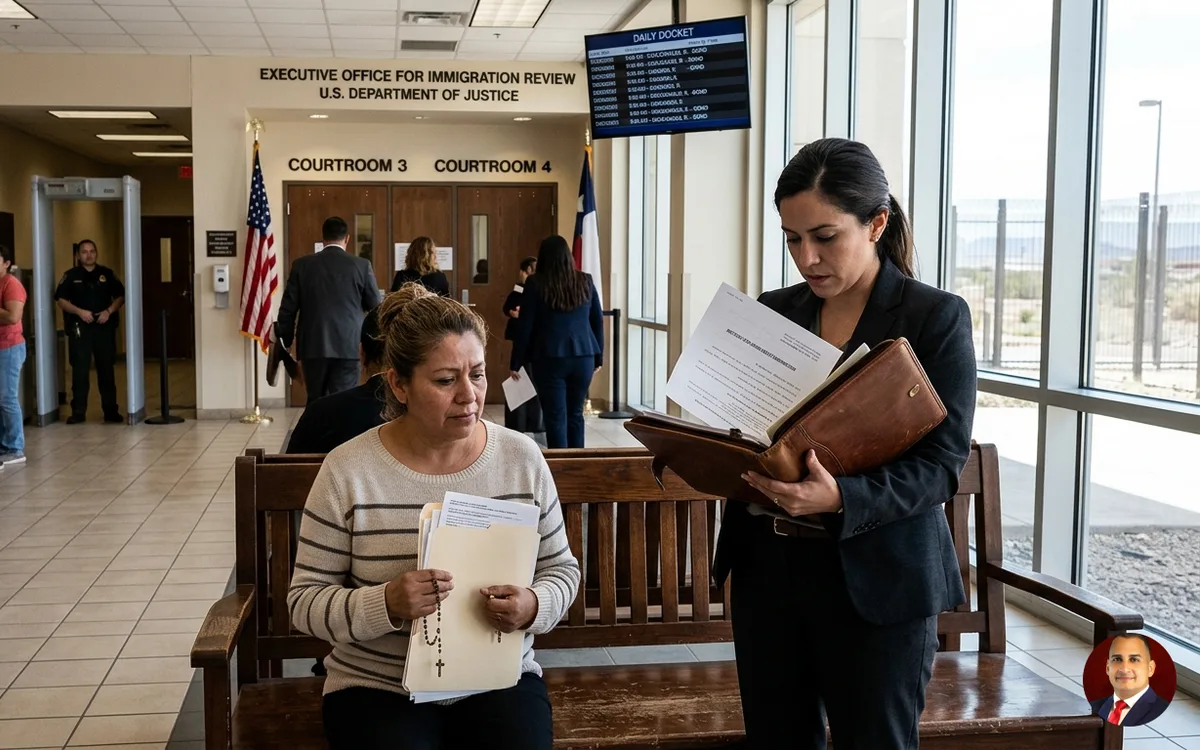
The master calendar hearing comes next, held at Dallas Immigration Court (1100 Commerce Street), Houston Immigration Court (126 Northpoint Drive), San Antonio Immigration Court (800 Dolorosa Street), or El Paso Immigration Court (adjacent to the El Paso Service Processing Center). This is a short procedural hearing, usually 5 to 15 minutes, where the judge confirms identity, takes pleadings on the NTA's allegations, and sets deadlines for any relief applications.
For detained clients, a bond motion is filed separately from the removal case. Immigration judges can set bond for most detained noncitizens, but mandatory detention under INA § 236(c) applies to certain criminal grounds and removes that option entirely. Clients held at Prairieland Detention Facility in Alvarado generally have bond matters heard through the Dallas Immigration Court.
Three relief paths commonly diverge at the filing stage. Asylum (Form I-589) requires filing within one year of your last entry absent an exception, and is barred by certain convictions and by a prior denial absent changed circumstances. Cancellation of removal for non-permanent residents under INA § 240A(b) requires ten years of continuous presence and is barred by aggravated felony convictions, with no independent filing deadline since it is raised during the case rather than filed on its own. Voluntary departure lets you leave at your own expense by a set date and avoids some bars to future immigration benefits, but requires giving up the right to contest removal.
All filings in Texas immigration courts go through the EOIR Courts & Appeals System (ECAS), mandatory electronic filing for represented parties under the EOIR Immigration Court Practice Manual. Administrative closure, once a routine tool for pausing lower-priority cases, is sharply limited after Matter of Castro-Tum, 27 I&N Dec. 271 (A.G. 2018), so judges in Dallas and Houston now grant it only in narrow circumstances.
At the individual (merits) hearing, the judge takes testimony and documentary evidence and decides whether to grant relief or order removal. An adverse decision can be appealed to the Board of Immigration Appeals within 30 days under 8 C.F.R. § 1003.38. From there, a petition for review to the U.S. Court of Appeals for the Fifth Circuit, which has jurisdiction over Texas, is a separate filing with its own 30-day deadline.
A Real-World Example
Consider a composite example based on common patterns in Texas removal cases, not a real client. 'Marco' is detained at Prairieland Detention Facility after a traffic stop leads to an ICE hold. DHS files a Notice to Appear charging him as removable for entering without inspection years earlier.
At the master calendar hearing in Dallas Immigration Court, his attorney enters pleadings, contests one of the factual allegations in the NTA, and requests a separate bond hearing. The judge sets a date for the individual merits hearing and a deadline to file any relief application, in this case a Form I-589 asylum application with supporting country-condition evidence.
Because Marco has lived in the country more than ten years and has a U.S. citizen child, his attorney also evaluates cancellation of removal under INA § 240A(b) as an alternative, which requires proof of continuous presence, good moral character, and exceptional hardship to a qualifying relative. The bond motion moves on its own track, separate from the merits of the removal case. What happens at each stage depends on the judge's assessment of the record, the government's position, and the specific facts, which vary in every proceeding.
William J. Vasquez is admitted to the North Carolina State Bar and to the U.S. Court of Appeals for the Fifth Circuit, the circuit that hears petitions for review of Texas immigration cases. Immigration proceedings before EOIR, including the courts in Dallas, Houston, San Antonio, and El Paso, and before the Board of Immigration Appeals, are federal matters. Under 8 C.F.R. § 1292.1, any attorney licensed and in good standing in one U.S. state bar can represent clients nationwide before EOIR and the BIA. His authority to appear in Texas removal proceedings rests on that federal immigration-bar standing, not on a Texas or Florida state law license, and he does not hold a Florida state-bar credential.
Our office is based in Miami-Dade County, Florida, and represents clients with hearings in Texas immigration courts because removal proceedings are federal and do not require a local state bar license. Our attorneys have noted a recurring pattern in Texas filings: cases filed through the EOIR Courts & Appeals System (ECAS) with complete, correctly formatted documents tend to avoid the delays that come from rejected or incomplete submissions. Bond motions for clients held at facilities like Prairieland in Alvarado also tend to move faster when supporting documents are filed before the first hearing rather than after.
Key Terms Explained
Notice to Appear (NTA): The charging document DHS files with EOIR to start removal proceedings, listing the allegations against you and, when complete, the hearing date and location, per 8 U.S.C. § 1229(a).
Master calendar hearing: A short, often group, procedural hearing where the judge confirms identity and address, takes pleadings on the NTA, and sets deadlines, typically 5 to 15 minutes per case.
Individual (merits) hearing: The hearing where the judge takes testimony and evidence and decides whether to grant relief or order removal under 8 U.S.C. § 1229a.
Bond redetermination hearing: A separate hearing where a judge decides whether a detained noncitizen can be released on bond, unavailable for those subject to mandatory detention under INA § 236(c).
Cancellation of removal (non-LPR): Relief under INA § 240A(b) requiring ten years of continuous physical presence, good moral character, and exceptional and extremely unusual hardship to a qualifying U.S. citizen or lawful permanent resident relative.
Administrative closure: A docket-management tool that removes a case from the active calendar without deciding it, sharply limited after Matter of Castro-Tum, 27 I&N Dec. 271 (A.G. 2018).
In absentia order: A removal order entered when you do not appear for a hearing, reopenable only through a motion to reopen under 8 C.F.R. § 1003.23 showing lack of proper notice or exceptional circumstances.
ECAS (EOIR Courts & Appeals System): The electronic filing and case-access system Texas immigration courts require represented parties to use for most filings, per the EOIR Immigration Court Practice Manual.
Reinstatement of removal: A streamlined process under 8 U.S.C. § 1231(a)(5) that reinstates a prior removal order for someone who reentered without authorization, generally without a new hearing.
Voluntary departure: Permission to leave the United States at your own expense by a set date instead of under a removal order, which avoids some bars to future immigration benefits that a removal order triggers.
Frequently Asked Questions
Q: How much does a deportation defense attorney cost in Texas? A: Fees vary by case complexity, whether you are detained, and how many forms of relief you are pursuing. Ask for a written fee agreement before signing, and confirm whether it covers a BIA appeal or a petition for review, since those are often billed separately.
Q: How long does a deportation case take in Texas immigration court? A: It depends on the court and the relief sought. Texas immigration courts carry dockets of tens of thousands of pending cases each, per TRAC Immigration, and a non-detained merits hearing can be scheduled years out, while detained cases generally move faster.
Q: What is the one-year deadline for asylum, and are there exceptions? A: You generally must file Form I-589 within one year of your last arrival, per INA § 208(a)(2)(B). Exceptions exist for changed circumstances affecting eligibility or extraordinary circumstances causing the delay, but you must file within a reasonable period after the circumstance ends and document it.
Q: What happens if the Fifth Circuit denies my petition for review? A: A denial generally allows DHS to proceed with the removal order, though you can seek rehearing en banc or, rarely, petition the U.S. Supreme Court. A motion to reopen can still be an option afterward in limited situations, such as new evidence of changed country conditions.
Q: Can I get bond if I am detained at Prairieland Detention Facility? A: It depends on whether you are subject to mandatory detention under INA § 236(c), usually tied to certain convictions. If not, you can request a bond redetermination hearing, generally heard through the Dallas Immigration Court for clients held at Prairieland.
Q: What is the difference between a detainer and a removal warrant? A: An immigration detainer is a request that a local jail hold someone for ICE pickup after criminal custody ends; it is not a court order. A warrant of removal is issued after an immigration judge or the BIA orders removal and authorizes DHS to carry it out.
Q: Do I need a lawyer for a master calendar hearing? A: It's not required, but the pleadings entered at that hearing, admitting or denying the NTA's allegations, can affect what relief remains available later. Many people bring an attorney to this first hearing for that reason.
Q: What if I missed my hearing and already have an in absentia removal order? A: You can file a motion to reopen under 8 C.F.R. § 1003.23, generally within 180 days, showing you did not receive proper notice or that exceptional circumstances prevented your appearance. Filing after that window requires meeting a narrower set of exceptions.
Q: Is cancellation of removal available if I have a criminal conviction? A: Certain convictions, including aggravated felonies and some controlled substance offenses, bar cancellation of removal entirely under INA § 240A(b). A conviction that does not trigger an automatic bar can still weigh against the discretionary good moral character and hardship findings the judge must make.
Clients describe our team's explanations of each hearing date and filing deadline as a reason they stayed with us through a multi-year case. Reviews posted on Google and Avvo reference responsiveness between hearings and plain-language updates about what a continuance or a new deadline actually means for the case. We do not publish outcome statistics; removal cases are decided by immigration judges and the BIA based on the individual record, not by any attorney's track record.
If you have a hearing date in Dallas, Houston, San Antonio, or El Paso, or a family member detained at Prairieland or another facility, the filing deadlines in your case are already running whether or not you have a lawyer. Reviewing your Notice to Appear and custody status now is the only way to know which deadlines actually apply to you.
Schedule a consultation with our immigration team to review your Notice to Appear, your custody status, and the relief options available in your specific Texas immigration court. We handle removal defense, bond motions, cancellation of removal, and BIA appeals for clients with hearings in Dallas, Houston, San Antonio, and El Paso. Call or request a consultation online before your next hearing date.
- /practice-areas/cancellation-of-removal
- /practice-areas/asylum
- /practice-areas/bond-hearings
- /practice-areas/bia-appeals
- /practice-areas/motions-to-reopen
- /contact